private pilot licence cost
Flying Lessons Cost: Full Breakdown for UK & US Pilots
26 Sep 2026 · 14 min read
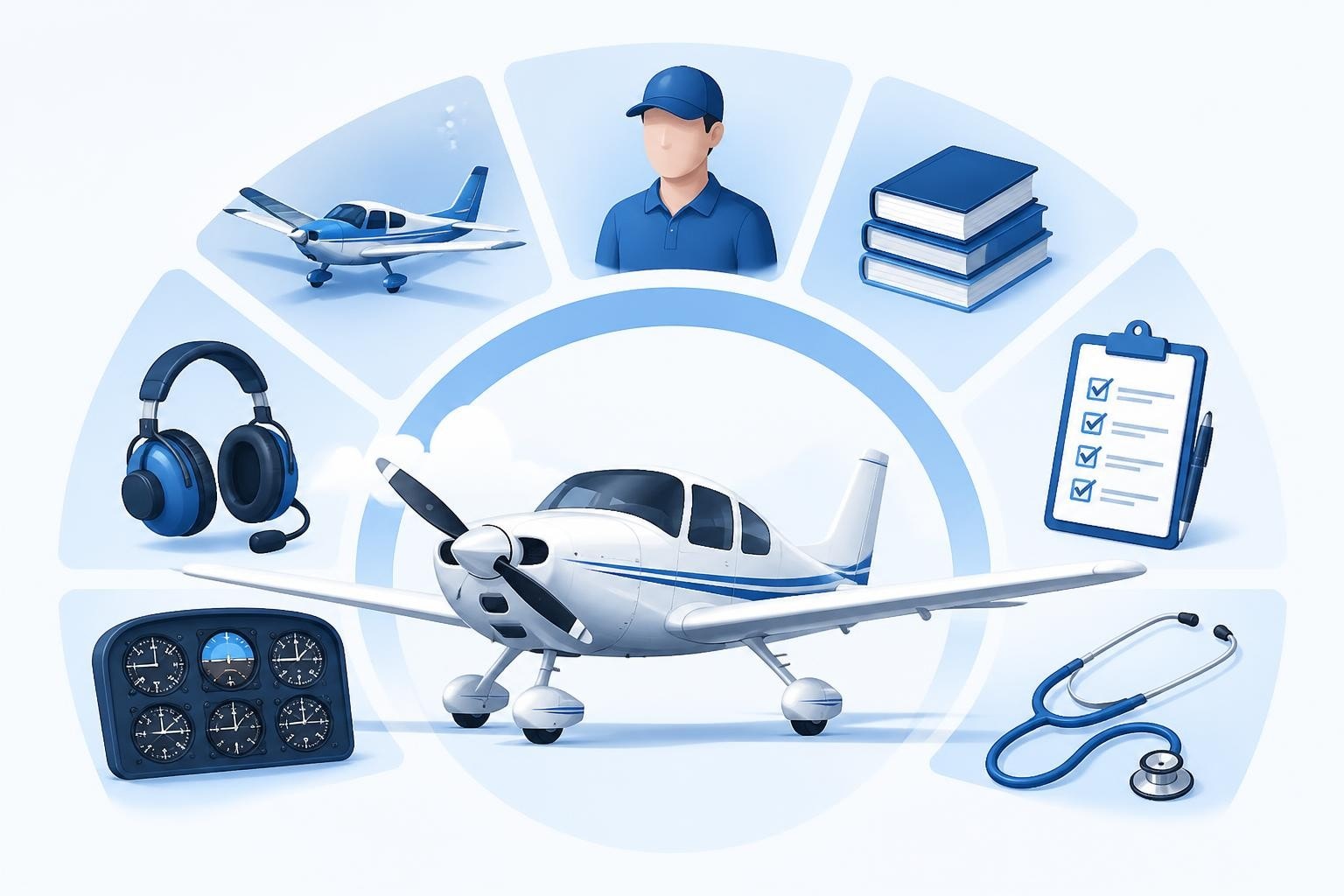
Flying lessons cost anywhere from £8,000 to £15,000 for a UK private pilot licence (PPL) or around $10,000 to $15,000 in the United States, though the final figure varies widely based on aircraft type, training pace, location, and individual progress. These numbers cover the hours mandated by regulators, instructor time, exams, medicals, and materials, but most pilots exceed minimum hours. Understanding the components behind flying lessons cost helps you budget accurately and avoid surprises halfway through training.
What Drives Flying Lessons Cost
Every hour you fly combines several discrete charges. Aircraft rental (typically "wet" hire with fuel included) forms the largest single expense, followed by instructor fees, ground school, exam and medical costs, and materials.
Aircraft rental rates depend on type and complexity. A simple two-seat trainer such as a Cessna 152 may cost £120–£140 per hour wet in the UK, while a four-seat Cessna 172 runs £150–£180 per hour. In the US, recent data from Redbird's 2024 training report shows median single-engine rates near $155–$175 per hour at Part 61 schools. Complex or multi-engine aircraft push hourly rates significantly higher.
Instructor time is billed separately. UK instructors typically charge £40–£60 per flight hour, while US CFIs average $50–$70. Ground instruction (pre-flight briefing, debrief, and classroom time) also counts, so a one-hour flight often triggers 1.5 to 2 hours of billable instructor time.
Ground school can be self-study using books and online courses (£200–£500) or formal classroom courses (£800–£1,500 in the UK; $1,000–$2,000 in the US). Many pilots blend both approaches.
Regulatory Minimums vs Reality
EASA Part-FCL requires 45 hours total time for a PPL, with at least 25 hours dual and 10 hours supervised solo. The UK CAA applies Part-FCL, so UK PPL candidates train to the same standard. In the US, FAA regulations set the minimum at 40 hours (20 dual, 10 solo), but average students finish closer to 60–70 hours.
Flying lessons cost calculations must account for this gap. The Redbird survey shows most American students log 60–75 hours to pass the private checkride. UK students average 50–60 hours, though many need more if training is interrupted or weather delays accumulate.
- Minimum hours are only the legal floor; they assume efficient, continuous training.
- Weather cancellations extend timelines in northern climates.
- Lesson frequency matters: flying once per week slows progress and raises total cost compared with two or three sessions weekly.
- Aptitude and study habits influence how quickly you master each manoeuvre.
Flying Lessons Cost Breakdown by Certificate
Private Pilot Licence (PPL)
A realistic UK PPL budget sits between £10,000 and £15,000 for an average student. Here's a worked example based on 55 total hours:
| Line item | Unit cost | Quantity | Total |
|---|---|---|---|
| Aircraft hire (C152) | £130/hour | 55 hours | £7,150 |
| Instructor time (flight) | £50/hour | 45 hours | £2,250 |
| Ground instruction | £50/hour | 15 hours | £750 |
| Ground school (online + books) | Lump sum | 1 | £400 |
| Medical (Class 2) | Lump sum | 1 | £150 |
| Skills test (examiner + aircraft) | Lump sum | 1 | £400 |
| Written exams (9 papers) | £25 each | 9 | £225 |
| Landing fees, maps, headset | Misc | 1 | £300 |
| Total | £11,625 |
US students can expect similar proportions. Using AOPA's overview, a 65-hour Part 61 PPL at $155/hour aircraft and $60/hour instructor runs roughly $13,000–$15,000 all-in.
For more detail on UK PPL budgets, see our private pilot licence cost guide.
Commercial Pilot Licence (CPL)
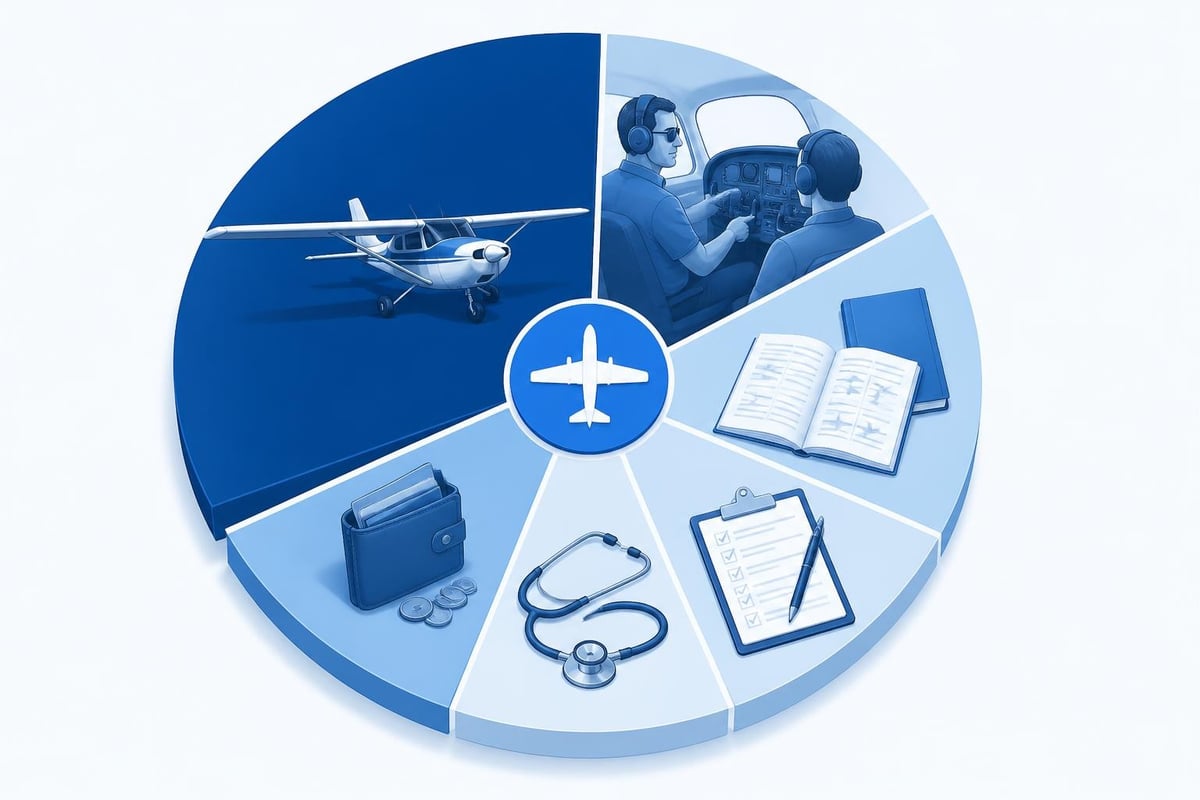
Flying lessons cost escalates sharply for the CPL. EASA Part-FCL requires 200 total hours (including PPL time), with specified solo cross-country, night, and instrument flight. UK integrated CPL courses (zero to frozen ATPL) cost £60,000–£100,000 and take 12–18 months.
Modular CPL training (building on an existing PPL) is cheaper but still substantial:
- Hour-building to 150 hours (PPL to CPL entry): 95 hours at £150/hour = £14,250
- CPL course (commercial manoeuvres, navigation, night): 20 hours dual + 5 solo, plus exams and test = £6,000–£8,000
- CPL exams (13 papers, plus skill test): £1,500
Total modular path: roughly £25,000–£30,000 beyond the PPL.
In the US, Part 141 commercial programs cost $35,000–$50,000 from zero time, while Part 61 modular routes average $30,000–$40,000. Check our commercial pilots licence cost article for a full comparison.
Instrument Rating (IR)
The EASA instrument rating demands 50 hours cross-country PIC plus 40 hours dual instrument instruction (of which up to 30 may be simulator). UK IR courses cost £8,000–£12,000, depending on aircraft vs simulator ratio. US instrument ratings (40 hours instrument time, 15 with an instructor) run $8,000–$12,000 as well.
Type Ratings and Jet Training
Type ratings for commercial jets (A320, B737) cost £25,000–£35,000 and are typically employer-funded. Initial jet training includes simulator sessions, ground school, and a final skill test. These courses assume you already hold an ATPL or CPL with IR, so they represent the final step rather than ab-initio flying lessons cost.
Hidden and Variable Costs
Flying lessons cost estimates often miss smaller but significant expenses that compound over months of training.
Repeat tests and exams: If you fail a skill test (15–20% fail rate on first attempt), you pay the examiner again (£300–£400) plus aircraft hire (£200–£300 for the retest flight). Failed written exams require resit fees (£20–£30 each).
Weather and scheduling: Winter weather in northern Europe can ground you for weeks. Each cancelled lesson still requires rebooking, and long gaps erode skills, sometimes necessitating extra revision flights.
Medical renewals: Class 2 medicals (required for PPL exercise of privileges) cost £100–£150 in the UK and expire after 60 months under age 40, 24 months age 40–50, and 12 months over 50. Class 1 medicals (CPL/ATPL) cost £300–£400 and renew annually or every six months depending on age. Budget for at least one renewal during extended training.
Headsets, charts, and kit: A decent headset (essential for clear comms) costs £200–£500. Charts, flight computers, kneeboards, and publications add another £100–£200.
Membership and insurance: Flying club membership may be mandatory (£500–£1,500 annual fee). Student pilot insurance is optional but recommended (£200–£400/year).
Financing Flying Lessons Cost
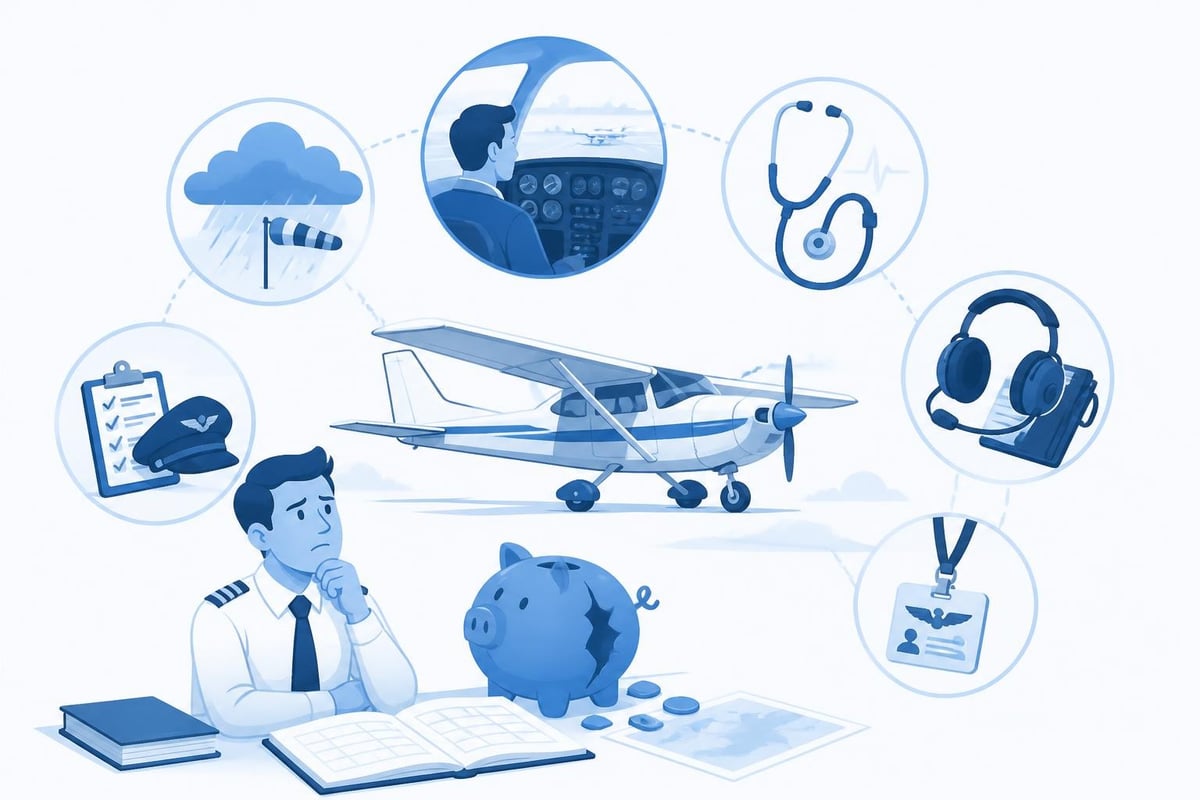
Few pilots pay cash upfront. AOPA's flight training finance page outlines common funding routes in the US, including private loans, credit cards, savings, and family support. UK options include personal loans, career development loans (now discontinued for most providers), and payment plans offered by flight schools.
Pay-as-you-go spreads cost but prolongs training. Block-hour discounts (buying 10 or 20 hours upfront) reduce hourly rates by 5–10% and encourage regular flying.
Integrated course loans: Some UK schools partner with lenders to offer deferred-payment loans for integrated ATPL programmes. Interest rates run 6–10%, and repayment starts after course completion or when you reach a set income threshold. Read terms carefully; not all loans pause repayment during job-search periods.
Sponsorships and cadetships: Airlines occasionally sponsor ab-initio students through integrated programmes, recovering costs via salary deductions (bonded contracts). Competition is intense, and programmes may pause during downturns. Check IATA's global outlook reports for workforce trends that influence cadetship availability.
Military pathways: Air force pilot training is fully funded but requires a service commitment (typically 10–12 years) and highly competitive selection.
Strategies to Reduce Flying Lessons Cost
Choose Aircraft and Location Wisely
Smaller, simpler aircraft cost less per hour. A Piper PA-28 or Cessna 152 is adequate for PPL training and £20–£40 cheaper per hour than a glass-cockpit Cessna 172 with G1000. Rural airfields often have lower fees and less airspace congestion than city airports, trimming both landing charges and instructor time.
If your goal is rotary-wing, helicopter flight lessons follow a similar cost structure but with higher hourly rates (£250–£350/hour for a Robinson R22 or R44 in the UK).
Fly Frequently and Consistently
Two or three lessons per week consolidate learning faster than one every fortnight. Frequent flying reduces the need for revision flights and keeps total hours near the regulatory minimum. A six-month PPL completed in summer will cost less than a two-year programme interrupted by winter weather and gaps.
Self-Study and Online Ground School
Classroom ground school is convenient but expensive. Self-paced online courses (CAE Oxford, Padpilot, Aviation Exam) cost £300–£600 and let you study around work commitments. Pair self-study with occasional instructor sessions to clarify complex topics (airlaw, meteorology, human performance).
Simulator Time
Non-motion simulators (FNPT I/II) count toward instrument training hours at half the cost of real aircraft (£60–£100/hour vs £150–£180). EASA permits up to 10 hours FNPT credit for PPL and 20 hours for IR. Use sim time for procedural practice (radio calls, holds, approaches) rather than visual manoeuvres.
Track Every Hour and Stay Current
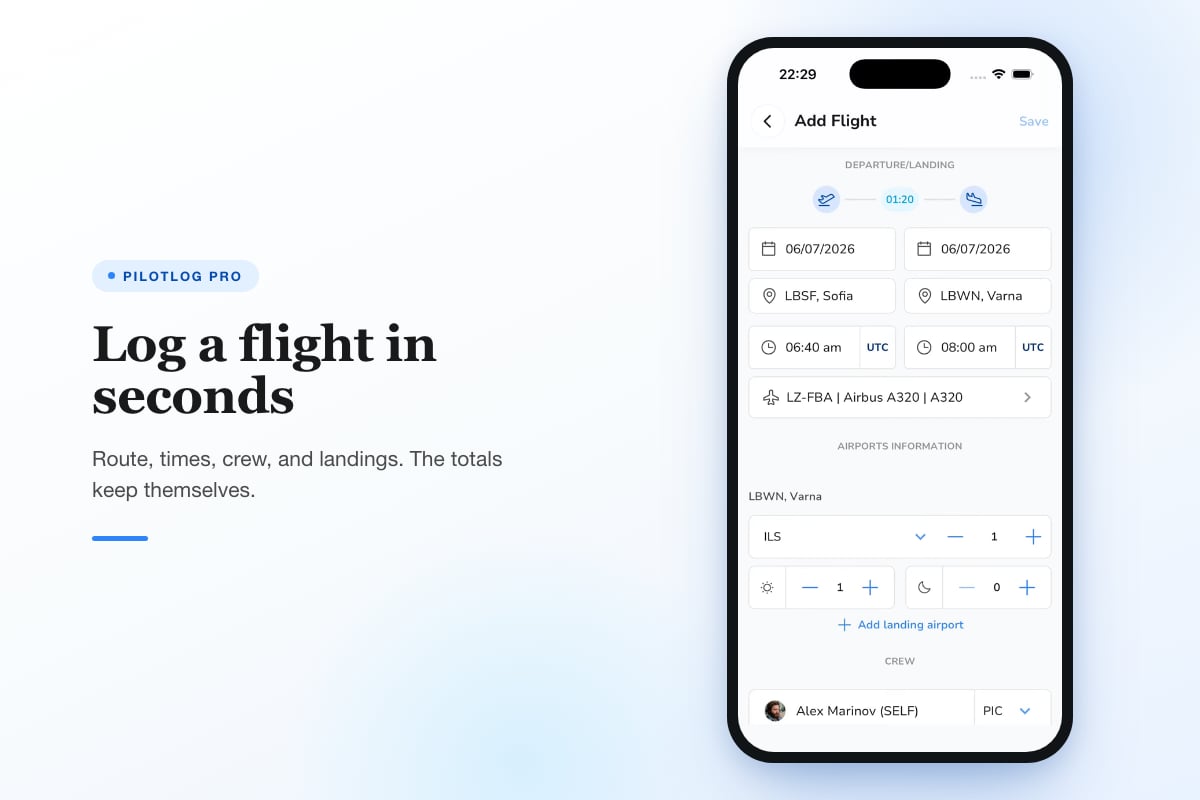
Once you start training, every logged hour contributes to certificate requirements and pilot currency rules. Missing a logbook entry can mean repeating flights or scrambling for records during skill-test preparation. A digital logbook ensures accurate, searchable records and surfaces currency gaps before they lapse.
Pilotlog Pro tracks your total time, solo hours, cross-country, night, and instrument currency automatically, flagging when you approach limits or expiries. From student pilot to commercial crew, it keeps your training hours current and audit-ready.
Regional and Regulatory Variations
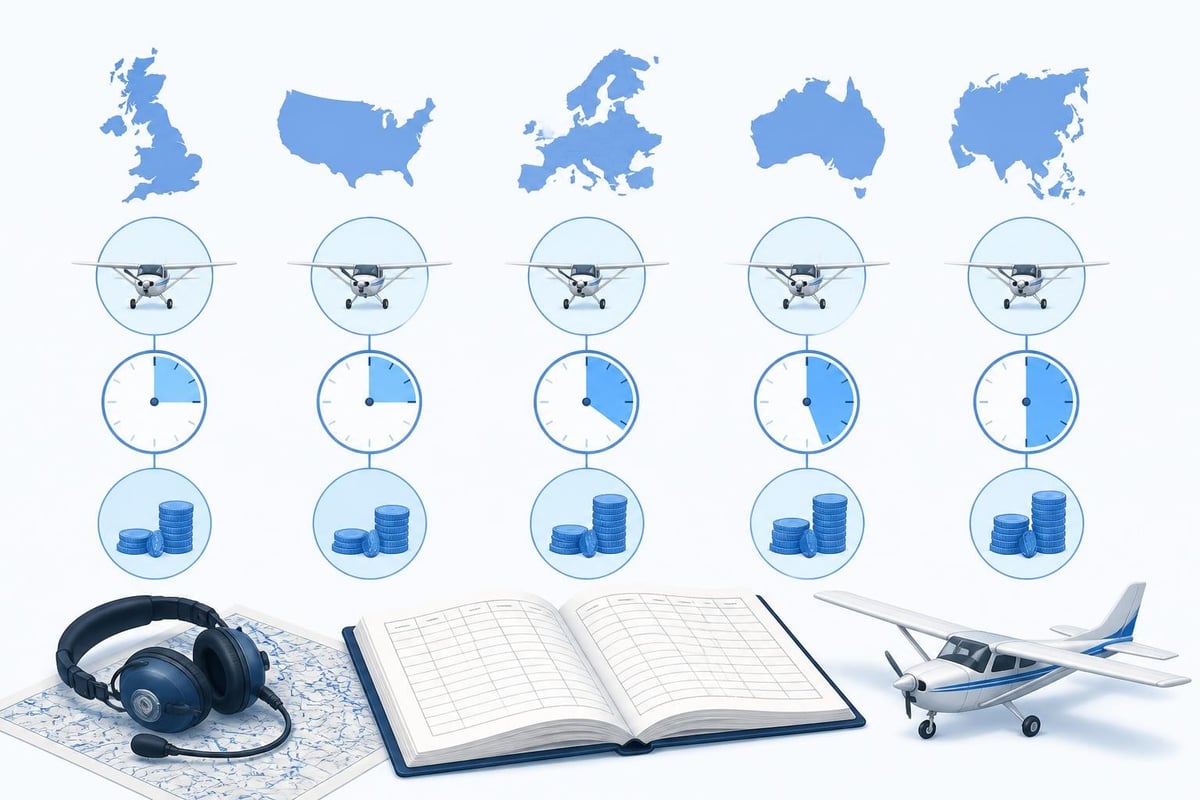
Flying lessons cost differs by country due to regulatory frameworks, fuel prices, labour markets, and airspace complexity.
United Kingdom (EASA Part-FCL): PPL 45 hours minimum, CPL 200 hours, IR with EASA competency-based rules. Costs at the higher end globally due to airspace congestion, weather, and instructor wages.
United States (FAA Part 61/141): PPL 40 hours minimum (Part 61) or structured syllabi (Part 141). Lower hourly rates than UK on average, but total cost similar due to higher average hours to solo and pass checkrides. FAA hourly requirements provide the baseline.
Europe (EASA states): Spain, Greece, and Portugal offer lower hourly rates (€100–€130/hour aircraft) and better weather, making them popular for integrated ATPL courses. Language and relocation costs offset some savings.
Australia and New Zealand: Competitive hourly rates (AUD 180–220) and high VFR weather availability. CPL in 12–15 months. CASA (Australia) and CAA NZ rules differ slightly from EASA but are mutually recognised under bilateral agreements.
Rest of world: ICAO training standards set the framework, but national variations exist. Middle East and Asia-Pacific flight schools target international students with purpose-built academies and financing packages.
Impact of Inflation and Market Trends
Flying lessons cost has risen faster than general inflation since 2020. Fuel surcharges, insurance premiums, maintenance costs, and instructor shortages all push hourly rates upward. The Redbird 2024 report documents a 15–20% median increase in US training costs between 2020 and 2024, with aircraft rental climbing from $130 to $155 per hour on average.
IATA's economic outlook notes that global pilot demand remains strong through 2026, sustaining training volumes despite higher costs. Instructor wages have risen in response to airline hiring, narrowing the gap between flight-school pay and first-officer salaries and making it harder for schools to retain senior instructors.
Fuel costs: Avgas prices in the UK fluctuate between £1.80 and £2.20 per litre (roughly £8–£10 per gallon). A Cessna 152 burns about 6 US gallons per hour, so fuel alone costs £20–£25 per flight hour, before aircraft ownership, maintenance, and insurance.
Regulatory compliance: FAA policy discussions on training pathways and workforce implications highlight how compliance costs (maintenance inspections, ADS-B mandates, updated avionics) flow through to students. EASA's Safety Management System requirements similarly add administrative overhead to approved training organisations.
Budgeting for Your Licence
Start by defining your goal (PPL recreational, CPL career, or ATPL airline) and researching local schools. Request detailed cost breakdowns, not just headline "from £X" figures. Ask:
- Hourly wet rate for the aircraft you'll fly most.
- Instructor rate for dual and ground instruction.
- Included items: are exams, test fees, landing fees, and materials bundled or extra?
- Average student hours to solo, first cross-country, and skill test.
- Payment terms: block-hour discounts, payment plans, refund policy if you pause training.
Build a spreadsheet listing each cost component and track actual vs budgeted hours as you progress. Add a 15–20% contingency for overruns, resits, and delays.
Compare integrated vs modular training. Integrated courses (zero to CPL/ATPL in one programme) offer structure and sometimes economies of scale but lock you into a single school and payment schedule. Modular training (PPL, then IR, then CPL as separate courses) spreads cost over years and lets you pause between certificates, but total hours may creep higher without a tight syllabus.
For those tracking training progress digitally, a structured electronic pilot logbook simplifies record-keeping and proves invaluable when you apply for certificates, ratings, or jobs.
Medical and Skills Test Costs
Medical examinations: Class 2 (PPL) costs £100–£150 in the UK and $100–$150 in the US. Class 1 (CPL/ATPL) runs £300–£400 (UK) or $150–$200 (US). Factor in reissue fees if you have a condition requiring regular monitoring (colour vision tests, ECGs, specialist reports).
Skills tests: The PPL skill test (checkride) takes 3–4 hours including ground oral, preflight, flight manoeuvres, and debrief. UK examiners charge £300–£400 plus aircraft hire (examiner flies as passenger, so you pay dual rate: £150–£180/hour for 1.5–2 hours). US checkrides cost $500–$700 for the DPE, plus aircraft (typically 2 hours at dual rate). Budget £600–£800 (UK) or $800–$1,000 (US) total for the test itself.
Written exams: EASA PPL candidates sit nine exams (Air Law, Human Performance, Meteorology, Communications, Principles of Flight, Operational Procedures, Flight Performance and Planning, Aircraft General Knowledge, Navigation). Each costs £20–£30 in the UK. FAA written tests cost $175 each; PPL requires one knowledge test.
Student Pilot to Airline Costs
From zero time to airline-ready ATPL (frozen or full), UK integrated programmes cost £80,000–£120,000 over 18–24 months. This includes PPL, ATPL theory (14 exams), CPL, multi-engine rating, IR, MCC (multi-crew cooperation), and upset recovery training.
US equivalents (ATP-CTP plus ratings) cost $70,000–$100,000. Many US pilots build hours as instructors (paid, unlike UK where instructing requires separate qualification and low initial pay), offsetting some costs.
Type rating bonds: Airlines may require a type-rating bond (£15,000–£30,000 repaid over 3–5 years) if they fund your jet training. Read contracts carefully; leaving early can trigger immediate repayment.
Total career investment: Realistically, reaching a right-hand seat in a regional jet costs £100,000–£150,000 (UK self-funded modular) or £80,000–£100,000 (integrated/sponsored). US pilots spend $80,000–$120,000 but often recoup some via instructor income.
Managing Costs Through Training
Pause strategically: If finances tighten, pause at a natural break (after solo, after cross-country solo, after PPL issue) rather than mid-skill. Long gaps before complex endorsements (IR, night, multi-engine) are less costly to recover than mid-PPL gaps that require revalidation flights.
Insurance and liability: Student pilot insurance is optional but wise. It covers third-party liability if you damage the aircraft or another party. Premiums run £200–£400/year. Schools typically require you to cover excess (first £500–£1,500 of damage).
Record-keeping: Accurate pilot logs protect you if disputes arise over billed hours. Digital logs time-stamp entries and sync across devices, preventing lost or incomplete records. Paper logbooks can be mislaid, damaged, or inaccurately totalled, leading to costly hour-verification exercises during skill-test prep.
How Flying Lessons Cost Fits into Career Planning
Before committing, model the return on investment. An airline first officer in the UK earns £30,000–£45,000 starting, rising to £60,000–£80,000 after 3–5 years. Captains earn £80,000–£150,000+ depending on aircraft and airline. US regional FOs start near $50,000–$70,000, with major-airline captains reaching $200,000–$400,000 after progression.
Break-even typically occurs 5–10 years post-qualification if you reach a major carrier. Regional or general-aviation careers may never recover six-figure training costs, so weigh alternatives (military, sponsored cadetships, instructing to build hours cheaply).
Non-career pilots (PPL for recreation) should view flying lessons cost as a hobby investment. A PPL lets you rent aircraft for personal travel, but ongoing costs (annual BFR, medical, club membership, rental) run £2,000–£5,000/year for moderate flying (30–50 hours).
Trends and Future Outlook
Pilot demand through 2026 remains robust, driven by fleet expansion in Asia-Pacific and retirements in North America and Europe. Training capacity has not kept pace, sustaining high costs and long waiting lists at popular schools. Electric and hybrid trainer aircraft promise lower operating costs (£60–£80/hour projected) but certification and fleet rollout lag, so traditional Cessna and Piper trainers dominate through at least 2028.
Simulator technology continues improving, with EASA and FAA expanding creditable hours for FNPT and FTD devices. Expect future regulations to permit more sim time for ab-initio training, potentially trimming 10–15% from total flying lessons cost.
Regulatory bodies are also exploring competency-based training (CBT) that emphasises proficiency milestones over fixed hours. Early trials show CBT can reduce hours by 10–20%, but full implementation requires rewriting syllabi and examiner standards, a multi-year process.
Inflation and fuel volatility will continue influencing costs. Budget conservatively and revisit your financial plan every six months during training.
Flying lessons cost varies widely by location, aircraft, and individual pace, but realistic budgets range from £10,000 to £15,000 for a PPL and climb into six figures for full ATPL programmes. Track every hour meticulously, fly consistently, and choose aircraft and schools that match your budget and goals. Once you start logging flights, Pilotlog ensures you never lose track of hours, currency, or expiries, keeping you current and ready for every checkride, rating, and career milestone ahead.
- private pilot licence cost
- ppl cost uk
- flying lessons cost
- cpl cost
- learn to fly
A logbook that keeps itself.
Join the waitlist and be first in line when Pilotlog launches.
Free to join, no spam. Unsubscribe any time.