pilot logbook
Pilot Logs: How to Track Flight Time and Stay Current
29 Jul 2026 · 13 min read

Pilot logs are the official record of your flight time, experience, and currency. They document every flight you've logged as pilot-in-command, dual instruction, cross-country, night, and instrument time, forming the foundation for licence applications, job interviews, and regulatory compliance. Whether you're a student working toward your first solo or an airline captain tracking rolling duty limits, your logbook proves you meet the legal requirements to act as PIC.
What Pilot Logs Must Contain
Aviation regulators on both sides of the Atlantic require specific entries in pilot logs. The Federal Aviation Administration sets out logbook requirements under 14 CFR § 61.51, mandating that pilots record date, total flight time, departure and arrival location, aircraft make and model, and the type of pilot time (PIC, dual, solo).
In practice, most pilots log additional details. You'll typically record:
- Date of flight (required)
- Aircraft registration and type (required)
- Departure and arrival airports (required by FAA; EASA Part-FCL requires only "route of flight")
- Total flight time or block time (required)
- Pilot-in-command time (required when acting as PIC)
- Solo time (for students and recreational pilots)
- Dual instruction received (required when logging training flights)
- Cross-country time (required for licence applications)
- Night time (required for currency and ratings)
- Instrument time (actual or simulated, required for IFR privileges)
- Instructor's signature and certificate number (when logging dual instruction)
EASA Part-FCL AMC1 FCL.050 similarly requires pilots to record flight details, though with slightly different categories. UK and European pilots log "route" rather than specific airports and track multi-pilot time separately. Both systems require instructors to sign off training flights.
Missing or falsified logbook entries carry serious consequences. The FAA can suspend or revoke certificates for inaccurate or incomplete records, and airlines routinely verify logbook totals during hiring processes.

Cross-Country Time and Rating Requirements
Cross-country flight time causes confusion because the definition changes depending on context. For FAA private pilot certification, cross-country means a flight with a landing at least 50 nautical miles from the departure point. For instrument rating and commercial certificate cross-country requirements, the distance increases to more than 50 nautical miles, and the flight must include a landing.
ATP applicants face stricter standards. The 1,500 hours for an airline transport pilot licence must include 500 hours of cross-country time under 14 CFR § 61.1(b)(3)(vi), defined as flights with landings more than 50 nautical miles away that include navigation by pilotage, dead reckoning, or electronic aids.
EASA defines cross-country differently. Under Part-FCL, cross-country time requires a flight between two points with a landing at least 50 km (approximately 27 nautical miles) from departure. For commercial pilot licence applicants, EASA Part-FCL requires 20 hours of cross-country flight time as PIC.
Log the full definition in your remarks column when the flight meets cross-country criteria. Many digital logbook systems automatically flag qualifying flights based on distance calculations.
Tracking Currency and Expiries in Pilot Logs
Pilot logs serve a second critical function beyond recording total time. They prove you meet recency requirements to carry passengers, fly IFR, or act as PIC.
The FAA's 90-day rule (14 CFR § 61.57(a)) requires three takeoffs and landings in the preceding 90 days to carry passengers. For night currency, you need three takeoffs and landings to a full stop between one hour after sunset and one hour before sunrise. These must occur in the same category, class, and type (if a type rating is required).
IFR currency under 14 CFR § 61.57(c) demands six instrument approaches, holding procedures, and intercepting and tracking courses in the preceding six calendar months. You can use an approved flight simulator or training device for some of these requirements, but you must log the device details.
EASA Part-FCL sets similar standards. To carry passengers, you need three takeoffs and landings in the preceding 90 days (FCL.060). Night currency requires one takeoff and landing at night in the preceding 90 days if you plan to carry passengers at night. For single-pilot IFR, you must complete the relevant section of the IR proficiency check within the preceding 12 months.
| Currency Type | FAA Requirement | EASA Requirement |
|---|---|---|
| Passenger (day) | 3 takeoffs and landings in 90 days | 3 takeoffs and landings in 90 days |
| Passenger (night) | 3 takeoffs and full-stop landings (1 hour after sunset to 1 hour before sunrise) in 90 days | 1 takeoff and landing at night in 90 days |
| IFR | 6 approaches, holding, intercepting/tracking in 6 months | IR proficiency check within 12 months |
Your pilot logs must prove currency on demand. Examiners, chief pilots, and insurance underwriters regularly audit logbooks during checkrides, new-hire processes, and policy renewals. Missing currency can ground you until you complete the required approaches or landings with an instructor.
Worked Example: Tracking Rolling Currency
Imagine you're a commercial pilot building multi-engine time. On June 15, 2026, you complete three landings in a Piper Seminole. Your last three landings before that were May 20, May 22, and May 28. You're planning a passenger flight on August 10.
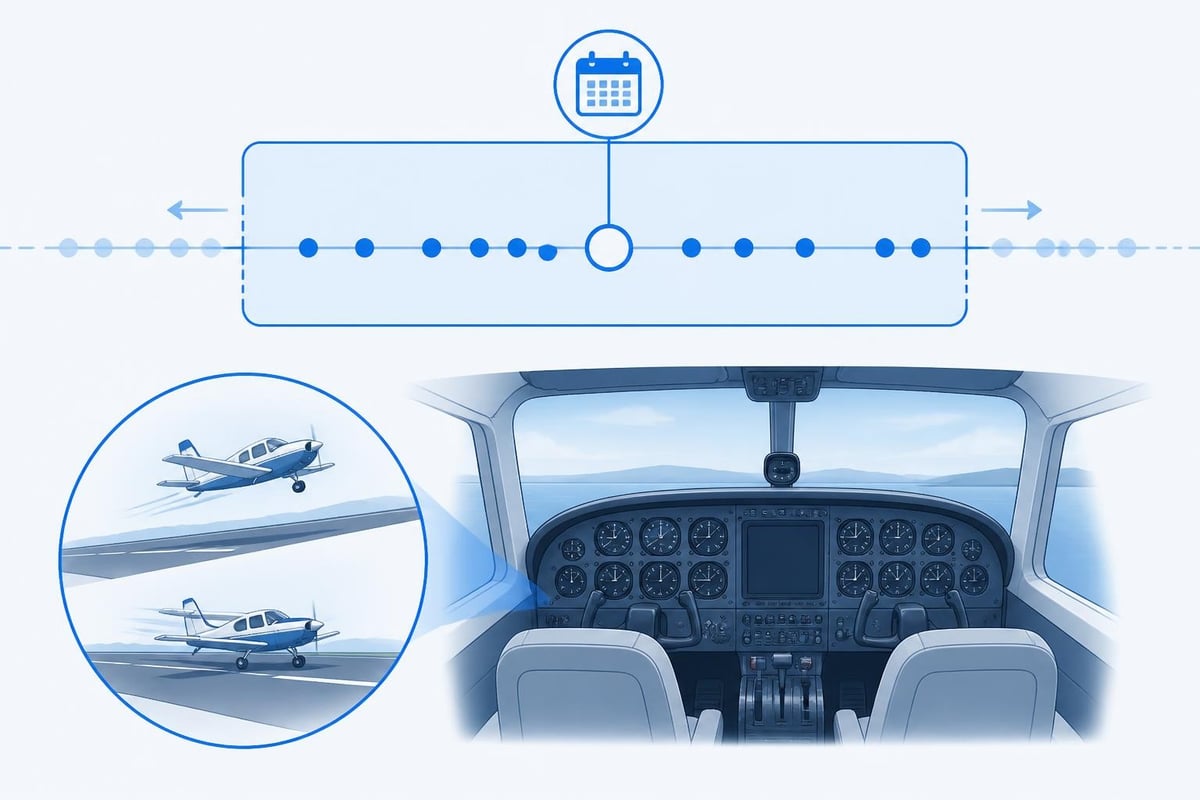
Count back 90 days from August 10. That's May 12, 2026. Your May 20, May 22, and May 28 landings all fall within the window, so you're current. But if you wait until August 20, the May 20 landing drops outside the 90-day window, and you're no longer current.
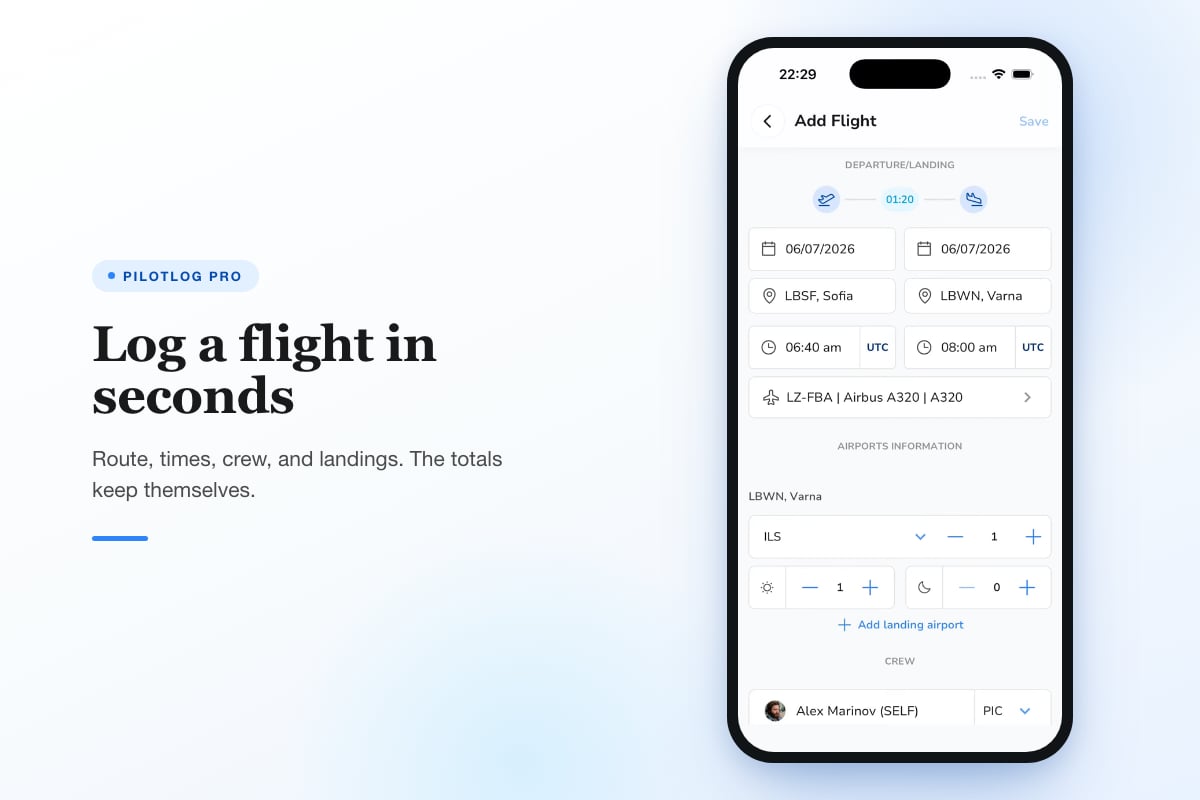
Rolling currency means the window moves forward every day. Manual tracking with paper logs requires constant recalculation. Pilotlog Pro automatically tracks 28-day and 90-day currency with lapse dates, flagging when you're about to lose passenger or IFR privileges so you can plan a proficiency flight.
Paper vs Digital Pilot Logs
Traditional paper logbooks offer permanence and universal acceptance. The Jeppesen Professional Pilot Logbook and ASA Standard Pilot Logbook have recorded millions of flight hours since the 1960s. Examiners and airline hiring departments recognize the format instantly.
But paper logs have limitations. You can't search for specific flights, calculate currency automatically, or generate filtered reports by aircraft type. Totals require manual addition, and errors compound across pages. Lost or damaged paper logbooks can end careers, especially if you haven't maintained backup records.
Digital pilot logs solve these problems. Apps calculate totals instantly, flag currency lapses, and export logbook data in multiple formats. You can search by aircraft registration, filter by flight conditions, and generate reports for insurance renewals or job applications.
Transitioning to digital logbooks requires careful data migration. Photograph every page of your paper logbook before entering flights, and cross-check totals at each licence milestone (solo, private, instrument, commercial, ATP). Many pilots maintain both systems during the transition, updating paper and digital logs in parallel until they trust the digital record.
The FAA accepts digital logbooks provided they meet the requirements of 14 CFR § 61.51. EASA similarly accepts electronic records under Part-FCL, though you must ensure the system protects against data loss and unauthorized changes. Airlines and insurance companies increasingly prefer digital logs for their audit trails and searchability.
Choosing Between Formats
Your logbook choice depends on career stage and preferences. Students often start with paper logs during training, then migrate to digital logbook systems as flight hours accumulate and currency tracking becomes complex.
Consider these factors:
- Backup and redundancy: Paper logs require photocopies or scanned backups. Digital systems need cloud sync and export functions.
- Regulatory acceptance: Both FAA and EASA accept electronic logs, but ensure your chosen system meets regulatory standards.
- Currency automation: Digital logs calculate rolling currency windows automatically. Paper logs require manual tracking with a calendar.
- Cost: Paper logbooks cost between $15 and $50. Digital subscriptions range from free basic tiers to $50 annually for professional features.
- Longevity: Paper logs last decades if stored properly. Digital systems require ongoing vendor support and data portability.
Many professional pilots use a hybrid approach. They maintain official digital logs for daily operations and print annual summaries for permanent paper records. This combines the convenience of digital tracking with the archival security of paper.
Common Pilot Log Errors and How to Avoid Them
Logbook mistakes range from simple arithmetic errors to serious misrepresentations. The most common issues include:
Incorrect PIC time: Only log pilot-in-command time when you're the sole manipulator of the controls in an aircraft for which you're rated, or when you're acting as PIC under 14 CFR § 61.51(e). Students often incorrectly log PIC time during dual instruction before they hold the appropriate category and class rating.
Misclassified cross-country time: Flights between nearby airports don't qualify as cross-country unless they meet the distance requirements for your certificate or rating. A 30-mile flight counts for private pilot currency but not for commercial certificate cross-country requirements.
Missing instructor endorsements: Every dual instruction flight requires the instructor's signature and certificate number. Missing signatures can invalidate training hours during certificate applications.
Rounding errors in time calculations: Flight time must be logged in hours and tenths (or hours and minutes, converted to decimal). Rounding 1.9 hours to 2.0 hours across dozens of flights creates significant discrepancies.
Inadequate night time documentation: Night time has specific definitions. For FAA purposes, night means the time between the end of evening civil twilight and the beginning of morning civil twilight, logged when you're the sole manipulator of the controls. Logging "sunset to sunrise" without checking official twilight times leads to inaccurate totals.
Professional pilots often face additional scrutiny. Airlines verify logbook totals against company records, and discrepancies can delay hiring or trigger fraud investigations. Insurance companies audit logs during claims, and inaccurate flight time can void coverage.
| Error Type | Impact | Prevention |
|---|---|---|
| PIC time logged during dual instruction (student) | Invalid hours for certificate requirements | Only log PIC after solo endorsement or when rated in category/class |
| Cross-country flights under distance minimum | Rejected certificate applications | Measure distance from airport reference points; use navigation apps |
| Missing instructor signatures | Training hours not credited | Request signature immediately after each dual flight |
| Rounding flight time | Accumulating total discrepancies | Calculate exact time using Hobbs or tach; convert minutes to decimal |
| Night time outside civil twilight | Overstated night currency | Check official sunset/sunrise tables for exact civil twilight times |
Double-check entries within 24 hours of each flight. Compare your totals against aircraft Hobbs or tach records, and reconcile monthly totals with any employer or flight school records. If you discover an error, draw a single line through the incorrect entry, write the correction, and initial the change. Never erase or obliterate original entries.
Advanced Pilot Log Tracking for Professional Operations
Commercial and airline pilots track additional data beyond basic flight time. Part 117 duty and flight time limitations require detailed records of:
- Flight duty period start and end times
- Rest periods between duty days
- Cumulative flight time over rolling 28-day, 365-day, and calendar-year periods
- Cumulative duty time over rolling 168-hour and 672-hour periods
14 CFR Part 117 limits FAA-regulated airline pilots to 100 hours of flight time in any 672 consecutive hours (28 days) and 1,000 hours in any 365 consecutive days. These rolling limits require constant calculation. Missing a limit violation can result in FAA enforcement action against both the pilot and the airline.
EASA regulates flight and duty time under EU-OPS Subpart FTL (now incorporated into EASA Part-ORO). European airline pilots face similar rolling limits: 900 flight hours per calendar year, 100 hours per 28 consecutive days. Duty periods have maximum lengths based on the number of sectors and time of day.
Professional pilot flight logbooks must track these limits alongside standard flight time. Paper systems require manual calculation with spreadsheets or calendar tools. Digital logbooks calculate rolling limits automatically and flag approaching violations before you accept a trip.
Charter and corporate pilots often track per-aircraft experience. Insurance companies require minimum hours in type, and many corporate flight departments mandate recurrent training based on time since last flown in each aircraft. Your logs must clearly separate time by aircraft make and model.
Type Rating and Checkride Documentation
Pilot logs serve as official records for type ratings, instrument proficiency checks, and flight reviews. After completing a checkride or proficiency check, the examiner or instructor must endorse your logbook with:
- Date of the check or review
- Type of certificate, rating, or authorization
- Statement that the applicant has demonstrated satisfactory knowledge and skill
- Examiner or instructor signature, certificate number, and expiration date
These endorsements prove you met the requirements at the time of the check. Airlines verify type rating endorsements during new-hire training, and the FAA can request logbook documentation during ramp checks or investigations.
File photocopies of all examiner endorsements separately from your logbook. If the logbook is lost, these copies provide evidence of your ratings and checkrides. Many pilots scan endorsement pages and store PDFs in cloud storage as additional backup.
Regulations change, and requirements vary by jurisdiction and operation type. Always confirm current rules against official sources before relying on any summary. The FAA publishes the complete regulations at ecfr.gov, and EASA maintains current Part-FCL at easa.europa.eu.

Logbook Security and Long-Term Preservation
Your pilot logs represent decades of career investment. Protect them with the same care you'd apply to passport or medical certificates.
Paper logbooks should be stored in fireproof safes or safety deposit boxes when not in use. Photocopy every page after every 10-20 flight entries, and store copies in a separate location. Water damage, fire, theft, and simple loss destroy paper records every year.
Digital logs require three-part backup strategies:
- Local device storage (primary record)
- Cloud synchronization (automatic backup)
- Periodic exports (independent backup files)
Export your full logbook data monthly in multiple formats (PDF for readability, CSV for data portability). Store exports in at least two locations: local hard drive and cloud storage service. If the app vendor discontinues service or changes pricing, you maintain complete access to your data.
Test your backup and restore process annually. Download an export file and verify you can open and read all flight entries. Check that totals match your current logbook, and confirm instructor signatures and endorsements appear in PDF exports. A backup you can't restore is worthless.
Many pilots print annual summaries for permanent paper archives. These summaries include total time by category and class, currency-relevant experience (instrument, night, cross-country), and copies of key endorsements. Store these with other important documents like medical certificates and pilot licence paperwork.
Accurate pilot logs form the foundation of regulatory compliance, career progression, and personal safety. They prove you meet currency requirements, document your experience for job applications, and provide a reliable record of your aviation journey from first solo through retirement. Whether you maintain paper logbooks, digital systems, or a hybrid approach, consistent and accurate entries protect your licence and career. Pilotlog tracks your flight time, rolling currency windows, and licence expiries automatically, flagging lapses before they ground you. Log a flight in seconds on iOS or Android, and let the app handle the calculations while you focus on flying.
- pilot logbook
- flight time tracking
- cross-country time
- ifr currency
- faa logbook requirements
A logbook that keeps itself.
Join the waitlist and be first in line when Pilotlog launches.
Free to join, no spam. Unsubscribe any time.