helicopter flight lessons
Helicopter Flight Lessons: Training, Costs & What to Expect
31 Aug 2026 · 11 min read
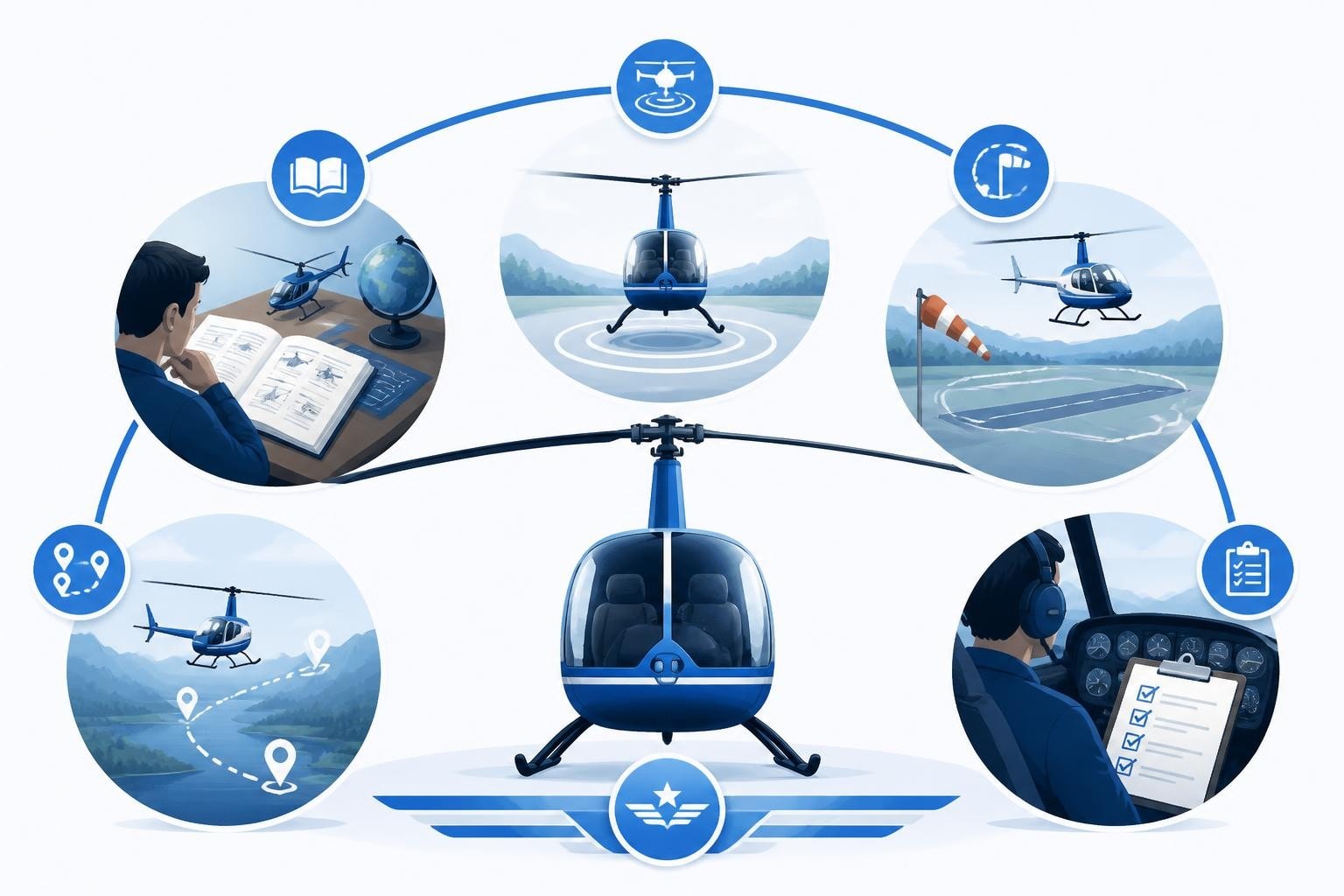
Helicopter flight lessons prepare pilots to operate rotorcraft safely across a structured syllabus that builds from basic hover control through advanced navigation and emergency procedures. Training follows regulatory standards set by authorities such as the FAA in the United States or EASA in Europe, progressing through ground school, dual instruction, solo flight, and checkride preparation. Most students complete a Private Pilot (Helicopter) licence in 40 to 60 flight hours depending on aptitude, weather, and lesson frequency, with costs typically ranging from £8,000 to £15,000 for the full course.
How Helicopter Flight Lessons Are Structured
Helicopter flight lessons follow a defined syllabus mapped to certification standards. The FAA Airmen Certification Standards for rotorcraft detail the tasks and performance tolerances examiners use during checkrides, and flight schools design lesson plans to meet every requirement.
Ground School and Pre-Flight Briefings
Each lesson begins with a ground briefing covering the manoeuvre or procedure you will practise. Typical topics include:
- Aerodynamics: rotor systems, dissymmetry of lift, translating tendency, and ground effect
- Systems: engine, fuel, hydraulics, and electrical systems specific to the training aircraft
- Flight planning: weight and balance, performance charts, weather minimums, and navigation
- Regulations: airspace, medical requirements, and operating rules
Ground school can be completed in a classroom setting, online, or one-on-one with an instructor. Many schools integrate ground lessons with flight training so theory immediately reinforces practice.
Dual Instruction: Building Core Skills
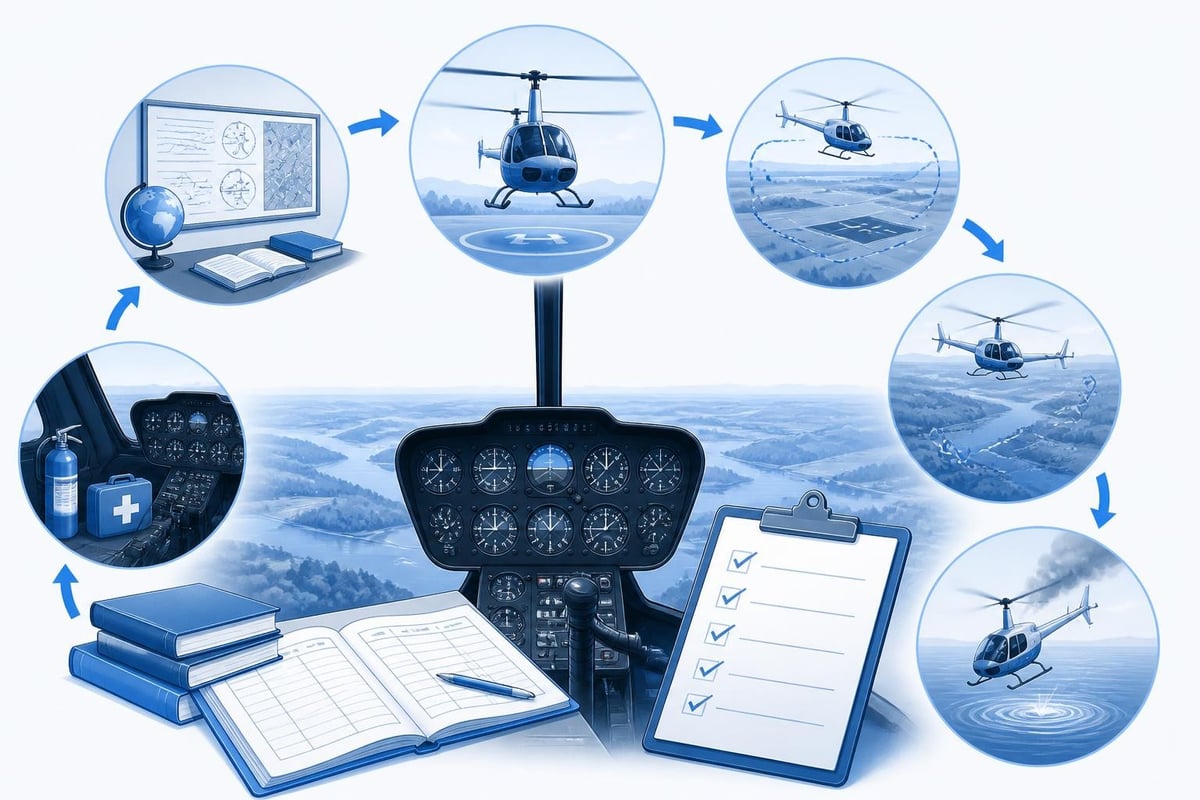
Your first 10 to 15 hours focus on hover control, the most challenging aspect for new helicopter pilots. You will learn to hold a stable hover over a reference point while managing collective, cyclic, and pedal inputs simultaneously. The FAA Helicopter Flying Handbook describes these fundamentals in detail, including hovering turns, forward flight transitions, and traffic patterns.
Typical dual instruction milestones include:
- Hover taxi and takeoffs - maintaining height, heading, and position over ground references
- Traffic pattern work - normal and crosswind takeoffs, downwind legs, and approaches
- Autorotations - simulated engine-off landings to develop emergency skills
- Cross-country navigation - pilotage, dead reckoning, and use of GPS or VOR
- Night operations - orientation, illusions, and landing techniques (if pursuing night privileges)
Each lesson builds on previous skills. Instructors use demonstration, guided practice, and solo consolidation to move you from novice to proficient.
Solo Flight and Supervised Practice
FAA regulations require a minimum of 20 hours of dual instruction and 10 hours of solo flight for a Private Pilot (Helicopter) certificate under Part 61. Your first solo, typically at 15 to 20 hours, involves hover practice and traffic patterns in the local training area. Later solo flights include dual cross-country planning followed by solo cross-country legs of at least 100 nautical miles with landings at three points.
EASA training under Part-FCL requires 29 hours dual and 10 hours solo for a PPL(H), along with five hours of cross-country and one solo cross-country of at least 185 km (100 nm) with two full-stop landings. The EASA Easy Access Rules for Aircrew outline the full syllabus and crediting options for pilots converting from aeroplanes or adding ratings.
What Helicopter Flight Lessons Cost
Helicopter flight lessons are billed by flight hour (rotor time) plus instructor fees and ground instruction. Costs vary by aircraft type, location, and school.
| Cost Component | Typical Range (UK/Europe) | Typical Range (US) |
|---|---|---|
| Helicopter hire (R22) | £200–£280/hour | $250–$350/hour |
| Helicopter hire (R44) | £350–£450/hour | $400–$550/hour |
| Instructor fee | £40–£60/hour | $50–$80/hour |
| Ground school | £300–£600 | $400–$800 |
| Books and materials | £100–£200 | $150–$300 |
| Checkride (examiner + hire) | £600–£900 | $700–$1,200 |
For a 50-hour PPL(H) course in a Robinson R22, expect total costs between £12,000 and £15,000 in the UK or $15,000 and $20,000 in the United States. Training in a larger R44 increases costs by roughly 50 per cent.
Many students spread training over several months due to budget and availability. Lesson frequency affects progression: flying two to three times per week maintains muscle memory and reduces the need to re-teach skills.
The AOPA student resources provide budgeting guidance and advice on choosing a flight school, including questions to ask about aircraft maintenance, instructor turnover, and pass rates.
Choosing a Helicopter Flight School
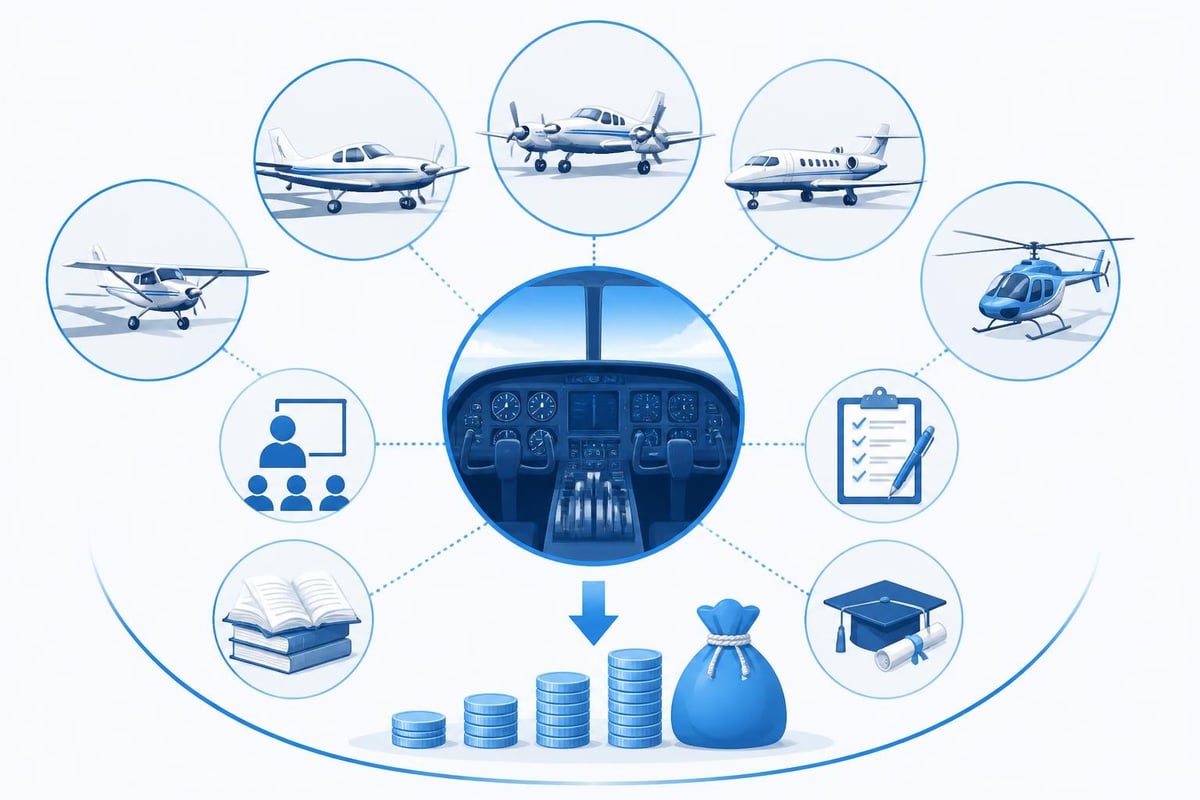
Selecting the right school affects your training experience, timeline, and ultimate success. Evaluate schools on these criteria:
- Aircraft fleet: well-maintained, modern helicopters with up-to-date avionics
- Instructor qualifications: experience level, teaching style, and availability
- Syllabus structure: clear progression, written lesson plans, and stage checks
- Safety record: accident history, maintenance logs, and insurance coverage
- Flexibility: scheduling options, weather policies, and solo aircraft access
Visit multiple schools, fly a trial lesson with different instructors, and speak to current students. Some universities offer integrated programmes combining academic degrees with professional helicopter training. For example, Embry-Riddle partners with helicopter academies to provide ab-initio pathways for students pursuing commercial or airline transport careers.
Part 61 vs. Part 141 Training (US Pilots)
In the United States, helicopter flight lessons can follow Part 61 or Part 141 rules. Part 61 offers flexibility with no fixed syllabus; you meet minimum hour requirements and demonstrate proficiency. Part 141 schools use FAA-approved syllabi and may reduce minimum hours (for example, 35 hours for a Commercial Pilot certificate instead of 40).
For most private pilot students, Part 61 provides adequate structure without the administrative overhead. Part 141 suits students aiming for integrated commercial or flight instructor courses where reduced minimums and VA benefits apply.
Tracking Hours, Currency, and Expiries
Once you earn your licence, maintaining currency becomes essential. Helicopter pilots must meet recency requirements to carry passengers and remain legal for flight.
Regulatory Currency Requirements
FAA (United States): To carry passengers, you must complete three takeoffs and three landings within the preceding 90 days in the same category and class of aircraft (14 CFR § 61.57). No specific regulation number exists for this rule; it is codified in Part 61, Section 57(a).
EASA (Europe): Under FCL.060, single-pilot helicopter pilots must complete six hours, six flights including three hours PIC, and one training flight with an instructor within the preceding 12 months. Night currency requires one hour of flight time including five takeoffs and landings as PIC in the preceding 90 days.
The UK CAA Standards Document 19(H) provides additional national guidance on skill tests and licence renewals.
Rules change periodically, so confirm current requirements against official sources before each flight.
How Digital Logbooks Help
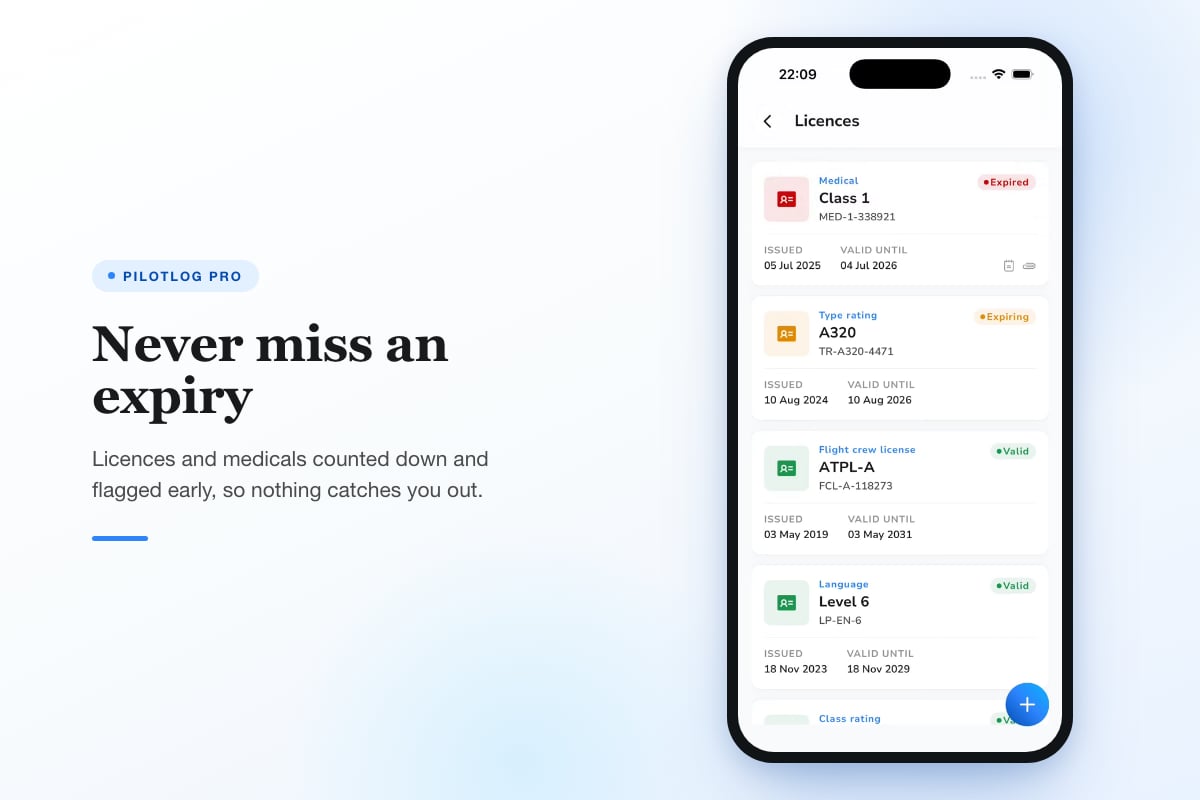
Digital pilot logbooks automate currency tracking and alert you when recency or medical expiries approach. Instead of manually counting takeoffs or cross-referencing flight dates, you log each flight and the system calculates rolling totals.
Pilotlog Pro tracks 28-day and 365-day flight-time limits, passenger and night currency, and licence and medical expiry dates flagged well in advance. You log a flight in seconds, and Pro calculates whether you are current to carry passengers or need a refresher flight. This is especially useful for helicopter pilots flying irregularly or managing multiple type ratings.
Common Challenges in Helicopter Flight Lessons
Helicopter training presents unique difficulties not encountered in aeroplane flight.
Hover Control and Coordination
Hovering requires constant, small adjustments across all three flight controls. New students often over-control, inducing oscillations that compound into larger deviations. The Robinson R22, the most common training helicopter, is particularly sensitive due to its lightweight design and semi-rigid rotor system.
Expect 5 to 10 hours before achieving consistent hover control. Instructors often demonstrate a stable hover, then gradually transfer control one axis at a time: pedals first, then collective, finally cyclic.
Autorotations and Emergency Procedures
Autorotations simulate engine failure by entering a controlled descent with the rotor freewheeling. You lower collective to maintain rotor RPM, establish a descent profile, and time the flare and collective pull to cushion landing. The manoeuvre demands precise timing and feel.
Most students find autorotations intimidating initially. Repetition builds confidence, and examiners test both straight-in and 180-degree autorotations during checkrides.
The NTSB aviation accident data shows that loss of control and inadequate emergency procedures contribute to many helicopter accidents. Thorough training in autorotations, low-rotor-RPM recovery, and vortex ring state avoidance directly improves safety margins.
Weather Sensitivity and Cancellations
Helicopters operate under visual flight rules for most training flights, requiring cloud clearances and visibility minimums. Wind, especially gusts and crosswinds, limits training in lightweight helicopters like the R22, which has a maximum demonstrated crosswind of 17 knots.
Lesson cancellations due to weather are common, particularly in winter or coastal areas. Budget extra time in your training timeline and maintain flexibility in scheduling.
Advanced Helicopter Flight Lessons and Ratings
After earning a Private Pilot (Helicopter) licence, many pilots pursue additional ratings or advanced endorsements.
Instrument Rating (Helicopter)
An instrument rating allows flight in instrument meteorological conditions (IMC) under IFR. Helicopter IFR training focuses on precision approaches, holding patterns, and partial-panel flight. The FAA requires 50 hours of cross-country PIC time, 40 hours of simulated or actual instrument time, and 15 hours with an instructor for the rating.
EASA requires 50 hours of cross-country PIC, 30 hours of instrument dual, and an instrument rating skill test. Instrument-rated helicopter pilots can accept commercial contracts requiring IFR operations, such as offshore or emergency medical services.
Commercial Pilot and Flight Instructor
A Commercial Pilot (Helicopter) licence allows you to fly for hire. FAA Part 61 requires 150 total hours including 100 hours PIC, 50 hours cross-country, and **10 hours in a complex or turbine helicopter. EASA CPL(H) training requires 185 total hours including specific cross-country and night requirements.
Many commercial helicopter pilots add a Certified Flight Instructor (Helicopter) rating to build hours while teaching. Instructing sharpens stick-and-rudder skills and deepens understanding of aerodynamics and systems.
Type Ratings and Turbine Transition
Larger or turbine-powered helicopters require type ratings or manufacturer-specific training. Transitioning from a piston R22 to a turbine Bell 206 involves learning turbine engine management, governor systems, and different handling characteristics. These courses typically require 10 to 20 hours of dual instruction plus ground school.
Aerodynamics Refreshers During Training
Understanding rotor aerodynamics improves your ability to anticipate helicopter behaviour and troubleshoot performance issues. Key concepts include:
- Dissymmetry of lift: the advancing blade generates more lift than the retreating blade in forward flight, corrected by cyclic feathering
- Translating tendency: tail rotor thrust causes the helicopter to drift laterally, requiring cyclic correction
- Ground effect: increased rotor efficiency within one rotor diameter of the surface, reducing power required to hover
- Vortex ring state: a dangerous descent condition where the helicopter settles into its own downwash, requiring immediate forward cyclic and collective reduction
The NASA Beginner's Guide to Aerodynamics provides clear explanations of these principles with diagrams and equations accessible to student pilots.
Logging Helicopter Flight Lessons Accurately
Every flight must be logged to prove experience for licence applications, insurance, and currency checks. Logbook accuracy matters: examiners and employers scrutinise entries during checkrides and job interviews.
Record these details for each lesson:
- Date and aircraft registration
- Departure and arrival aerodromes
- Flight time (block-to-block or Hobbs time, depending on school policy)
- Pilot-in-command or dual time
- Day vs. night
- Conditions (VFR, simulated instrument, actual instrument)
- Landings (full-stop, touch-and-go)
- Remarks: manoeuvres practised, stage checks, solo endorsements
Digital tools simplify logging. A digital pilot logbook auto-fills aircraft details, calculates totals, and exports reports for licence applications. You avoid arithmetic errors and always have a backup accessible on mobile devices.
International Considerations for Helicopter Flight Lessons
Pilots training outside their home country should verify licence conversion rules before beginning lessons. FAA licences can often be converted to EASA licences (and vice versa) with additional exams or skill tests, but hour credits and training recognition vary by state.
For example, an FAA PPL(H) holder seeking an EASA PPL(H) must pass EASA theoretical exams and complete a skill test, though some flight time may be credited. Always confirm conversion pathways with the target authority early in training to avoid duplicating hours.
Helicopter flight lessons offer a structured, rewarding path from first hover to confident PIC operations, whether you pursue flying recreationally or as a career. Accurate logging, currency tracking, and early planning around regulatory requirements keep your training on schedule and your licence valid long after the checkride. Pilotlog helps helicopter pilots log flights quickly, track rolling currency windows, and receive alerts for upcoming medical and licence expiries so you stay current, legal, and ready for every flight.
- helicopter flight lessons
- helicopter training cost
- ppl(h)
- learn to fly helicopter
- robinson r22
A logbook that keeps itself.
Join the waitlist and be first in line when Pilotlog launches.
Free to join, no spam. Unsubscribe any time.