cpl cost
Commercial Pilots Licence Cost: Real Numbers for 2026
30 Aug 2026 · 10 min read

A commercial pilots licence cost typically ranges from £55,000 to £130,000 depending on your training route, location, and how efficiently you complete each rating. The total reflects hundreds of flight hours, ground school, examiner fees, medical certificates, and regulatory checkrides. Below you'll find region-by-region breakdowns, hidden costs, and practical strategies to control your investment without compromising safety or quality.
Regulations and costs change. Always confirm current requirements with your national authority: FAA (United States), EASA (European Union), UK CAA (United Kingdom), or Transport Canada.
Why the Commercial Pilots Licence Cost Varies So Widely
Training pathways differ. You can build hours through a modular route (one rating at a time) or an integrated academy (PPL through CPL in a single structured program). Each carries a different price tag and timeline.
Geographic location drives variance. Fuel, insurance, instructor wages, and regulatory overhead vary by country and even by state or region. A flight hour in Arizona averages £150-£180; the same hour in southern California or the UK can reach £220-£280.
Your pace matters. Students who fly three times per week progress faster and use fewer total hours than pilots who fly once every ten days. Currency lapses mean re-training; inefficiency adds cost.
Breakdown by Region and Authority
| Authority | Typical CPL Cost Range | Notes |
|---|---|---|
| FAA (U.S.) | £60,000–£90,000 | 250-hour minimum; Part 141 may be faster than Part 61 |
| EASA (Europe) | £85,000–£130,000 | Integrated (frozen ATPL) includes theory and multi-engine time |
| UK CAA | £70,000–£110,000 | Modular routes often cheaper; add £15k–£20k for ATPL theory upfront |
| Transport Canada | £65,000–£95,000 | 200 hours commercial PIC; lower minimums but similar market rates |
Industry reports from PilotBound's 2026 Flight Training Cost Report and the FAA's ACT ARC recommendations confirm cost inflation of 12-18% since 2023, driven by fuel and instructor shortages.
The Full Path: From Zero to Commercial Licence
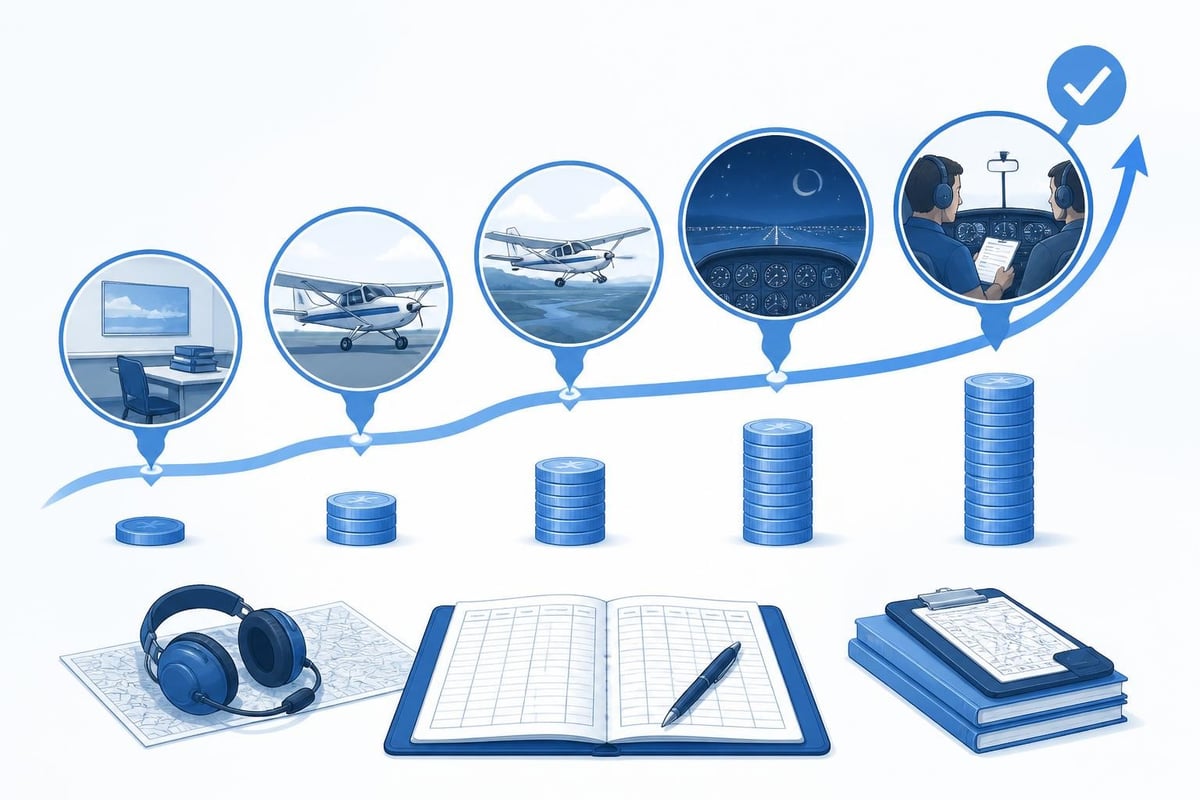
Most pilots don't jump straight to commercial training. You need foundational licences first. Here's a realistic hour-by-hour cost model for the FAA (Part 141) pathway in the United States in 2026:
Step 1: Private Pilot Licence
- Minimum hours: 40 (Part 141) or 45–60 (national average to checkride standard)
- Flight time: 55 hours × £180/hour = £9,900
- Ground school: £600–£1,200
- Written exam: £130
- DPE checkride fee: £550–£750
- Books, headset, medical: £800
- Subtotal: £12,000–£13,000
Step 2: Instrument Rating
- Minimum hours: 40 instrument time (often 50–60 real-world)
- Flight time: 50 hours × £200/hour (complex avionics) = £10,000
- Ground school: £800
- Written exam: £130
- DPE checkride: £600–£800
- Subtotal: £11,500–£12,000
Step 3: Time Building to 250 Hours
You need 250 hours total time before the CPL checkride. After PPL (55) and IR (50), you have 105 hours. You must build the remaining 145.
- Solo time building (single-engine): 100 hours × £160/hour = £16,000
- Cross-country PIC time: 45 hours × £180/hour = £8,100
- Subtotal: £24,000–£26,000
Step 4: Commercial Pilot Training
The FAA requires at least 10 hours of commercial manoeuvres training in a complex aircraft (retractable gear, constant-speed prop, or TAA).
- Commercial flight training: 20 hours × £210/hour = £4,200
- Ground school (commercial): £700
- Written exam: £130
- DPE checkride: £700–£900
- Subtotal: £5,700–£6,000
Total FAA CPL Cost (Part 141 efficient route): £53,000–£57,000
Add 10–15% for retakes, weather delays, or above-minimum hours. A realistic budget is £60,000–£65,000 for the U.S. modular pathway.
EASA and UK: Higher Minimums, Higher Costs
The EASA commercial pilots licence cost runs higher because integrated courses bundle ATPL theory (14 written exams) and often include multi-engine and instrument ratings in one package.
EASA Integrated CPL/IR/ME (frozen ATPL):
- Flight hours: 150–200 (depending on school)
- Ground school: 14 ATPL exams (9–12 months residential or online)
- Multi-engine time: 10–20 hours
- Typical tuition: £75,000–£105,000
- Accommodation, living: £12,000–£18,000
- Medical (Class 1 initial): £400
- Total: £87,000–£125,000
The EASA training pathway guide breaks down modular vs. integrated routes. Modular is cheaper upfront but can stretch to 24 months and still approach £80,000–£95,000 when you add exams, hour-building, and IR separately.
Hidden UK and EASA Costs
- Re-sit fees: Each ATPL theory exam re-sit costs £90–£150
- Licence application fees: CAA CPL issue: £180; IR issue: £140
- English Language Proficiency test (ICAO Level 4+): £120
- Airport landing fees for checkrides: £50–£150 per attempt
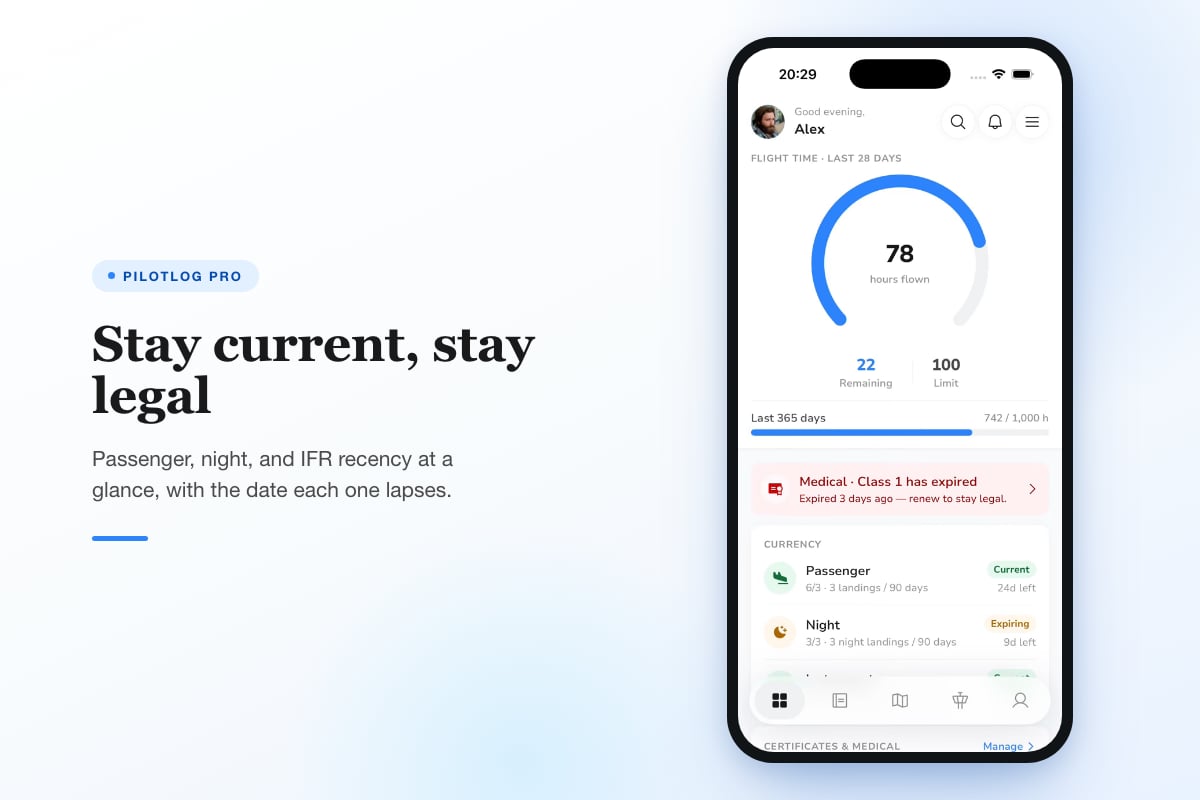
Every 90 days you must log three take-offs and landings to carry passengers; instrument currency requires six approaches and holding in the past six months. A digital pilot logbook with automatic currency tracking prevents costly lapses and re-training.
Canadian and International Pathways
Transport Canada sets a 200-hour minimum for commercial licences, but real-world training averages 220–240 hours. A Canadian parliamentary report estimates the full cost to reach airline-ready standards (CPL + multi-IFR + 1,500 hours) at CAD $120,000–$180,000.
Canadian CPL standalone cost:
- Flight training: 220 hours × CAD $220/hour ≈ CAD $48,400
- Ground school, exams, medical, checkrides: CAD $6,000–$8,000
- Total: CAD $54,000–$56,000 (approx. £32,000–£34,000)
Lower currency strength makes Canada attractive to international students, but foreign-trained licences require conversion exams and check flights when returning home.
Australia (CASA) and New Zealand (CAA NZ) follow similar 200-hour minimums. Costs in AUD and NZD track closely to CAD rates when adjusted for fuel and wages.
The Real Cost Drivers You Can Control
Aircraft Rental and Availability
Single-engine rental rates vary by aircraft type:
- Cessna 152 (basic trainer): £120–£160/hour
- Cessna 172 (primary trainer): £160–£200/hour
- Piper Arrow/Cessna 182 (complex): £200–£260/hour
- Twin-engine (ME time-building): £350–£500/hour
Joining a flying club or partnership can cut hourly rates by 15–25%. Some schools offer block-hour discounts: buy 50 hours upfront and save £10–£15/hour.
Instructor Fees
Instructor rates run £40–£70/hour on top of aircraft rental. Senior instructors and check pilots command the upper end. Ground instruction (pre-flight briefings, exam prep) is billed separately, often at £35–£60/hour.
Ask for package rates covering 10 or 20 lessons. Many schools bundle ground and flight time at a slight discount.
Examiner and Checkride Fees
Designated Pilot Examiners (DPE) in the U.S. charge £550–£900 per checkride depending on region and aircraft complexity. EASA examiners in the UK average £600–£800. If you fail a section, the partial re-test fee is £300–£500.
Prepare thoroughly. Every failed checkride costs you the re-test fee plus 3–5 additional training hours (£600–£1,200). Use online question banks and mock orals to reduce risk.
Medical Certification
A Class 1 medical (required for CPL in most jurisdictions) costs:
- FAA initial Class 1: £120–£180
- EASA initial Class 1 (UK): £350–£450
- Renewals: Every 12 months under age 40; every 6 months over 40
Factor medical costs into your annual budget. EASA medicals include ECG, audiometry, and ophthalmology, raising the price.
Financing and Scholarships
Few pilots pay cash upfront. Options include:
- Private student loans: APR 6–12% in the U.S.; specialist lenders (Sallie Mae, Citizens Bank) offer aviation programs
- Career-conditional financing: Some academies (ATP, CAE) tie repayment to airline employment
- Scholarships: Women in Aviation International, AOPA, EAA, and NGPA award £2,000–£15,000 grants annually
- Military pathways: Zero tuition but service commitment (8–10 years in most air forces)
The ICAO Training Value Partnership report highlights public-private financing models in multiple countries. Canada's recent TRAN committee recommendations include proposals for federally backed training loans.
Managing Costs Without Cutting Corners
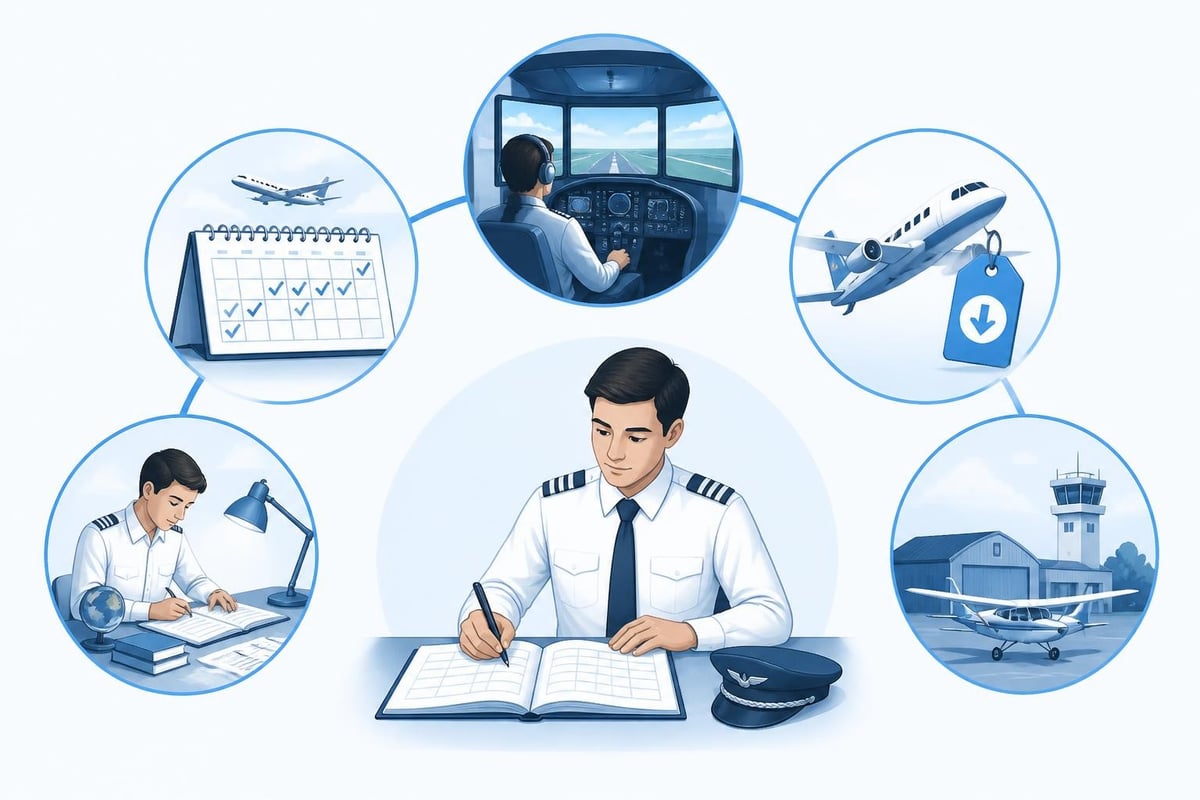
Fly consistently. Three lessons per week keeps skills sharp and reduces re-training. Students who fly once a month spend 20–30% more hours reaching checkride standard.
Use simulators strategically. EASA and FAA allow approved simulator time to count toward instrument and commercial requirements. Simulator rates (£50–£90/hour) are half the cost of aircraft time. The Redbird State of Flight Training 2024 report shows schools integrating simulators save students an average of 8–12 flight hours.
Track every hour. Know your rolling totals, currency windows, and endorsement expiries. Pilotlog Pro automatically calculates 28-day and 365-day limits, flags passenger and IFR currency, and alerts you 30 and 14 days before licence and medical expiries. You'll avoid surprise lapses that cost re-training hours and checkride delays.
Shop around. The PilotBound marketplace lists published hourly rates for 400+ U.S. flight schools. Regional price spreads can be 25–40%. If you can relocate for 12–18 months, training in the Southwest or Midwest saves £8,000–£15,000 compared to coastal metro areas.
Self-study ground school. Online courses (Sporty's, King Schools, Aviator Ace) cost £200–£400 vs. £800–£1,500 for classroom instruction. You'll still need CFI endorsement hours, but cutting classroom time trims the bill.
What the Commercial Pilots Licence Cost Includes
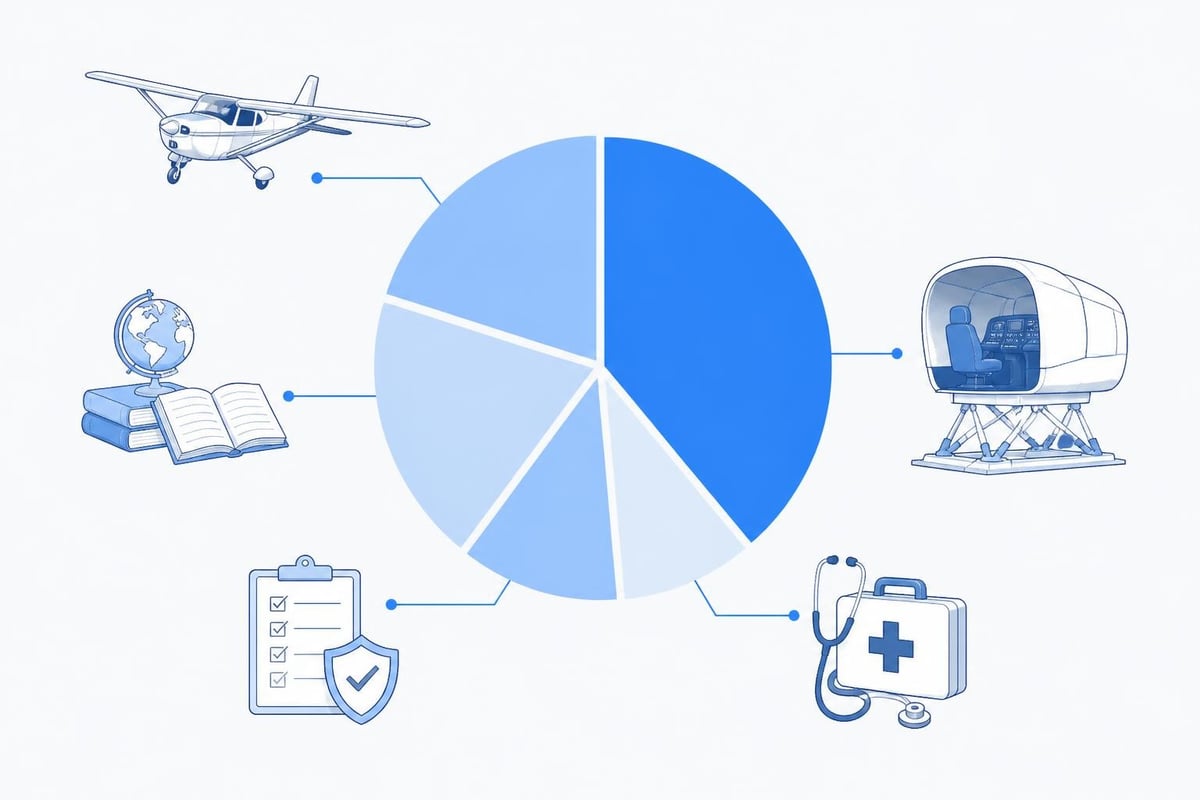
To summarize line items across a full FAA pathway (similar structure applies to EASA and others):
| Line Item | Estimated Cost (£) |
|---|---|
| PPL (flight + ground + checkride) | 12,000–13,000 |
| Instrument rating (flight + ground + checkride) | 11,500–12,000 |
| Time building to 250 hours | 24,000–26,000 |
| Commercial training + checkride | 5,700–6,000 |
| Headset, charts, iPad, apps | 800–1,200 |
| Medical certificates (3–4 over 18 months) | 400–600 |
| Total | 54,400–58,800 |
Add 10% contingency for weather delays, re-tests, and above-minimum hours: £60,000–£65,000 for FAA. EASA and UK integrated routes add ATPL theory and ME time, lifting totals to £85,000–£125,000.
Beyond the Licence: Hour Building to 1,500
Airlines require 1,500 hours (FAA ATP) or frozen ATPL with 1,500 hours (EASA). After earning your CPL at 250 hours, you need another 1,250.
Hour-building strategies:
- Flight instructing (CFI/CFII): Earn £25–£50/hour while logging dual-given time (counts toward ATP)
- Banner towing, pipeline patrol, skydive drops: £15,000–£25,000/year salary; 500–800 hours/year
- Time-share or partnerships: Split aircraft costs with other low-time CPLs
- Aerial survey, cargo (single-pilot 135): Requires 500–1,200 hours; pays £20,000–£35,000/year
Total cost from zero to ATP-ready (1,500 hours) in the U.S. typically reaches £80,000–£120,000 depending on whether you pay for time-building or earn while you build. The FAA's training-cost analysis estimates median all-in costs at USD $120,000–$150,000 (£92,000–£115,000).
Making the Investment Work
The commercial pilots licence cost is substantial, but it's an investment in a career with strong demand. Global pilot shortages mean airlines hire at lower total times than in past decades. Regional carriers in the U.S. now offer cadet programs and bonuses covering £15,000–£30,000 of training debt.
Track your progress rigorously. Know your hours in each category: PIC, night, cross-country, instrument, multi-engine. Missing a single endorsement or currency can delay checkrides and add unplanned hours. A flight logbook with automatic totals and expiry alerts keeps you ahead of paperwork and on schedule.
Understand your local regulations. FAA Part 61 vs. Part 141, EASA modular vs. integrated, and Transport Canada vs. CASA all have different hour requirements and allowable credit for simulator time. Confirm with your school and national authority before committing deposits.
Plan for contingencies. Budget 10–15% above quoted minimums. Weather, maintenance groundings, instructor availability, and personal learning pace all influence final cost. A realistic forecast reduces financial stress and keeps you focused on safe, competent flying.
The commercial pilots licence cost reflects a significant but achievable investment in a professional flying career, typically between £55,000 and £130,000 depending on your pathway and location. Smart planning, consistent training, and rigorous tracking keep you on budget and on schedule. Pilotlog helps you log every flight in seconds, monitor rolling currency windows and expiry dates, and stay ready for the next checkride without surprise lapses or paperwork gaps.
- cpl cost
- commercial pilot licence
- flight training cost
- easa cpl
- pilot training budget
A logbook that keeps itself.
Join the waitlist and be first in line when Pilotlog launches.
Free to join, no spam. Unsubscribe any time.