trip logs
Trip Logs for Pilots: A Complete Guide to Flight Records
25 Oct 2026 · 14 min read
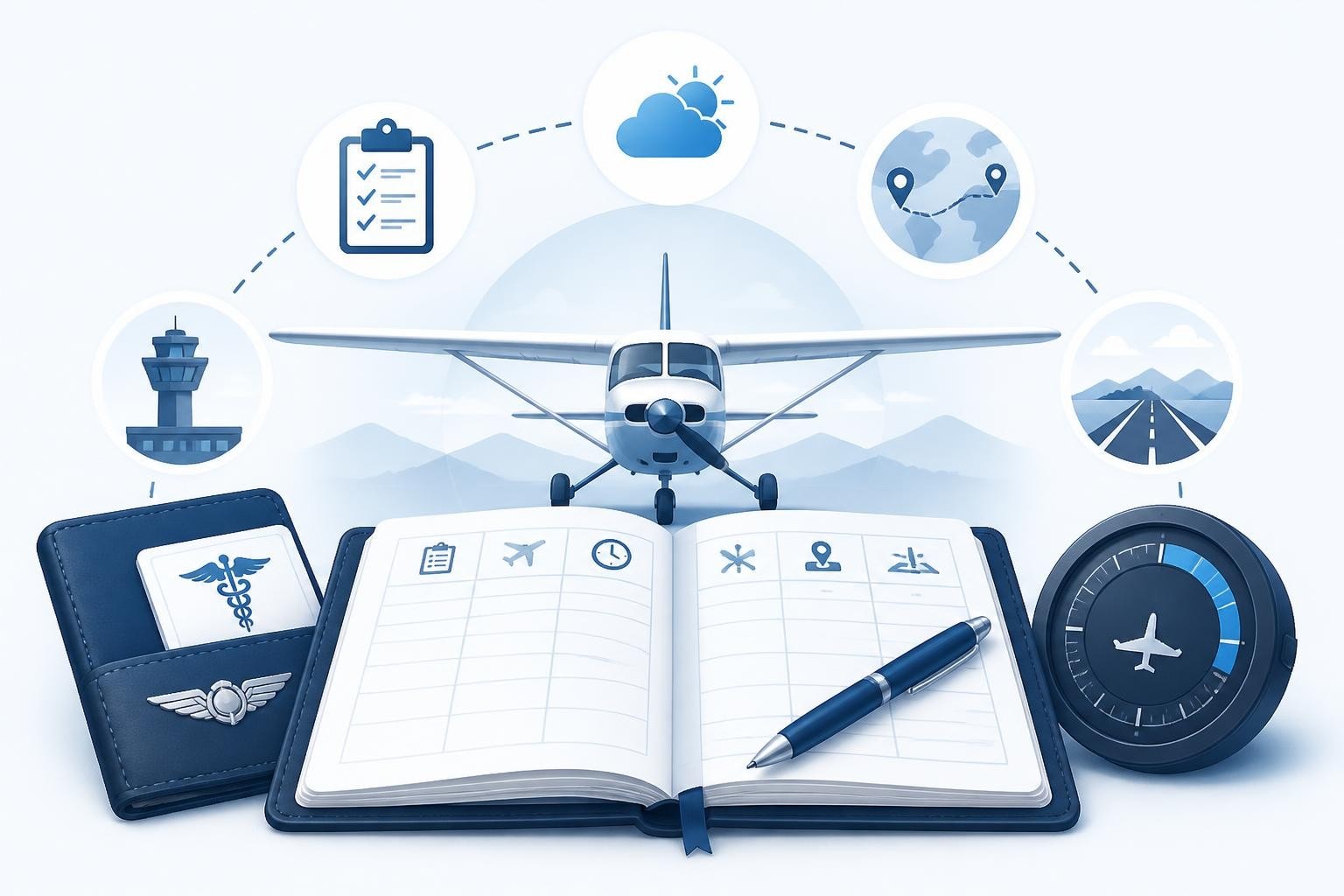
Trip logs are detailed records of individual flights that document your journey from departure to arrival. Every pilot maintains trip logs, whether on paper or digitally, to track flight time, prove currency, satisfy regulatory requirements, and build a verifiable career record. Each entry captures essential data such as aircraft registration, departure and arrival points, flight time, conditions, and pilot role.
You complete a trip log entry after every flight. The level of detail varies by operation and regulation, but the core purpose remains constant: accurate, verifiable documentation of your flying activity.
What Trip Logs Must Contain
Regulatory authorities define minimum requirements for trip logs. The FAA requires specific elements in pilot logbooks, while EASA accepts electronic records provided they meet defined standards under Regulation (EU) No 1178/2011.
Mandatory Elements
Your trip logs must include:
- Date of flight – day, month, year
- Aircraft identification – registration or tail number
- Aircraft type and variant – exact model (e.g., C172S, A320-214)
- Departure and arrival aerodromes – full ICAO codes preferred
- Departure and arrival times – block times or chock-to-chock
- Total flight time – from engine start to shutdown or wheels-off to wheels-on
- Pilot function – PIC, co-pilot, dual, instructor, examiner
- Conditions – day/night, VFR/IFR, actual/simulated instrument
Many pilots add columns for landings (day, night, full-stop), instrument approaches, cross-country time, and remarks. These extras help track currency and provide context years later when reconstructing your experience for job applications or rating renewals.
Why Trip Logs Matter for Currency and Compliance
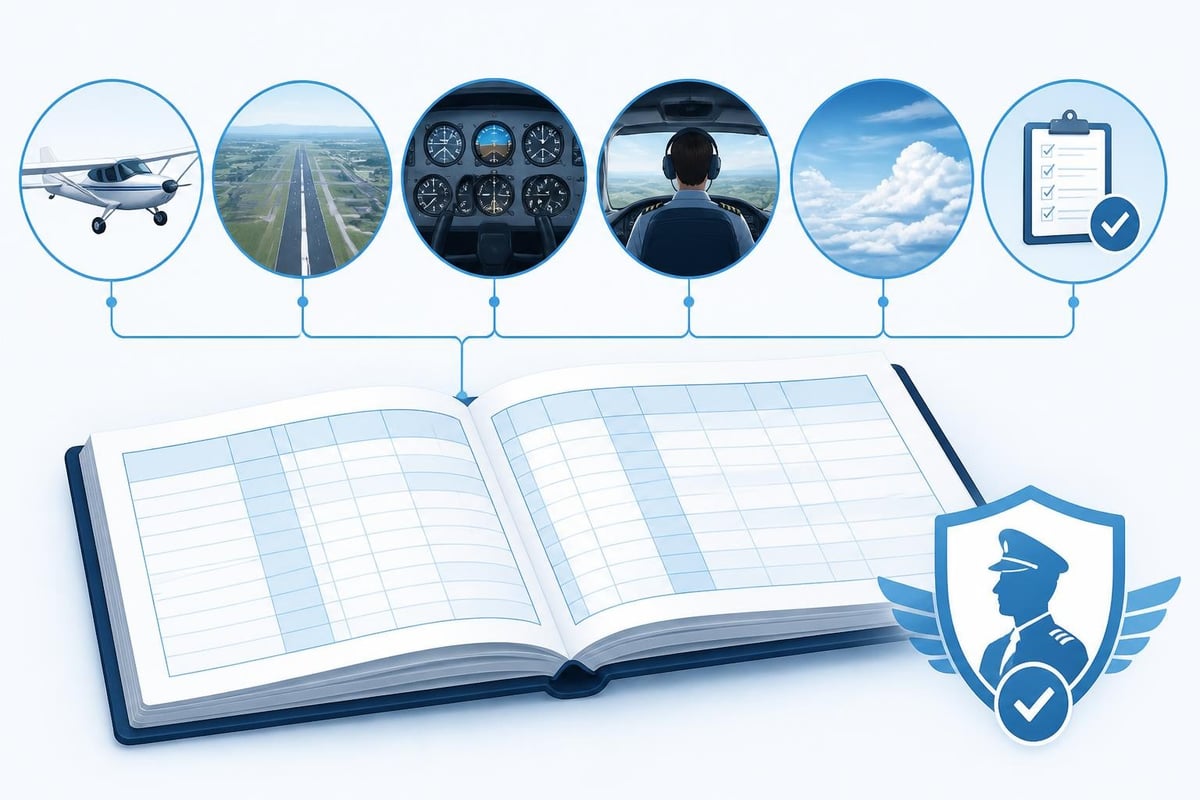
Trip logs form the legal proof of your recent experience. Without accurate records, you cannot demonstrate compliance with recency requirements.
Currency Tracking
EASA Part-FCL FCL.060 requires three takeoffs and landings in the preceding 90 days to carry passengers. For night passenger privileges, you need three night circuits (including takeoffs and landings) in the same period. Your trip logs provide the raw data to calculate these rolling windows.
IFR currency demands vary by jurisdiction, but most require a defined number of approaches, holds, and tracking procedures within six or twelve months. Each trip log entry that includes instrument time contributes to this tally.
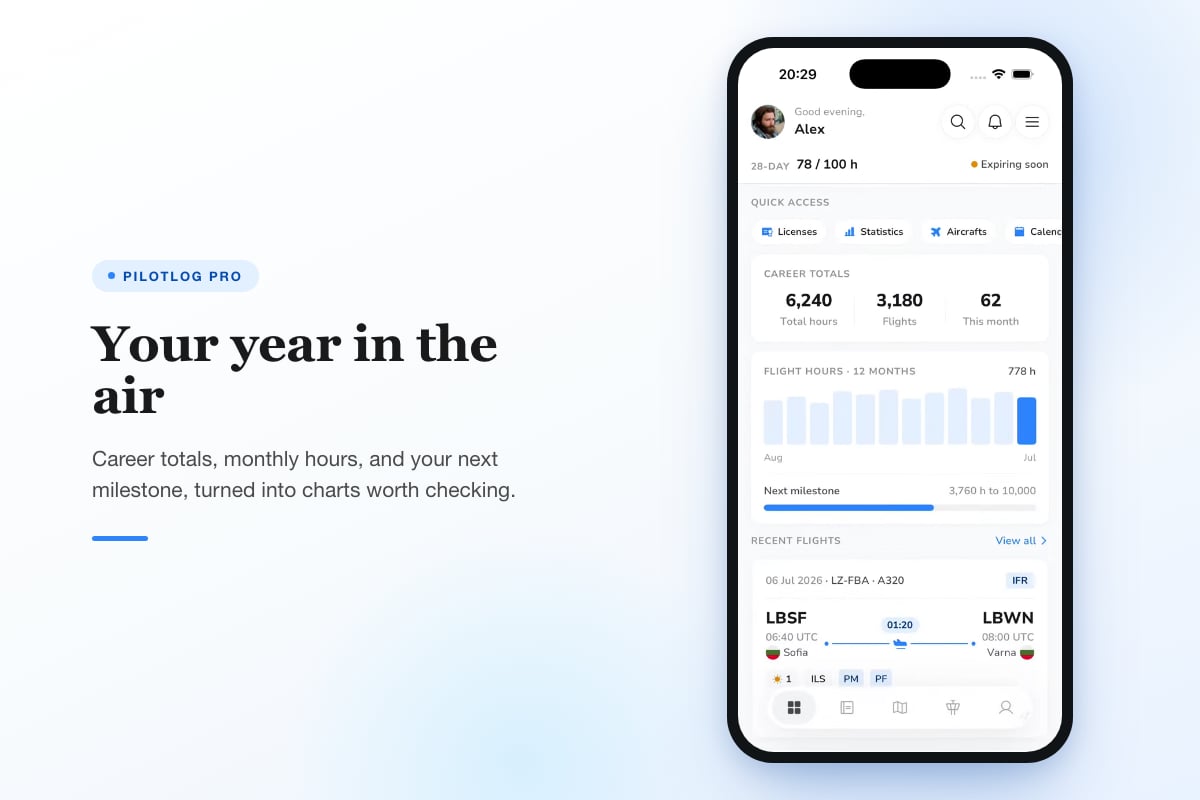
Flight time limits matter for commercial operations. A pilot on a 28-day rolling duty roster must prove total hours flown. Trip logs supply the daily inputs for this calculation. Pilotlog Pro automates rolling 28-day and 365-day flight-time and duty limits, flagging when you approach regulatory maximums.
Regulatory Audits and Ramp Checks
Inspectors may request your logbook during a ramp check or scheduled audit. Trip logs demonstrate that you meet minimum experience for the licence or rating you hold, that your recent flight activity satisfies currency rules, and that you correctly logged PIC time for insurance or operator requirements.
Incomplete or inaccurate trip logs raise questions. Gaps in dates, missing aircraft types, or vague entries ("local flight") weaken your case during scrutiny.
Digital vs Paper Trip Logs
For decades, pilots relied on bound paper logbooks with pre-printed columns. Today, digital logbooks dominate, offering search, backup, and automatic calculation.
| Feature | Paper Logbook | Digital Logbook |
|---|---|---|
| Totals calculation | Manual addition, error-prone | Automatic, instant |
| Currency tracking | Manual counting back 90 days | Automated alerts before expiry |
| Backup | Photocopy or scan required | Cloud sync, instant backup |
| Search | Page-by-page scan | Filter by aircraft, airport, date |
| Audit trail | Ink corrections visible | Version history, tamper-evident |
| Portability | One physical book | Access on phone, tablet, computer |
Digital trip logs must meet the same regulatory standards as paper. Regulators accept electronic records if the system ensures data integrity, prevents unauthorized changes, and allows export to readable formats.
How to Maintain Accurate Trip Logs
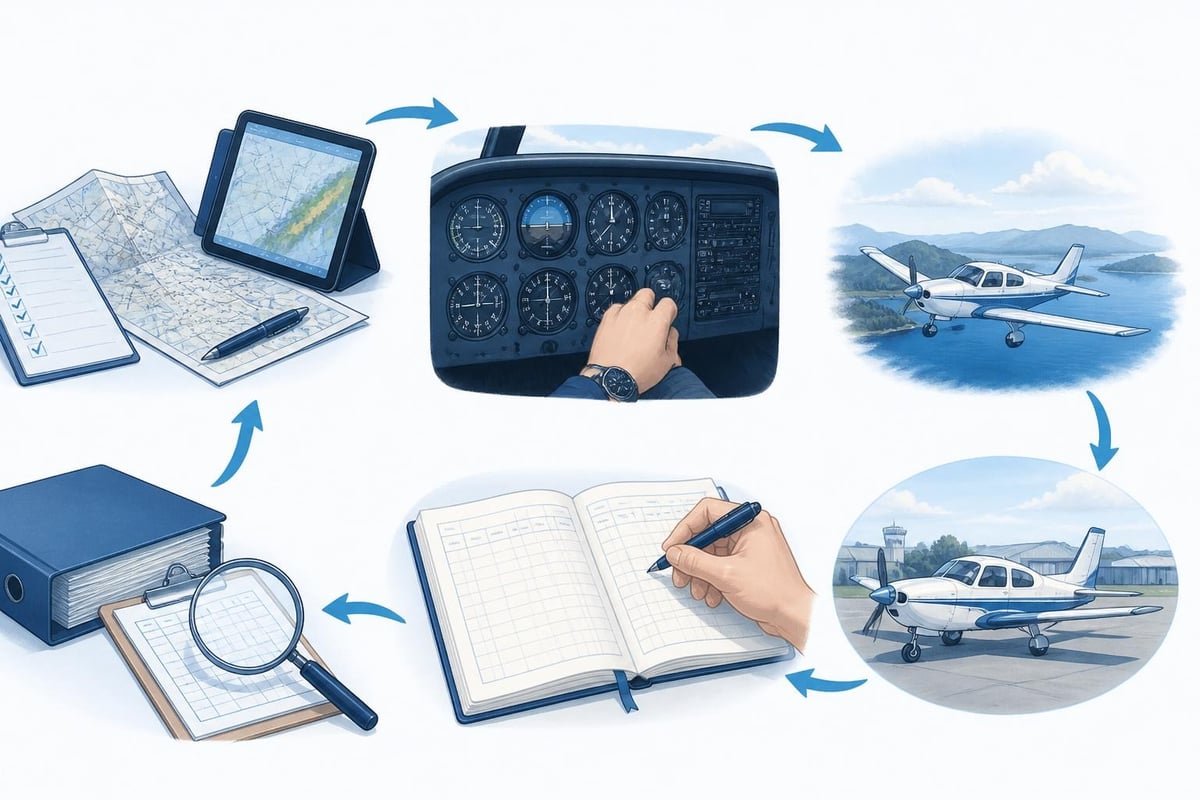
Accuracy starts with timely entry. Log each flight as soon as practical after shutdown, while details remain fresh.
Step-by-Step Logging
- Record the date – use ISO format (2026-10-25) to avoid confusion.
- Enter aircraft details – registration, type, variant.
- Log departure and arrival – ICAO codes and times (UTC or local with timezone noted).
- Calculate block or flight time – be consistent across all entries.
- Mark your role – PIC, SIC, dual received, instructor.
- Note conditions – day/night split, VFR/IFR, approaches flown.
- Count landings – full-stop day, full-stop night, touch-and-go if relevant.
- Add remarks – route details, unusual events, rating or currency milestones.
Cross-check your entry against the aircraft's journey log or tech log. Discrepancies between pilot and aircraft records create problems during audits.
Consistency and Standards
Use the same time reference throughout your logbook. Mixing UTC and local time leads to calculation errors and confusion when reconstructing a day with multiple flights across time zones.
Adopt standard abbreviations. "XC" for cross-country, "IFR" for instrument flight rules, "NVG" for night-vision goggles. Consistency makes your trip logs readable to examiners, employers, and future you.
For pilots moving between jurisdictions, note that definitions vary. The FAA defines cross-country differently from EASA for PPL and CPL purposes. Your trip logs should include enough detail to satisfy multiple regulatory frameworks if your career spans borders.
Common Trip Log Errors and How to Avoid Them
Even experienced pilots make logging mistakes. Most are avoidable with attention to process.
Retroactive Logging
Logging flights days or weeks after they occurred from memory invites errors. Departure times, approach types, and even aircraft registration blur. If you must reconstruct trip logs, use supporting documents: booking sheets, fuel receipts, ATC recordings, or the aircraft's journey log.
Rounding and Estimation
Some pilots round flight times to the nearest tenth or quarter hour. Small errors compound over hundreds of flights, creating significant discrepancies between your totals and the aircraft's recorded hours. Log exact times.
Missing Dual or Instructor Time
Student and instructor pilots sometimes forget to log dual received or dual given. These columns matter for meeting experience requirements and proving instructional experience for CFI renewals or job applications. A certified flight instructor builds a career on accurate dual-given records.
Inconsistent PIC Logging
PIC time is tightly defined by regulation. Logging PIC when acting as a rated safety pilot under the hood requires the safety pilot to be the sole manipulator or acting PIC under an agreed arrangement. Logging PIC as a type-rated FO in a multi-crew aircraft is prohibited in some jurisdictions. Know the rules and apply them consistently.
Trip Logs and Career Progression
Your trip logs tell your professional story. An airline hiring manager reviews them to verify total time, multi-engine time, turbine time, and PIC hours. Inconsistent or incomplete records raise red flags.
Building Credible Experience
Early-career pilots often fly a mix of instruction, charter, survey, and personal flights. Trip logs must clearly distinguish between commercial and private operations, PIC and SIC time, and single- vs multi-crew environments.
For pilots transitioning to airlines, trip logs demonstrate that you meet the legal minimums: typically 1,500 hours total time for an ATPL under FAA rules, or defined hours of multi-engine and instrument time under EASA Part-FCL. These figures must be verifiable from your trip logs.
Airlines also assess quality of experience. A pilot with 200 hours of actual instrument time logged across varied weather and airspace stands out from one with 200 hours of simulated instrument time. Your trip logs provide the evidence.
Data Portability and Formats
You may need to transfer trip logs between systems during your career. The GPX format allows exchange of GPS tracks and waypoints, though it is not designed for complete flight data. Most digital logbooks export to CSV or proprietary formats that include all required fields.
Before choosing a digital logbook, confirm it supports export to standard formats. Vendor lock-in limits your flexibility if you later need to move data to another platform or present it to a regulator who requires a specific file type.
Security and Integrity of Digital Trip Logs
Electronic trip logs must protect against tampering and data loss. Cybersecurity guidance from NIST outlines best practices for log management: secure transmission, encrypted storage, access controls, and retention policies.
A robust digital logbook system ensures that once an entry is saved, it cannot be silently altered. Audit trails record who changed what and when. This tamper-evidence is critical during regulatory reviews or legal disputes over pilot experience.
Backup is non-negotiable. Cloud sync protects against device loss, but also maintain periodic offline exports. A complete backup stored separately from your primary system guards against service outages, account issues, or platform discontinuation.
Trip Logs in Research and Operational Analysis
Beyond individual pilot records, aggregated trip logs support safety research and operational efficiency. Researchers link GPS mobility data to health and behaviour patterns, demonstrating how structured trip logs enable analysis of movement, exposure, and outcomes.
Airlines analyze trip logs fleet-wide to identify training needs, optimize routes, and assess pilot utilization. Patterns in instrument approaches, go-arounds, and diversions inform simulator scenarios and recurrent training focus areas.
Flight schools use student trip logs to track progress toward solo, cross-country, and checkride readiness. A glance at logged dual instruction time, solo hours, and landings reveals whether a student meets the prerequisites for the next training milestone. For more on training progression, see learning to fly a plane.
Comparing Trip Log Platforms
Pilots choose digital logbooks based on features, platform support, and cost. Each system has strengths.
ForeFlight integrates trip logging with flight planning and charts. After a flight, you can log directly from your planned route. Read more about ForeFlight's logbook features.
LogTen Pro offers deep customization and is popular among corporate and airline pilots for its advanced filtering and reporting. See the LogTen Pro comparison for details.
Pilotlog focuses on currency and expiry tracking, alerting you well before licence or medical deadlines. Its rolling time-limit tracking suits commercial pilots managing complex duty rules.
For maintenance professionals, see AMT logbook options which serve a different recordkeeping need.
Transitioning from Paper to Digital Trip Logs
If you have years of paper logbooks, transferring to digital feels daunting. Approach it systematically.
Manual Entry
The most accurate method is manual re-entry of every flight. Time-consuming, but you verify each detail and catch past errors. Many pilots enter only the last two years manually, then scan or photograph older pages for archival reference.
Bulk Import
Some digital logbooks accept CSV imports. Export data from your current system (if digital) or use a spreadsheet to structure paper entries, then import in one operation. Validate totals carefully after import to catch formatting or mapping errors.
Hybrid Approach
Maintain paper logbooks for historical record and start digital logging going forward. After a transition period, backfill older data as time permits. This minimizes disruption while you learn the new system.
Legal and Regulatory Considerations by Region
Trip log requirements differ globally. Pilots operating internationally must understand multiple frameworks.
United States (FAA): 14 CFR Part 61 requires logbook entries for training, solo, PIC, and certain endorsements. No official logbook format is mandated, but specific data elements are.
Europe (EASA): Regulation (EU) No 1178/2011 defines logbook content for licence holders. Electronic logbooks are accepted if they meet data integrity standards. Member states may impose additional requirements.
United Kingdom (CAA): Post-Brexit, the UK adopted a version of EASA Part-FCL. Electronic logbooks remain acceptable under the same integrity criteria.
Australia (CASA): CASR Part 61 specifies logbook requirements, and CASA has published guidance on electronic logbooks, emphasizing accuracy and accessibility for audit.
Canada (Transport Canada): CARs 401.01 to 401.05 outline logbook obligations, including the acceptance of electronic systems that meet prescribed standards.
Always confirm current rules with the relevant authority. Regulations change, and interpretations evolve. This article reflects understanding as of October 2026; verify against official sources before relying on any stated requirement.
How Employers and Insurers Use Trip Logs
Airlines, charter operators, and insurers scrutinize trip logs during hiring and underwriting.
Hiring managers look for:
- Total time and time in type
- Recent experience (last 90 days, last 12 months)
- PIC vs SIC split
- Actual vs simulated instrument time
- Consistency with stated experience on application
Insurance underwriters assess:
- Recency in the insured aircraft type
- Total tailwheel, turbine, or high-performance time
- Accident or incident remarks in the logbook
- Evidence of regular proficiency flying
Discrepancies or unexplained gaps trigger questions. A pilot with 5,000 hours total but only 20 hours in the past year raises concern about currency and proficiency.
Case example: A CFI applicant claimed 800 hours of dual given. Trip logs showed only 600 hours explicitly marked as instructor time, with the remainder listed as PIC in a training aircraft. The examiner required detailed reconstruction of each flight to verify the claim. Accurate, unambiguous trip logs would have avoided the delay.
Advanced Trip Log Practices
Experienced pilots develop habits that go beyond minimum compliance.
Cross-referencing: Link each trip log entry to the aircraft's journey log or tech log. Note the journey log page number or the aircraft's total time at start of flight. This cross-reference proves your entry is contemporaneous and accurate.
Route details: Record your actual route, not just departure and arrival. "KSEA–KBFI direct" is less useful years later than "KSEA HISKU V287 KBFI." Detailed routes help reconstruct flights for job applications or accident investigation.
Remarks that matter: Note rating or currency milestones. "3rd night landing for pax currency" or "IPC completed" provides context. If you performed an interesting operation (mountain checkout, seaplane rating, first solo in type), document it. These details enrich your professional narrative.
Photos and attachments: Digital logbooks often allow attachments. Link a photo of your first solo, a PDF of your checkride notice, or a scan of your instructor endorsement. These add depth and serve as memory aids.
Trip Logs for Specialized Operations
Some flying demands enhanced trip log detail.
Aerial work (survey, patrol, ag): Log area covered, product applied, or survey lines flown. This data supports billing and proves compliance with operational approvals.
Flight instruction: Record student name, lesson topic, maneuvers performed, and solo endorsements. Your trip logs double as a teaching record.
Test flying: Note test points completed, speeds and configurations tested, and anomalies encountered. This level of detail is essential for experimental or post-maintenance test flights.
Ferry and delivery: Document empty legs, fuel stops, and special permits. International ferries require proof of each leg for customs and immigration.
Balancing Detail with Practicality
Over-logging wastes time and clutters your records. Under-logging risks non-compliance. Find the balance.
Capture everything required by regulation and everything you may need to prove later: currency, experience thresholds, commercial vs private operations. Skip minutiae that add no value. You do not need to log every circuit individually if you flew 20 in one session; summarize the session and note total landings.
Some pilots keep a detailed narrative diary separate from their official trip logs. The diary holds personal reflections, lessons learned, and memorable moments. The trip log remains a crisp, factual record.
Future-Proofing Your Trip Logs
Technology evolves, platforms change, and regulations shift. Build trip logs that endure.
Use open standards where possible. Export data regularly to CSV or GPX. These formats outlast proprietary systems.
Version control: If your digital logbook supports versioning, enable it. Historical snapshots protect against accidental deletion or corruption.
Metadata: Include GPS coordinates for departure and arrival if available. Geotagged trip logs enable advanced analysis and provide incontrovertible proof of where you flew.
Regular audits: Review your trip logs quarterly. Check for missing entries, calculation errors, or inconsistencies. A small error corrected early avoids a major problem at checkride or interview.
Trip Logs and Professional Reputation
Your trip logs reflect your professionalism. Neat, accurate, complete logs signal discipline and attention to detail. Sloppy logs suggest carelessness.
Employers, examiners, and insurers form judgments based on your records. A logbook with crossed-out entries, missing data, or obvious errors undermines your credibility. Take pride in maintaining a logbook that would stand up to the toughest scrutiny.
For pilots entering the profession, consider reviewing articles on the cost to become a pilot and Delta Flight Academy to understand the investment and pathways ahead. Your trip logs document every step of that journey.
Trip logs are the foundation of your flying career, proving currency, satisfying regulators, and building your professional record. Whether you log on paper or digitally, accuracy and completeness are non-negotiable. Pilotlog automates the repetitive work of tracking currency, rolling time limits, and expiry alerts, so you can focus on flying. Log a flight in seconds and let the app handle the rest, keeping you current, legal, and ready.
- trip logs
- pilot logbook
- flight records
- currency tracking
- digital logbook
A logbook that keeps itself.
Join the waitlist and be first in line when Pilotlog launches.
Free to join, no spam. Unsubscribe any time.