certified flight instructor
Certified Flight Instructor: Role, Requirements & Career
7 Oct 2026 · 13 min read

A certified flight instructor holds an FAA licence that authorises teaching student pilots and certificated pilots for initial certificates, ratings, and proficiency checks. The CFI certificate requires passing a rigorous practical test covering aeronautical knowledge, instructional techniques, and the ability to teach manoeuvres to Airman Certification Standards. The role demands not just piloting skill but the capacity to analyse, correct, and explain flight performance in real time.
CFI certificates carry specific recency and renewal requirements. Every certified flight instructor must track endorsements given, flight reviews conducted, and continuing education credits to maintain currency and legal status.
What a certified flight instructor does
Flight instruction spans private pilot training, instrument ratings, commercial certificates, multi-engine endorsements, and tailwheel transitions. A certified flight instructor plans each lesson, delivers ground instruction, demonstrates manoeuvres, evaluates student performance, and endorses students for solo flights and practical tests.
Ground and flight instruction responsibilities
Teaching begins on the ground. Before any flight, a CFI delivers pre-flight briefings covering aerodynamics, airspace, weather interpretation, and regulatory knowledge. Ground instruction sessions often run one to two hours and cover subjects tested on FAA knowledge exams.
Airborne, the instructor demonstrates each manoeuvre, talks the student through the first attempts, then observes and corrects as the student practises. Common sequences include:
- Pattern work and landings (touch-and-go, full-stop, crosswind)
- Slow flight and stall recognition
- Emergency procedures (engine failure, systems malfunctions)
- Instrument scan and approaches for instrument students
- Cross-country navigation and diversion planning
Each flight ends with a debrief. The certified flight instructor records lesson outcomes, identifies areas for improvement, and signs the student's logbook. Accurate record-keeping protects both instructor and student and forms the audit trail for practical test eligibility.

Endorsements and regulatory compliance
CFIs issue endorsements for solo flights, solo cross-countries, practical tests, flight reviews, and instrument proficiency checks. Each endorsement cites the relevant regulation (typically 14 CFR Part 61) and confirms the pilot meets specific prerequisites. A student cannot solo without a CFI endorsement verifying pre-solo aeronautical knowledge and pre-solo flight training per FAA regulations.
Endorsement errors carry consequences. If a certified flight instructor endorses a student who lacks required training or experience, both the instructor and student face potential enforcement action. The CFI must verify logbook totals, confirm recency, and ensure medical certificate validity before signing.
How to become a certified flight instructor
The path to CFI starts with holding a commercial pilot certificate, an instrument rating (for CFI-IA), and passing the FAA Fundamentals of Instructing (FOI) knowledge test. Most candidates complete a formal CFI ground school covering teaching methods, learning theory, and lesson planning before beginning flight training.
Training syllabus and practical test preparation
CFI training typically requires 15 to 25 hours of dual instruction. The candidate learns to demonstrate manoeuvres from the right seat, verbalise techniques, and identify common student errors. Right-seat landings, power-off stalls from the instructor's seat, and steep turns while narrating each control input all demand new muscle memory.
The Airman Certification Standards define the knowledge, risk management, and skill standards for the CFI practical test. The examiner evaluates:
- Technical Subject Areas (aerodynamics, systems, regulations)
- Preflight Preparation and Lesson Planning
- Preflight Procedures (pre-flight inspection teaching)
- Airport and Seaplane Base Operations instruction
- Takeoffs, Landings, and Go-Arounds from both seats
- Fundamentals of Flight (slow flight, stalls, spin awareness)
- Performance Manoeuvres (steep turns, chandelles, lazy eights for commercial)
- Emergency Operations (engine failures, systems malfunctions)
- Postflight Procedures (debrief and critique techniques)
Candidates must teach each task, not simply perform it. The examiner plays the role of a student and may introduce intentional errors to test the applicant's ability to recognise and correct mistakes.
CFI currency and renewal requirements
A certified flight instructor certificate expires 24 calendar months from the month of issuance or most recent renewal. Renewal requires one of three paths: passing a practical test for an additional CFI rating, completing a Flight Instructor Refresher Course (FIRC), or meeting activity-based requirements.
Activity-based renewal
To renew by activity, the CFI must have:
- Trained and recommended at least five students for practical tests within the preceding 24 months, with at least 80 per cent passing on the first attempt, or
- Served as a company check pilot, chief flight instructor, or FAA-designated examiner within the preceding 24 months, or
- Graduated at least 10 students from an approved pilot school course
This path suits full-time instructors with consistent student flow. Part-time CFIs often find FIRC renewal simpler and more predictable. Details on renewal options and timelines are available through AOPA's CFI resources.
Flight Instructor Refresher Course
FIRC programs run 16 hours (online or in-person) and cover recent regulatory changes, teaching techniques, and safety topics. Courses update instructors on new Airman Certification Standards, human factors research, and accident case studies. Upon completion, the provider issues an endorsement the CFI submits to the FAA for certificate renewal.
FIRC deadlines matter. If your CFI certificate expires, you cannot provide instruction until you complete a practical test with an examiner. Tracking expiry dates and scheduling FIRC early prevents lapses. Digital logbook tools can flag upcoming renewals well before the deadline.
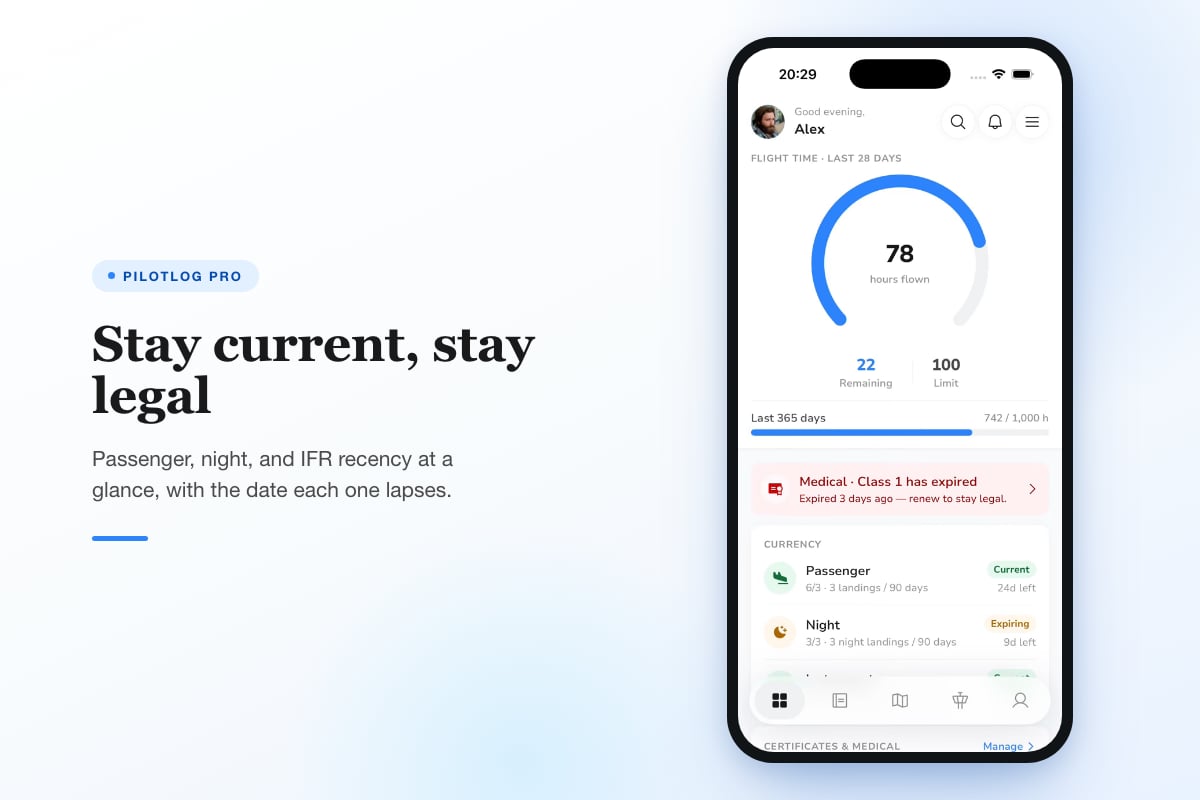
Pilotlog Pro tracks CFI expiry dates alongside medical certificates, instrument currency, and flight review due dates, sending alerts 60 and 30 days before each deadline so nothing catches you by surprise.

Building hours and career progression
Most newly minted CFIs begin with 250 to 300 total hours. Teaching builds time towards airline or corporate minimums while sharpening aeronautical knowledge and decision-making. A full-time certified flight instructor typically logs 50 to 80 hours per month, reaching ATP minimums (1,500 hours) within 18 to 24 months.
Flight school and independent instruction
Flight schools offer structure, insurance coverage, and a steady stream of students. Independent instructors set their own rates and schedules but handle marketing, insurance, and administrative tasks. Both paths work; choice depends on personality, location, and career goals.
| Model | Pros | Cons |
|---|---|---|
| Flight school | Insurance, scheduling support, aircraft access | Lower hourly rate, less flexibility |
| Independent (freelance) | Higher rates, flexible schedule | Marketing effort, insurance costs |
| University program | Benefits, steady salary, structured environment | Lower flight hours, academic duties |
Many instructors combine models: teach primary students at a flight school and offer instrument or commercial training independently. This diversifies income and builds a broader skill base.
Specialisation and advanced ratings
Adding CFI-I (instrument) and MEI (multi-engine) ratings expands the student base and increases hourly rates. A CFI-I can conduct instrument training and instrument proficiency checks; an MEI teaches multi-engine operations and prepares commercial multi candidates for practical tests.
Other specialisations include tailwheel endorsements, aerobatic instruction, seaplane ratings, and upset recovery training. Each niche attracts pilots seeking specific skills and often commands premium rates. A certified flight instructor with diverse ratings stays busy year-round and builds a reputation as a go-to resource.
Tracking instruction hours and endorsements
Accurate records protect your certificate and demonstrate professionalism. The CFI logbook must include:
- Date, aircraft type, and registration
- Dual instruction given (split by category: primary, instrument, commercial)
- Ground instruction time
- Endorsements issued (solo, cross-country, practical test)
- Student names and certificate sought
Many CFIs maintain a separate endorsement log tracking each student's progression, solo dates, and test results. This record simplifies FIRC renewal applications and provides evidence during any FAA audit. Logging instruction time correctly matters for career milestones, too. Airlines and corporate operators review CFI hours when evaluating experience and teaching ability.
For pilots managing hundreds of students across private, instrument, and commercial courses, a digital logbook for aviation simplifies tracking and ensures all dual given, ground instruction, and endorsements appear in exportable, audit-ready formats.
Common challenges and best practices
Every certified flight instructor faces plateaus, cancellations, and difficult students. Weather scrubs 20 to 40 per cent of scheduled flights in many regions; building a sustainable income requires adapting to these realities.
Managing student progress and expectations
Students progress at different rates. One pilot solos in 12 hours; another needs 25. A CFI who sets realistic expectations, communicates clearly, and adjusts lesson plans to individual learning styles keeps students motivated and reduces frustration.
When a student struggles, break the task into smaller steps. If landings prove difficult, isolate the flare, practice power-off approaches at altitude, and revisit pattern procedures before returning to the runway. Patience and incremental progress build confidence and competence.
Safety and decision-making under pressure
Flight instruction involves risk. The certified flight instructor must recognise when a student's control inputs exceed safe limits and take over smoothly. Briefing "positive exchange of controls" before every flight prevents confusion and ensures clear authority during emergencies.
Weather decisions matter. Scrubbing a lesson for marginal VFR demonstrates sound judgment and teaches students the importance of personal minimums. Industry research from the Flight Safety Foundation highlights instructor standardisation and decision-making as critical factors in training safety.
<image_prompt alt="CFI safety decision framework">Certified flight instructor go/no-go decision process weighing student proficiency level, weather minimums, aircraft serviceability, and personal currency to determine lesson suitability and risk mitigation steps</image_impact>
Comparing international instructor standards
Instructor requirements vary globally. EASA Part-FCL mandates a Flight Instructor Certificate (FI) issued after completing an FI course, passing theoretical exams, and demonstrating instructional competence on a practical test. The EASA Easy Access Rules detail these requirements, including revalidation based on activity and proficiency checks.
In Canada, the Flight Instructor Rating requires 200 hours total time, a CPL, and completion of an approved flight instructor course. Transport Canada oversees instructor standards and provides guidance on renewal and recurrent training.
Understanding international frameworks helps CFIs who train foreign students, pursue overseas opportunities, or validate FAA certificates abroad. The ICAO Training Instructors Guide offers global best practices and competency frameworks useful for standardising instruction quality.
| Region | Certificate name | Min. total time | Renewal period | Key requirement |
|---|---|---|---|---|
| FAA (USA) | Certified Flight Instructor | ~250 hr | 24 months | FOI + ACS practical test |
| EASA (Europe) | Flight Instructor (FI) | ~200 hr | 36 months | FI course + revalidation flight |
| Transport Canada | Flight Instructor Rating | 200 hr | 24 months | CPL + approved FI course |
Continuing education and professional development
The best CFIs never stop learning. Attending safety seminars, reading accident reports, and participating in Flight Safety Foundation forums sharpens knowledge and keeps teaching methods current. The FAA Aviation Instructor's Handbook updates periodically; reviewing new editions ensures alignment with modern instructional theory.
Joining instructor groups (NAFI, SAFE, local CFI clubs) provides mentorship, shares lesson plans, and fosters discussion on challenging scenarios. Experienced instructors offer insights on managing difficult students, structuring commercial training, and balancing full-time instruction with family life.
Mentorship works both ways. Seasoned CFIs benefit from observing how newer instructors use technology, engage younger students, and apply fresh teaching techniques. Continuous improvement keeps instruction effective and careers fulfilling.
Transitioning from CFI to airline or corporate roles
Airlines value CFI experience. Teaching builds communication skills, systems knowledge, and the ability to mentor junior pilots. Regional carriers often hire low-time CFIs who meet ATP minimums (1,500 hours total time, including specific PIC and cross-country requirements). Corporate operators seek instructors with turbine time, international experience, or type ratings in specific aircraft.
When transitioning, update your logbook to highlight:
- Total dual given (often 800 to 1,200 hours for full-time CFIs)
- Multi-engine instruction time
- Instrument instruction and IPC sign-offs
- Complex and high-performance endorsements
These metrics demonstrate teaching breadth and readiness for structured airline training. Maintaining detailed records throughout your CFI tenure streamlines job applications and interview preparation. Resources like how to fill out a pilot logbook ensure your entries meet employer and regulatory standards from day one.
Practical example: Tracking CFI activity over 24 months
Consider a certified flight instructor who earns their CFI on 15 January 2025. They must renew by 31 January 2027. Over the first 18 months, they train 22 students: 14 private, 6 instrument, and 2 commercial. Of those, 18 take practical tests and 15 pass on the first attempt (83 per cent pass rate).
By June 2026, the CFI has logged:
- 912 hours dual given
- 187 hours ground instruction
- 42 solo endorsements
- 18 practical test endorsements
In December 2026, they complete an online FIRC (16 hours over two weekends). The provider issues an endorsement on 20 December. The CFI submits the endorsement to the FAA and receives a renewed certificate valid through 31 December 2028.
This example shows how consistent activity supports both renewal pathways. The pass rate qualifies for activity-based renewal, but completing FIRC early avoids last-minute stress and ensures no lapse in teaching authority.
Managing multiple CFI ratings and endorsements
Instructors holding CFI, CFI-I, and MEI track separate expiry dates only if they were issued at different times. When all ratings appear on one certificate (issued or renewed together), the single expiry date applies to all. This simplifies tracking but requires understanding the renewal scope.
Adding a new rating (e.g., earning MEI after holding CFI for 18 months) resets the expiry clock for all ratings on that certificate. The new certificate shows the issuance date of the added rating and expires 24 months later.
Clear record-keeping prevents confusion:
- Note the current expiry date in your logbook and digital calendar
- Set reminders 90, 60, and 30 days before expiry
- Track students recommended for tests and their outcomes
- Maintain copies of all FIRC completion endorsements
For instructors teaching across multiple aircraft types and certificate levels, these details matter. Missing a renewal deadline halts all instruction until you complete a reinstatement practical test.
Additional resources for certified flight instructors
Staying current on regulatory changes and teaching best practices requires regular engagement with authoritative sources. The FAA publishes the Aviation Instructor's Handbook, updated periodically to reflect new research on learning theory, human factors, and assessment techniques. Reviewing updates ensures your methods align with current standards.
Industry publications like AOPA's instructor guidance offer practical perspectives on student engagement, career development, and recent regulatory shifts. These articles translate dense regulations into actionable advice and real-world scenarios.
Safety organisations, including the Flight Safety Foundation, publish research on instructor standardisation, accident prevention, and training quality. Integrating these insights into lesson planning improves outcomes and contributes to the wider aviation safety culture.
Reading accident reports (NTSB, AAIB, ATSB) reveals common training gaps and decision-making errors. Discussing these cases with students during ground instruction reinforces risk management and builds critical thinking skills. A certified flight instructor who studies failures as carefully as successes delivers more resilient training.
Becoming and remaining a certified flight instructor demands rigorous initial training, ongoing currency management, and a commitment to continuous improvement. Accurate record-keeping, timely renewals, and diverse instructional experience build both career progression and professional credibility. Pilotlog helps CFIs track dual given, endorsements, and expiry dates in one digital platform, ensuring you stay current, legal, and ready to teach. Log your flights, monitor your currency, and let automated alerts handle the details so you can focus on shaping the next generation of pilots.
- certified flight instructor
- cfi requirements
- cfi renewal
- flight instruction
- becoming a cfi
A logbook that keeps itself.
Join the waitlist and be first in line when Pilotlog launches.
Free to join, no spam. Unsubscribe any time.