learn to fly
Learn to Fly a Plane: Steps, Costs & What to Expect
11 Oct 2026 · 12 min read
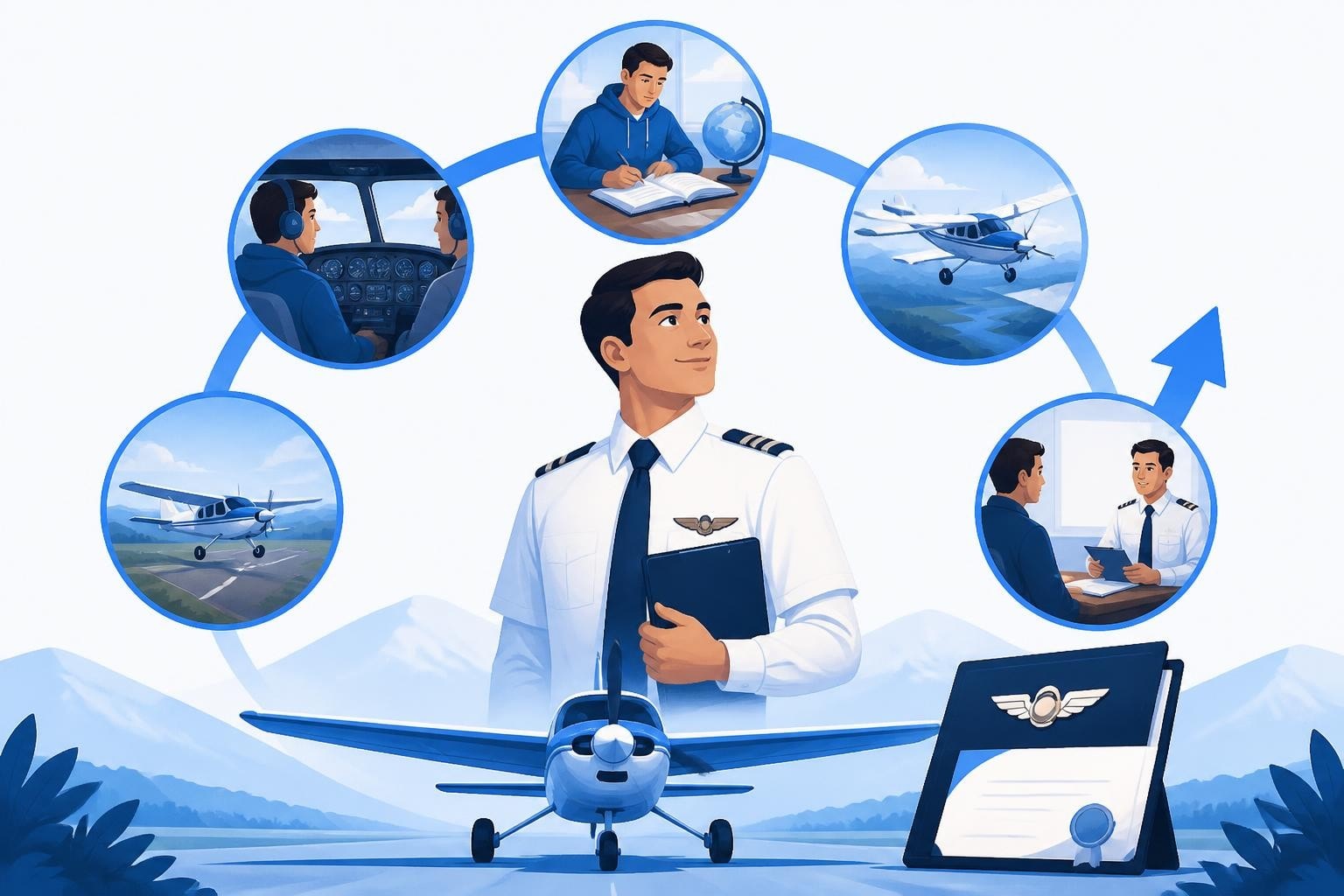
To learn to fly a plane, you complete ground school, pass a written exam, fly at least 40 hours with an instructor (US Private Pilot) or 45 hours under EASA rules, demonstrate solo proficiency, and pass a practical test with an examiner. Most students finish in six to twelve months, depending on weather, scheduling, and budget. The path is structured, regulated, and achievable for anyone who can meet medical standards and commit the time.
What It Actually Means to Learn to Fly
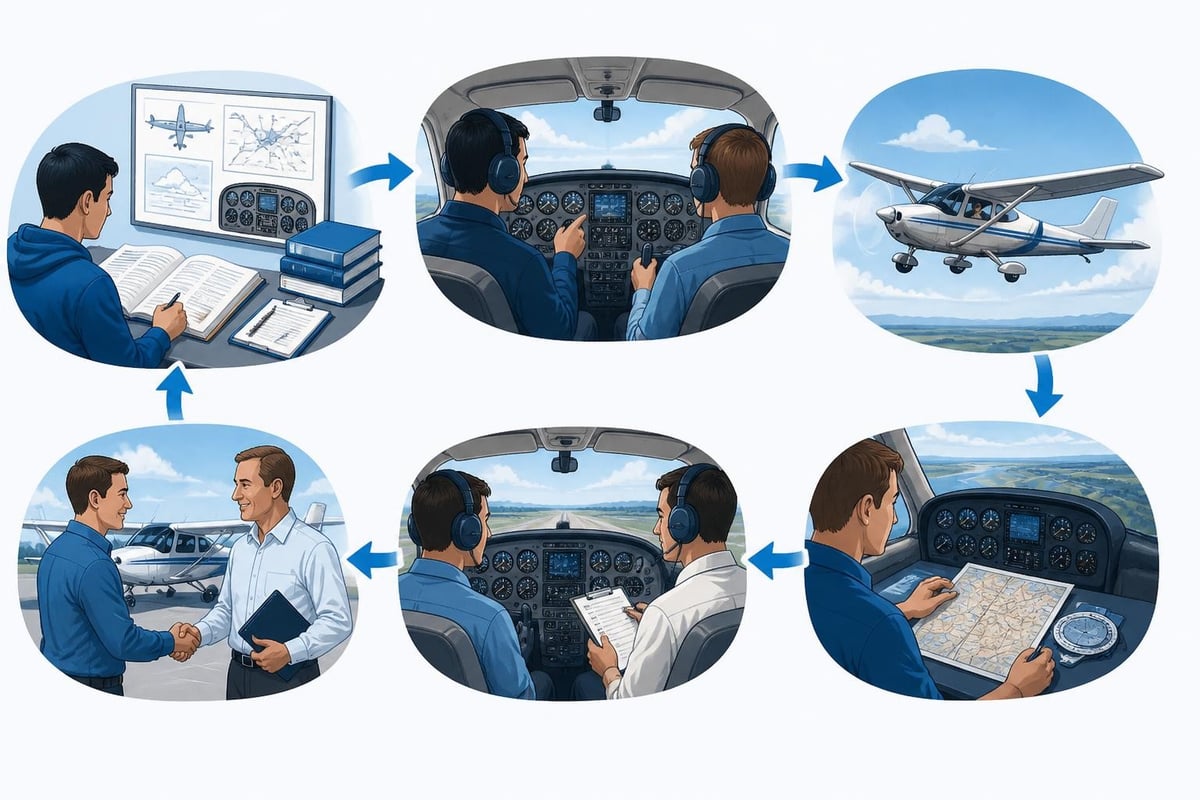
Learning to fly is not a single event. It is a staged process of ground study, flight training, and testing that builds skill and confidence over dozens of lessons.
You begin with discovery flights and introductory lessons, move through basic manoeuvres and local-area work, progress to solo flight, then add navigation, emergency procedures, and complex airspace operations. Each stage has measurable standards. The FAA Airman Certification Standards (ACS) define what you must demonstrate on your checkride, from slow flight to cross-country planning. EASA has parallel standards in Part-FCL, and the UK CAA publishes detailed guidance on how flight training organisations operate.
Medical Requirements Before You Start
Before you can solo, you need a medical certificate. In the United States, third-class medical is the minimum for private pilots; first-class is required for airline transport pilots. The examination covers vision, hearing, cardiovascular health, and general fitness. If you have a disqualifying condition, you may apply for a special issuance, but this adds time and paperwork.
BasicMed offers an alternative route. If you hold or have held a valid medical certificate after July 14, 2006, you can fly under BasicMed by completing an online course, getting a physical from any state-licensed doctor, and meeting the aircraft and operational limits. This is especially useful for older pilots or those with well-managed chronic conditions.
EASA and UK CAA require an EASA Class 1 or Class 2 medical, depending on licence type. The Class 2 is sufficient for private pilots. The examination is more detailed than a US third-class and includes ECG, audiometry, and sometimes lab work. Medical validity ranges from 12 to 60 months based on age and class.
Always confirm your medical eligibility early. A deferred or denied medical can derail training before it starts.
Ground School and Theory Study
Flight training has two halves: flying and knowing why the aeroplane behaves as it does. Ground school covers aerodynamics, weather, navigation, regulations, airspace, radio procedures, human factors, and aircraft systems.
You can attend a classroom course, study online, or work through textbooks. The FAA Pilot's Handbook of Aeronautical Knowledge is the authoritative US reference. EASA students use the JAR-FCL syllabus and national supplements.
Typical ground school topics:
- Principles of flight (lift, drag, thrust, weight)
- Meteorology and METARs
- Navigation (dead reckoning, VOR, GPS)
- Airspace classification and ATC procedures
- Federal Aviation Regulations (14 CFR) or EASA Part-FCL
- Weight and balance calculations
- Human factors and decision-making
Most students spend 30 to 50 hours on ground study before the written exam. The US FAA written test has 60 questions; you need 70 per cent to pass. EASA written exams are more detailed and subject-specific, with nine separate papers for the PPL(A).
Human factors training is critical. Research shows that cognitive engineering and pilot-automation coordination play a growing role in safe flight, even at the private pilot level. Understanding fatigue, decision-making, and task saturation prevents accidents.
Flight Training: Hours, Stages, and Checkpoints
Flight training begins with dual instruction. Your instructor demonstrates, you practise, and you repeat until the manoeuvre is safe and consistent.
Minimum Hour Requirements
| Licence | Jurisdiction | Minimum Total | Minimum Dual | Minimum Solo | Cross-Country |
|---|---|---|---|---|---|
| Private Pilot (A) | US FAA | 40 hours | 20 hours | 10 hours | 5 hours |
| PPL(A) | EASA | 45 hours | 25 hours | 10 hours | 5 hours |
| Recreational Pilot | US FAA | 30 hours | 15 hours | Not required | 3 hours |
| LAPL(A) | EASA | 30 hours | 15 hours | 6 hours | 3 hours |
These are minimums. The US national average for a Private Pilot certificate is closer to 60 to 70 hours. Weather, instructor availability, student aptitude, and scheduling all affect total time.
What Each Stage Teaches
Early lessons focus on basic aircraft control: straight and level, climbs, descents, turns. You learn the four fundamentals (pitch, bank, power, trim) and how to maintain heading and altitude.
Once you can control the aeroplane, you add:
- Slow flight and stalls: understanding low-speed handling and stall recovery
- Steep turns: 45-degree bank, constant altitude, coordination
- Ground reference manoeuvres: turns around a point, S-turns, tracking a road
- Takeoffs and landings: normal, crosswind, short field, soft field
You also practise emergency procedures: engine failure after takeoff, forced landing site selection, simulated engine-out approaches. These are not hypothetical. They appear on the checkride.
The First Solo
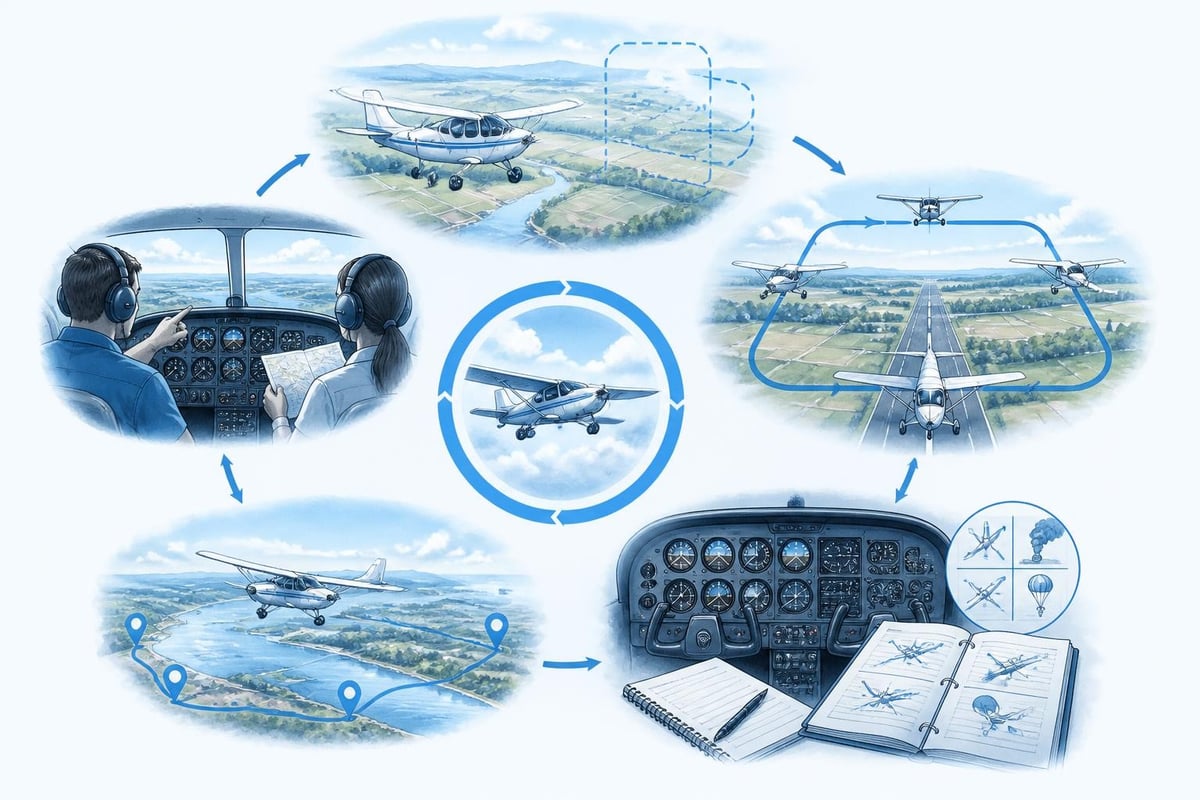
Your first solo is a regulatory and personal milestone. Before you can solo, you must demonstrate competence in all the manoeuvres above, plus emergency procedures, and pass a pre-solo written test.
Your instructor endorses your logbook under 14 CFR 61.87 (US) or the equivalent EASA provision. You fly three takeoffs and landings to a full stop, alone, in the pattern. It usually happens between 10 and 20 hours of dual instruction.
Solo flight builds confidence and decision-making. There is no instructor to catch mistakes. You plan, execute, and correct on your own.
Cross-Country and Navigation
Cross-country training teaches you to plan a route, calculate fuel and time, file a flight plan, navigate using pilotage and radio aids, and land at unfamiliar airports.
In the US, the long solo cross-country must be at least 150 nautical miles total distance with landings at three points, one of which is at least 50 nautical miles from departure. EASA requires a solo cross-country of at least 150 km (81 nautical miles) with one full-stop landing away from the departure aerodrome.
You learn to read sectional charts, interpret METARs and TAFs, and make go/no-go decisions based on weather and personal minimums. These are the skills that keep pilots alive after they earn the certificate.
Cost, Scheduling, and Realistic Timelines
Most students ask two questions: how much, and how long.
Typical US costs (2026):
- Aircraft rental (Cessna 172): £90 to £130 per hour
- Instructor: £40 to £65 per hour
- Ground school materials: £150 to £400
- Written exam: £150
- Checkride (DPE fee): £500 to £800
- Medical exam: £100 to £200
Total cost for 60 hours of flight time and 30 hours of dual instruction: £8,000 to £12,000. EASA training in Europe runs £8,000 to £15,000 depending on country and school.
For a detailed breakdown of how flight lesson pricing works, see flight lessons price.
Flying twice a week, most students finish in six to nine months. Flying once a week stretches it to twelve months or more, and you lose proficiency between lessons. Weather, instructor availability, and aircraft maintenance cause delays.
Budgeting matters. Training is expensive, and stopping halfway wastes money and momentum. Plan for the full cost before you start.
Checkride: What the Examiner Tests
The practical test has two parts: oral exam and flight test. The oral lasts two to four hours and covers all ground-school topics, aeronautical decision-making, regulations, weather interpretation, aircraft systems, and performance calculations.
The flight test lasts 90 minutes to two hours and includes:
- Preflight planning and risk assessment
- Normal and crosswind takeoffs and landings
- Slow flight and power-off stalls
- Steep turns (both directions, 45-degree bank)
- Ground reference manoeuvres
- Emergency descent and simulated engine failure
- Navigation to a checkpoint using pilotage and dead reckoning
- Diversion to an alternate airport
- Radio communication and airspace procedures
The examiner scores each task as pass or fail against the ACS standards. Altitude tolerances are typically plus or minus 100 feet, heading plus or minus 10 degrees, and airspeed plus or minus 10 knots. If you fail a task, you can retrain and retest that area.
Pass rate for first-time applicants is around 80 per cent. Most failures are due to inadequate preparation, not lack of skill.
Logging Your Training and Staying Current
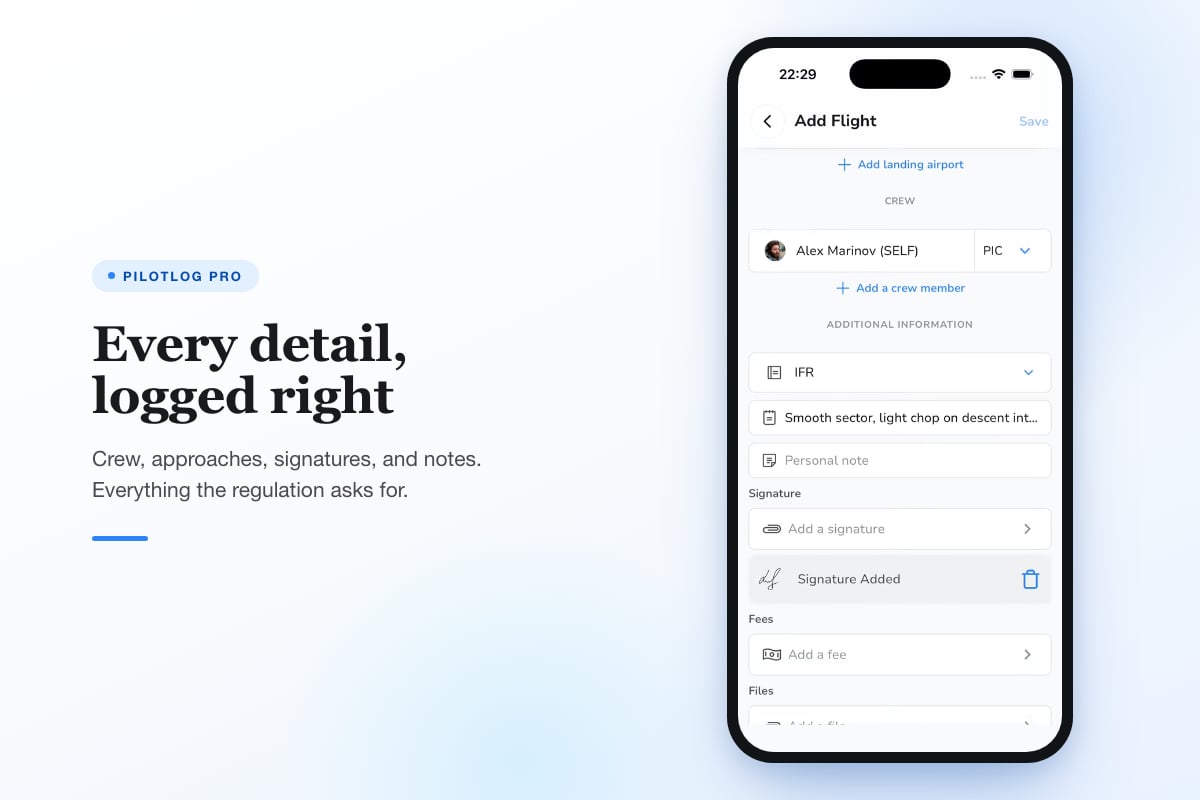
From your first lesson, you log every flight. Your logbook is a legal document that proves your experience, currency, and qualification for each privilege.
You record date, aircraft type and registration, departure and arrival points, flight time (total, PIC, dual, solo), landings, and manoeuvres practised. Endorsements from your instructor document stage completions, solo authorisations, and checkride readiness.
Pilotlog Pro tracks everything automatically: total time, dual received, solo, cross-country, and night hours. It calculates rolling 28-day and 365-day limits for commercial pilots, tracks passenger and IFR currency, and flags licence and medical expiry dates weeks before they lapse. For student pilots, it keeps your progress visible and ensures you meet the hour breakdowns for the checkride.
After you earn your certificate, currency rules apply. To carry passengers, you need three takeoffs and landings in the preceding 90 days in the same category, class, and type (if applicable). Night currency requires three night takeoffs and landings to a full stop within 90 days. IFR currency requires six approaches, holding, and intercepting/tracking courses in the preceding six months, either in actual or simulated conditions.
Tracking these dates manually is tedious and error-prone. A digital logbook keeps you legal without the guesswork. For more on how to structure and fill out your logbook correctly, see pilot logbook how to fill it out.
Where to Find Flight Schools and Introductory Flights
AOPA's Learn to Fly resources provide a searchable directory of flight schools, typical timelines, and scholarship opportunities. Many schools offer introductory flights for £100 to £150, where you take the controls for 30 to 60 minutes and experience basic manoeuvres.
The EAA Eagle Flights program offers free introductory flights through volunteer pilots. It is a low-risk way to learn to fly a plane before committing thousands of pounds.
Visit several schools before choosing one. Ask about aircraft condition, instructor turnover, lesson scheduling, and whether the school operates under Part 141 (structured syllabus, FAA-approved) or Part 61 (flexible, student-paced).
In Europe, check that the school holds an Approved Training Organisation (ATO) certificate under EASA regulations. The syllabus, record-keeping, and instructor qualifications are standardised. The EASA Easy Access Rules for Aircrew detail training requirements and standards across all member states.
Technology, Simulation, and Modern Training Tools
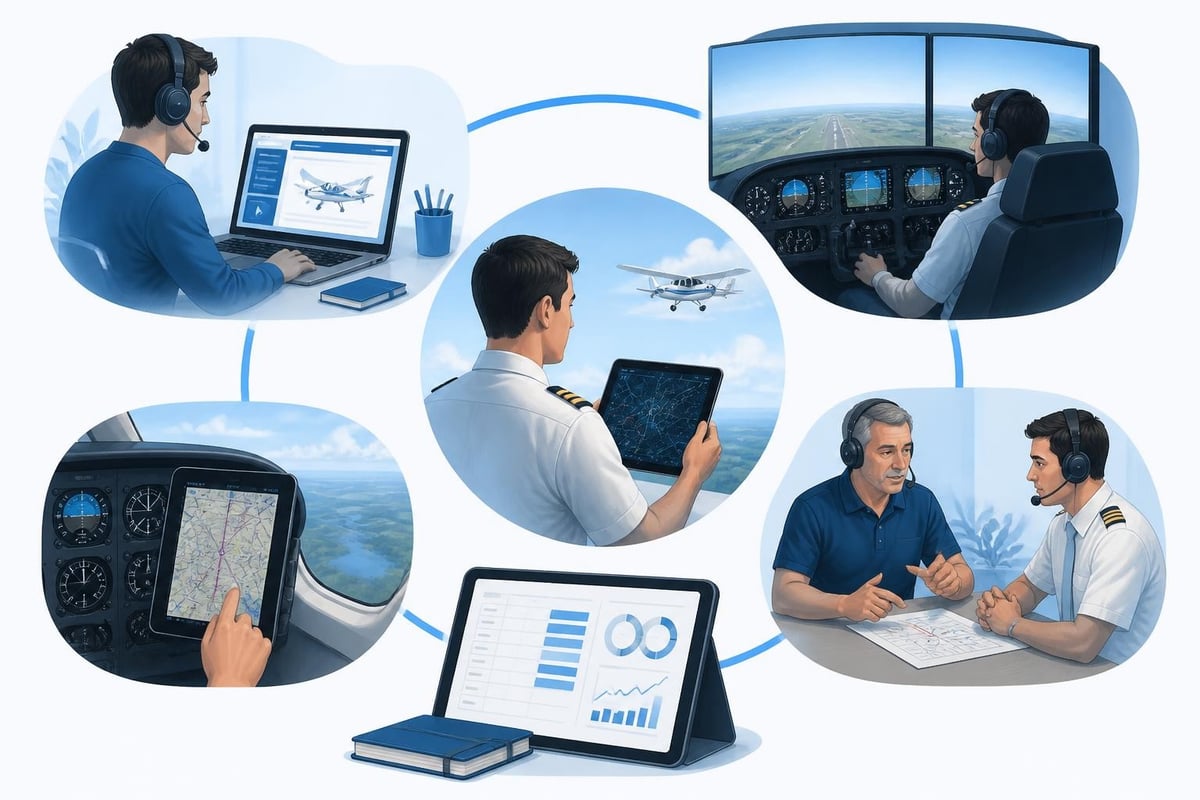
Modern flight training uses simulators, flight training devices, and augmented reality to reduce cost and improve proficiency. The FAA allows up to 2.5 hours of flight training device time to count toward the Private Pilot certificate. EASA allows up to 5 hours of FNPT (Flight and Navigation Procedures Trainer) time.
Research on augmented reality and simulator transfer shows measurable benefits for instrument scan, procedural memory, and emergency decision-making. Simulators let you practise engine failures, severe weather, and instrument approaches safely and repeatedly.
Tablet computers running ForeFlight, SkyDemon, or similar apps replace paper charts and provide real-time weather, traffic, terrain, and airport information. Students learn to integrate these tools early, balancing automation with basic pilotage and chart-reading skills.
International Variations and Licence Conversion
If you learn to fly a plane under FAA rules and later move to Europe, you can convert your FAA certificate to an EASA licence. The process requires:
- Proof of FAA certificate and medical
- Completion of EASA-specific theoretical knowledge exams (usually Air Law and Communications)
- A skill test or proficiency check with an EASA examiner
- Compliance with EASA medical standards (Class 2 for PPL)
Conversion takes time and paperwork, but it preserves your investment. The reverse process (EASA to FAA) is similar and governed by bilateral agreements.
UK CAA post-Brexit rules are closely aligned with EASA but are administered separately. Check current guidance if you hold a UK-issued licence and plan to fly in the EU, or vice versa.
Always confirm currency and validity periods when operating across borders. Regulation changes, and this guide reflects 2026 standards. Pilots should verify against current official sources before relying on any stated rule or hour requirement.
Real Numbers: A Worked Example
Here is a realistic training timeline for a student starting in January 2026 with no prior experience, flying twice a week in the United States under Part 61.
| Month | Cumulative Hours | Milestones |
|---|---|---|
| January | 8 hours | First 8 lessons, basic aircraft control |
| February | 16 hours | Slow flight, stalls, ground reference |
| March | 24 hours | Pre-solo check, first solo (pattern work) |
| April | 32 hours | Solo consolidation, dual cross-country prep |
| May | 42 hours | Long solo cross-country (150+ nm) |
| June | 52 hours | Night training (3 hours dual, landings) |
| July | 60 hours | Checkride prep, mock oral, stage check |
| August | 62 hours | Checkride (pass), certificate issued |
Total elapsed time: eight months. Total cost at £110/hour aircraft, £50/hour instructor, 40 hours dual, 20 hours solo: approximately £10,000 including exams and checkride.
This student logged every flight in a digital logbook, tracked solo and cross-country time automatically, and reviewed progress weekly. The Pilotlog currency cheat sheet helped maintain passenger currency after the certificate was issued.
Learning to fly a plane is a structured, measurable process with clear stages, regulated standards, and realistic timelines. Most students finish in six to twelve months and 50 to 70 hours, then face ongoing currency and medical requirements. Pilotlog keeps your logbook accurate, tracks every currency rule automatically, and flags expiries before they ground you, so you stay current, legal, and ready from first lesson to airline command.
- learn to fly
- private pilot license
- flight training
- ground school
- pilot medical certificate
A logbook that keeps itself.
Join the waitlist and be first in line when Pilotlog launches.
Free to join, no spam. Unsubscribe any time.