amt logbook
AMT Logbook: Maintenance Record Essentials (2026)
20 Oct 2026 · 11 min read
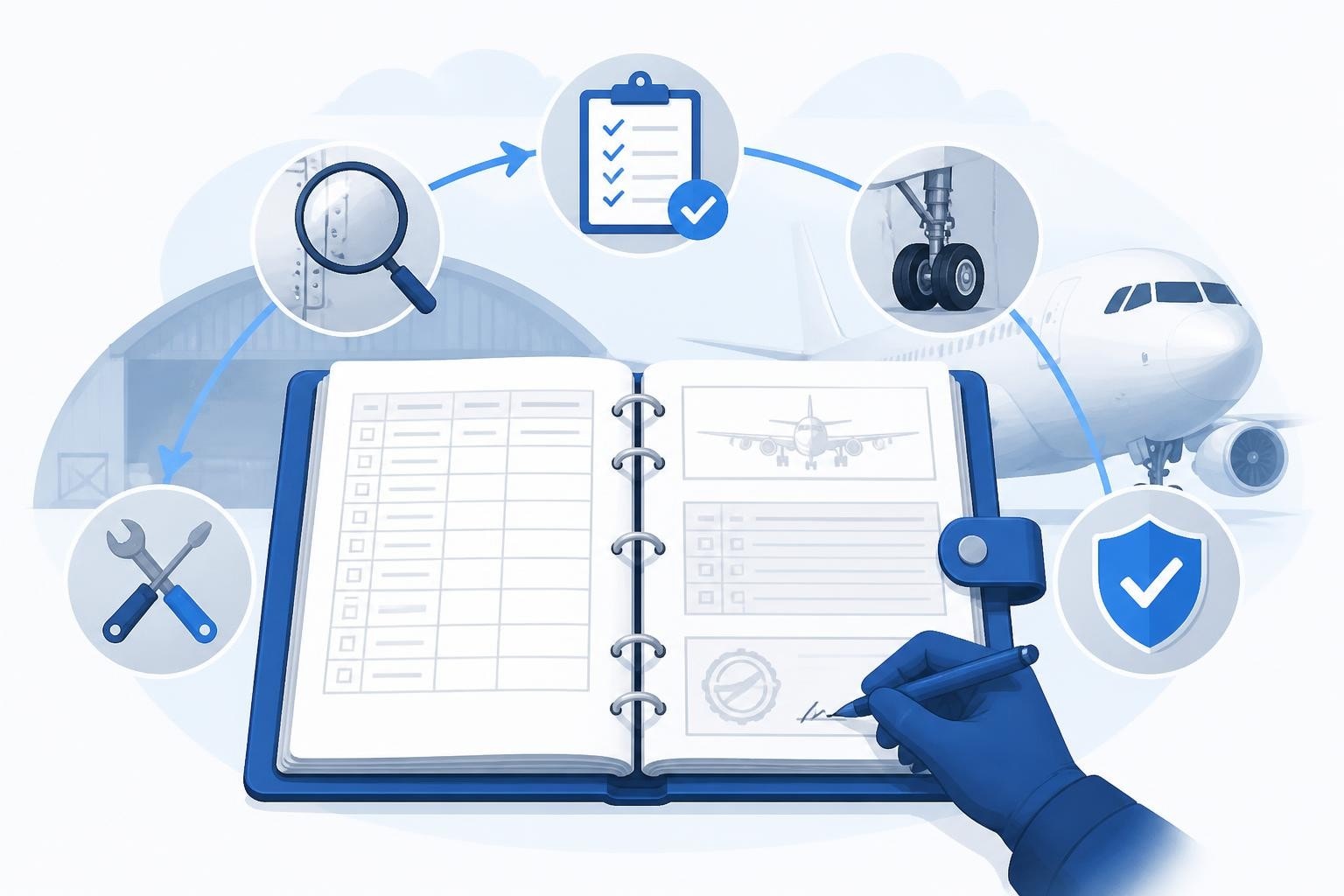
An AMT logbook, or Aircraft Maintenance Technician logbook, documents the work performed on an aircraft, the qualifications of the technician, and the return-to-service authorisation following maintenance, preventive maintenance, or inspections. These records form the legal foundation of aircraft airworthiness and regulatory compliance, whether kept in traditional paper format or modern digital systems. For pilots, understanding AMT logbook requirements helps you verify that the aircraft you fly has been properly maintained and released for service.
Why the AMT Logbook Matters to Pilots
Every flight begins with trust in the aircraft. That trust rests on documented maintenance work and certified inspections recorded in an amt logbook. Under 14 CFR §91.417, aircraft owners and operators must maintain records of all maintenance, preventive maintenance, and alterations, plus records of required inspections. Before you accept an aircraft for flight, you verify that someone has signed it off properly.
The AMT logbook serves three critical functions:
- Proves compliance with annual, 100-hour, and progressive inspections
- Documents airworthiness directives (ADs) and service bulletins
- Establishes a chain of accountability for each maintenance action
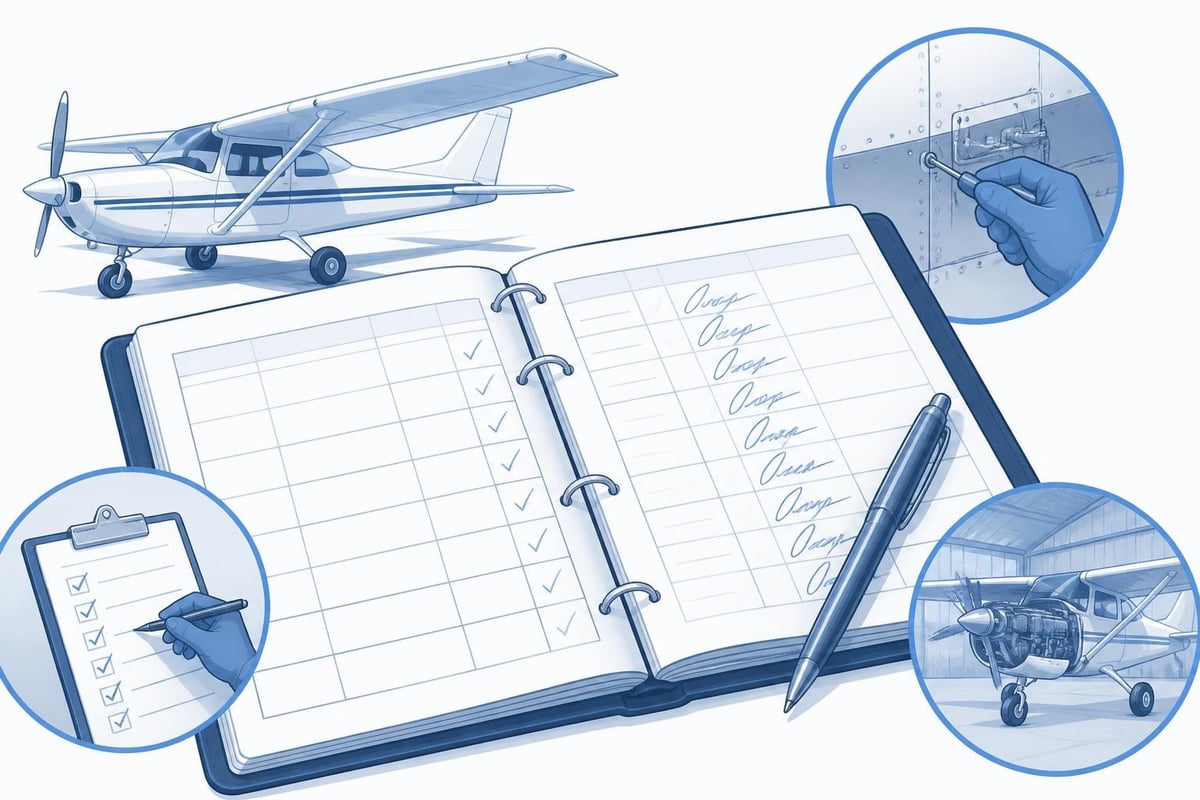
When reviewing an amt logbook during pre-purchase inspection or after extended downtime, you look for complete entries that identify the aircraft, describe the work, reference applicable data, and carry a signature with certificate number and type. Missing or incomplete entries raise red flags that may ground the aircraft until corrected.
Required Contents of an AMT Logbook Entry
Regulatory standards define exactly what belongs in an amt logbook entry. The FAA Advisory Circular AC 43-9D provides detailed guidance on acceptable maintenance recordkeeping practices and return-to-service statements. Whether paper or electronic, each entry must contain specific elements.
Mandatory Elements for Every Entry
| Element | Requirement |
|---|---|
| Aircraft identification | Registration number, serial number, or other unique identifier |
| Work description | Clear statement of the work performed, including parts replaced |
| Date of completion | The calendar date work was finished and aircraft approved for return to service |
| Signature | Technician's name, certificate number, and certificate type (A&P, IA, repair station) |
| Approval reference | Applicable regulation, airworthiness directive, manufacturer's manual, or other approved data |
Inspections require an additional statement that the aircraft has been inspected in accordance with the applicable regulation and found airworthy or unairworthy. An annual inspection entry, for example, must state compliance with 14 CFR §43 Appendix D and certify the aircraft airworthy or list discrepancies. A qualified inspector with an Inspection Authorisation (IA) signs annual inspections; an A&P mechanic with appropriate ratings signs 100-hour inspections.
Academic research from TU Delft on aircraft maintenance documentation highlights common problems with traditional paper logbooks: illegible handwriting, missing cross-references, incomplete work descriptions, and difficulty tracing parts provenance. Digital systems address many of these issues through structured data entry and automated compliance checks.
Paper versus Digital AMT Logbooks
The industry is shifting from bound paper books to electronic recordkeeping systems. Both formats remain legally acceptable under current regulations, but digital platforms offer distinct advantages for traceability, accessibility, and long-term preservation. The FAA Advisory Circular AC 120-78B sets standards for electronic signatures and electronic recordkeeping systems used in aviation.
Advantages of paper AMT logbooks:
- No software or device dependencies
- Familiar format for older mechanics and inspectors
- Physical signature provides traditional authenticity
- Works anywhere without power or connectivity
Advantages of digital AMT logbooks:
- Searchable records across years of maintenance history
- Automated calculations of time-between-overhaul (TBO) and cycles
- Remote access for pilots, owners, and mechanics
- Backup and disaster recovery protections
- Structured fields reduce incomplete entries
The Federal Register rulemaking on manual requirements clarified that electronic manuals and records meet regulatory intent when they provide equivalent accessibility and reliability. For an amt logbook, that means the system must prevent unauthorised alterations, maintain an audit trail, and remain readable throughout the record retention period.

Recent research published in Nature Scientific Reports on blockchain traceability explores cryptographic methods to secure maintenance records against tampering. While full blockchain implementation remains experimental in aviation, the principles of immutable records and transparent audit trails are increasingly relevant as digital amt logbook systems mature.
Record Retention Requirements
You cannot simply discard old maintenance records when the logbook fills up. Regulations specify minimum retention periods to preserve the aircraft's documented history through ownership changes and major maintenance events. Under 14 CFR §91.417, owners and operators must retain maintenance records for defined periods or transfer them with the aircraft.
Retention Periods by Record Type
- Current status records: Retained until superseded by newer work of equivalent scope and detail
- Total time in service: Retained and transferred with aircraft permanently
- Current inspection status: Retained until replaced by another inspection of the same kind
- Airworthiness directive compliance: Retained and transferred with aircraft permanently
- Major alterations (Form 337): Retained and transferred with aircraft permanently
- Annual and 100-hour inspections: Retained for one year after superseding inspection
When you purchase an aircraft, the seller must transfer all records showing total time, AD compliance, and major alterations. Without these records, you may need expensive inspections or component overhauls to re-establish airworthiness. An incomplete amt logbook history can reduce aircraft value by tens of thousands of pounds or ground the aircraft until compliance is proven.
EASA and International AMT Logbook Standards
European regulations follow parallel principles with distinct terminology and oversight. The EASA Easy Access Rules for Continuing Airworthiness under Regulation (EU) No 1321/2014 define the Aircraft Maintenance Technician (AMT) role and the documentation required for aircraft registered in EASA member states.
Key EASA terminology differences:
- Certifying staff rather than A&P mechanics
- Aircraft Maintenance Licence (AML) aligned with Part-66 categories
- Certificate of Release to Service (CRS) instead of return-to-service statement
- Continuing Airworthiness Management Organisation (CAMO) oversight for complex aircraft
A Part-66 B1 or B2 licence holder signs the CRS in the amt logbook after completing maintenance. The entry must reference the applicable maintenance data, record defects found, and confirm compliance with airworthiness requirements. EASA emphasises the Continuing Airworthiness Management system, where a CAMO may control logbook entries and ensure compliance across fleets.
For pilots flying N-registered aircraft in Europe or G-registered aircraft crossing the Atlantic, understanding both regulatory frameworks helps you verify maintenance compliance regardless of where the work was performed. Many digital amt logbook platforms now support both FAA and EASA formats, automatically adapting entry fields and signature requirements to the relevant authority.
How Investigators Use AMT Logbooks
When accidents occur, maintenance records become central evidence. The NTSB memorandum reviewing airframe maintenance records shows how investigators trace component history, inspection intervals, and compliance with mandatory modifications. Incomplete or altered amt logbook entries raise immediate questions about airworthiness and regulatory compliance.
Investigators look for:
- Consistent chronological entries without gaps
- Proper documentation of all airworthiness directive compliance
- Evidence that time-limited components were replaced before expiry
- Qualified signatures on all return-to-service statements
- Records matching physical placards, data plates, and installed equipment
An amt logbook with missing pages, white-out corrections, or entries signed by individuals without proper certification can invalidate the aircraft's airworthiness certificate. In accident litigation, logbook discrepancies may establish negligence or regulatory violations. Digital systems with audit trails provide stronger evidence of proper recordkeeping than paper books vulnerable to loss or alteration.
Practical AMT Logbook Review for Pilots
Before you fly an unfamiliar aircraft, invest 15 minutes reviewing the amt logbook. Start with the most recent entries and work backwards, checking that required inspections are current and all open discrepancies have been addressed. Many pilots skim the logbooks during pre-purchase inspection but never look again until selling, missing deteriorating compliance or deferred maintenance.
Your Pre-Flight Logbook Checklist
- Annual inspection date: Must be within the preceding 12 calendar months for aircraft not under 100-hour requirements
- 100-hour inspection: Required if aircraft is used for hire or flight instruction; calculated from prior inspection, not calendar date
- Airworthiness directive status: Check the separate AD log or indexed entries; note next compliance dates for recurring ADs
- Outstanding discrepancies: Review any MEL or open squawks; confirm pilots may legally dispatch with these items
- ELT inspection: Required within 12 months or after 1 hour of cumulative use
- Altimeter, static system, transponder: Must be inspected within 24 months for IFR flight
- Propeller and engine overhaul: Note time since major overhaul (SMOH) and remaining hours to TBO
Just as tracking pilot currency prevents inadvertent violations of recency requirements, maintaining awareness of aircraft maintenance status keeps you legal and safe. If you notice an approaching inspection or AD compliance date, alert the owner or operator well in advance.
Digital pilot logbooks like Pilotlog Pro help you track your own currency, expiries, and rolling duty limits with automated alerts that flag upcoming deadlines. While Pilotlog focuses on pilot records rather than aircraft maintenance, the same principle applies: proactive monitoring prevents last-minute scrambles and regulatory violations.

Common AMT Logbook Errors and Corrections
Even experienced mechanics make logbook mistakes. Incomplete entries, incorrect dates, missing signatures, and vague work descriptions appear regularly. FAA regulations allow corrections, but the process must preserve the original entry and create a clear audit trail.
Proper correction procedure:
- Draw a single line through the incorrect information (never obscure or erase)
- Write the correct information adjacent to the crossed-out text
- Initial and date the correction
- If the correction is extensive, add a separate entry explaining the error and referencing the original entry date
Attempting to remove or white-out entries raises suspicion during inspections or investigations. If you discover an error in your aircraft's amt logbook, contact the mechanic or inspector who made the original entry. They should make the correction following proper procedures. If the individual is unavailable or unwilling, consult an A&P or IA to add a corrective entry that references the original mistake.
Digital systems reduce error rates through structured forms, required fields, and validation checks. When a mechanic enters a date that precedes the last logbook entry, the system flags the inconsistency. When an AD number is entered, the system can verify it against the FAA AD database and auto-populate compliance requirements. These features do not eliminate human error, but they catch common mistakes before the entry is finalised.
Integrating AMT Logbooks with Pilot Records
Your aviation logbook tracks flight hours, currency, and ratings; the amt logbook tracks aircraft condition and compliance. Both interact when you fly for compensation or hire, where 14 CFR §91.409 requires 100-hour inspections and specific recordkeeping.
For flight schools and commercial operators, coordinating pilot scheduling with aircraft inspection status prevents inadvertent operation beyond inspection limits. If an aircraft reaches 98.5 hours since its last 100-hour inspection and a student pilot books a 3-hour cross-country, the school must either complete the inspection first or assign a different aircraft. Digital dispatch systems can integrate amt logbook data with flight schedules to prevent these conflicts.
Similar coordination applies to recurring ADs. If an airworthiness directive requires inspection every 50 flight hours, scheduling software should track remaining hours and prevent dispatch when compliance is due. For pilots renting or borrowing aircraft, ask the owner how they monitor inspection intervals and who is responsible for tracking hours toward the next inspection.
Understanding both your own currency and the aircraft's inspection status is part of professional flight operations. Just as you would not launch IFR without verifying your instrument currency, you should not launch in an aircraft whose inspection status you have not confirmed. The amt logbook is your evidence that the aircraft is legal and airworthy.
Future Trends in AMT Logbook Technology
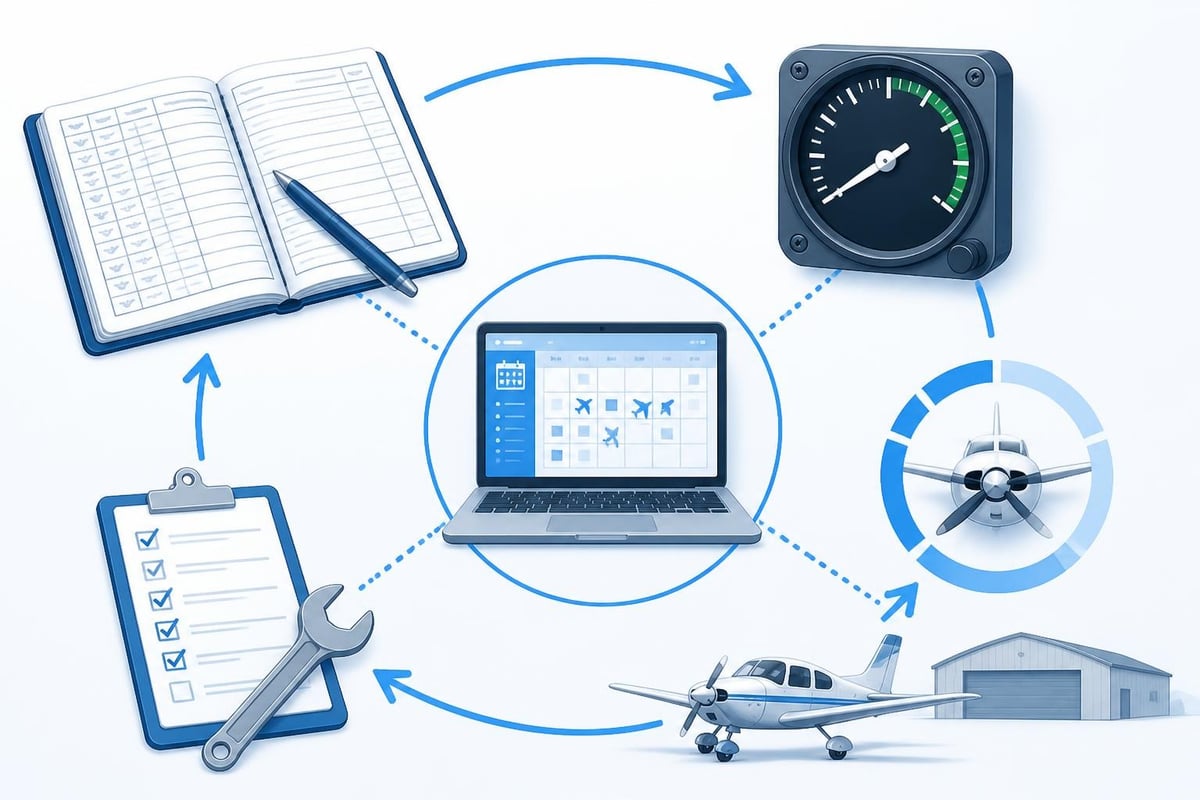
Blockchain distributed ledgers, artificial intelligence analysis of maintenance trends, and cloud-based platforms accessible worldwide are reshaping how amt logbook data is captured, stored, and analysed. The aviation industry moves slowly on certification and regulation, but the direction is clear: digital, interconnected, and transparent.
Emerging capabilities in 2026:
- Automatic population of part numbers and specifications from manufacturer databases
- Predictive maintenance alerts based on component life trends across similar aircraft
- Integration with parts suppliers to auto-order components approaching TBO
- Real-time sync between owner, operator, mechanic, and inspector platforms
- Machine-readable entries that feed directly into aircraft dispatch and flight planning systems
These systems still require qualified human signatures and judgement. Technology cannot replace the A&P mechanic's inspection or the IA's annual signoff. But digital platforms reduce administrative burden, improve accuracy, and create permanent audit trails that satisfy regulators and reassure pilots.
For pilots selecting an aircraft to purchase or a flight school to train with, ask about digital amt logbook systems. An operator using modern maintenance tracking demonstrates commitment to safety and compliance. Conversely, illegible paper logbooks with missing entries suggest lax recordkeeping that may extend to other operational areas.
Keeping detailed, accurate maintenance records protects pilots, owners, and mechanics from regulatory violations and establishes the chain of airworthiness that makes safe flight possible. Whether you review an amt logbook before a flight, during pre-purchase inspection, or as part of annual recurrent training, understanding what belongs in those entries helps you verify that the aircraft is legal and properly maintained. Just as Pilotlog helps you track your own flight hours, currency, and medical expiries with automated alerts and structured logging, modern digital amt logbook platforms bring the same benefits to aircraft maintenance recordkeeping, ensuring nothing catches you by surprise when it is time to fly.
- amt logbook
- maintenance records
- return to service
- airworthiness compliance
- digital logbook
A logbook that keeps itself.
Join the waitlist and be first in line when Pilotlog launches.
Free to join, no spam. Unsubscribe any time.