digital pilot logbook
Logbook Aviation: Complete Guide to Pilot Records 2026
27 Jul 2026 · 12 min read

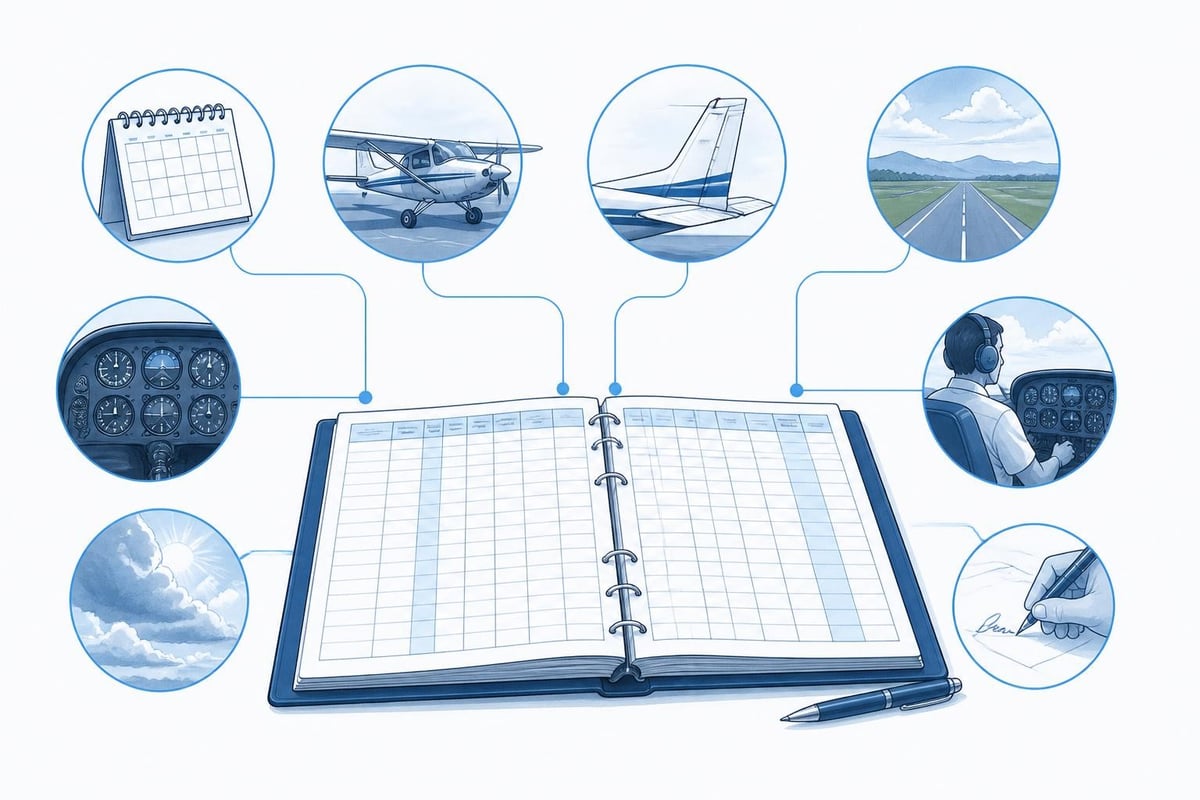
Logbook aviation encompasses both the physical or digital record every pilot maintains and the regulatory framework governing what must be logged. A pilot logbook documents flight time, training, endorsements, currency, and proficiency checks required by aviation authorities. Whether you fly under FAA, EASA, or UK CAA rules, your logbook serves as legal proof of experience, qualifications, and recency, critical for everything from licence applications to insurance underwriting.
The term logbook aviation also refers to aircraft maintenance records, but this article focuses on pilot logbooks. Both are essential, and understanding FAA logbook requirements helps you avoid costly mistakes.
What Must Be Logged
Regulatory requirements dictate minimum entries. Under FAA 14 CFR Part 61.51, you must log date, total flight or lesson time, location, aircraft type and identification, name of safety pilot or instructor if required, and the nature of the flight (solo, dual, PIC, SIC). EASA Part-FCL AMC1 FCL.050 requires similar detail: departure and arrival aerodromes, aircraft registration and type, date, block times, PIC name, duty time if commercial, and the nature of the flight.
Core Entries
- Date of flight: Day, month, year
- Aircraft type and registration: Exact model (e.g. PA-28-161, C172S) and tail number
- Departure and arrival aerodromes: ICAO or IATA codes preferred
- Block time or flight time: Depending on jurisdiction
- Pilot in command: Your name if acting as PIC, or the PIC's name
- Dual or solo time: Broken down for student and training flights
- Conditions: Day, night, VFR, IFR, simulated instrument
- Landings: Number and type (day, night, full stop)
- Endorsements and instructor signatures: Required for training, proficiency checks, type ratings
FAA Part 61.51(b) specifies that you log the type of pilot time (PIC, SIC, solo, dual received) and conditions (actual instrument, simulated instrument, night). EASA requires operational condition time: single-pilot or multi-pilot, multi-engine or single-engine, and any credit claimed toward licence or rating requirements.
Forgetting to log critical details creates gaps that can delay certificate applications or raise questions during ramp checks. Missing instructor signatures invalidate endorsements.
Currency and Recency Requirements
Logbook aviation records prove you meet currency to carry passengers, fly IFR, or operate specific aircraft categories. Currency is time-limited and lapses if not maintained.
Under FAA 14 CFR Part 61.57(a), to carry passengers you need three takeoffs and landings in the preceding 90 days in the same category, class, and type (if a type rating is required). For night passenger currency, those landings must be to a full stop between one hour after sunset and one hour before sunrise. The IFR currency requirement under Part 61.57(c) is six instrument approaches, holding procedures, and intercepting and tracking courses in the preceding six calendar months, either in actual or simulated conditions.
EASA Part-FCL FCL.060 requires three takeoffs and three landings in the preceding 90 days for passenger-carrying privileges. Night recency under FCL.060(b)(2) requires one takeoff and landing at night in the preceding 90 days. IFR recency is more complex: you need to complete an instrument proficiency check (IPC) within the validity of your instrument rating, typically 12 months.
Tracking Currency in Practice
| Requirement | FAA (Part 61.57) | EASA (FCL.060) |
|---|---|---|
| Passenger (day) | 3 T/O + landings, 90 days | 3 T/O + landings, 90 days |
| Passenger (night) | 3 full-stop landings, 90 days | 1 T/O + landing, 90 days |
| IFR | 6 approaches + holds + tracking, 6 months | IPC within rating validity (12 months) |
You calculate these rolling windows from your logbook. A digital logbook automates the lookback and flags upcoming lapses.
Worked example: You last flew on June 15, 2026 with three landings. On September 13, 2026 (89 days later), you are still current for passengers. On September 14, 2026 (90 days), currency lapses. You must complete three more takeoffs and landings (solo if necessary) to restore it.
Rules change. Always confirm current requirements against official FAA regulations or EASA Part-FCL.
Digital vs Paper Logbooks
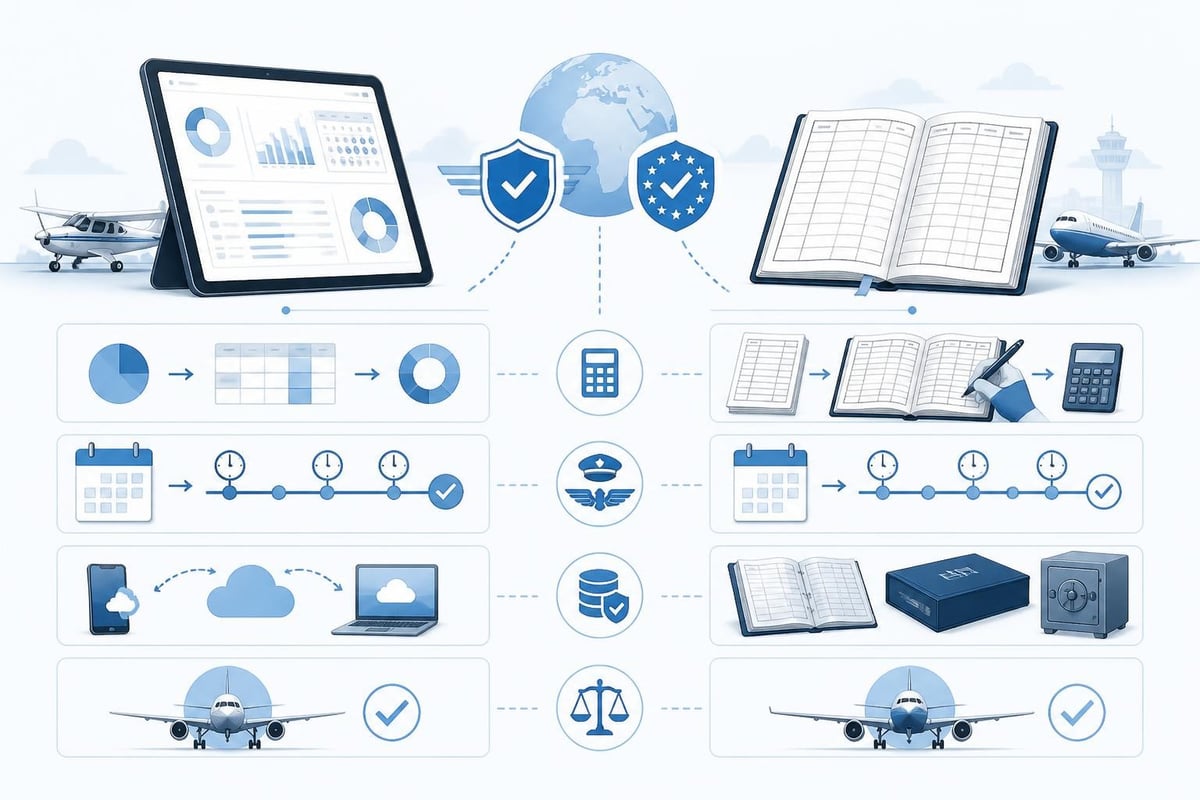
Paper logbooks remain legal and widely used. They require no software, no subscription, and survive electronic failures. Handwritten entries are permanent and courts accept them as evidence. However, paper is vulnerable to loss, fire, water damage, and theft. Calculating totals manually invites arithmetic errors. Tracking multiple currency windows across categories and classes becomes tedious.
Digital logbook aviation platforms offer automatic totalling, currency calculations, expiry alerts, cloud backup, and instant exports for job applications or check rides. Pilotlog and similar services store encrypted copies on remote servers, protecting against device loss. Entries sync across phone, tablet, and web browser.
Regulatory authorities accept digital logbooks. FAA AC 120-78A acknowledges electronic recordkeeping for both pilot and aircraft logs, provided the system ensures data integrity, accessibility, and auditability. EASA does not mandate a specific format; Part-FCL requires only that you maintain a reliable, accurate, and retrievable record.
Comparison
| Feature | Paper Logbook | Digital Logbook |
|---|---|---|
| Automatic totals | No | Yes |
| Currency tracking | Manual calculation | Automated flags and alerts |
| Backup | Physical copies only | Cloud sync, export to PDF/CSV |
| Portability | One physical book | Access on multiple devices |
| Cost | One-time purchase (£15–30) | Free tier or subscription (£5–10/month) |
| Regulatory acceptance | Fully accepted | Fully accepted (with proper audit trail) |
Many pilots maintain both: digital for day-to-day logging and analysis, paper as a certified backup signed by instructors and examiners.
What Happens If Records Are Missing
Incomplete or lost logbook aviation records jeopardize licence applications, renewals, insurance claims, and employment. The FAA can suspend or revoke certificates if you cannot prove flight experience or training. EASA Part-FCL requires demonstration of experience; without a logbook, you may be forced to repeat flight tests or training.
When applying for an ATP, you must prove 1,500 hours total time (FAA 14 CFR Part 61.159) or 1,500 hours under EASA Part-FCL.510. Missing 200 hours of entries means you fall short on paper, even if you flew those hours. Reconstructing from other records (receipts, aircraft logbooks, instructor records, flight school records) is possible but time-consuming and may not satisfy an inspector.
Insurance underwriters request total hours, hours in type, and recent experience. Gaps raise premiums or result in coverage denial. Airlines and charter operators require a complete, accurate pilot logbook during hiring. Missing entries or obvious discrepancies trigger deeper scrutiny.
Best practice: Scan or photograph every page of a paper logbook monthly. Store digital copies in two separate locations (cloud storage and external drive). Export your digital logbook quarterly and save the PDF. Keep instructor endorsements, checkride records, and medical certificates with your logbook copies.
Understanding aircraft logbook best practices also helps you appreciate the parallel discipline required for pilot records.
Recording Training and Endorsements
Student and certificated pilots log dual instruction, ground training, and endorsements. Under FAA Part 61.51(h), an instructor must sign each logbook entry for training given, including ground and flight instruction. The signature certifies that the instruction was provided and, where applicable, that the student demonstrated proficiency.
Endorsements authorize solo flight, solo cross-country, knowledge test eligibility, practical test eligibility, and additional aircraft category or class privileges. Each endorsement cites the relevant regulation (e.g. "I certify that [name] has received the required training of § 61.87(c) and is proficient to conduct solo flights in a [aircraft make and model]"). FAA AC 61-65H lists standardized endorsement language.
EASA training records include a training record folder (maintained by the training organization) and a personal logbook. Instructors sign after each training flight, and major milestones (skill test, proficiency check, differences training) are annotated with examiner or instructor signatures and licence or rating numbers.
Endorsement Checklist
- Pre-solo endorsement: Required before first solo flight
- Solo cross-country: Separate endorsement for flights beyond 50 nm
- Knowledge test: Endorsement confirming ground training completion
- Practical test: Endorsement certifying training and readiness
- Flight review: Biennial (FAA) or proficiency check (EASA)
- Additional category/class: Transition training to new aircraft types
- High-performance, complex, tailwheel: Specific endorsements under Part 61.31
Missing endorsements ground you. If you cannot produce a valid solo endorsement, you may not act as PIC even if you hold a private pilot licence.
Professional Logbook Practices
Commercial pilots, flight instructors, and airline crews face stricter logbook aviation standards. Part 117 (FAA) and EU-OPS/FTL regulations require logging of duty time, flight duty periods, and rest periods in addition to flight time. Exceeding flight time or duty limits can result in certificate action or civil penalties.
Professional pilots log:
- Block time: From first movement under own power to engine shutdown
- Flight time: FAA defines this as from first movement for takeoff to final stop after landing; EASA uses block-to-block
- Duty time: From report time to release
- Flight duty period: Duty that includes flight time
- Rest periods: Time free from all duties
Multi-crew operations require logging PIC, SIC, or relief pilot time. Type ratings and recurrent training are annotated with check airman signatures and check date. Line checks, proficiency checks, and competency assessments all enter the logbook.
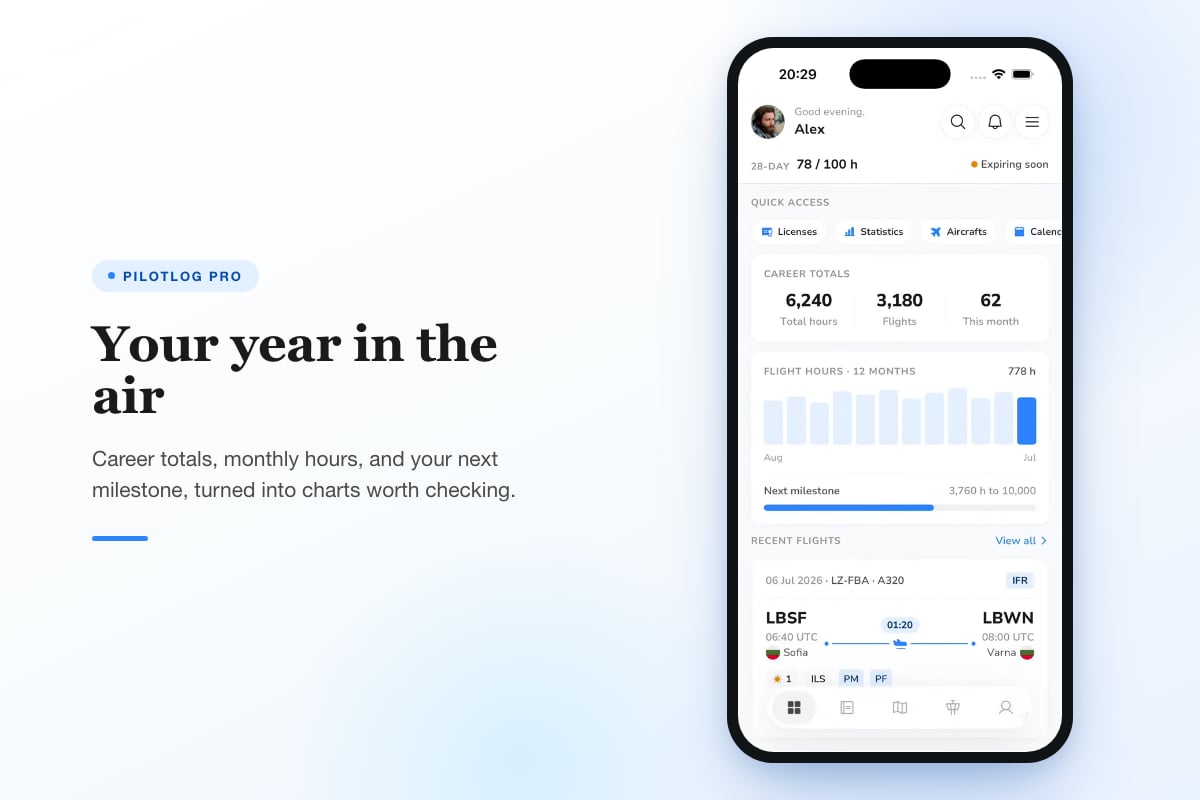
Accurate flight time tracking prevents inadvertent violations. Rolling 28-day and 365-day limits (e.g. 100 hours in 28 days, 1,000 hours in 365 days under FAA Part 117) require continuous monitoring. A single miscalculation can ground you mid-trip.
Pilotlog Pro automatically tracks rolling 28-day and 365-day flight-time and duty limits, flags passenger, night, and IFR currency with lapse dates, and sends early alerts for licence and medical expiries. It streamlines compliance for pilots flying under Part 121, 135, or EASA commercial operations.
Logbook Audits and Inspections
Aviation authorities and employers periodically audit logbooks. FAA inspectors may request logbook aviation records during ramp checks, accident investigations, or enforcement actions. EASA competent authorities conduct surveillance and can demand production of training records and logbooks.
An audit verifies:
- Total time matches other records (aircraft logs, billing records, flight school records)
- Endorsements are properly signed and dated
- Currency requirements are met
- Training meets regulatory minimums (e.g. 40 hours for private pilot under Part 61, 45 hours under EASA Part-FCL)
- No falsified entries or suspicious patterns
Falsifying logbook entries is a federal offense in the US (18 USC 1001) and grounds for certificate revocation under Part 61.59. EASA can revoke licences under Part-ARO for fraudulent records.
Common audit findings include:
- Missing instructor signatures
- Undocumented night or instrument time
- Inconsistent aircraft registrations or types
- Totals that do not sum correctly
- Endorsements lacking regulation citations
- Flight time that exceeds aircraft Hobbs or Tach records
Prepare for an audit by keeping your logbook current, reconciling totals monthly, and maintaining supporting documents (receipts, training certificates, ground school completion certificates).

Long-Term Career Value
Your logbook tells your career story. It documents progression from student to private pilot to commercial, from single-engine VFR to multi-engine IFR, from right seat to left seat. Employers assess experience quality: hours in multi-crew jets, PIC time in turbine aircraft, international operations, and challenging weather.
A well-maintained pilot flight logbook supports:
- Job applications: Airlines request detailed breakdowns (total, PIC, multi-engine, turbine, jet, night, instrument)
- Insurance: Lower premiums with documented recent experience in type
- Licence upgrades: ATP applications require precise hour tallies
- Type ratings: Proof of prerequisites (e.g. 200 hours PIC for certain EASA type ratings)
- Instructor renewals: Evidence of continuing activity and endorsements given
Retroactive logging is difficult and suspect. Log every flight promptly. A daily habit prevents forgotten details and ensures your totals remain accurate.
Handling Errors and Corrections
Mistakes happen. In a paper logbook, draw a single line through the error, write the correction above or beside it, initial and date the change. Never use correction fluid or obliterate entries, as this suggests tampering.
Digital logbooks allow edits, but reputable systems maintain an audit trail showing who changed what and when. Pilotlog, for example, timestamps edits and preserves original data in the background for compliance.
If you discover a significant error (e.g. double-counted hours, incorrect aircraft type), correct it immediately and document the reason. If the error affects currency or a recent checkride, notify your instructor or examiner.
International Operations and Licence Conversion
Pilots operating in multiple jurisdictions must ensure logbook aviation records satisfy each authority. FAA and EASA recognize each other's licences under bilateral agreements, but conversion often requires proof of flight time in specific categories.
When converting an FAA certificate to an EASA licence, you submit a logbook showing hours in relevant aircraft types, instrument time, and night time. EASA reviews the logbook and may credit experience or require additional training. The reverse process (EASA to FAA) also demands a detailed logbook with entries matching FAA definitions of flight time.
Keep logbook entries clear and detailed to simplify international verifications. Note differences in flight time definitions: FAA counts engine start to engine stop for some purposes, while EASA uses block time (chocks off to chocks on).
Technology and Integration
Modern digital logbook aviation platforms integrate with electronic flight bags (EFBs), scheduling software, crew management systems, and aircraft tracking. Some import flight data from ADS-B receivers or aircraft avionics, auto-populating route, duration, and registration.
Integration reduces data entry errors and saves time. A flight logged in your EFB auto-fills departure, arrival, aircraft type, and route into your logbook. Currency calculations update in real time.
APIs allow third-party services to pull logbook data for advanced analytics, trend reporting, and predictive alerts. You can visualize hours by month, aircraft type, or operation type, helping you plan training, manage currency, and optimize career progression.
Security is critical. Choose platforms with encryption, two-factor authentication, and regular backups. Review terms of service to confirm data ownership and portability.
Regulatory Changes and Future Trends
Logbook aviation requirements evolve. The FAA periodically updates Part 61 and issues new advisory circulars. EASA revises Part-FCL and associated acceptable means of compliance. Stay current by reviewing FAA regulations annually and subscribing to regulatory update services.
Emerging trends include blockchain-based logbooks for tamper-proof records, AI-driven currency predictions, and integration with unmanned aircraft systems (UAS) for drone pilots subject to Part 107 logging.
As automation increases, logbook accuracy remains your responsibility. Technology assists, but you verify every entry and ensure compliance.
Maintaining accurate logbook aviation records keeps you current, legal, and ready for the next stage of your flying career. Whether you choose paper, digital, or a hybrid approach, consistent logging and attention to regulatory detail protect your certificates and open doors to new opportunities. Pilotlog simplifies the process with automated currency tracking, expiry alerts, and cloud backup, so you can focus on flying while staying ahead of every deadline and requirement.
- digital pilot logbook
- faa part 61.51
- easa part-fcl
- currency requirements
- flight time logging
A logbook that keeps itself.
Join the waitlist and be first in line when Pilotlog launches.
Free to join, no spam. Unsubscribe any time.