14 cfr 61.51
Pilot Flight Logbook: Requirements and Best Practices
20 Jul 2026 · 14 min read
A pilot flight logbook is the official record of your aeronautical experience, documenting every flight, training session, and rating you earn. Under 14 CFR 61.51 in the United States and equivalent EASA regulations in Europe, you must maintain accurate logbook entries to prove currency, meet licence requirements, and demonstrate compliance during ramp checks or medical renewals. Your logbook tells the story of your flying career, from first solo to command of commercial aircraft.
What Must a Pilot Flight Logbook Contain
Regulatory requirements define exactly what information each logbook entry must capture. The FAA's logbook requirements under 14 CFR 61.51 specify that pilots must record date, total flight time, departure and arrival locations, aircraft type and registration, and the nature of the flight.
You must log flight time by category. This includes:
- Pilot in command (PIC) time when you are the sole manipulator of controls in an aircraft for which you hold the appropriate category and class rating
- Second in command (SIC) time in operations requiring more than one pilot
- Dual instruction received with an authorised instructor
- Solo time as a student or rated pilot
- Cross-country flights meeting the regulatory definition (typically 50 nautical miles from departure point)
- Night time as defined by regulation (one hour after sunset to one hour before sunrise)
- Instrument time in actual or simulated conditions
The logbook must also record specific conditions. For instrument currency, you need 6 approaches, holding, and intercepting/tracking courses in the preceding 6 months. Night currency requires 3 takeoffs and landings to a full stop within 90 days for carrying passengers after sunset.

Training flights require additional detail. Your instructor must sign each dual flight and include their certificate number. Endorsements for solo flights, practical tests, flight reviews, and instrument proficiency checks must appear with the instructor's signature and certificate details. Understanding how to fill out a pilot logbook correctly from the start prevents compliance issues later.
Endorsements and Certifications
Your pilot flight logbook serves as the permanent record of critical endorsements. A flight review under 14 CFR 61.56 must be logged every 24 calendar months, showing completion of one hour ground training and one hour flight training. The endorsement must state you are proficient to exercise pilot privileges.
Instrument proficiency checks follow similar rules. If your instrument currency lapses beyond 6 months, you need an IPC with an authorised instructor or examiner. The logbook entry must show the check is complete and you meet instrument currency requirements.
Type rating endorsements, high-performance aircraft authorisations, and complex aircraft approvals all require specific logbook entries. Each endorsement must include the date, the regulation authorising the endorsement, and the instructor's signature with certificate number and expiry date.
Why Accuracy Matters in Your Pilot Flight Logbook
Insurance claims, accident investigations, and enforcement actions all turn on logbook accuracy. If you claim 1,500 hours for an airline interview but cannot substantiate those hours with proper entries, you risk your career. Examiners and inspectors know what compliant entries look like.
Common errors destroy credibility:
- Rounding flight times instead of logging actual block-to-block time
- Claiming PIC time when not qualified or endorsed
- Recording instrument approaches not flown to published minimums
- Backdating entries or fabricating flights
- Missing required instructor signatures
One captain lost their ATP certificate after an investigation revealed 200 hours of fabricated entries in their logbook. The penalty for falsifying records extends beyond certificate action to potential criminal charges under 18 USC 1001. Your logbook is a legal document.
| Error Type | Consequence | Prevention |
|---|---|---|
| Fabricated entries | Certificate revocation | Log only actual flights immediately after completion |
| Missing endorsements | Failed check ride | Ensure instructor signs every dual flight |
| Incorrect PIC time | Insurance denial | Claim PIC only when qualified and sole manipulator |
| Vague descriptions | Currency questions | Specify airport, approaches, conditions explicitly |
Accuracy supports your career progression. When you apply for positions requiring specific experience, hiring managers verify your hours. Airlines require documented proof of turbine time, multi-engine time, and PIC time. Corporate operators want to see your actual weather experience, not inflated estimates.
Digital tools reduce transcription errors but the pilot remains responsible for content. Whether you use paper or electronic records, maintaining compliance with digital logbook requirements means understanding what the regulations demand and ensuring your entries meet those standards.
Currency Tracking Through Your Logbook
Your pilot flight logbook proves you meet currency requirements to carry passengers and operate under IFR. Different operations impose different currency rules, and you must track each one accurately.
Passenger Currency Requirements
For VFR passenger operations, you need 3 takeoffs and landings in the same category, class, and type (if a type rating is required) within the preceding 90 days. For night passenger operations, those 3 takeoffs and landings must occur between one hour after sunset and one hour before sunrise, and they must be to a full stop.
Tailwheel aircraft require additional currency. You need 3 full-stop landings in a tailwheel aircraft within the preceding 90 days to carry passengers in any tailwheel aircraft. This requirement runs parallel to the standard passenger currency rule.
Your logbook entries must show the specific aircraft type and whether landings were full stop or touch-and-go. Recording "3 T&L" without specifying full stop leaves doubt about night currency compliance.
Instrument Currency Requirements
IFR operations require precise currency tracking. Under 14 CFR 61.57(c), you must complete 6 instrument approaches, holding procedures, and intercepting and tracking courses through navigation systems within the preceding 6 months. These tasks can be completed in actual or simulated conditions, in flight or in an approved simulator.
Your logbook must specify which approaches you flew. Recording "ILS RWY 27" provides specific proof. Writing "various approaches" creates ambiguity that can lead to currency questions. Include the location and approach type for each one.
If currency lapses beyond 6 months but remains within 12 months, you can regain currency with an instrument proficiency check. Beyond 12 months, you definitely need an IPC. The logbook entry for the IPC must state compliance with 61.57(d) and bear the instructor's or examiner's signature.
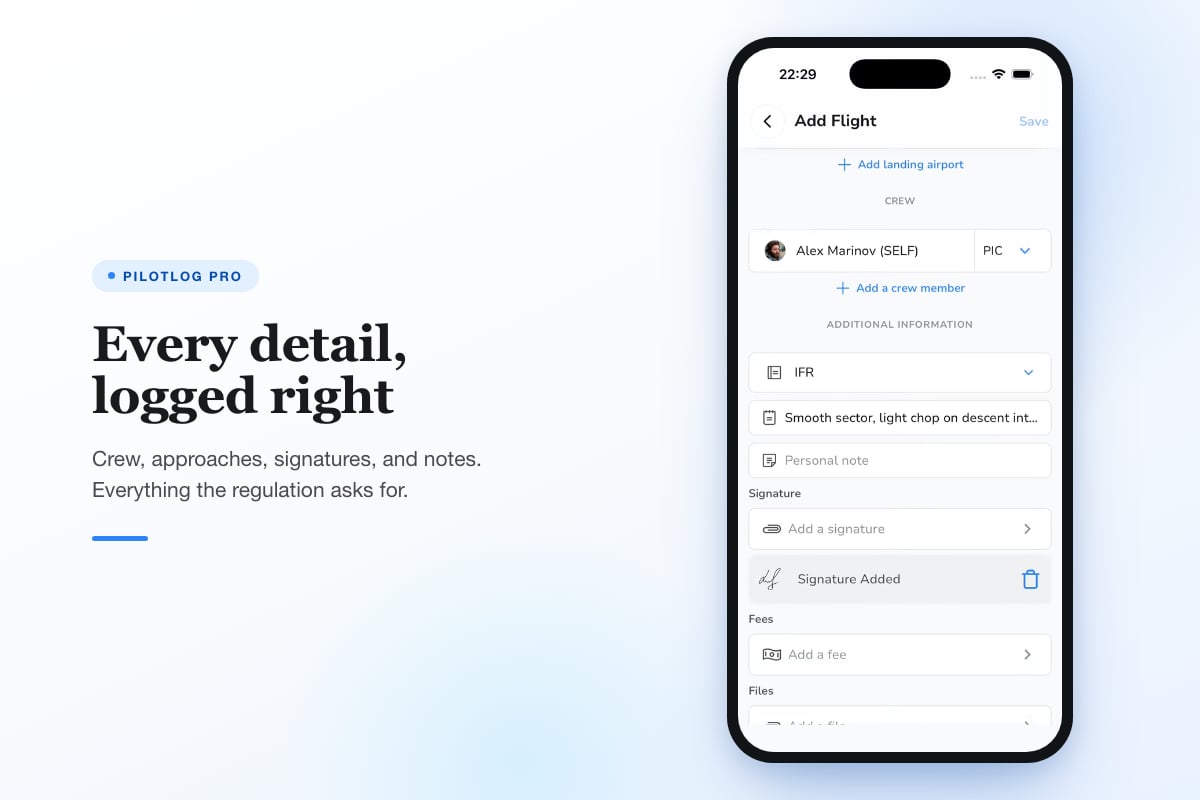
Commercial and airline pilots face additional duty and flight time limitations. Pilotlog Pro tracks rolling 28-day and 365-day limits automatically, flagging when you approach regulatory maximums for flight time and duty hours, while maintaining currency tracking for passenger, night, and IFR operations.
Logbook Formats and Organisation
Paper logbooks remain legally acceptable under FAA and EASA rules, but they carry risks. Fire, water damage, or simple loss destroys irreplaceable records. Photocopies provide some protection, but many pilots now maintain parallel digital records.
Digital logbook options range from basic spreadsheets to purpose-built applications. Choosing pilot logbook software requires evaluating backup systems, export formats, and regulatory compliance features. The key consideration is whether you can produce the logbook in an acceptable format during a ramp check.
The FAA accepts electronic logbooks provided they are legible and available for inspection. EASA regulations similarly permit electronic records under EASA Part-FCL. However, you must be able to display the logbook to inspectors on demand, which means cloud-based systems need offline access capability.
Backup and Redundancy Strategies
Protecting your flight records requires redundant storage. Paper logbook users should maintain scanned copies stored separately from the original. Digital logbook users need automated backups to multiple locations.
Best practices include:
- Monthly exports of your complete logbook to PDF format
- Cloud storage with version history to recover from accidental deletions
- Physical copies of key endorsements and certificates stored separately
- Annual verification that backup systems work and files are readable
- Format migration when changing logbook systems to ensure no data loss
Loss of your logbook does not erase your experience, but reconstructing records from memory, receipts, and aircraft logbooks takes months. Pilots face significant challenges when attempting to recreate lost records for airline applications or certificate upgrades.
Special Categories of Flight Time
Certain flight time categories require careful definition to avoid claiming time you did not legally accrue. Cross-country time offers the clearest example of definitional precision.
For private pilot purposes, a cross-country flight must include a landing at an airport more than 50 nautical miles from the original departure point. For instrument rating purposes, the flight must cover more than 50 nautical miles in a straight line between departure and arrival. For commercial and ATP purposes, you need a landing at a point more than 50 nautical miles away, but the regulation specifies use of pilotage, dead reckoning, and navigation systems.
Your logbook entry must support the category you claim. Recording a flight from KJFK to KEWR (12 nautical miles) as cross-country time signals unfamiliarity with the rules. Recording the route, distance, and navigation methods used helps demonstrate compliance.
| Time Category | Definition | Common Error |
|---|---|---|
| Cross-country | 50+ nm landing from departure | Claiming short repositioning flights |
| Night | 1 hr after sunset to 1 hr before sunrise | Using civil twilight instead |
| Actual IMC | Flight in instrument meteorological conditions | Claiming IMC on clear days |
| Simulated instrument | Hood or approved device with safety pilot | Logging without safety pilot signature |
| PIC | Sole manipulator, rated, or acting as PIC | Claiming PIC as a passenger |
Actual instrument time can only be logged when operating in instrument meteorological conditions. Flying under the hood in clear weather is simulated instrument time, not actual. The distinction matters for insurance and employer requirements that specify actual IMC experience.
Logbook Entries for Career Milestones
Certain flights deserve detailed logbook entries beyond the regulatory minimum. Your first solo, first cross-country, check ride flights, and type rating rides mark career progression. Including brief notes about conditions, challenges, or achievements creates a personal record of your development.
Check ride entries should reference the specific regulation tested. For example, a commercial pilot practical test entry might note "14 CFR 61.129 commercial ASEL practical test, satisfactory completion" along with the examiner's signature and designation number. This entry proves you passed and met the aeronautical experience requirements for the certificate.
Transition training to new aircraft types benefits from detailed entries. Recording the specific manoeuvres practised, flight characteristics encountered, and proficiency gained helps when returning to that aircraft after a gap. Airlines and corporate operators reviewing your logbook assess not just total time but recency and variety of experience.
Ferry flights, international operations, and unusual events also merit expanded descriptions. A transatlantic crossing in a single-engine aircraft or a precautionary landing due to weather demonstrates judgement and experience beyond routine flights. These entries distinguish you in competitive hiring environments.
<image_prompt alt="Career milestone logbook entries">Significant pilot career milestones documented in logbook: first solo, rating check rides, type ratings, and transition training with detailed endorsements</image_image_prompt>
Regulatory Compliance Across Jurisdictions
Pilots operating internationally must reconcile different logbook requirements. FAA regulations under 14 CFR Part 61, EASA Part-FCL rules, and ICAO standards overlap but include jurisdiction-specific details. Your logbook must satisfy the most stringent requirement when you hold multiple licences.
EASA Part-FCL FCL.050 requires pilots to maintain records demonstrating compliance with experience, training, and currency requirements. The format differs slightly from FAA requirements, particularly regarding night time definitions and cross-country criteria. EASA defines night as the period between the end of evening civil twilight and the beginning of morning civil twilight, which varies by latitude and season.
UK CAA post-Brexit regulations largely mirror EASA Part-FCL but include specific British interpretations. Pilots should verify current requirements through official sources, as regulations change and interpretations evolve. Relying on outdated guidance or anecdotal advice risks non-compliance.
Canadian, Australian, and other civil aviation authorities impose similar logbook requirements with local variations. If you plan to validate or convert your licence in another jurisdiction, research those requirements early. Some authorities require specific endorsement formats or translation of foreign logbook entries.
Worked Example: Building Hours Toward Commercial Certificate
Consider a pilot working toward the FAA commercial certificate requiring 250 total hours, including specific cross-country, night, and instrument time. Your logbook must prove each requirement.
Starting with 160 total hours, including:
- 78 hours PIC
- 12 hours cross-country PIC (to commercial standard)
- 8 hours night
- 5 hours actual instrument
- 35 hours dual instruction received
You need to build 90 hours total, with emphasis on:
- 20 hours instrument training (dual, devices acceptable for up to 10 hours)
- 10 hours complex or turbine aircraft
- Additional cross-country PIC to reach required totals
- Night operations to meet the 5-hour dual requirement
Each hour you log must specify whether it counts toward commercial requirements. A night cross-country dual flight might simultaneously build night time, cross-country time, and dual instruction received. Your logbook entries must break down each component clearly.
After completing commercial training, your logbook should show:
- 250+ total hours
- 100+ hours PIC
- 50+ hours cross-country PIC (with one 300+ nm flight)
- 20 hours instrument training
- 10 hours complex aircraft
- 10 hours night (including 5 dual with 10 T&L and one cross-country over 100 nm)
The FAA reviews logbook entries carefully during practical tests. Missing signatures, vague entries, or time that does not meet regulatory definitions can delay your check ride or result in disapproval.
Common Questions About Pilot Flight Logbooks
Pilots frequently ask whether they must log every flight. The regulations require logging only time used to meet experience, recency, or currency requirements. However, most pilots log all flights to maintain a complete record and avoid questions about gaps.
Student pilots often wonder about logging flights before solo. All dual instruction counts toward your total time and certificate requirements. Ensure your instructor signs each entry with their certificate number and expiry date. Missing signatures render those hours unusable for meeting requirements.
Can you log time in a simulator? Yes, under specific conditions. Approved flight simulation training devices (FSTDs) and flight training devices (FTDs) allow logging time toward certain requirements. The device must be approved and the training must meet regulatory standards. Your logbook entry must identify the device by its qualification level.
What happens if you make an error? Draw a single line through the incorrect entry, write the correction nearby, and initial it. Never erase, use correction fluid, or tear out pages. Alterations that hide original entries raise suspicion during audits.
How long must you retain logbook records? Permanently. Your logbook proves your entire flight history. While you must retain endorsements for currency only as long as you rely on them, retaining all records protects you in investigations, insurance claims, and career verification.
Logbook Maintenance Throughout Your Career
Early career pilots often maintain meticulous records but become lax as hours accumulate. Airline pilots with 15,000 hours sometimes neglect logbook entries, assuming their employment records suffice. This creates gaps that matter when changing employers, upgrading certificates, or facing investigations.
Maintain the same entry discipline at 10,000 hours as you did at 10 hours. Each flight merits a complete entry with all required fields. Technology makes this easier than in the paper logbook era, but the pilot remains responsible for accuracy.
Review your logbook quarterly. Verify that currency requirements are met, endorsements are current, and totals reconcile. Discrepancies compound over time, making retrospective corrections difficult. Finding a 10-hour error after 200 flights requires reconstructing which entries contributed to the mistake.
Update your logbook promptly after each flight. Waiting until month-end invites errors as you forget details about aircraft registration, conditions, or approaches flown. Log flights within 24 hours while memory remains fresh.
Pilotlog simplifies this process through mobile apps that let you log flights immediately after shutdown. Quick entry of basic details captures the essential information, with detailed breakdowns available when you have more time.
A pilot flight logbook documents your experience, proves your currency, and supports your career from student certificate through airline command. Accurate entries meeting regulatory requirements protect your certificates and demonstrate professionalism to employers and inspectors. Pilotlog keeps your logbook current across all devices, tracks currency automatically, and alerts you to approaching expiry dates for licences and medicals, ensuring you stay legal and ready for every flight.
- 14 cfr 61.51
- pilot logbook
- logbook requirements
- currency tracking
- flight endorsements
A logbook that keeps itself.
Join the waitlist and be first in line when Pilotlog launches.
Free to join, no spam. Unsubscribe any time.