learn flying
Learn Flying: Complete Guide to Getting Your Pilot Licence
30 Sep 2026 · 11 min read
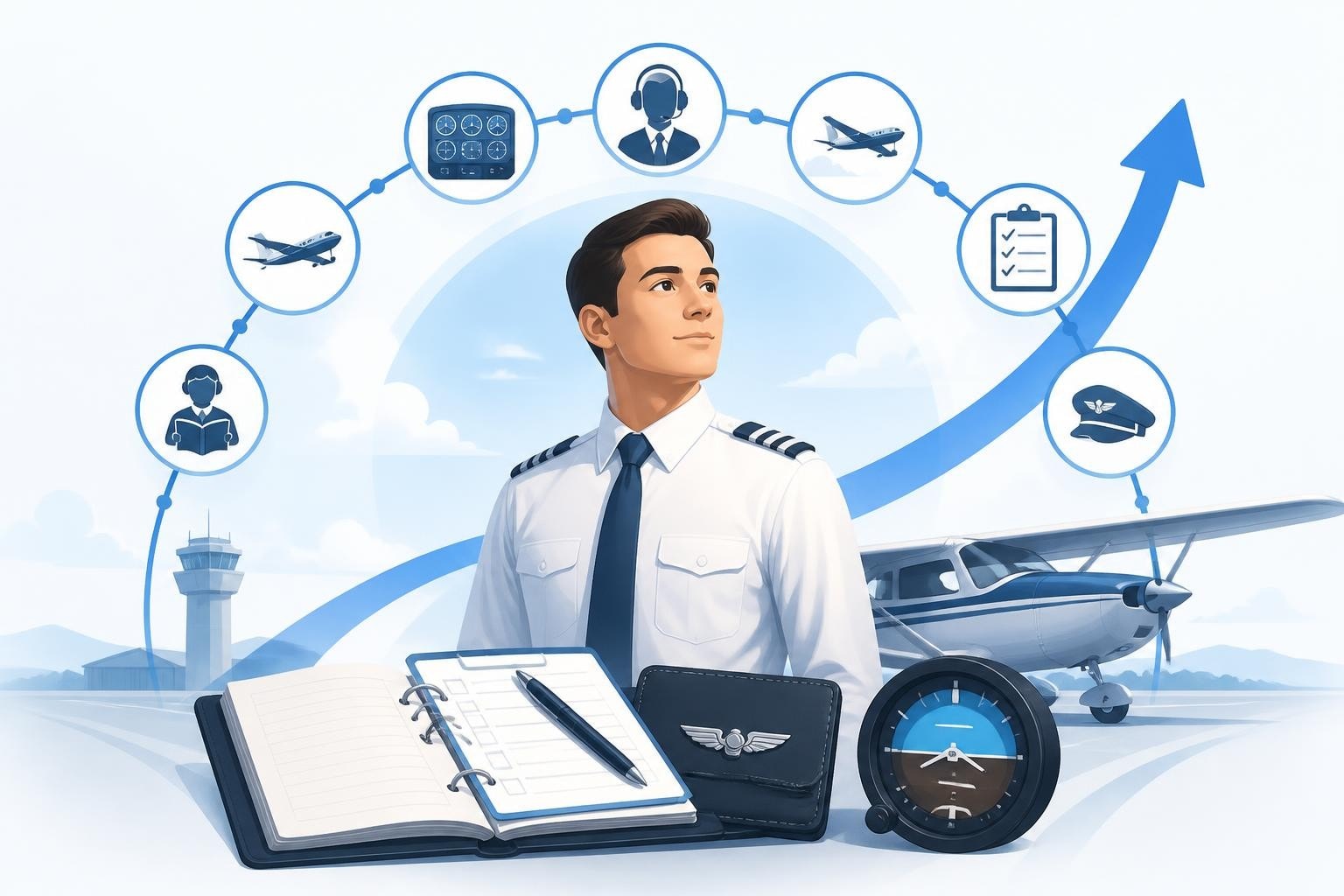
Learning to fly is a structured, achievable goal. Most student pilots begin with a Private Pilot Licence (PPL), which requires a minimum of 45 flight hours in the UK under CAA Part-FCL, or 40 hours under FAA rules in the United States. You will need to pass theoretical exams, complete solo and dual instruction, and demonstrate proficiency in a practical test. The process demands commitment, consistent training, and meticulous record-keeping from your first lesson through certification and beyond.
Choosing the right training path to learn flying
The first decision when you decide to learn flying is selecting a training organisation and the type of licence you want to pursue. In the UK, the UK Civil Aviation Authority sets the framework for pilot training under Part-FCL. In the United States, the FAA oversees training through approved flight schools and independent Certified Flight Instructors.
Your options typically include:
- Private Pilot Licence (PPL) for non-commercial flying
- Commercial Pilot Licence (CPL) for paid flying work
- Instrument Rating (IR) to fly in poor weather
- Airline Transport Pilot Licence (ATPL) for airline operations
Most pilots start with a PPL. It permits you to fly single-engine aircraft carrying passengers in visual conditions. The minimum requirements under UK CAA Part-FCL include:
| Requirement | Minimum hours/items |
|---|---|
| Total flight time | 45 hours |
| Dual instruction | 25 hours |
| Solo flight | 10 hours (including 5 hours solo cross-country) |
| Solo cross-country | 1 flight minimum 270 km (150 nm) with two full-stop landings |
| Theoretical exams | 9 subjects |
| Practical test | 1 skills test with examiner |
In the United States, FAA requirements are slightly different: 40 total hours minimum, with 20 hours dual and 10 hours solo. Flight schools affiliated with universities or Part 141 approved programmes may offer structured syllabi with reduced minimums.
Ground school and theoretical knowledge
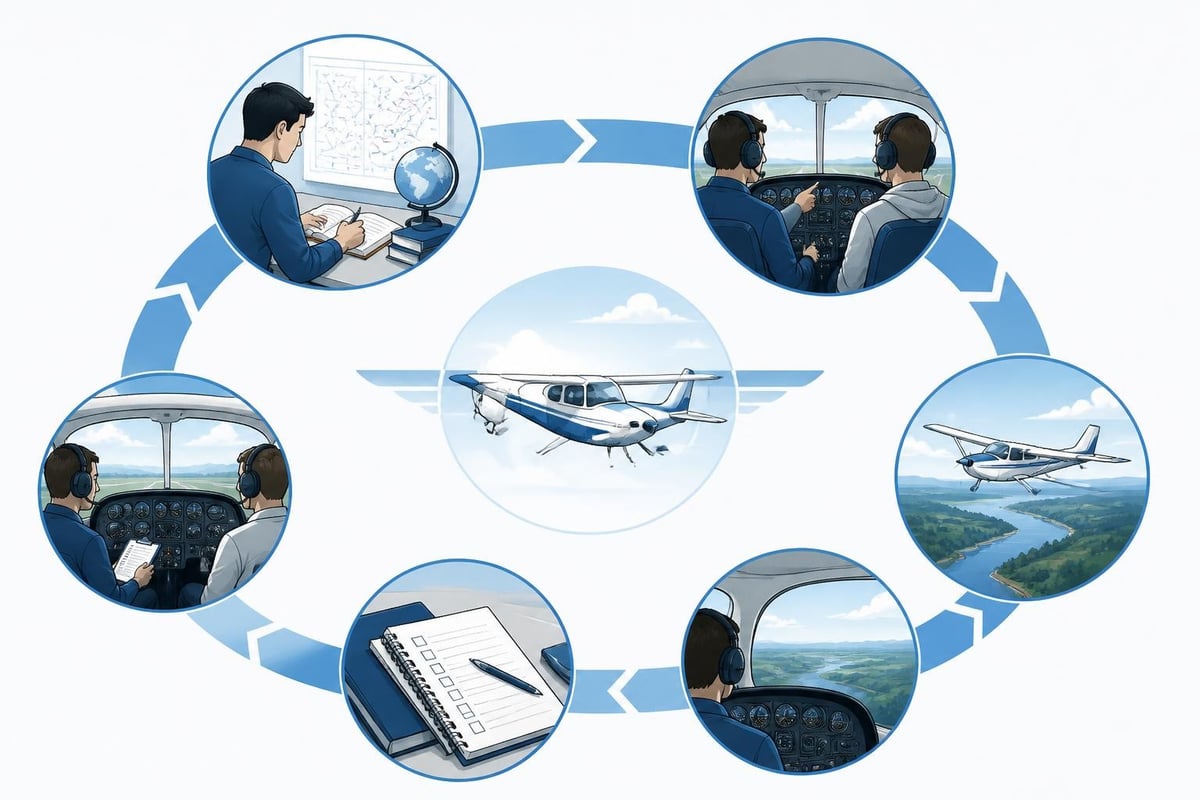
Before you can solo, you need a solid grasp of aerodynamics, meteorology, navigation, regulations, and human performance. Ground school typically runs alongside flight training. Some students attend evening classes at their training organisation; others complete online courses at their own pace. The theoretical knowledge exams cover:
- Air law and ATC procedures
- Aircraft general knowledge (airframes, systems, powerplants)
- Flight performance and planning
- Human performance and limitations
- Meteorology
- Navigation
- Operational procedures
- Principles of flight
- Communications (radiotelephony)
You must pass all exams within an 18-month period (UK Part-FCL) before taking your skills test. Study materials include official publications like the FAA Airplane Flying Handbook, which provides comprehensive coverage of flight manoeuvres and procedures used worldwide.
Building flight hours and logging experience
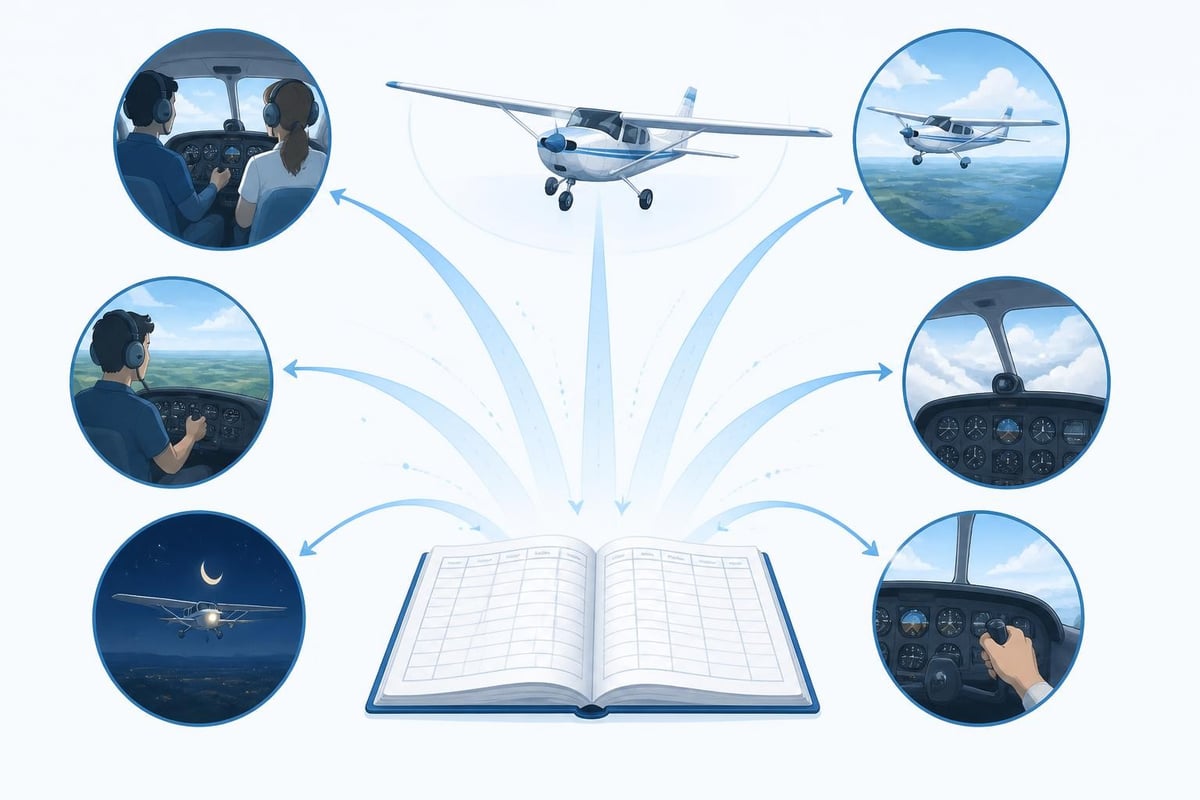
Once ground school is underway, you begin logging flight time. Every hour counts towards your licence, currency requirements, and future career progression. A digital pilot logbook ensures you track dual, solo, cross-country, night, and instrument hours accurately from day one.
Your early lessons focus on basic aircraft handling:
- Pre-flight checks and aircraft systems
- Taxiing, take-off, and climb
- Straight and level flight, turns, and coordination
- Descents and approach to landing
- Stalls, slow flight, and emergency procedures
- Circuit work and touch-and-go landings
After roughly 10 to 15 hours, your instructor will authorise your first solo. This milestone is one of the most memorable moments in learning to fly. You demonstrate the ability to safely take off, fly a circuit, and land without an instructor on board. Your instructor signs your training record (often called a student licence or pilot logbook), and you operate the aircraft alone within strict geographic limits.
Solo cross-country and navigation
Solo cross-country flying is the next major phase. You plan a route to an airfield at least 50 nautical miles away (UK PPL requirement), file a flight plan, calculate fuel, check weather, and navigate using visual landmarks and radio aids. For UK students, one cross-country solo must be at least 270 km with landings at two different aerodromes.
This is where meticulous logbook records become essential. You must demonstrate:
- Total cross-country time as pilot-in-command
- Solo cross-country flights meeting distance requirements
- Night flying hours (if included in your licence)
- Instrument flight time under simulated or actual IMC
Many students use Pilotlog to log these flights in detail. The platform tracks rolling hours, separates dual from solo time, and flags approaching currency limits so nothing is overlooked as training progresses.
Medical certification and regulatory requirements
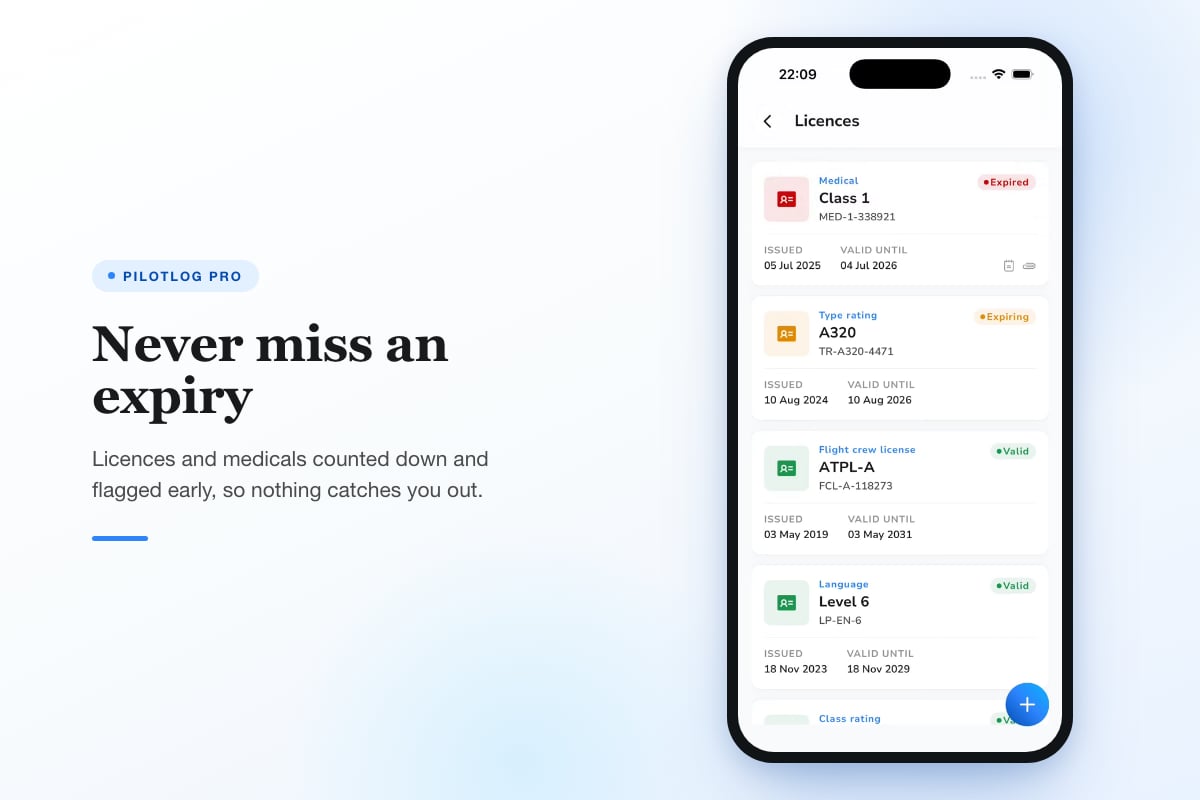
You cannot fly solo without a valid medical certificate. The UK CAA requires a Class 2 medical for a PPL, issued by a CAA-authorised Aviation Medical Examiner (AME). The medical covers vision, hearing, cardiovascular health, and neurological fitness. It is valid for 60 months if you are under 40, 24 months if you are between 40 and 50, and 12 months thereafter.
In the United States, student pilots need at least an FAA third-class medical. The validity periods differ slightly, but the principle is the same: you must be medically fit to exercise the privileges of your licence. Book your medical early. A deferral or limitation can delay solo flight and disrupt training momentum.
Key documents you need before first solo:
- Medical certificate (Class 2 or equivalent)
- Student pilot licence or certificate
- Government-issued photo ID
- Instructor endorsement in logbook
Regulations also require specific endorsements for solo flight in certain airspace, aircraft types, and cross-country operations. Your instructor will review FAA Airman Certification Standards or equivalent Part-FCL standards to ensure you meet each requirement before signing your logbook.
Skills test and licence issue
After completing your minimum hours, passing all theoretical exams, and receiving your instructor's recommendation, you book a skills test (also called a check ride in the United States). The examiner will review your logbook, verify that all requirements are met, and conduct an oral exam followed by a flight test.
The flight test assesses:
- Pre-flight preparation (weather, weight and balance, performance)
- Airmanship and aircraft handling (take-off, climb, cruise, descent, landing)
- Navigation (pilotage, dead reckoning, radio navigation)
- Emergency procedures (engine failure, forced landing, systems malfunctions)
- Manoeuvres (steep turns, stalls, slow flight)
- Compliance with ATC and regulations
The examiner will ask you to demonstrate each element to the standard defined in the certification criteria. In the United States, this is the Private Pilot Airplane Airman Certification Standards. In Europe, it is the Part-FCL skill test described in AMC1 FCL.235.A.
If you pass, the examiner issues a recommendation (or certificate, depending on jurisdiction). Your new licence arrives by post within a few weeks. You are now a qualified private pilot.
Staying current and continuing to learn flying
Earning your licence does not end the learning process. To stay legal and safe, you must maintain currency. UK Part-FCL regulation FCL.060 requires:
- 90-day rule: 3 take-offs and 3 landings in the last 90 days to carry passengers
- Biennial revalidation or renewal of your licence
- Proficiency check or training with an instructor if currency lapses
FAA regulations (14 CFR 61.57) have similar requirements: 3 take-offs and landings within the preceding 90 days for passenger-carrying privileges. Night currency requires 3 take-offs and landings to a full stop between one hour after sunset and one hour before sunrise within the preceding 90 days.
Tracking these windows manually is tedious and error-prone. Pilotlog Pro automatically calculates rolling currency, flags expiring medicals and ratings, and displays 28-day and 365-day limits if you advance to commercial flying. The system alerts you in time to plan a refresher flight or proficiency check, ensuring you stay current, legal, and ready.
Progressing beyond the PPL
Many pilots continue to learn flying by adding ratings and endorsements:
- Night rating (if not included in initial PPL)
- Tailwheel endorsement for conventional gear aircraft
- Aerobatic training for upset recovery and advanced handling
- Instrument Rating (IR) to fly in IMC and poor weather
- Multi-engine class rating for twin-engine aircraft
- Commercial Pilot Licence for paid flying work
- Flight instructor rating to teach others
Each step requires additional flight hours, ground training, and a check ride or skills test. Accurate logbook records are the foundation for demonstrating eligibility. Examiners and training organisations will scrutinise your logged hours, endorsements, and currency before approving progression.
Choosing a flight school and instructor
Quality instruction makes all the difference when you learn flying. Visit multiple flight schools before committing. Ask about:
| Factor | What to look for |
|---|---|
| Fleet condition | Well-maintained aircraft with modern avionics |
| Instructor qualifications | Experience, teaching style, pass rates |
| Training syllabus | Structured lessons aligned with Part-FCL or FAA standards |
| Availability | Consistent scheduling, aircraft and instructor availability |
| Safety record | Accident history, maintenance culture |
| Costs | Transparent pricing, no hidden fees |
AOPA's Learn to Fly resources offer excellent guidance on evaluating flight schools in the United States. The UK CAA provides a searchable database of approved training organisations on its website. Look for schools with a high first-time pass rate on skills tests and positive student reviews.
Your relationship with your flight instructor is critical. A good instructor explains concepts clearly, adapts to your learning style, and builds your confidence while maintaining high standards. If the fit is not right, speak with the school's chief instructor about switching. Continuity matters, but so does effective communication and trust.
Cost and time commitment
Learning to fly is an investment. In the UK, expect to spend between £8,000 and £12,000 for a PPL, depending on the school, aircraft type, and how quickly you progress. In the United States, costs range from $10,000 to $15,000. Additional expenses include:
- Medical examination (£150 to £200)
- Theoretical exam fees (roughly £100 per subject)
- Skills test fee (£400 to £600)
- Learning materials (books, apps, headset)
- Licence and certificate issue fees
For more detail on budgeting, see our breakdown of flight lesson costs. The key to controlling cost is consistency. Flying once every two weeks allows you to retain skills between lessons; gaps of a month or more mean repeating material and wasting money.
Time commitment varies. If you fly three times per week, you can finish a PPL in four to six months. One lesson per week stretches the timeline to 12 to 18 months. Weather, aircraft availability, and personal schedules all influence your pace.
Safety culture and human factors
Pilot training emphasises safety from day one. Accident data from NASA's Aviation Safety Reporting System highlights common training gaps and human performance issues. Understanding these lessons makes you a safer pilot.
Key principles include:
- Decision-making: Use structured models like the DECIDE framework (Detect, Estimate, Choose, Identify, Do, Evaluate)
- Risk management: Identify hazards, assess risk, mitigate through planning and contingency
- Crew resource management: Even as a solo pilot, manage workload, communicate clearly, and use all available resources
- Continuous learning: Participate in safety seminars, read accident reports, and fly with experienced mentors
Flight Safety Foundation resources provide evidence-based guidance on training competency and safety culture. Integrating these practices from your first lesson creates habits that last a career.
Evidence-based training and modern standards
Aviation training is evolving. Traditional time-based training (minimum hours) is giving way to competency-based training (CBT) and evidence-based methods. ICAO's personnel and licensing resources describe frameworks for modern training design, emphasising measurable outcomes over seat time.
This shift means instructors focus on whether you can perform a task to standard, not just whether you have flown 45 hours. Advanced simulators, scenario-based training, and data-driven assessments improve learning efficiency and safety. Some European schools now integrate EASA's Together4Safety guidance, which promotes safety culture and instructor best practices across all training.
For you as a student, this means higher-quality instruction and better preparedness for real-world flying. It also means you need to demonstrate mastery, not just log hours. Keep detailed notes on each lesson, review areas where you struggled, and actively seek feedback from your instructor.
Practical example: tracking progress through training
Imagine you are learning to fly at a UK flight school. After 30 dual hours and 8 solo hours, you have:
- Total time: 38 hours
- Dual instruction: 30 hours
- Solo: 8 hours (including 4 hours solo cross-country)
- Night: 0 hours (scheduled next month)
- Instrument: 2 hours (under simulated IMC)
You need 7 more hours total to meet the 45-hour minimum. You still require 5 more hours of solo cross-country and one qualifying cross-country flight of at least 270 km. You have passed 7 of 9 theoretical exams. Your medical is valid for another 52 months. Your instructor expects you will be ready for the skills test in six weeks.
A digital logbook shows these figures at a glance. It flags that you need the long cross-country and night hours, and reminds you to book the remaining exams. Every entry is timestamped, categorised, and exportable for the examiner. This level of detail prevents surprises and keeps training on track.
Note: Regulations and requirements change. Always confirm current minima and procedures with your national aviation authority or approved training organisation before committing to a training programme.
Learning to fly combines technical skill, regulatory knowledge, and disciplined record-keeping from your first lesson through every rating and endorsement. Staying current and legal means tracking hours, currency windows, and expiry dates accurately as your flying career progresses. Pilotlog is built for exactly that: log flights in seconds, track rolling currency automatically, and receive timely alerts for medicals and licence renewals so you can focus on flying safely and confidently.
- learn flying
- ppl training
- pilot licence
- flight hours logging
- ground school
A logbook that keeps itself.
Join the waitlist and be first in line when Pilotlog launches.
Free to join, no spam. Unsubscribe any time.