flying lessons
Airplane Flying Lessons: What Pilots Need to Know in 2026
1 Nov 2026 · 9 min read
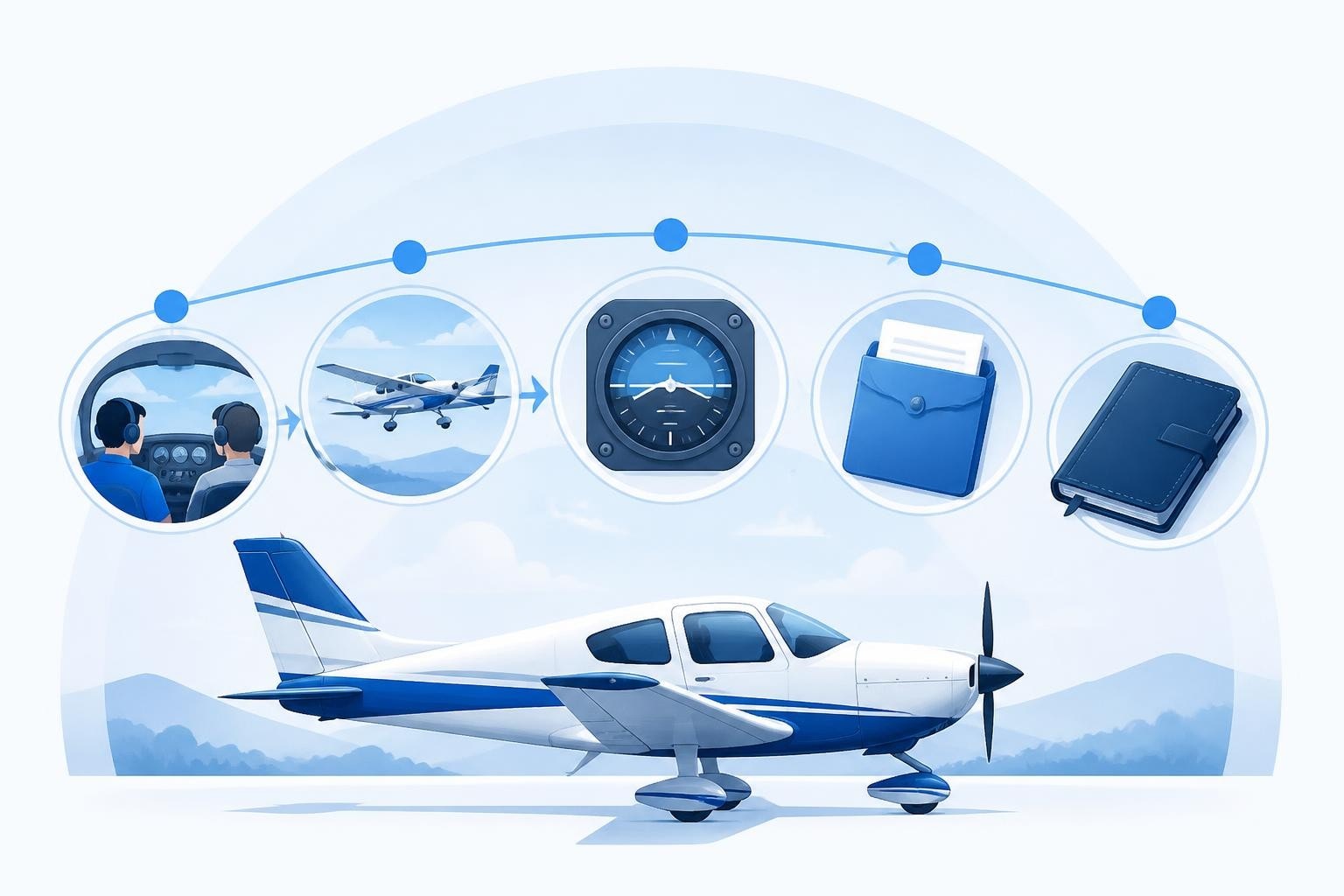
Airplane flying lessons train you to pilot an aircraft safely and legally, beginning with dual instruction and progressing to solo flight, navigation exercises, and eventually a skills test for your first licence. Under EASA Part-FCL, a Private Pilot Licence (Aeroplane) requires a minimum of 45 hours of flight instruction, including at least 25 hours dual and 10 hours supervised solo (FCL.210.A). The FAA requires 40 hours for a Private Pilot certificate under 14 CFR 61.109, though the U.S. national average is closer to 60-70 hours. Lessons combine airborne training with ground school covering principles of flight, meteorology, navigation, air law, and human performance.
What Airplane Flying Lessons Cover
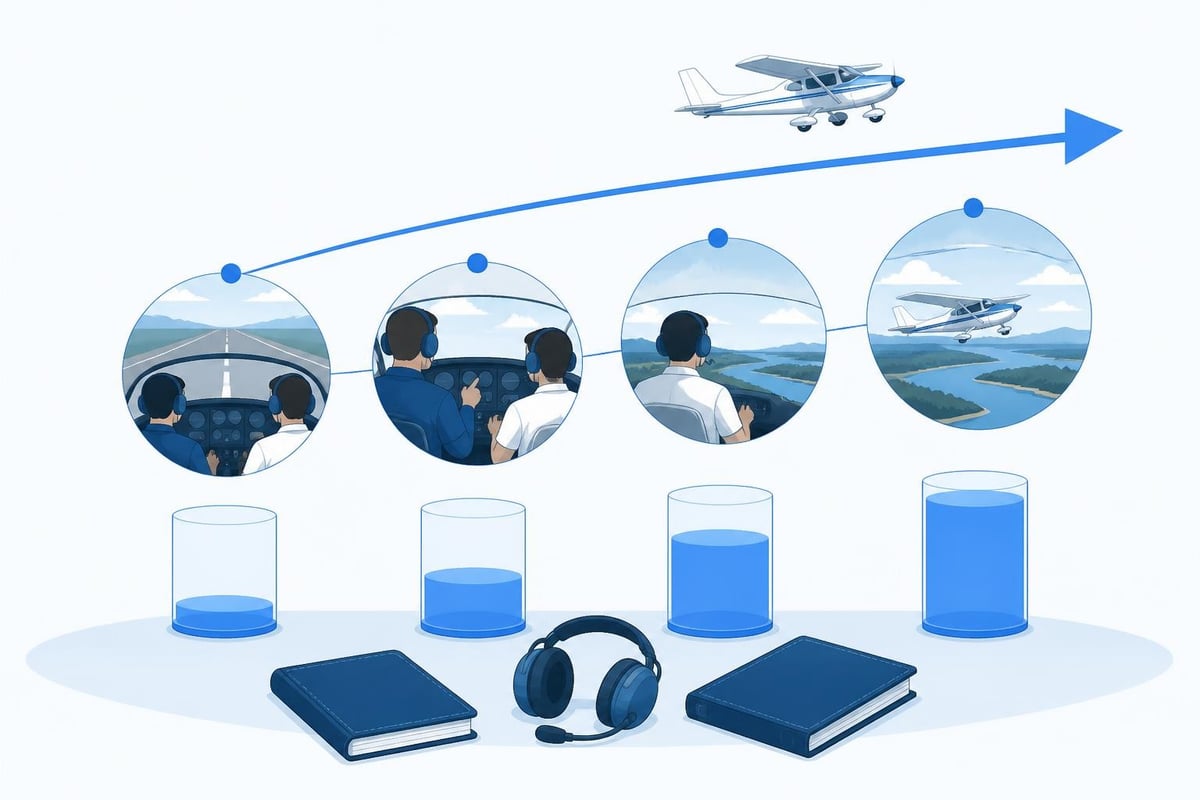
Your training syllabus breaks down into distinct phases, each building on the last. Early lessons teach basic aircraft handling: straight and level flight, climbs, descents, and medium turns. You will learn the effects of controls, power settings, and trim, typically in a single-engine piston aircraft such as a Cessna 152 or Piper PA-28.
Mid-phase training introduces emergency procedures, including practice forced landings, engine failures after take-off (EFATO), and systems malfunctions. You will also master circuits (the traffic pattern), landings in various configurations, and crosswind techniques. Navigation training follows, both visual (map, compass, stopwatch) and radio (VOR, GPS, ADF where available).
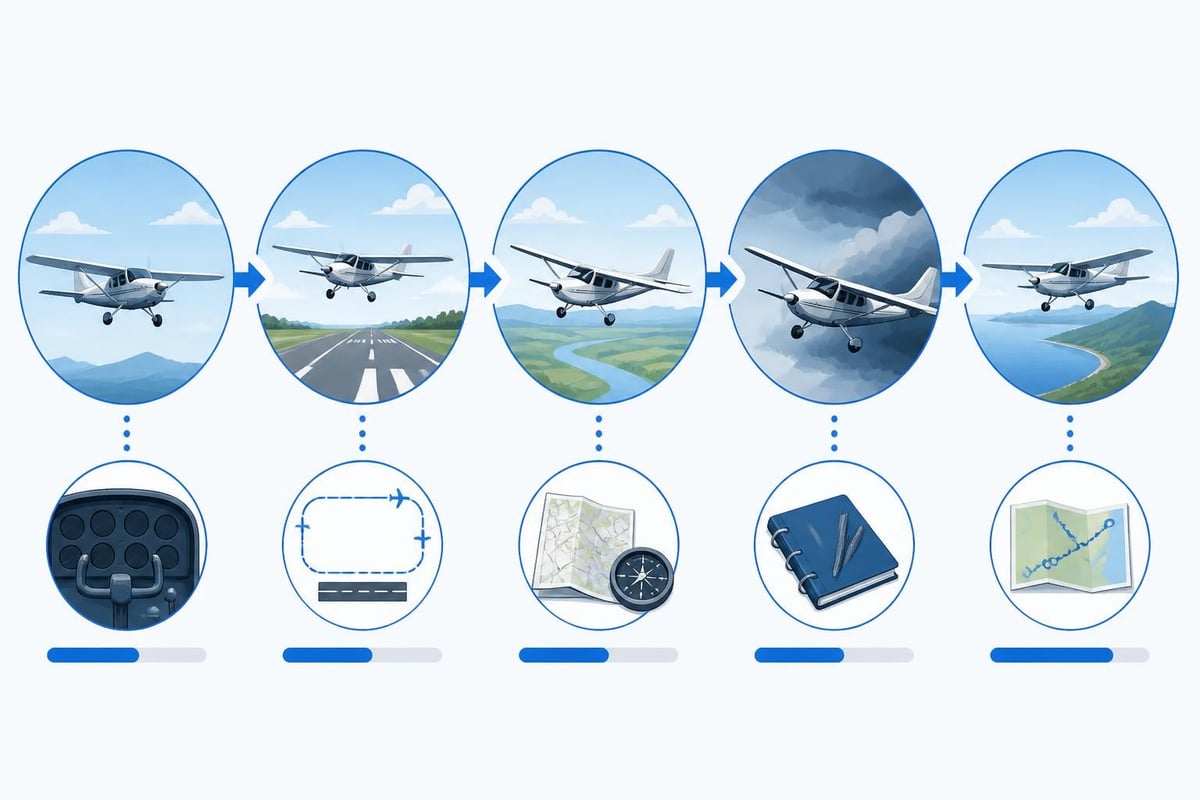
Advanced lessons address instrument appreciation (recovering from unusual attitudes under the hood), controlled airspace procedures, radio telephony, and night flying if your licence permits it. EASA requires at least 5 hours of instrument instruction for the PPL(A); the FAA requires 3 hours under 14 CFR 61.109(a)(3). These minimums prepare you to recognise and escape inadvertent IMC, a leading cause of fatal accidents according to NTSB general aviation data.
How Long Training Takes and What It Costs
Duration depends on lesson frequency and weather. Flying two or three times per week, most students complete a PPL(A) in six to twelve months. Flying once per week or less stretches training to 18 months or more, and you will need extra consolidation flights because skills decay between lessons.
| Frequency | Typical Duration | Total Hours (Average) |
|---|---|---|
| 3-4 lessons/week | 4-6 months | 50-60 hours |
| 2 lessons/week | 6-9 months | 55-65 hours |
| 1 lesson/week | 12-18 months | 65-75 hours |
Costs vary by region and aircraft type. In the UK (2026), expect £180-£250 per hour for a basic trainer (PA-28 or C152), instructor included. In the United States, wet rates run $150-$200 per hour plus instructor fees of $50-$70 per hour. Ground school may be included or charged separately; budget £500-£1,500 for structured courses or online programmes.
A worked example: Sarah starts her PPL(A) training in March 2026 in southern England, flying a PA-28-161 at £210/hour all-in. She flies twice per week and completes 52 hours by October 2026 (7 months). Total cost: 52 × £210 = £10,920, plus £800 ground school, £150 books and charts, £200 medical (EASA Class 2), and £300 skills test fee. Grand total: £12,370.
Additional costs include licence application fees, landing fees at training aerodromes, and examiner charges. Always ask the flight school for an itemised breakdown before committing. The AOPA student pilot hub offers budgeting worksheets and cost surveys for U.S. students.
Medical and Regulatory Requirements
Before you can fly solo, you need a medical certificate. EASA requires a Class 2 medical issued by an aeromedical examiner (AME), valid for 60 months if you are under 40, 24 months if you are 40-49, and 12 months if you are 50 or older (Part-MED). The FAA requires at least a third-class medical, valid for 60 months under age 40 and 24 months thereafter, or BasicMed if you meet eligibility criteria. Details are on the FAA medical certification page.
You will also need a student pilot licence or permit before solo. In the UK, the CAA issues a Student Pilot Licence (SPL) on application; in the U.S., student pilot certificates are now issued electronically through IACRA after an instructor endorsement. These documents authorise supervised solo flight under specific limitations set by your instructor.
Key regulatory milestones:
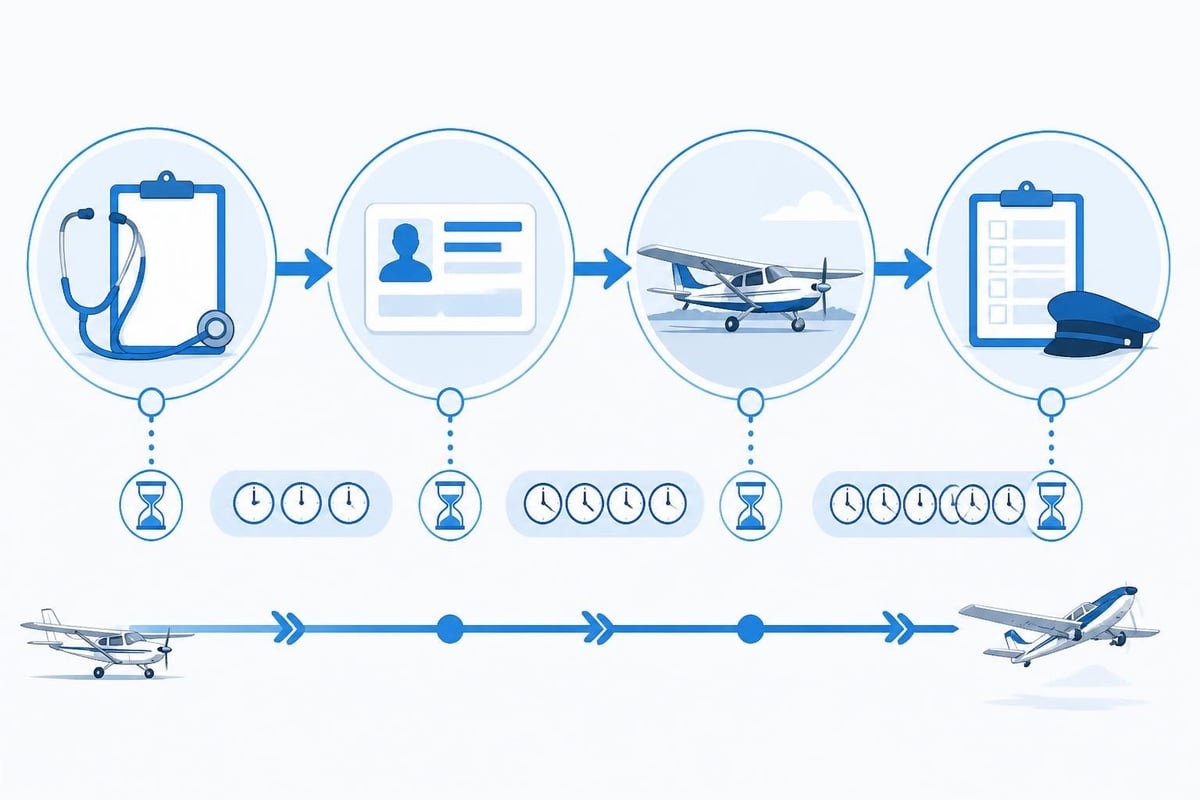
- Medical certificate obtained and valid
- Student licence or certificate issued
- First solo endorsement (usually 10-15 hours dual)
- Solo cross-country endorsement (navigation exercises)
- Skills test authorisation (instructor sign-off that you meet standards)
The FAA Airman Certification Standards define the knowledge and skill areas tested. EASA equivalents are detailed in Part-FCL easy access rules. Both frameworks emphasise risk management, aeronautical decision-making, and single-pilot resource management throughout training.
Choosing a Flight School and Instructor
Not all schools are equal. Visit at least two before deciding. Check the school's approval or certification status: EASA Approved Training Organisations (ATOs) or Declared Training Organisations (DTOs) in Europe, FAA Part 141 or Part 61 schools in the U.S. ATOs and Part 141 schools follow structured syllabi approved by the regulator; Part 61 and DTOs offer more flexibility but require the same final standards.
Ask about instructor qualifications. In Europe, instructors hold a Flight Instructor (FI) rating with at least 200 hours as PIC (FCL.905.FI). In the U.S., certificated flight instructors (CFIs) need a commercial certificate and specific training under 14 CFR 61.183. Instructor experience matters: ask how many students they have taken to test and their first-time pass rate. More about instructor credentials is covered in our flight instructor guide.
Questions to ask the school:
- What is the average total cost to PPL completion, including all fees?
- How many aircraft are available, and what is their serviceability rate?
- Are simulators or flight training devices (FTDs) available for instrument and procedure training?
- What is your first-time skills test pass rate?
- Can I switch instructors if the relationship is not working?
Fleet size and aircraft availability directly affect how often you can fly. Schools with only one or two aircraft suffer frequent cancellations for maintenance. A good school will have spare capacity. The UK CAA learn-to-fly page lists approved organisations and offers guidance on evaluating schools.
Tracking Your Progress and Currency
Once you start airplane flying lessons, you must log every flight accurately. Your logbook is a legal record, required for licence applications, insurance, and proving recency. Recording take-offs, landings, PIC time, dual instruction, and conditions (day, night, IFR, VFR) ensures nothing is missed when you apply for your skills test.
Digital logbooks simplify this. Pilotlog Pro tracks your hours in real time, flags currency lapses, and reminds you when your medical or licence endorsements are due. From the first lesson through to ATP, Pro keeps the arithmetic current so you can focus on flying.
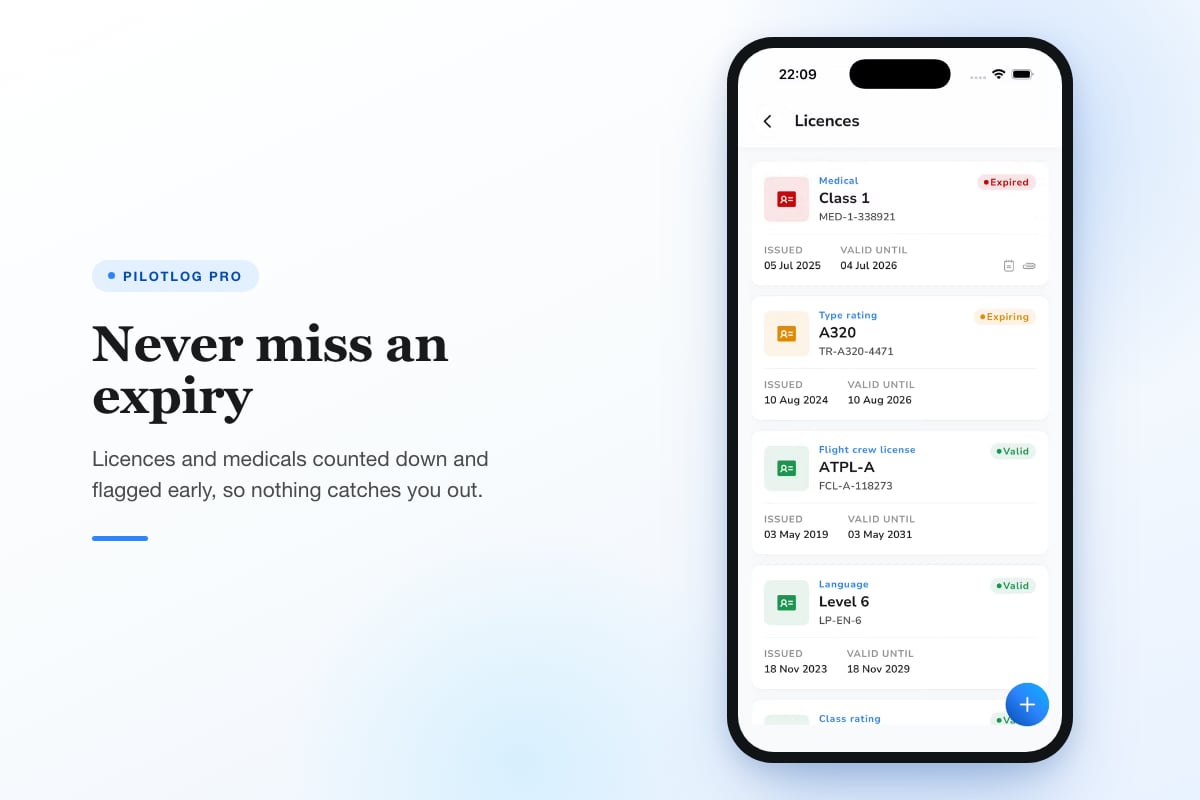
Students often underestimate the admin involved. You will need to track not only total hours but also specific categories: solo time, solo cross-country distance (at least 150 nautical miles under EASA FCL.210.A, or 150 NM with full-stop landings under 14 CFR 61.109), and instrument time. Missing a single entry can delay your skills test authorisation by weeks.
Paper logbooks are acceptable, but errors are permanent. Scanning or photographing pages is wise. If you are training toward a professional career, starting with a digital logbook from day one means every flight from your first lesson to your last line check is searchable, exportable, and backed up. Guidance on structured logging is available in our learn to fly a plane article.
Safety, Human Factors, and Modern Training Methods
Accident data shows that loss of control in flight (LOC-I) and controlled flight into terrain (CFIT) are the top killers in general aviation. Training now incorporates threat-and-error management (TEM) and evidence-based methods to address these risks. Skybrary human factors guidance informs many European syllabi, while Flight Safety Foundation advocates competency-based training (CBT) globally.
Modern airplane flying lessons emphasise scenario-based training: realistic situations (deteriorating weather, unplanned diversions, passenger illness) rather than rote manoeuvres. Instructors assess not just stick-and-rudder skills but also aeronautical decision-making, situational awareness, and workload management. ICAO competency-based training resources detail this shift, which is progressively being adopted worldwide.
Safety topics covered in good training programmes:
- Pre-flight risk assessment (PAVE: Pilot, Aircraft, enVironment, External pressures)
- Recognition and recovery from unusual attitudes and stalls
- Fuel planning with reserves and alternate aerodromes
- Weather interpretation (METARs, TAFs, area forecasts, significant weather charts)
- Single-pilot resource management (checklists, sterile cockpit, prioritisation)
You should finish your training confident in your ability to recognise when a flight should not go ahead. If your instructor does not regularly discuss these topics or cancels lessons only for unserviceability, not weather minima or fatigue, find another school.
Frequently Asked Questions
How many hours of airplane flying lessons do I need for a private licence?
EASA Part-FCL requires a minimum of 45 hours total time for a PPL(A), including at least 25 hours dual instruction and 10 hours supervised solo (FCL.210.A). The FAA requires 40 hours under 14 CFR 61.109, though most students take 60-70 hours to reach test standard. Your actual total depends on aptitude, lesson frequency, and weather.
Can I start airplane flying lessons without a medical certificate?
You can begin dual instruction in most jurisdictions without a medical, but you cannot fly solo. Obtain your medical early to avoid investing time and money only to discover a disqualifying condition. EASA Class 2 and FAA third-class medicals are mandatory before solo. Processing takes 2-6 weeks, so apply as soon as you commit to training.
Do airplane flying lessons include ground school and exams?
Yes. All licences require passing written (theoretical knowledge) exams covering air law, meteorology, navigation, aircraft performance, and human performance. EASA has nine subjects for PPL(A); the FAA has a single knowledge test. Ground school can be classroom-based, online, or self-study. Budget 80-120 hours of ground study alongside your flight training.
Airplane flying lessons are a structured, regulated process that transforms you from passenger to pilot in under a year if you fly regularly and track your progress carefully. From your first lesson to your skills test, accurate logging of hours, currency, and endorsements is essential. Pilotlog keeps every flight recorded, tracks your progress toward licence minimums, and alerts you to upcoming expiries, so nothing catches you by surprise as you build toward solo and beyond.
- flying lessons
- ppl training
- learn to fly
- flight school
- student pilot
A logbook that keeps itself.
Join the waitlist and be first in line when Pilotlog launches.
Free to join, no spam. Unsubscribe any time.