helicopter lessons cost
Helicopter Flying Lessons Cost: The Full Price Breakdown
17 Sep 2026 · 16 min read
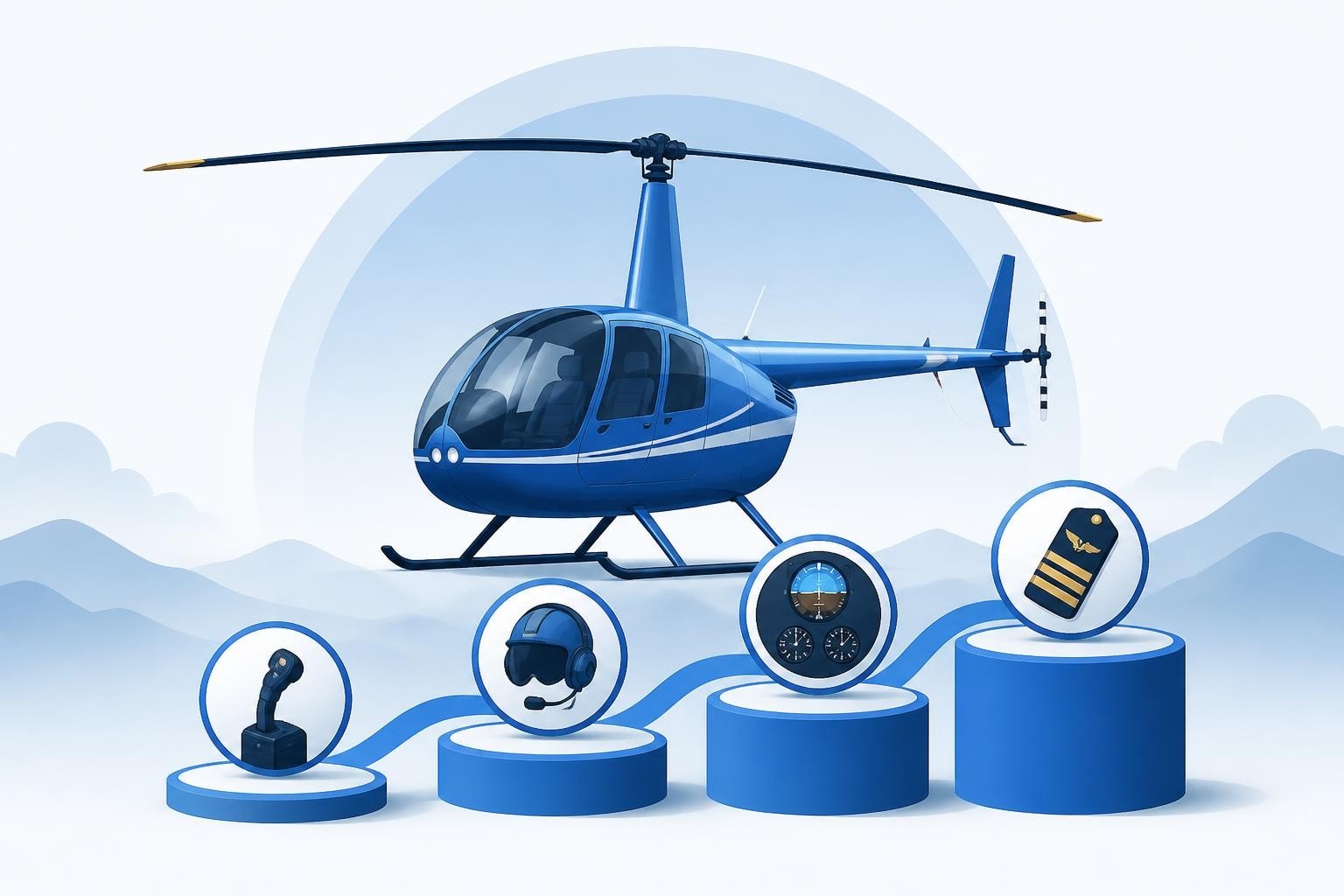
Helicopter flying lessons cost between £300 and £500 per hour in the UK, with total training to private pilot licence (PPL(H)) typically requiring 45–60 hours and £15,000–£30,000. Commercial helicopter pilots can expect to invest £60,000–£100,000 from zero experience to a CPL(H) with instrument rating. The final bill depends on aircraft type, school location, instructor rates, and how efficiently you progress through the syllabus.
Understanding helicopter flying lessons cost means looking beyond the advertised hourly rate. Ground school, examinations, medical certificates, and additional training hours all stack up. This guide breaks down every element so you can budget accurately and make informed decisions about your rotary-wing training path.
Hourly Rates and What They Include
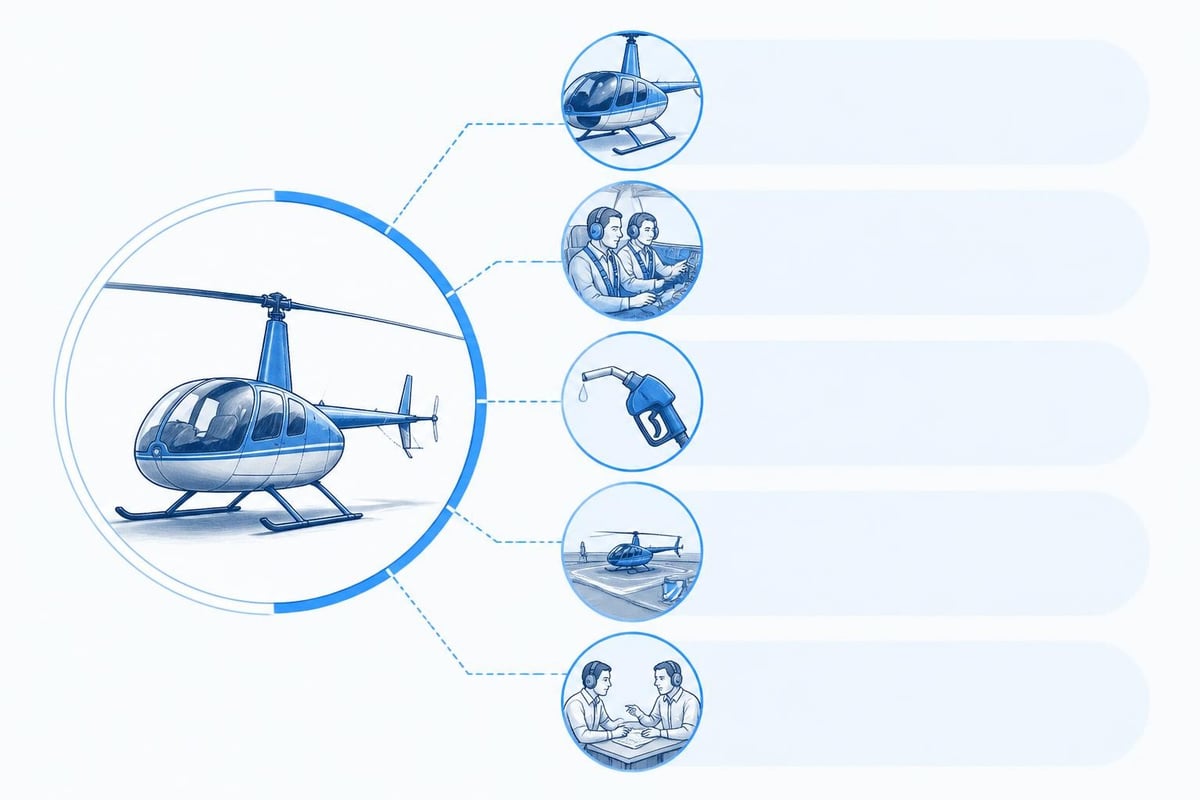
The hourly rate you see advertised is almost always wet-rate: aircraft rental with fuel, oil, and insurance included. Instructor fees may be bundled or charged separately, typically adding £40–£80 per hour.
Most schools quote for these common training helicopters:
- Robinson R22 (two-seat piston): £250–£350/hour
- Robinson R44 (four-seat piston): £350–£450/hour
- Cabri G2 (two-seat piston): £280–£380/hour
- Schweizer 300 (three-seat piston): £300–£400/hour
Turbine helicopters command significantly higher rates. An Airbus H125 or Bell 206 can run £800–£1,200 per hour, so unless your career path requires turbine time early, most students train in piston machines and transition later.
Ground briefings and debriefs are usually charged at instructor rates, not aircraft rates. Expect 30 minutes of ground time for every hour of flight during early training. Schools bundle these differently: some include briefing time in a flat per-lesson fee; others itemise every quarter-hour.
PPL(H) Total Cost Estimates
The EASA PPL(H) requires a minimum of 45 hours total flight time under Part-FCL, including at least 25 hours dual instruction and 10 hours supervised solo. Most students finish between 50 and 60 hours because helicopters demand more stick-and-rudder finesse than aeroplanes, and weather in the UK often disrupts training schedules.
| Cost Element | Typical Range (£) |
|---|---|
| Flight training (50–60 hours) | 12,500–27,000 |
| Ground school (classroom or online) | 500–1,500 |
| Books, charts, equipment | 200–400 |
| Medical certificate (Class 2) | 150–250 |
| Skills test (examiner + aircraft) | 600–900 |
| Licence application and admin | 100–200 |
| Total PPL(H) | 14,050–30,250 |
Flight training dominates the budget. At £350/hour for an R44 and £60/hour for instruction, a 55-hour syllabus costs £22,550 in the air alone. Add ground school, exams, and sundries, and you land near £25,000 for a typical PPL(H) completed without major interruptions.
Schools offering integrated courses sometimes package everything into a fixed price, which caps your exposure if you need extra hours. Pay-as-you-go Part 61 training offers flexibility but no cost ceiling, so progress efficiently or the bill climbs. The FAA summary of flight-hour requirements provides a useful comparison for those training under FAR Part 61 or 141 in the United States, where minimums differ slightly.
Hidden Costs and Scheduling Impact
Weather cancellations are facts of rotary-wing training. Unlike fixed-wing students who can fly in moderate crosswinds, helicopter trainees need lighter conditions, especially for hovering practice. Every cancelled lesson still requires a rebooking fee or lost deposit at some schools.
Students who fly once a week take 12–18 months to finish 50 hours. Those flying three times weekly finish in four to six months and spend less overall because skills retention is higher and fewer revision hours are needed. Intensive courses compress timelines but demand full-time availability and are mentally exhausting.
Budget an extra 10–15% above the advertised course price to cover additional hours, resits, and unforeseen fees. Pilots who track their flight hours accurately from day one can spot inefficiencies early. A digital pilot logbook makes it simple to monitor exactly how many dual, solo, and solo cross-country hours you've logged against syllabus minimums.
CPL(H) and Advanced Training Costs
A commercial pilot licence (helicopters) requires 155 hours total time, including 50 hours PIC, 10 hours cross-country PIC, and 30 hours dual on helicopters (EASA Part-FCL). Most students entering CPL(H) training already hold a PPL(H), so they need roughly 100–110 additional hours plus advanced ground school and instrument training.
Typical CPL(H) pathway costs from PPL(H):
- Additional flight training (100–110 hours): £30,000–£50,000
- ATPL ground school (distance learning or classroom): £3,000–£6,000
- CPL skills test: £700–£1,000
- Instrument rating (IR(H)): £8,000–£12,000
- Night rating (if not included in PPL): £1,500–£2,500
- Type rating for larger helicopters: £5,000–£15,000
From zero to CPL(H) with instrument rating, budget £65,000–£100,000. This wide range reflects aircraft choice, training intensity, and whether you pursue modular or integrated training. Integrated courses lock in pricing but lack flexibility; modular training lets you pause and spread costs, though hourly rates may rise between phases.
Turbine transition is a critical expense. Most commercial operators require turbine PIC time, yet training in turbine helicopters costs double or triple piston rates. Many pilots build piston hours to minimums, then pay for 10–20 turbine hours and a type rating on an H125 or similar. That final push can add £10,000–£20,000 to the total.
Instructor and Examiner Fees
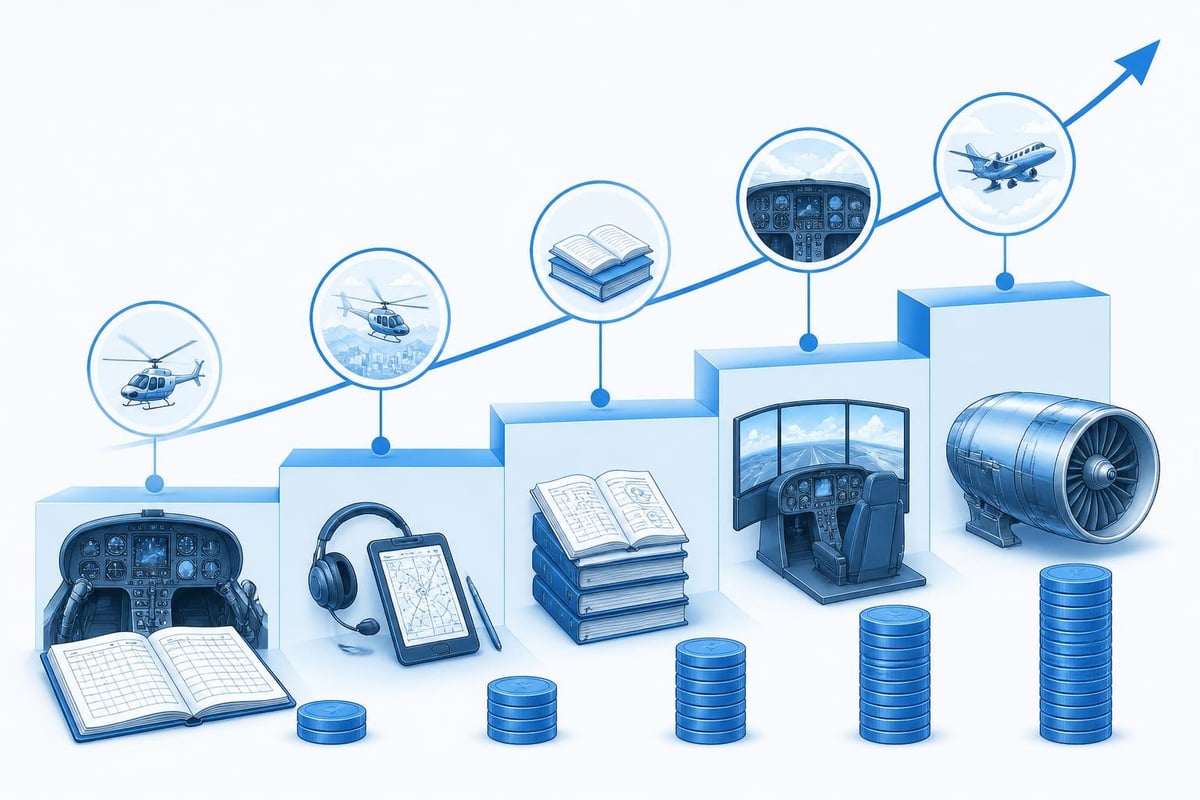
Instructor rates vary by experience and school prestige. A newly qualified flight instructor (FI(H)) may charge £40–£50 per hour; a senior instructor or examiner charges £70–£100. For skills tests, you pay both the examiner's fee (£300–£500) and aircraft hire for the test duration (typically 2–3 hours).
Some schools employ salaried instructors and include all instruction in the advertised per-hour rate. Independent instructors working with flying clubs usually invoice separately, so confirm what's included before signing up. The published helicopter flight fees from Lake Superior College provide a transparent example of how US collegiate programs itemise instruction, aircraft, and lab fees.
Ground school can be delivered in person, via distance learning, or through self-study with occasional instructor sessions. Classroom courses cost £1,000–£3,000 and offer structure and peer support. Online ATPL theory packages run £500–£1,500 and suit flexible schedules. Either way, budget 200–300 hours of study time for the full ATPL theory syllabus.
Regional and School Variations
Location drives significant price variation. Schools near London or operating from busy controlled airfields pass on higher landing fees, hangarage, and insurance costs. A school in rural Scotland or Wales may charge 15–20% less for the same aircraft type.
Sample R44 hourly rates by region (2026):
| Region | Typical R44 Rate (£/hour) |
|---|---|
| South-East England | 400–450 |
| Midlands | 360–400 |
| North England | 340–380 |
| Scotland | 330–370 |
| Northern Ireland | 320–360 |
These are indicative; individual schools set their own pricing. Some bundle extras (charts, headset hire, insurance excess waivers) into a higher hourly rate; others keep the base rate low and charge separately. Always request a fully itemised quote covering flight time, ground instruction, exam fees, and materials.
Part 141-equivalent approved training organisations (ATOs) must follow a structured syllabus and often offer fixed-price integrated courses with guaranteed completion or your money back. Non-ATO schools offer modular training that's cheaper per hour but with no ceiling. For disciplined, self-motivated students, modular training under Part-FCL can save thousands. If you need structure and accountability, an ATO's integrated course may deliver better value despite the higher sticker price.
The Rotorcraft Pro industry article discusses how instructor shortages and fleet bottlenecks are pushing some schools to raise rates or limit intake in 2026, so early booking and deposit locks can protect you from mid-training price hikes.
Financing and Payment Plans
Few students pay the full helicopter flying lessons cost upfront. Most schools offer phased payment: pay for a block of 10–20 hours, then top up as you progress. Block-hour discounts of 5–10% are common, but read the terms carefully. Some blocks expire after 12 months; others are non-refundable if you switch schools or pause training.
Financing options include:
- Career development loans (UK Government scheme, up to £10,000 per loan)
- Private pilot training loans from specialist lenders (12–24% APR typical)
- Employer sponsorship (some operators fund type ratings in exchange for bonded service)
- Military scholarships (limited availability, competitive)
- Vertical Aviation International education programs offering grants and fee-paid professional courses
Interest rates on training loans are rarely competitive with mainstream consumer credit, so exhaust savings, family support, and scholarships first. Spreading payments reduces upfront strain but extends training timelines, which can paradoxically increase total cost due to skill decay between lessons.
A few students work part-time as ground crew, dispatchers, or admin staff at their training school in exchange for discounted or free flight time. These arrangements are informal and not widely advertised, but worth asking about if cash flow is tight and you have time to dedicate.
Aircraft Type and Transition Costs
Most students begin in a Robinson R22 because it's the cheapest option at £250–£350/hour. The R22 is light, responsive, and unforgiving, which builds precise handling skills. After PPL(H), many transition to the R44 for hour-building because it's more comfortable, holds more fuel for cross-country flights, and is common in the commercial market.
Type ratings for larger helicopters are required before you can act as PIC. A type rating course runs 5–15 hours depending on aircraft complexity and your total time. Expect to pay:
| Helicopter Type | Rating Cost (£) |
|---|---|
| Robinson R44 (if trained on R22) | 1,500–3,000 |
| Airbus H125 (AS350) | 8,000–12,000 |
| Bell 206 JetRanger | 7,000–10,000 |
| Airbus H135 | 10,000–15,000 |
Turbine type ratings are expensive but essential for commercial employment. Most operators want 500+ hours total time and a relevant type rating before they'll consider you for a right-seat job. Pilots often self-fund the type rating as a final investment after accumulating the hour minimums through lower-cost piston flying.
Understanding helicopter pilot licence requirements helps you plan which type ratings to pursue and when, avoiding costly detours.
Comparing Fixed-Wing and Rotary Training Costs
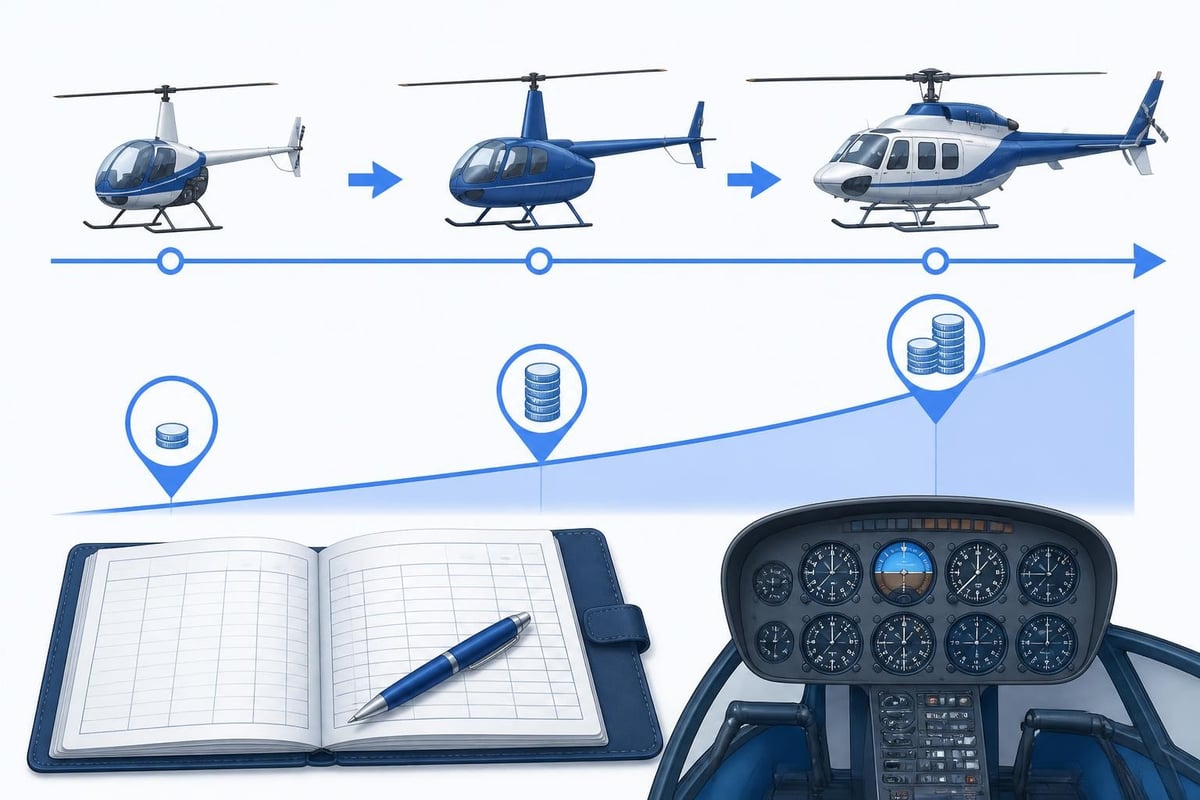
Helicopter flying lessons cost roughly double what fixed-wing lessons cost per hour, and CPL(H) training requires fewer total hours than CPL(A), yet the final bill is often similar or higher because helicopters are mechanically complex and burn more fuel relative to speed.
A PPL(A) typically costs £8,000–£15,000 for 45–60 hours in a single-engine piston aeroplane. A PPL(H) costs £15,000–£30,000 for the same hour range in a piston helicopter. The cost-per-licence is nearly double, but career trajectories differ: helicopter CPL holders often find work faster in offshore, emergency medical, and utility roles where demand is high and competition less fierce than airline pilot positions.
If your goal is professional flying and you're undecided between rotary and fixed-wing, consider long-term employment prospects and lifestyle, not just training cost. The Pilot Institute guide to helicopter pilot training costs offers a side-by-side comparison with aeroplane training paths and discusses return on investment for both.
Some pilots hold both licences. Adding a PPL(H) after a PPL(A) (or vice versa) requires only the aircraft-specific syllabus and skills test, not full ground school, so the incremental cost is lower. Dual-rated pilots have more career options and can fly part-time instruction or charter in either category.
Tracking Training Costs and Hours
Accurate record-keeping is essential for budgeting and regulatory compliance. Every lesson generates a cost and adds hours toward your licence minimums. Spreadsheets work, but mistakes creep in when you're juggling dual, PIC, solo, cross-country, night, and instrument time across multiple aircraft types.
Pilotlog Pro helps you track every category of flight time, monitor rolling currency requirements, and flag upcoming licence or medical expiries so nothing derails your training schedule. When you're investing tens of thousands in helicopter flying lessons, knowing exactly where you stand against syllabus minimums and budget caps is critical. Students using Pilotlog Pro can export their full logbook for skills-test preparation and spot gaps in experience early enough to fill them cost-effectively.
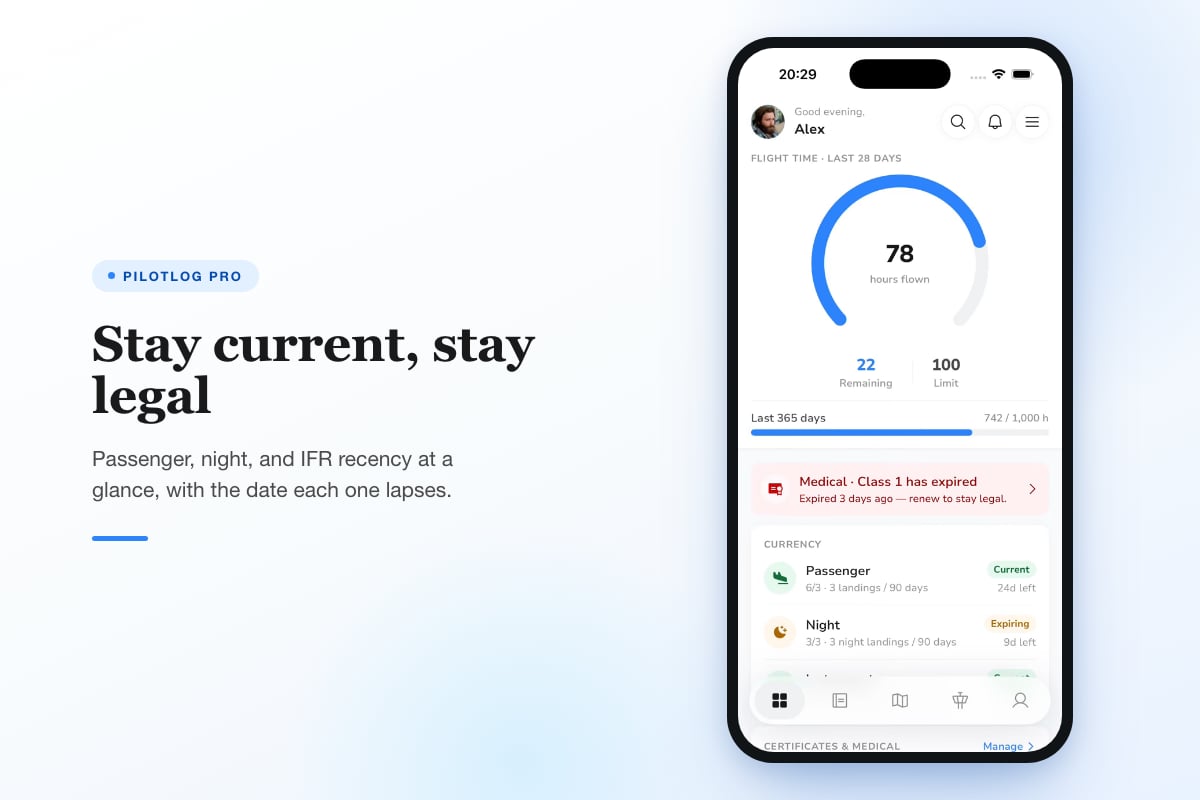
Digital logbooks also simplify invoicing disputes. If a school claims you've flown 58 hours but your records show 54, you have timestamped evidence. The Jeppesen pilot logbook has been a paper standard for decades, but digital options now offer automatic currency calculations and cloud backup that paper can't match.
Reducing Helicopter Flying Lessons Cost
You can control costs by:
- Flying frequently: Three lessons per week beats one. Skills retention cuts revision hours.
- Studying ground school ahead of flights: Arrive prepared; don't pay aircraft rates to learn theory.
- Choosing off-peak times: Some schools discount weekday morning slots.
- Comparing schools: Get three quotes and read reviews carefully.
- Avoiding training pauses: A six-month break costs 5–10 refresher hours.
Weather is your enemy. If visibility or wind is marginal, instructors often scrub the lesson and reschedule. That's safer but frustrating. Choose a school with a large fleet and flexible booking so you can swap slots when conditions improve.
Some students save thousands by doing initial PPL(H) training abroad in Spain, Greece, or the United States, where weather is more predictable and hourly rates can be lower. Licensing rules under EASA Part-FCL allow conversion of foreign PPL(H) licences with minimal additional training. However, travel, accommodation, and time away from work must be factored in, and not every overseas school meets UK CAA standards for licence conversion. The FAA Safety Briefing on helicopter training provides US-centric guidance but highlights universal principles around structured training and cost control.
Buying your own aircraft is an option for experienced pilots with deep pockets. A used Robinson R22 costs £80,000–£150,000; an R44 runs £200,000–£400,000. Ownership spreads costs over years and builds equity, but maintenance, insurance, and hangarage add £10,000–£20,000 annually before you turn a single rotor blade. Unless you plan to fly 100+ hours per year or run a small charter operation, renting remains cheaper.
Medical and Administrative Fees
Every pilot needs a valid medical certificate. A Class 2 medical (required for PPL(H)) costs £150–£250 and lasts five years if you're under 40, two years if you're 40–50, and one year if over 50. A Class 1 medical (required for CPL(H)) costs £300–£500 and renews annually after age 40.
Medical costs are small compared to flight training, but a failed medical can derail your entire investment. Disclose all conditions honestly during the application; attempting to hide issues risks a permanent ban. If you have controlled diabetes, cardiovascular history, or take certain medications, consult an Aviation Medical Examiner (AME) before starting training to confirm you'll meet standards.
Licence application fees, theory exam fees, and skills-test booking fees add another £500–£1,000 across the full training pathway. EASA theory exams cost around £100 per sitting, and you must pass all subjects within 18 months of your first attempt. Resits cost the same, so solid preparation saves money.
Continuous Training and Recency
Even after earning your licence, staying current costs money. The FAA Order 4040.28 on flight-hour rates outlines how institutional hourly rates are set, which helps benchmarking but doesn't directly apply to UK civilian training. However, the principle holds: every hour flown has a real cost, and maintaining recency means flying regularly.
PPL(H) holders must complete a revalidation flight with an instructor every two years or pass a proficiency check. Budget two hours (one briefing, one flight) at standard dual rates: £400–£600. CPL(H) holders face stricter recency rules and annual proficiency checks that cost £700–£1,000.
Tracking your IFR currency and passenger-carrying recency is simpler with a logbook that calculates rolling periods automatically. Missing a currency deadline means additional training flights before you can carry passengers again, and those hours cost just as much as initial training.
Real-World Example: PPL(H) Cost Breakdown
Here's a worked example for a student training at a Midlands school in an R44 during 2026:
| Item | Hours/Units | Rate (£) | Subtotal (£) |
|---|---|---|---|
| Dual instruction (R44) | 30 | 410 | 12,300 |
| Solo flight (R44) | 20 | 360 | 7,200 |
| Ground briefings | 25 | 60 | 1,500 |
| EASA PPL(H) ground school (online) | - | 800 | 800 |
| Books, headset, charts | - | 300 | 300 |
| Class 2 medical | - | 200 | 200 |
| Theory exam fees (multiple subjects) | - | 400 | 400 |
| Skills test (examiner + aircraft) | 2.5 | 410 + 400 | 1,425 |
| Licence application | - | 150 | 150 |
| Total | 52.5 hours | - | 24,275 |
This student finished in 52.5 hours with minimal extra training. If weather or personal schedule had stretched training to 60 hours, the total would climb to around £27,500. The lesson: helicopter flying lessons cost what the syllabus says, plus a margin for real-world friction.
For students curious about helicopter pilot lessons or exploring whether to pursue rotary training at all, this worked example provides a realistic baseline. Your final number will differ, but the structure and proportions remain consistent across most UK schools.
Scholarships and Financial Aid
Several organisations offer helicopter training scholarships, though competition is fierce and awards rarely cover the full cost. The Vertical Aviation International continuing education programs provide both fee-paid courses and member discounts that can reduce costs by thousands.
Other scholarship sources include:
- The Honourable Company of Air Pilots (UK-based, annual awards)
- Women in Aviation International (global, multiple categories)
- RAF and Army Air Corps (sponsored training in exchange for service commitment)
- Individual flying schools (merit-based or diversity scholarships, typically £1,000–£5,000)
Apply early, write compelling personal statements, and demonstrate commitment. Scholarship panels want to fund pilots who will complete training and contribute to the industry, not dabblers. Highlighting volunteer work, academic achievement, or overcoming adversity strengthens applications.
Employer-sponsored training is rare at the ab-initio level but common for type ratings. If you can secure a conditional job offer, some operators will pay for your H125 or Bell 407 type rating in exchange for a two- to three-year contract. That saves you £10,000+ and guarantees employment, though you're locked in even if better opportunities arise.
Is Helicopter Training Worth the Cost?
Helicopter flying lessons cost more per hour than fixed-wing training, and total investment to a commercial licence rivals a university degree. Yet rotary pilots often find work faster, enjoy diverse flying environments, and build unique skills that translate across aviation sectors.
If you love the idea of precision hovering, mountain flying, and mission-focused operations, the cost is an investment in a rewarding career. If you're chasing airlines or long-haul flying, fixed-wing training is the better financial bet. Neither path is cheap, but both offer returns far beyond the monetary when matched to the right pilot.
Regulatory requirements and costs change. Always confirm current minimums, medical standards, and school pricing with official sources before committing funds. The CAA website and your chosen ATO provide the latest guidance.
Helicopter flying lessons cost between £15,000 and £100,000 depending on your target licence and how efficiently you train. Track every hour, fly frequently, and budget for the unexpected. Pilotlog keeps your flight time, currency, and expiries organised so you stay on track and on budget throughout your training journey.
- helicopter lessons cost
- ppl(h) cost
- cpl(h) training
- rotary wing training
- helicopter pilot licence
A logbook that keeps itself.
Join the waitlist and be first in line when Pilotlog launches.
Free to join, no spam. Unsubscribe any time.