helicopter lessons
Helicopter Pilot Lessons: From Ground School to PPL(H)
12 Sep 2026 · 13 min read
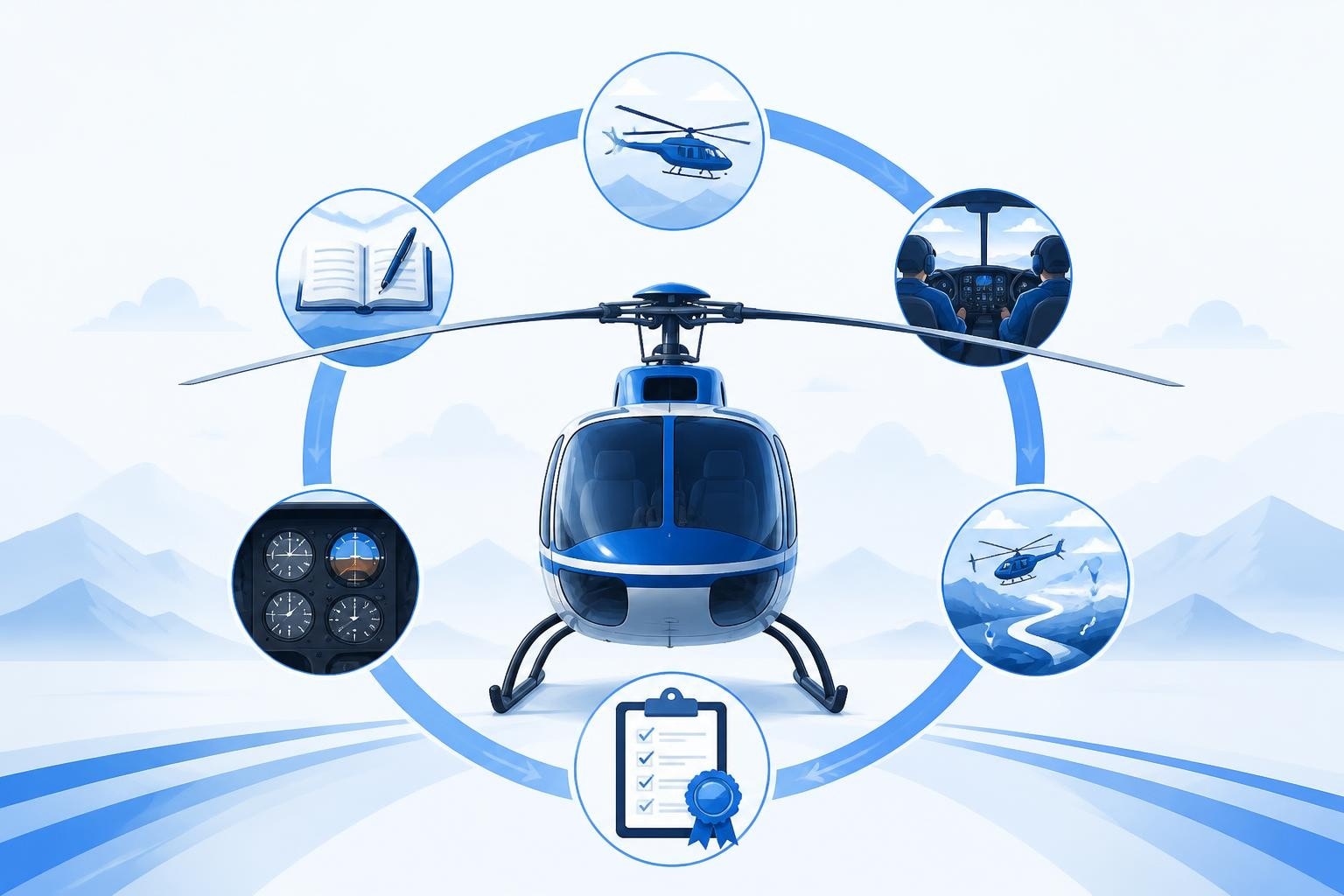
Helicopter pilot lessons combine structured ground instruction with intensive flight training to build the skills for a Private Pilot Licence (Helicopters). You will need a minimum of 45 flight hours under EASA rules or 40 hours under FAA regulations, plus ground school coverage of seven technical subjects and a formal skills test with an examiner. This article walks through every stage of helicopter pilot lessons, from choosing a school to logging your first solo and tracking the currency that keeps you legal after you pass.
Training for a helicopter licence follows a different rhythm to fixed-wing instruction. The machine hovers, lands vertically, and demands constant control inputs. Most students find the workload intense during the first five hours, then progress accelerates as muscle memory builds. Your lessons will move through four broad phases: ground school and basic handling, circuits and autorotations, navigation and emergency procedures, and skills test preparation. Each phase layers new techniques on top of what you have already mastered.
Understanding Helicopter Pilot Lesson Requirements
EASA Part-FCL sets out the PPL(H) training syllabus across member states. You must complete 45 flight hours (or 44 hours if you already hold a fixed-wing PPL) and pass nine theoretical knowledge exams covering Air Law, Aircraft General Knowledge, Flight Performance and Planning, Human Performance, Meteorology, Navigation, Operational Procedures, Principles of Flight, and Communications. The EASA operational safety and human performance resources include guidance on training principles that underpin these requirements.
In the United States, FAA rotorcraft regulations specify 40 flight hours for a private helicopter rating: 20 dual with an instructor, 10 solo (including 5 solo cross-country hours), and an additional 10 hours that may be dual or solo. You also sit a written knowledge test and a practical check-ride with a designated examiner.
Your medical certificate must be valid before solo flight. EASA requires at least a Class 2 medical; FAA requires at least a third-class. Both authorities allow student pilots to fly dual without a medical in hand, but you cannot fly solo or take your skills test until the medical is current.
Flight Hour Breakdown by Training Phase
Most schools structure helicopter pilot lessons into modules. A typical EASA PPL(H) course looks like this:
| Phase | Dual hours | Solo hours | Content |
|---|---|---|---|
| Basic handling & circuits | 12–15 | 0 | Hovering, transitions, normal take-off and landing, autorotations to ground |
| Solo consolidation | 2–4 | 4–6 | Supervised solo circuits, autorotations, emergency drills |
| Navigation & cross-country | 8–10 | 4–5 | Map reading, radio navigation, two-leg and three-leg trips, forced landing |
| Pre-skills test polish | 4–6 | 0 | Steep turns, limited power, advanced autorotations, simulated emergencies |
| Skills test | 1.5 | 0 | Examiner-led practical test |
The table shows notional hours; actual progress depends on weather, airspace complexity, and individual aptitude. Some students will solo at 10 hours, others at 15. Ground school runs in parallel, either as weekly evening classes or intensive blocks before the written exams.
Choosing a Helicopter Training School
Location, fleet type, and instructor availability matter more than glossy brochures. Visit at least two schools, inspect the helicopters, and ask to meet the chief flight instructor. Check the school's approval status: EASA-approved training organisations (ATOs) hold an ATO certificate under Part-DTO or Part-FCL, and FAA schools operate under Part 141 (structured syllabus) or Part 61 (more flexible). Both routes are valid; Part 141 may offer slightly faster progress and lower insurance costs for some students.
Ask about fleet mix. Many schools train on the Robinson R22 (two seats, piston) or R44 (four seats, piston). The R22 is lighter on the controls and cheaper to hire, but weight-restricted for taller or heavier students. The R44 offers more cockpit room and closer handling to larger helicopters. Some schools also operate the Cabri G2 or Schweizer 300, both of which have different control feel and may suit certain learning styles.
Questions to ask during your school visit:
- What is the instructor-to-student ratio, and how far in advance do I book lessons?
- Does the syllabus include simulator time, and is it approved for hour credit?
- What are the additional costs (landing fees, examiner fees, theory-exam sittings)?
- How does the school handle weather cancellations and scheduling delays?
- Can I see maintenance logs and insurance certificates?
Ground school can be in-house or via a third-party provider. Some schools offer distance learning with online modules; others run weekend blocks. Whichever format you choose, budget 80–100 hours of study time across all nine subjects. The EASA theoretical knowledge exams are computer-based and administered by national aviation authorities; the FAA knowledge test is also computer-based and taken at approved testing centres.
The Structure of Helicopter Pilot Lessons
Your first lesson will introduce the four flight controls: cyclic (stick), collective (left-hand lever), throttle (twist-grip on the collective), and anti-torque pedals (feet). The instructor will demonstrate each input and its effect, then let you follow through on the controls. Expect to feel overloaded. Hovering a helicopter demands constant, small corrections in all three axes, and most students cannot hold a stable hover in their first two or three flights.
Early-Stage Lessons (Flights 1–10)
The first block focuses on basic handling. You will practise straight and level flight, gentle turns, climbs, and descents, then transition to the hover. The instructor will talk you through each manoeuvre, demonstrate it, then coach you as you try. Lessons typically last 45–60 minutes in the air, with a 20-minute pre-flight brief and 15-minute debrief. Schools often schedule two or three lessons per week; flying more frequently accelerates learning, but back-to-back days can lead to fatigue.
Autorotation training begins around lesson five or six. An autorotation is a controlled descent with the engine at idle, using rotor inertia to slow the descent and cushion the landing. Your instructor will demonstrate power-off descents and talk through the flare and touchdown. You will practise autorotations to the ground, then build up to terminating at three feet (a "power recovery autorotation") to save wear on the skids.
EASA Safety Promotion materials on helicopter training include practical leaflets on autorotation techniques and threat-and-error management that many instructors incorporate into their briefings.
Mid-Stage Lessons (Flights 11–25)
Once you can hover with reasonable precision and perform safe autorotations, the instructor will clear you for first solo. EASA requires a minimum of 10 dual hours before solo; FAA requires the instructor to endorse your logbook confirming you are ready. Your first solo will be a short flight (often just three or four circuits) on a calm morning with the instructor watching from the ground.
Solo consolidation follows. You will fly circuits, practise hovering, and repeat autorotations under instructor supervision (the instructor watches from the apron or tower). Each solo flight must be authorised in advance, and many schools require a brief with the instructor before you fly.
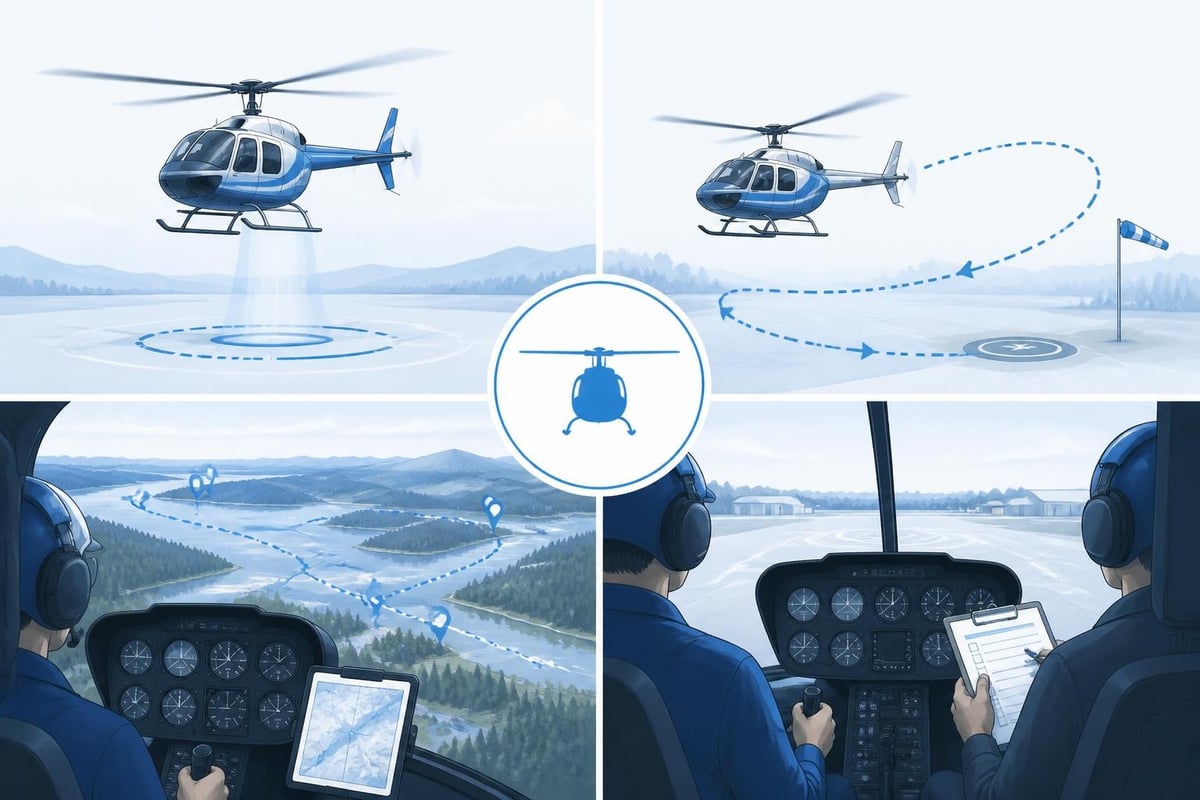
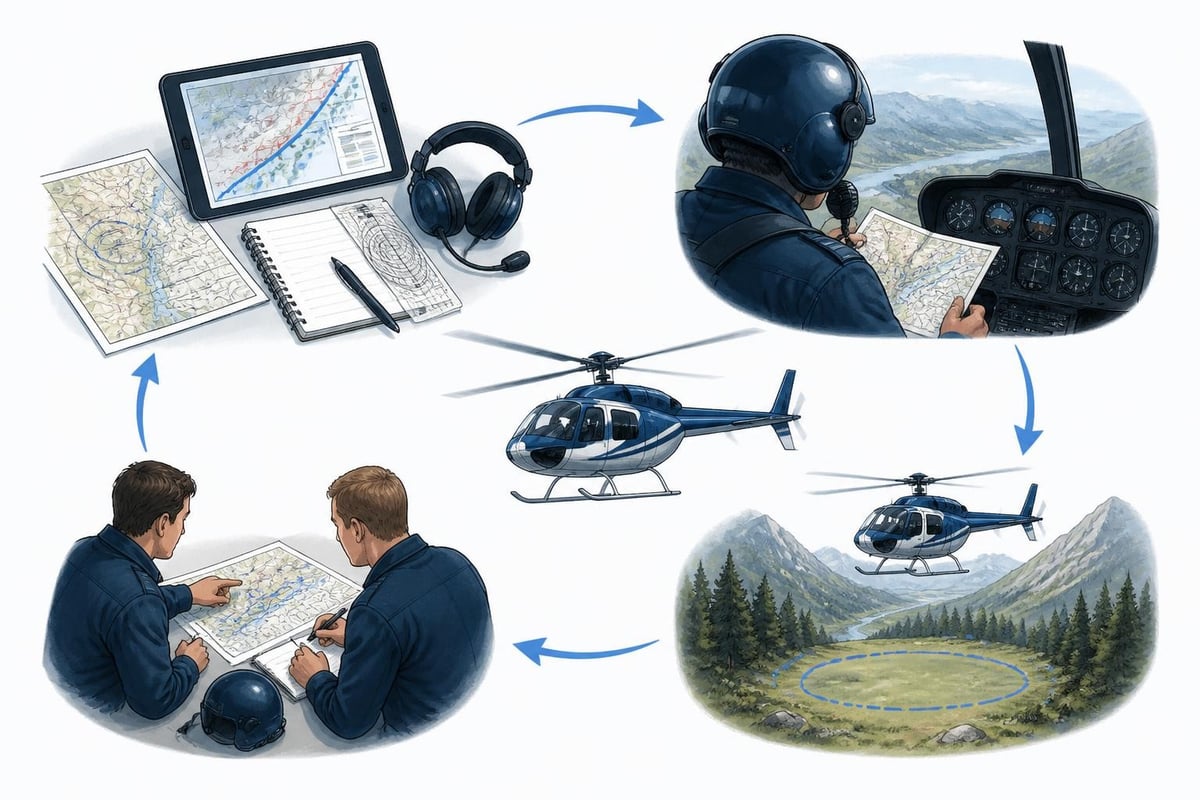
Navigation training introduces map reading, radio navigation aids, and cross-country planning. You will fly dual trips to nearby airfields, practising radio calls, joining procedures, and fuel planning. The instructor will simulate an emergency (usually an engine failure) and you will select a suitable landing area, brief your plan, and fly a practice forced landing. EASA requires 5 solo cross-country hours, including one flight of at least 185 km (100 nautical miles) with two full-stop landings at different aerodromes.
Advanced Techniques and Skills Test Preparation
The final phase polishes weak areas and introduces manoeuvres you will see on the skills test. Steep turns (30–40° bank) teach energy management and rotor control under higher g-loading. Limited-power operations (flying at high weight or high altitude) show you how to recognise and avoid settling with power or loss of tail-rotor effectiveness. You will also practise confined-area landings (touching down in a small clearing) and slope landings (one skid on a hillside).
Skills Test Content
The EASA PPL(H) skills test lasts about 90 minutes and covers:
- Pre-flight and departure - aircraft inspection, weight and balance, take-off
- General handling - steep turns, climbing and descending turns, slow flight, hovering manoeuvres
- Navigation - visual navigation to a predetermined point, diversion, precautionary landing
- Emergencies - simulated engine failure (autorotation), limited-power operations, systems malfunctions
- Approach and landing - normal approach, confined area, slope (if applicable), running landing
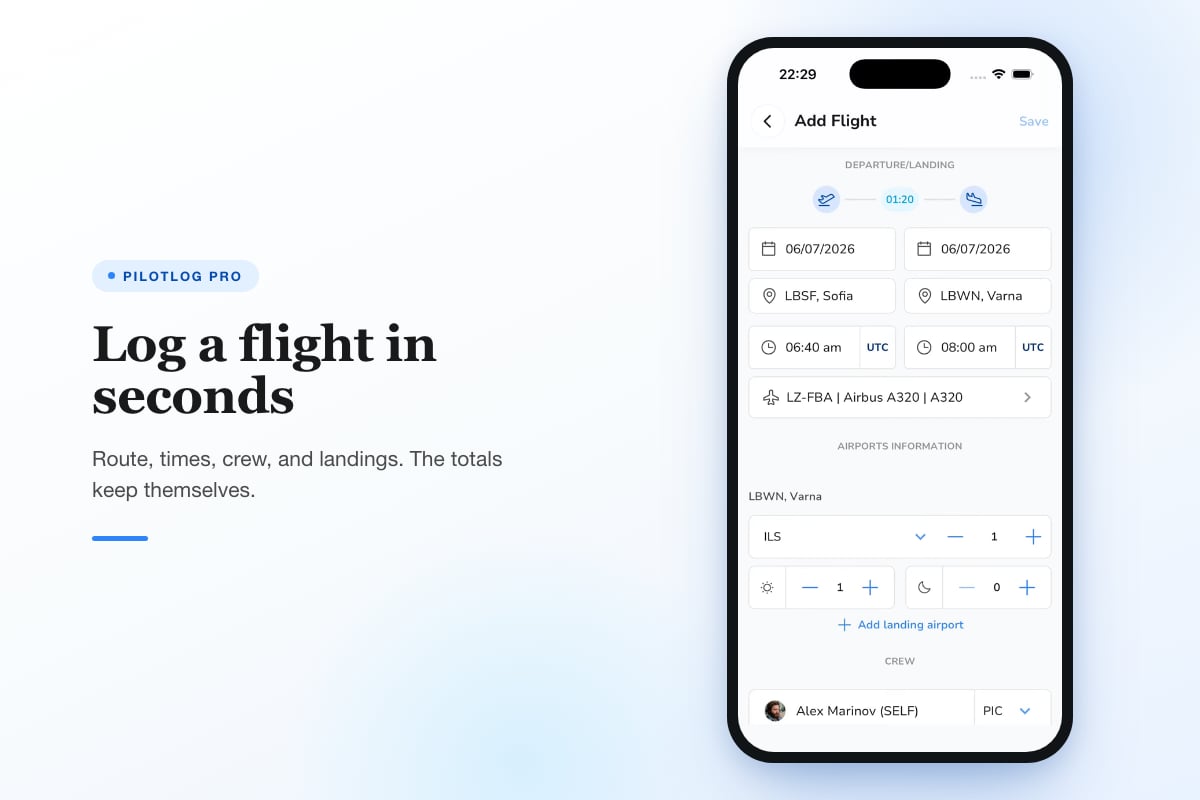
The FAA practical test follows a similar structure under the Private Pilot – Rotorcraft (Helicopter) Airman Certification Standards. Both examiners will ask oral questions on regulations, performance, and meteorology before the flight. A digital logbook like Pilotlog helps you present a clean, auditable record of your training hours and endorsements.
Tracking Progress and Staying Current
Throughout your helicopter pilot lessons, you will log each flight in a logbook. Record the date, aircraft registration, departure and arrival points, total flight time, and whether the flight was dual or solo. Also note the lesson content (for example, "autorotations to ground, hover taxi, circuits") so you and your instructor can track your progress against the syllabus.
EASA Part-FCL and FAA Part 61 both define currency rules for private pilots. Under EASA FCL.060, you must complete three take-offs and landings in the preceding 90 days to carry passengers. If your currency lapses, you must fly with an instructor until you regain it. FAA rules (14 CFR 61.57) require three take-offs and landings within the preceding 90 days to act as pilot in command carrying passengers. The currency cheat sheet at Pilotlog summarises these requirements across licence types.
Many newly qualified pilots find it hard to maintain currency if they do not fly regularly. Joining a club or syndicate spreads costs and keeps you active. If you plan to add an instrument rating or commercial licence later, keeping a detailed log from the start makes it easier to demonstrate total time and specific experience (night, cross-country, instrument time).
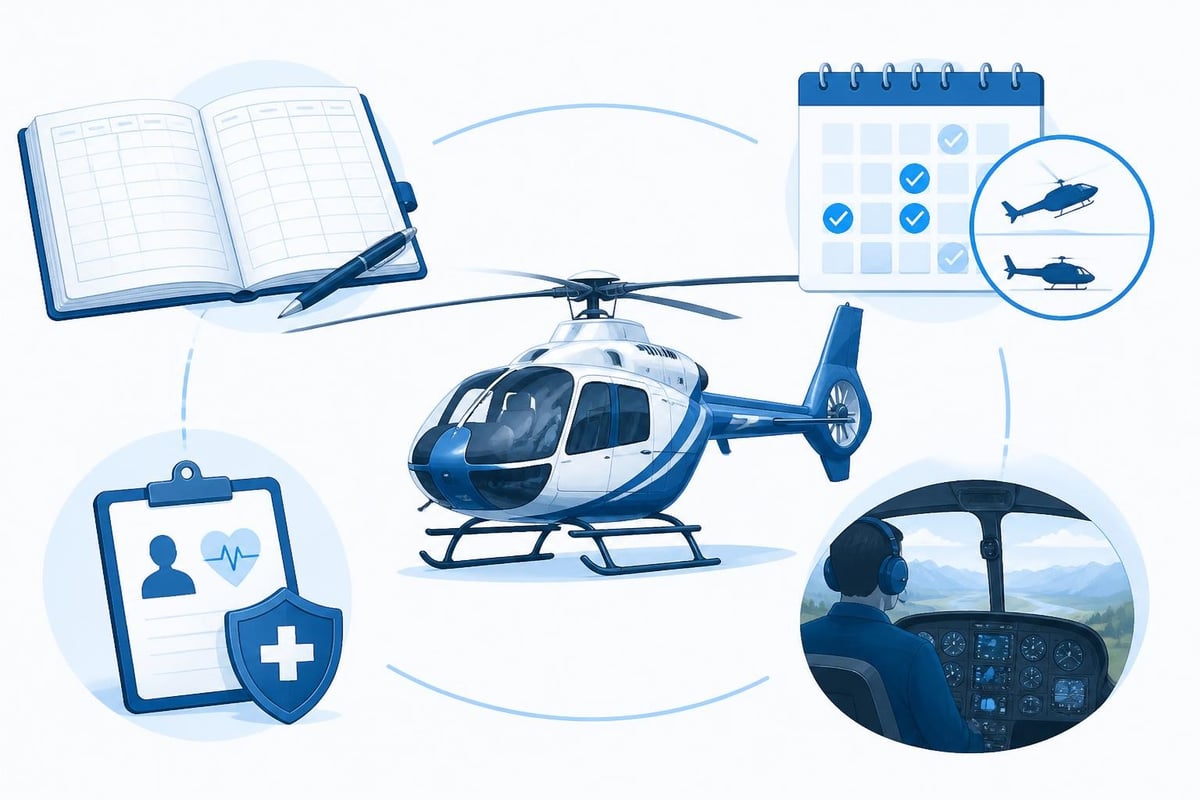
Pilotlog Pro automatically tracks your 90-day passenger currency, flags medical and licence expiries, and calculates rolling flight-time totals, so you know at a glance whether you are current and legal to fly. It is built for pilots across the whole career, from students logging their first dual lesson to airline crew managing complex duty limits.
Cost and Time Commitment
Helicopter pilot lessons are not cheap. In the United Kingdom, an R22 typically costs £250–£350 per hour including fuel and instructor; an R44 costs £350–£450 per hour. Ground school adds £500–£1,500 depending on the provider. Exam and test fees (theory exams, skills test, licence issue) total around £1,000. A full PPL(H) course costs £12,000–£18,000 in 2026.
In the United States, R22 rates range from $300–$450 per hour, R44 from $450–$650 per hour. Ground school and examiner fees add $1,500–$3,000. Total cost for 40 hours and check-ride is typically $15,000–$25,000.
Time commitment varies. Flying three times per week, you can complete the course in four to six months. Flying once per week stretches it to ten to twelve months. Weather delays are common, especially in northern latitudes. Budget for at least 20% more calendar time than the flight-hour total suggests.
Some students spread the cost by training in blocks: complete ground school and the first 20 hours, pause to save, then finish the remaining hours and skills test. This approach works if you fly often enough during the break to retain skills. A gap of more than three months will cost you revision hours.
Simulator Use in Helicopter Training
Flight simulators can reduce cost and accelerate learning. EASA permits up to 5 hours of approved simulator time to count toward the PPL(H) minimum. FAA allows up to 2.5 hours of approved flight training device time. Not all simulators qualify; the device must hold a relevant approval (EASA FSTD or FAA-approved AATD/BATD).
Research from TU Delft on helicopter simulator transfer-of-training shows that well-designed simulators improve learning of emergency procedures and instrument scan, but cannot fully replicate the physical cues of real flight. Use the simulator for procedures training (autorotation entries, radio navigation, instrument approaches if you later add an IR(H)), then consolidate in the aircraft.
Common Challenges and How to Overcome Them
Most students struggle with hovering at first. The helicopter drifts, the nose wanders, and the altitude bounces. This is normal. The breakthrough usually comes between flight five and flight ten, when your hands and feet start making corrections without conscious thought. If you are still fighting the hover at 15 hours, ask your instructor to demonstrate the control inputs in slow motion and talk you through the sight picture.
Autorotations cause anxiety for many students. The engine goes quiet, the descent rate increases, and you must flare at exactly the right moment. Start with power-recovery autorotations at altitude, then progress to full touchdowns when you are comfortable. Your instructor will not let you attempt an autorotation to the ground until you can consistently enter and control the descent.
Cross-country navigation can feel overwhelming if you try to do everything at once. Break the task into chunks: first, prove you can track a heading and identify checkpoints; second, add radio calls; third, add diversions and precautionary landings. Use AOPA guidance on mountain and specialty flying to prepare for terrain challenges.
Post-Licence Progression
After you pass the skills test and receive your PPL(H), you can carry passengers in visual conditions during daylight. Many pilots add a night rating (EASA requires 100 hours total time plus 5 dual night hours; FAA bundles night training into the private syllabus). An instrument rating (IR(H)) allows flight in cloud and poor visibility, but requires significant additional training (typically 30–40 hours dual plus ground school).
If you plan to fly commercially, the next step is a Commercial Pilot Licence (Helicopters). EASA CPL(H) requires 185 flight hours total time, including specific command and cross-country hours, plus fourteen theory exams. FAA commercial requires 150 hours including 50 hours cross-country and 10 hours instrument. Both routes demand a Class 1 medical.
Keep your logbook current and accurate. Regulatory authorities can audit your records at any time, and insurance companies will ask for a logbook summary if you join a syndicate or hire a helicopter. A digital logbook makes it easy to generate reports for medical renewals, recency checks, and currency audits.
Resources and Further Reading
The NTSB report on rotorcraft accidents highlights common training gaps and safety priorities. Many instructors incorporate NTSB findings into their lesson plans, focusing on controlled flight into terrain, loss of control during autorotation, and dynamic rollover.
Flight Safety Foundation materials on helicopter training and the EASA EHEST leaflets on threat-and-error management offer practical, evidence-based guidance for students and instructors. The U.S. Government 14 CFR text and EASA Part-FCL are the ultimate references for regulatory requirements, though both are dense reading.
Many pilots also find value in reading accident reports, joining online forums, and attending safety seminars. The more you understand how accidents happen, the better you can avoid them.
Note that regulations and training syllabuses change. Always confirm current requirements with your national aviation authority (EASA member state CAA, FAA, or equivalent) and cross-check hour totals and medical validity periods against official sources.
Helicopter pilot lessons build your skills from first hover to solo cross-country and final skills test, following a structured syllabus of ground school and flight training. Accurate logbook records and active currency tracking are essential throughout your training and beyond. Pilotlog gives you one place to log every flight, monitor your 90-day passenger currency, and set alerts for medical and licence expiries, so nothing catches you by surprise when you are ready to fly.
- helicopter lessons
- ppl(h) training
- easa ppl(h)
- robinson r22
- flight hour requirements
A logbook that keeps itself.
Join the waitlist and be first in line when Pilotlog launches.
Free to join, no spam. Unsubscribe any time.