helicopter flight lessons
Helicopter Flight Lessons Near Me: Complete Guide 2026
27 Sep 2026 · 13 min read
Finding helicopter flight lessons near me starts with knowing what you need. A private pilot rotorcraft licence (PPL(H)) requires between 40 and 50 flight hours depending on whether you train under FAA Part 61 or Part 141, plus ground school, medical certification, and a practical test. Most helicopter schools operate under Part 61 rules, which give you flexibility on lesson pace and location, while Part 141 programmes follow a structured FAA-approved syllabus often linked to college credit.
What helicopter flight lessons near me actually cover
Your first lesson typically lasts 60 minutes: 30 minutes of ground briefing covering controls, pre-flight inspection, and emergency procedures, then 30 minutes airborne. The instructor demonstrates basic hover technique, shows you cyclic, collective, and anti-torque pedal inputs, and lets you follow through on the controls. You will not hover solo on day one, but you will feel how sensitive a Robinson R22 or R44 responds compared to fixed-wing aircraft.
A complete PPL(H) syllabus under Part 61 includes:
- Pre-solo phase: 15-20 hours dual instruction covering normal take-offs and landings, hovering, transitions, autorotations, and emergency procedures
- Solo flight: minimum 10 hours including 3 hours solo cross-country and one solo flight of at least 50 nautical miles with two landings at different airports
- Advanced dual: navigation, night operations (if seeking night privileges), confined-area work, and slope operations
- Practical test preparation: 3-5 hours refining manoeuvres to FAA Practical Test Standards tolerances
Most students need 50-60 flight hours to reach test standard, even though the legal minimum is 40 hours Part 61 or 35 hours Part 141. Robinson R22 rental averages $350-450 per hour wet (fuel included), plus instructor fees of $75-100 per hour. Budget $22,000-28,000 total for a private rotorcraft licence when you include ground school, examiner fees, and written test costs.
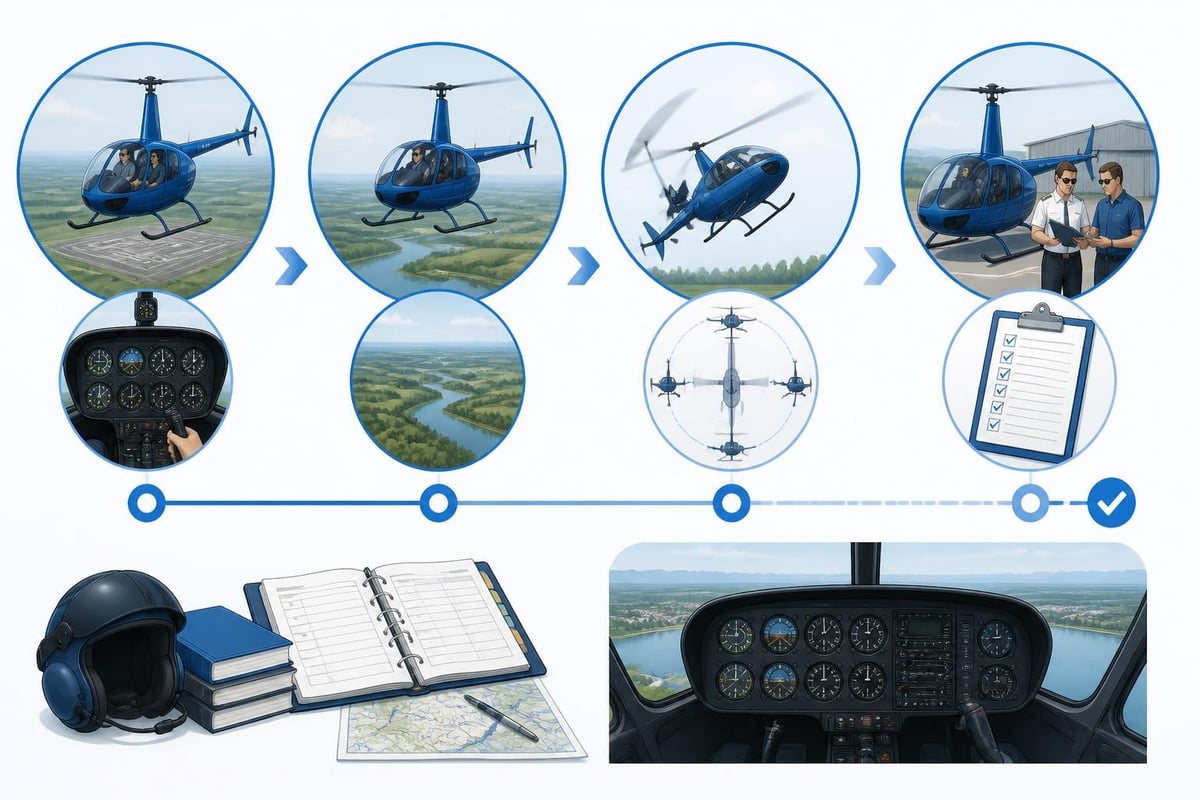
Medical and eligibility requirements before booking lessons
You must hold at least a third-class FAA medical certificate before you can solo. Most schools let you start lessons on a student pilot certificate while you arrange your medical, but you cannot fly alone until the Aviation Medical Examiner (AME) signs you off. Third-class medicals are valid for 60 calendar months if you are under 40, or 24 months if 40 or older. The AME checks vision, hearing, cardiovascular health, and neurological function; common disqualifying conditions include insulin-dependent diabetes, epilepsy, and certain cardiac arrhythmias, though many can be mitigated through a special issuance process.
You also need to read, speak, write, and understand English fluently enough to communicate with air traffic control. There is no minimum age to start lessons, but you must be 16 to solo and 17 to take the practical test for a private licence.
How to find quality helicopter flight lessons near me
Start by searching "helicopter flight lessons near me" or "rotorcraft training" plus your city or airport code. Check the FAA registry at faa.gov to confirm the school holds a valid Part 61 or Part 141 certificate. Visit at least two schools in person. Look for well-maintained helicopters with logbooks you can inspect, hangars or tie-downs that protect aircraft from weather, and a schedule board showing active students.
Questions to ask during your visit (adapted from AOPA's flight school selection guide):
- What is your instructor turnover rate in the past 12 months?
- How many hours does the typical student take to reach checkride standard?
- Can I fly with the same instructor throughout, or will I rotate?
- What is your aircraft dispatch reliability (percentage of lessons not cancelled for maintenance)?
- Do you require stage checks or progress reviews by a chief instructor?
- What weather minimums do you use for student training flights?
High instructor turnover is common at schools that feed regional helicopter operators, but you want at least 6-8 months with one primary instructor. Aircraft availability matters too: if the school operates only one or two helicopters, maintenance or weather can stall your progress for weeks.
| School type | Pros | Cons |
|---|---|---|
| Independent Part 61 | Flexible scheduling, lower overhead, tailored pace | Variable instructor quality, less structure, harder to get financing |
| Part 141 college-affiliated | Structured syllabus, VA benefits eligible, degree credit | Higher cost, rigid schedule, may require non-flying courses |
| Operator-owned school | Access to commercial jobs post-licence, turbine transition paths | High instructor turnover, pressure to finish quickly, fewer aircraft types |
You can also check AOPA Flight Training Magazine for recent articles on instructor fit and syllabus quality. An example of a structured college programme can be found in the Sinclair College Professional Pilot catalog, which details rotorcraft courses and integration with associate or bachelor degrees.
Costs and budgeting for helicopter flight lessons near me
Helicopter training costs significantly more than fixed-wing because turbine and piston helicopters burn more fuel per hour, require more frequent maintenance, and have higher insurance premiums. A Robinson R22 (two-seat piston) rents for $350-450 per hour; a Robinson R44 (four-seat piston) for $500-650; a turbine trainer like a Schweizer 300CBi for $600-800. Instructor fees add another $75-100 per hour.
Typical cost breakdown for PPL(H) under Part 61:
- Flight instruction (50 hours at $425 average aircraft + $85 instructor): $25,500
- Ground instruction (20 hours at $85): $1,700
- Written test (FAA knowledge exam): $175
- Practical test (examiner fee + aircraft): $1,200
- Books, headset, charts, supplies: $600
- Total: $29,175
You can reduce costs by flying more frequently. Two or three lessons per week keeps skills sharp and reduces the need to re-teach manoeuvres. Solo practice time (without instructor aboard) saves the instructor fee but still requires aircraft rental. Some schools offer block-time discounts: pay for 10 hours up front and save 5-10 per cent on the hourly rate.
Compare this to private pilot licence costs for aeroplanes, which typically run $12,000-16,000 for a PPL(A). Rotorcraft training demands more precision and shorter lesson intervals, which drives total hours and expense higher.
Financing and scheduling your lessons
Few lenders finance recreational helicopter training because it does not lead directly to employment. If you plan a commercial career, look for schools offering career-track financing through providers like AOPA Finance or Stratus Financial. VA benefits cover Part 141 programmes for eligible veterans. Otherwise, budget cash flow carefully: spreading 50 hours over 12 months at two lessons per week costs roughly $2,400 per month.
Weather and maintenance cancellations disrupt training flow. Helicopter flight lessons near me in the northern states often pause November through March due to ice, snow, and low ceilings. Plan to start training in spring or early summer if you want to finish the same calendar year. Schools in the southern or southwestern United States fly year-round but may limit summer afternoon lessons when density altitude climbs above safe limits for an R22.
Tracking your rotorcraft training hours and currency
From your first lesson onward, you must log every flight in a pilot logbook. The FAA accepts paper or electronic formats. You need to record date, aircraft type and registration, departure and arrival airports, flight time (total, dual, solo, PIC), and instructor signature for dual flights. These entries prove your eligibility for certificates, ratings, insurance, and future employment.
Key currency tracked during helicopter training:
- Total flight time: 40 hours minimum for PPL(H) Part 61, 35 hours Part 141
- Dual instruction: Logged when an instructor is aboard and signing for the flight
- Solo flight: 10 hours minimum, including 3 hours solo cross-country
- Cross-country time: One solo flight of 50+ nm with two full-stop landings
- Night flight (if seeking night privileges): 3 hours dual instruction including one cross-country over 50 nm and 10 take-offs and landings
Once you earn your PPL(H), you must log three take-offs and landings in a helicopter within the preceding 90 days to carry passengers (FAR 61.57(a)). This is the same 90-day rule that applies to aeroplane pilots. If you let currency lapse, you must complete those three take-offs and landings solo or with an instructor before you can take friends or family flying.
A digital pilot logbook simplifies tracking. Pilotlog lets you log each lesson in seconds on your phone, automatically totals your dual, solo, and cross-country time, and flags when you need another flight to stay current. For students juggling ground school, written test prep, and flight lessons, having one app that tracks everything prevents surprises at checkride time.
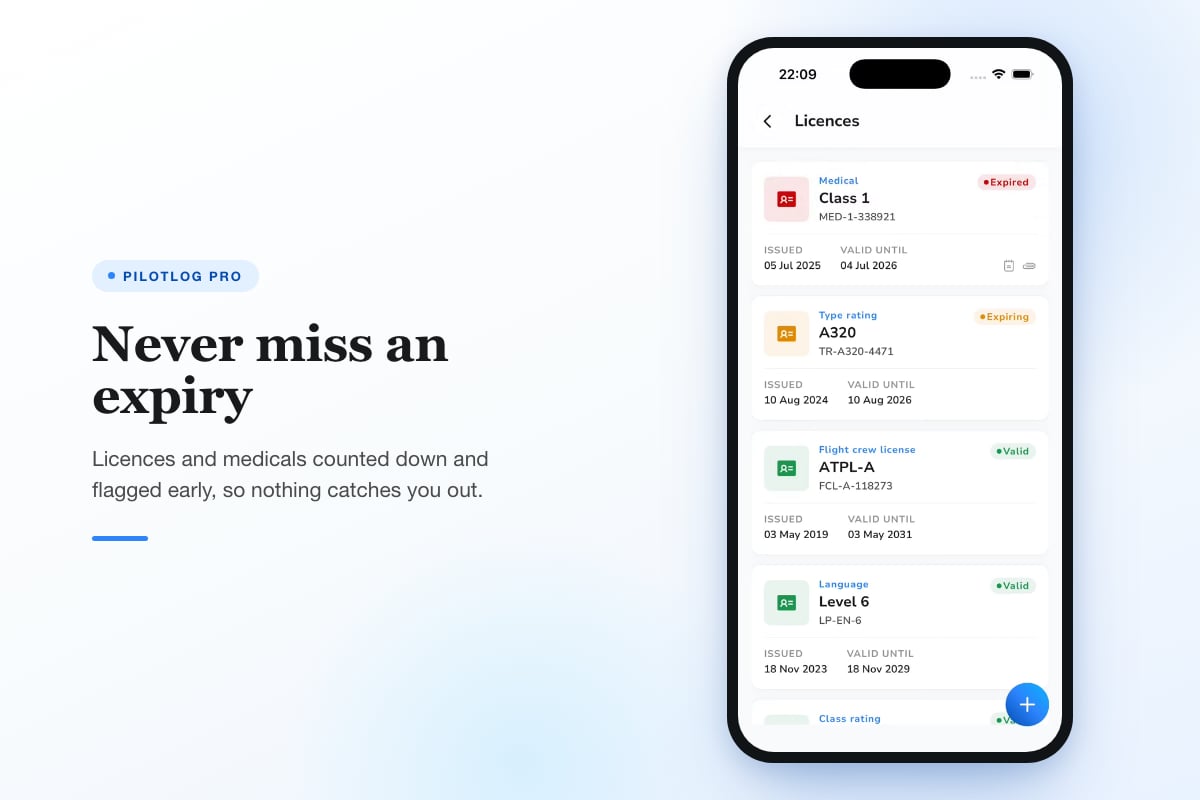
Pilotlog Pro goes further by monitoring rolling 28-day and 365-day limits (important later for commercial and ATP rotorcraft work), alerting you when passenger currency or night currency will lapse, and tracking medical expiry dates so you never miss a renewal. It is built for pilots at every stage, from your first helicopter lesson through to airline or operator employment.
Progressing from private to commercial helicopter licences
Most helicopter pilots do not stop at a private licence. A commercial pilot licence (CPL(H)) requires 150 total flight hours, including 100 hours as pilot in command, 20 hours cross-country PIC, 10 hours instrument training, and 5 hours night. The CPL(H) allows you to fly for hire: aerial tours, pipeline patrol, flight instruction, emergency medical services, or external load work.
Common post-PPL(H) training paths:
- Instrument rating (helicopter): Adds 40 hours instrument time (20 dual, 20 simulated or actual) and lets you file IFR flight plans; useful for EMS and utility operators
- Certified Flight Instructor Rotorcraft (CFII-H): Builds to 200 hours total time and enables you to teach students; most commercial pilots instruct for 800-1,200 hours before moving to turbine operator jobs
- Type ratings: Turbine helicopters over 12,500 lb (like a Bell 212 or Sikorsky S-76) require a type rating; typically employer-sponsored training
- Airline Transport Pilot Rotorcraft (ATP-H): Requires 1,200 total hours and is needed for Part 135 PIC operations or Part 121 helicopter air carrier work (rare in the U.S.)
European pilots follow EASA Part-FCL standards, which differ slightly: PPL(H) requires 45 hours minimum, CPL(H) requires 185 hours, and night rating is a separate add-on. If you plan to work internationally, consider training under both FAA and EASA syllabi or choosing a school with reciprocal agreements.
Safety culture and accident rates in helicopter training
Helicopter training has a higher accident rate per 100,000 flight hours than fixed-wing training, primarily due to low-altitude operations, confined-area work, and autorotation practice. NTSB safety research shows the majority of training accidents involve loss of tail-rotor effectiveness, dynamic rollover during slope landings, or student pilot solo accidents during first cross-country flights.
A good school mitigates risk through:
- Standardised pre-solo checks: No student solos until the chief instructor reviews progress and signs off
- Weather minimums above legal VFR: Many schools require 3 miles visibility and 1,500-foot ceilings for student solo, even though VFR minimums are lower
- Maintenance tracking: Inspections completed on time, squawks addressed before next flight, and logbooks available for student review
- Scenario-based training: Emphasis on risk management, aeronautical decision-making, and emergency procedure practice every lesson
Ask the school for its accident and incident history. Any school that has operated for several years will have had minor incidents (hard landings, tail strikes, ground resonance events). What matters is how they responded: did they retrain the instructor, update procedures, or improve maintenance checks?
Recording and reviewing each helicopter flight lesson
After every flight, debrief with your instructor. Note what manoeuvres you completed, which need more practice, and what the next lesson will cover. This habit builds structured learning and prepares you for solo decision-making. Many students keep a training journal separate from the logbook: "Lesson 8: worked on hover taxi and pedal turns; still drifting left during hover, need smoother pedal inputs; next lesson will add slope landing intro."
Your logbook must show the following endorsements (instructor signature and date) before you can take the practical test:
- Pre-solo flight training (FAR 61.87)
- Solo flight (each make and model)
- Cross-country flight planning and navigation
- Practical test preparation and recommendation (FAR 61.39)
Electronic logbooks like Pilotlog allow instructor endorsements via app or PDF signature, which the FAA accepts as equivalent to a wet signature in a paper logbook. You can also export your full flight hours as a PDF or spreadsheet for insurance applications, job interviews, or Part 135 operator onboarding.
| Milestone | Minimum hours | Typical hours | Endorsement required |
|---|---|---|---|
| First solo | 15-20 | 18-22 | Pre-solo and solo (61.87) |
| Solo cross-country | 25-30 | 28-35 | Cross-country planning (61.93) |
| Practical test | 40 (Part 61) | 50-60 | Test recommendation (61.39) |
Maintaining currency after earning your helicopter licence
Once you pass your checkride, the learning does not stop. You must complete a flight review (FAR 61.56) every 24 calendar months: one hour ground and one hour flight with a CFI covering manoeuvres and procedures. The review does not result in a pass or fail; the instructor simply endorses your logbook confirming you are proficient. Many pilots combine the review with recurrent training in advanced manoeuvres (mountain flying, confined areas, or instrument approaches if you hold an instrument rating).
You also need to track passenger currency (three take-offs and landings in 90 days) and night currency if you fly after sunset. If you plan to rent helicopters at different locations, each operator will want to see your logbook, current medical, and often a checkout flight in their specific make and model. A clean, organised digital logbook speeds up the rental process and shows professionalism.
Staying current as a low-time helicopter pilot:
- Fly at least once per month to maintain hover and autorotation proficiency
- Join a local helicopter club or co-ownership to reduce hourly costs
- Volunteer for charity flights (Angel Flight, disaster relief) to build hours and give back
- Pursue an instrument rating or CFI to stay engaged and employable
- Review currency requirements regularly so you know when you need another flight
Regulations change. In 2023-24, the FAA proposed updates to flight instructor qualifications and training record-keeping that may affect how schools log your lessons and endorsements. Always confirm current requirements against official FAA sources like the Federal Register or consult your instructor.
Choosing helicopter flight lessons near me: final checklist
Before you commit to a school and start writing checks, visit during a weekday when lessons are in full swing. Watch students pre-flight, observe instructor-student interactions, and listen for clear communication. A good school feels organised but not rushed. Instructors debrief thoroughly, students ask questions, and the flight line runs on schedule.
Your final evaluation checklist:
- Aircraft are clean, well-maintained, and have up-to-date logbooks
- School provides a written syllabus and stage-check schedule
- Instructor holds at least a commercial pilot licence with 500+ rotorcraft hours
- School can show completion rates and average time-to-checkride
- Insurance is current and covers student solo operations
- Airport has adequate practice areas (hover pad, traffic pattern, cross-country departure routes)
- School offers flexible scheduling including evenings or weekends
- Total cost estimate (including all fees) is transparent and in writing
Once you have chosen a school, set a realistic training schedule. Two lessons per week keeps skills fresh without overwhelming your budget. Block out study time for ground school and FAA written test prep. Track every flight hour and endorsement so you know exactly where you stand toward the 40-hour minimum. And remember: learning to fly helicopters is challenging, rewarding, and opens doors to careers and adventures most people never experience.
Finding the right helicopter flight lessons near me takes research, but the effort pays off in safety, cost savings, and career readiness. Whether you are training for fun, pursuing a commercial licence, or building hours toward an instructor rating, accurate logbook records and currency tracking matter from day one. Pilotlog keeps your flight hours, endorsements, medical expiry, and passenger currency in one place, so you stay legal, current, and ready for every lesson and every flight beyond.
- helicopter flight lessons
- ppl(h) training
- rotorcraft license
- robinson r22
- helicopter training cost
A logbook that keeps itself.
Join the waitlist and be first in line when Pilotlog launches.
Free to join, no spam. Unsubscribe any time.