flight hours
Flight Hours: Requirements, Tracking & Currency (2026)
11 Jul 2026 · 13 min read
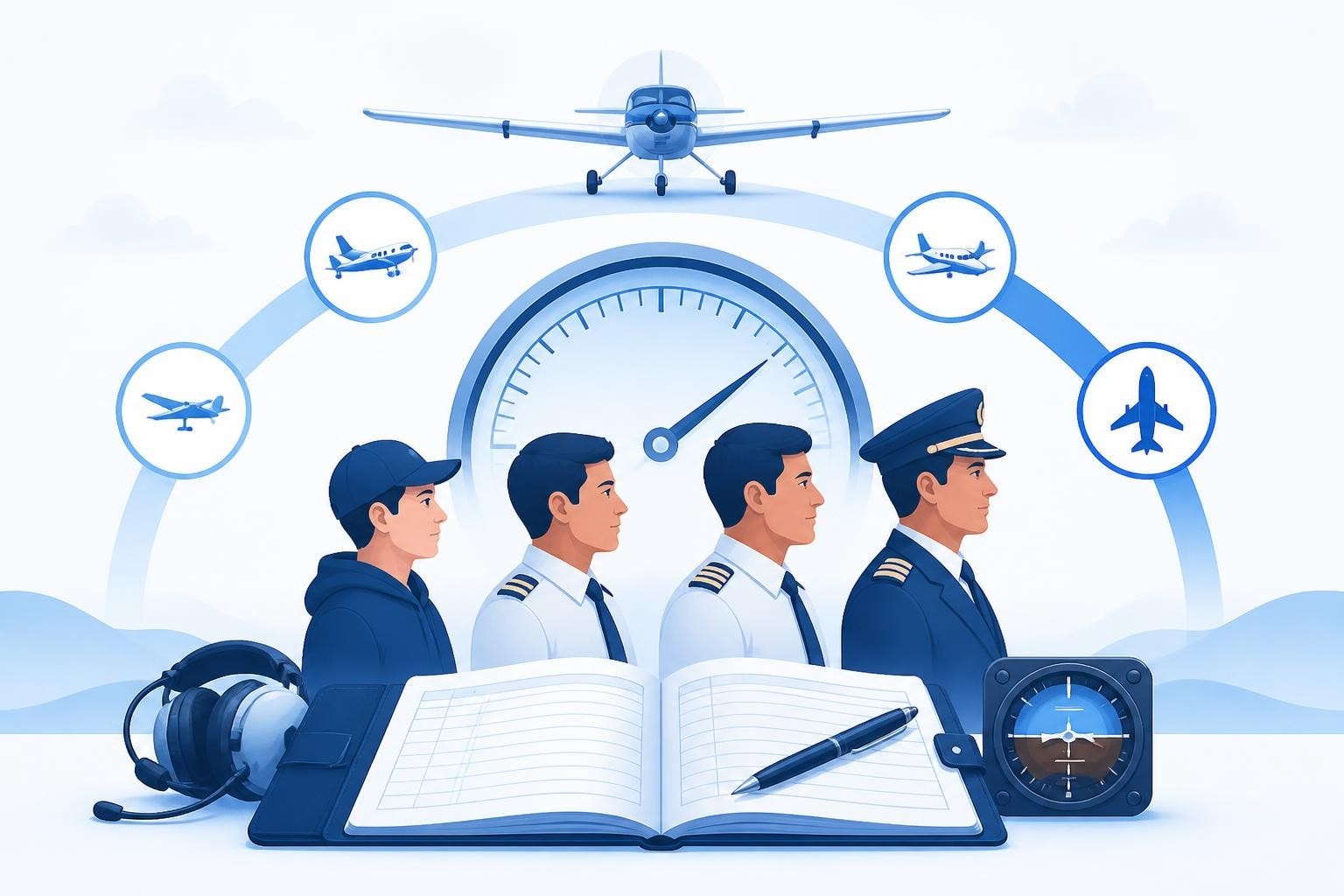
Flight hours measure the time you spend operating an aircraft from the moment it moves under its own power for the purpose of flight until it comes to rest at the next point of landing. Under 14 CFR § 1.1, flight time is recorded from when the aircraft first moves for takeoff until it stops at the end of the flight. These hours form the foundation of your aviation career, determining which certificates you can hold, whether you remain current to carry passengers, and how you demonstrate experience to employers.
Every pilot knows flight hours matter. But understanding exactly which hours count, how many you need, and how to track them properly makes the difference between staying legal and grounding yourself unexpectedly.
Why Flight Hours Define Your Aviation Career
Flight hours serve three distinct purposes in professional aviation. First, they establish your eligibility for certificates and ratings. The FAA sets minimum flight hour requirements for every pilot certificate, from private through airline transport pilot. Second, they determine your currency for specific operations. Carrying passengers at night, flying IFR, or acting as PIC each requires recent flight hours in particular conditions. Third, they limit how much you can fly within specific timeframes to prevent fatigue.
Regulators and employers track flight hours because they provide objective evidence of experience. A pilot with 3,000 hours has encountered more weather, systems, and scenarios than one with 300. Airlines use minimum flight hour thresholds for hiring. Insurance companies set premiums based on PIC time in type. Flight schools verify instructor hours before employment.
Your logbook tells your aviation story in numbers. Total time, PIC time, cross-country, night, instrument, multi-engine, and type-specific hours each unlock different opportunities.
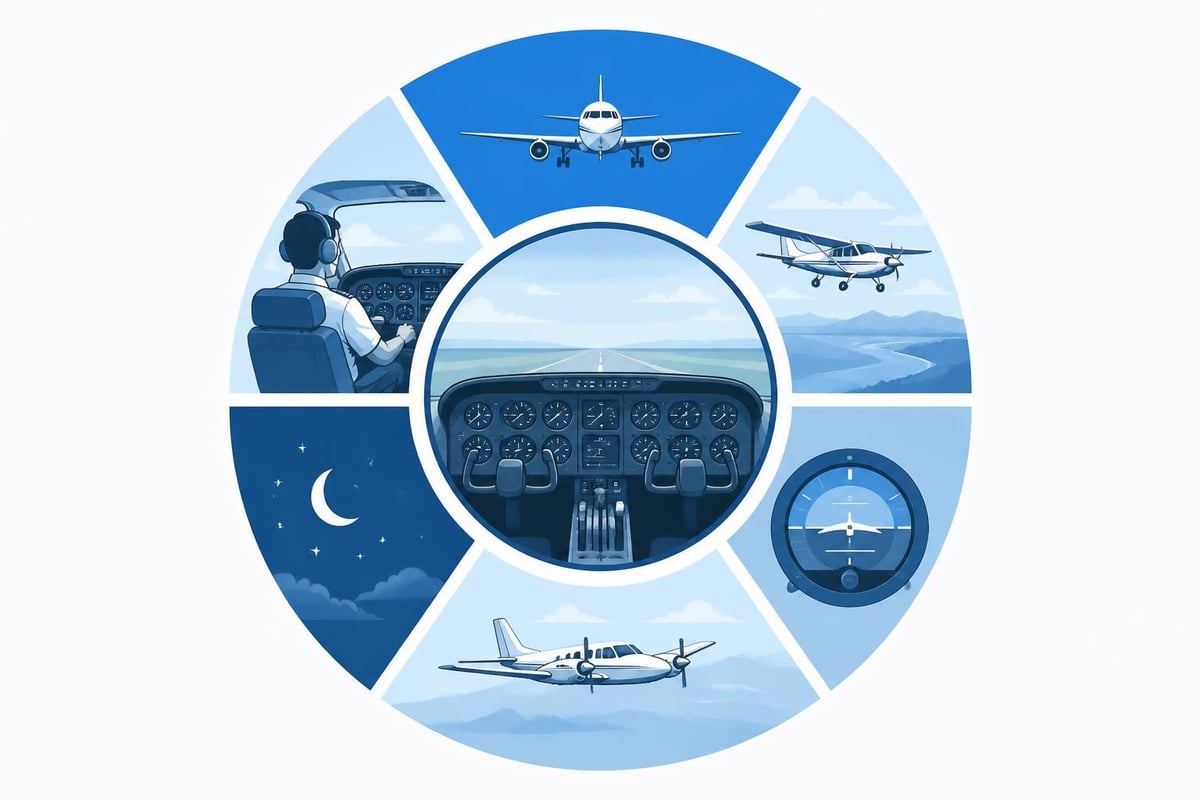
Minimum Flight Hour Requirements for FAA Certificates
The FAA establishes clear minimums for each certificate level. These are floors, not targets. Most pilots exceed them before testing.
Private Pilot Licence
40 hours minimum under Part 61, or 35 hours under Part 141 for approved schools. Of those hours:
- 20 hours of flight training from an instructor
- 10 hours of solo flight time
- 3 hours of cross-country flight training
- 3 hours of night flight training (including one cross-country over 100 nautical miles and 10 takeoffs and landings)
- 3 hours of instrument training
- 3 hours within the preceding 2 calendar months before the practical test
The FAA specifies these requirements to ensure pilots gain experience in varied conditions. The national average for private pilot certificate completion sits closer to 60-70 hours.
Commercial Pilot Licence
250 hours total flight time, including:
- 100 hours in powered aircraft
- 100 hours of PIC time (including 50 hours in aeroplanes)
- 50 hours of cross-country flight as PIC
- 20 hours of training including 10 hours of instrument training, 10 hours in a complex or technically advanced aeroplane
- One 2-hour day VFR cross-country totalling at least 100 nautical miles
- One 2-hour night VFR cross-country totalling at least 100 nautical miles
- 10 hours of solo flight in a complex or technically advanced aeroplane
These hours build decision-making skills and expose pilots to longer cross-countries and more demanding operations.
Airline Transport Pilot Licence
1,500 hours total time for unrestricted ATP, with specific category breakdowns:
- 500 hours of cross-country flight time
- 100 hours of night flight time
- 75 hours of instrument time (50 in actual or simulated flight)
- 250 hours as PIC, or 500 hours performing duties of PIC under supervision
Reduced ATP minimums exist for military pilots (750 hours) and graduates of approved university programmes (1,000 or 1,250 hours depending on degree type). Detailed ATP requirements specify exactly which experience counts toward these thresholds.
| Certificate Level | Minimum Total Hours | Key Sub-Requirements |
|---|---|---|
| Private Pilot | 40 (Part 61) / 35 (Part 141) | 10 solo, 3 night, 3 instrument |
| Commercial Pilot | 250 | 100 PIC, 50 XC as PIC |
| ATP (Unrestricted) | 1,500 | 500 XC, 100 night, 250 PIC |
| ATP (R-ATP University) | 1,000-1,250 | Same category requirements, reduced total |
Currency Requirements and Recent Flight Hours
Holding a certificate differs from remaining current. You need specific recent flight hours to exercise the full privileges of your licence.
Passenger currency requires three takeoffs and landings within the preceding 90 days in the same category, class, and type (if a type rating is required). If those landings will occur at night, you need three night takeoffs and landings to a full stop within the preceding 90 days. This is sometimes called the 90-day rule, though the regulation (14 CFR § 61.57) doesn't use that exact term.
Instrument currency demands six instrument approaches, holding procedures, and intercepting and tracking courses within the preceding 6 calendar months. If you let that lapse, you have an additional 6 months to regain currency using a safety pilot before requiring an instrument proficiency check.
Night currency applies separately. Three takeoffs and landings to a full stop between one hour after sunset and one hour before sunrise within the preceding 90 days. Without it, you cannot carry passengers during that period.
Pilots moving between aircraft types must rebuild currency in each. Your 90-day currency in a Cessna 172 doesn't transfer to a Piper Arrow. Each category and class stands alone.
Flight Time Limitations and Duty Periods
Flight hours aren't unlimited. Regulations cap how much you can fly to prevent fatigue.
Part 91 General Aviation
No specific flight time limits exist for Part 91 operations. You're responsible for determining if you're fit to fly. That said, commercial operations under Parts 121, 125, and 135 impose strict limits.
Part 121 Air Carrier Operations
Part 121 carriers operate under detailed flight time limitation rules:
- 8 hours of flight time in any 24 consecutive hours
- 100 hours of flight time in any 672 consecutive hours (28 days)
- 1,000 hours of flight time in any 365 consecutive calendar days
Duty periods (time from reporting for duty to release from duty) are limited separately and vary based on report time and number of flight segments.
Part 135 On-Demand Operations
Part 135 limitations differ slightly:
- 8 hours of flight time in any 24 consecutive hours for single-pilot operations
- 10 hours for two-pilot crews
- 500 hours in any quarter (calendar quarter)
- 800 hours in any two consecutive quarters
- 1,400 hours in any calendar year
Rest requirements mandate minimum time off between duty periods. A pilot who hits their 100-hour rolling 28-day limit cannot fly until enough hours fall outside the window.
Tracking these limits manually proves difficult. Pilotlog Pro automatically monitors rolling 28-day and 365-day flight time and duty limits, flagging approaching thresholds before you exceed them. The system recalculates daily, so you always know your remaining availability within each period.
Different Types of Flight Hours and How They're Logged
Not all flight hours carry equal weight. Your logbook should break down time into specific categories.
Total flight time includes every hour from engine start to engine stop (or, more precisely, from first movement to final stop). This is your headline number.
Pilot-in-command (PIC) time counts hours when you're the final authority for the aircraft's operation. Student pilots can log PIC time during solo flight. Rated pilots log PIC when they're sole manipulator of the controls in an aircraft for which they're rated.
Second-in-command (SIC) time applies when regulations require more than one pilot or the operation requires two pilots. Type ratings for multi-crew aircraft often require minimum SIC time.
Cross-country time has two definitions. For general certificate requirements, a cross-country includes a landing at least 50 nautical miles from the departure point. For ATP certification, it must be at least 50 nautical miles straight-line distance.
Night time counts flight between the end of evening civil twilight and the beginning of morning civil twilight, as published in the Air Almanac. For logging purposes, that's typically one hour after sunset to one hour before sunrise.
Instrument time includes actual instrument meteorological conditions and simulated instrument time using view-limiting devices. You cannot log both simultaneously.
Dual received covers training time with a CFI. Dual given applies to CFIs providing instruction.
Type-specific time matters for insurance and employment. Airlines want to see hours in transport-category aircraft. Insurers ask about time in make and model.
Logging Nuances That Catch Pilots Out
You can log both PIC and dual received on the same flight if you're sole manipulator and rated in the aircraft while receiving instruction. A private pilot flying a complex aircraft with a CFI logs both.
You cannot log both PIC and SIC for the same flight. If you're acting as PIC under supervision (building ATP hours), you log it as SIC unless regulations specifically allow PIC logging in that circumstance.
Ground training doesn't count as flight time, but instrument training devices (simulators and ATDs) can count toward certain requirements if they meet FAA approval standards.
How to Track Flight Hours Accurately
Accurate logging protects your career. Employers verify logbooks. Audits happen. Regulatory violations carry serious consequences.
Paper Logbooks
Traditional paper logbooks remain legal and common. They're permanent, don't require batteries, and create a physical record. Their drawbacks include:
- Manual calculation of totals, increasing error risk
- No automatic currency tracking
- Difficult to backup
- Time-consuming to complete after every flight
Pilots using paper logbooks should calculate rolling totals monthly and verify currency manually before each flight requiring it.
Digital Logbooks
Digital logbooks like Pilotlog automate calculations, track currency, and sync across devices. After logging a flight, the system updates totals, recalculates currency dates, and flags approaching expiries.
Key advantages include:
- Instant totals across all flight time categories
- Automatic currency calculations with lapse dates
- Duty and flight time limit tracking for commercial pilots
- Backup and export options for insurance and applications
- Quick flight entry with autofill and templates
Digital systems reduce the time to log a flight from 5 minutes to under 30 seconds. They eliminate arithmetic errors and ensure you never miss a currency deadline.
What to Log Every Flight
Each entry should include:
- Date of flight
- Aircraft type and registration
- Departure and arrival points
- Number of landings (day and night separately)
- Flight time (total, PIC, SIC as applicable)
- Conditions (day, night, actual instrument, simulated instrument)
- Type of piloting time (solo, dual received, dual given, cross-country)
- Remarks for unusual conditions, approaches, or training
Add approaches by type for instrument currency. Note holds and intercepting/tracking for the same reason.
Building Flight Hours Strategically
Beyond minimum requirements, building specific types of hours opens doors.
New commercial pilots often face the paradox: jobs require experience, but building experience requires flying. Strategies include:
Flight instructing builds both total time and PIC hours while getting paid. CFIs typically log 50-100 hours monthly, reaching ATP minimums within 18-24 months.
Ferrying aircraft adds cross-country PIC time. Pilots move aircraft between maintenance facilities, delivery to buyers, or repositioning for owners.
Pipeline patrol and survey work provides low-level, high-hour flying. These jobs accept lower minimums and build time quickly.
Volunteer flying through Angel Flight or similar organizations adds meaningful PIC cross-country hours while serving communities.
Split costs with other pilots on time-building flights. Ensure these comply with regulations on cost-sharing to avoid illegal charter concerns.
Target multi-engine time early. Many airline minimums include 50-100 hours multi-engine. This is expensive to build but essential for progression.
Common Flight Hour Questions and Scenarios
Can I log PIC time as a safety pilot? Yes, if you're the sole manipulator of the controls and rated in the aircraft. If you're only acting as safety pilot while the other pilot flies under the hood, you log SIC (if the aircraft requires two pilots for the operation) or nothing.
Does flight sim time count? Specific flight simulation training devices (FSTDs) approved by the FAA count toward certain requirements. These include full flight simulators and flight training devices. Your home desktop simulator does not count. Check the device's letter of authorization.
What if I fly internationally? Foreign flight hours count toward FAA certificate requirements. You must convert logbook entries if they use non-standard formats. Most countries define flight time similarly, but verify the specific regulation for unusual operations.
How do I prove my hours? Keep logbooks safe and backed up. For significant career moves, some pilots get their logbooks reviewed and signed by a CFI or DPE as an independent verification. Digital backups provide additional evidence.
What happens if I lose my logbook? Reconstruct it using flight school records, rental receipts, crew scheduling systems (for commercial pilots), and aircraft journey logs. It's time-consuming and incomplete. This is why backup matters.
| Scenario | Logging Method | Counts Toward |
|---|---|---|
| Solo student pilot | PIC | Total time, PIC |
| Private pilot with CFI | PIC + dual received | Total time, PIC, dual received |
| Safety pilot (sole manipulator) | PIC | Total time, PIC |
| Safety pilot (watching) | SIC (if applicable) or nothing | Total time, SIC (limited cases) |
| Instrument approach in VMC | Simulated instrument | Total time, simulated instrument (if using hood) |
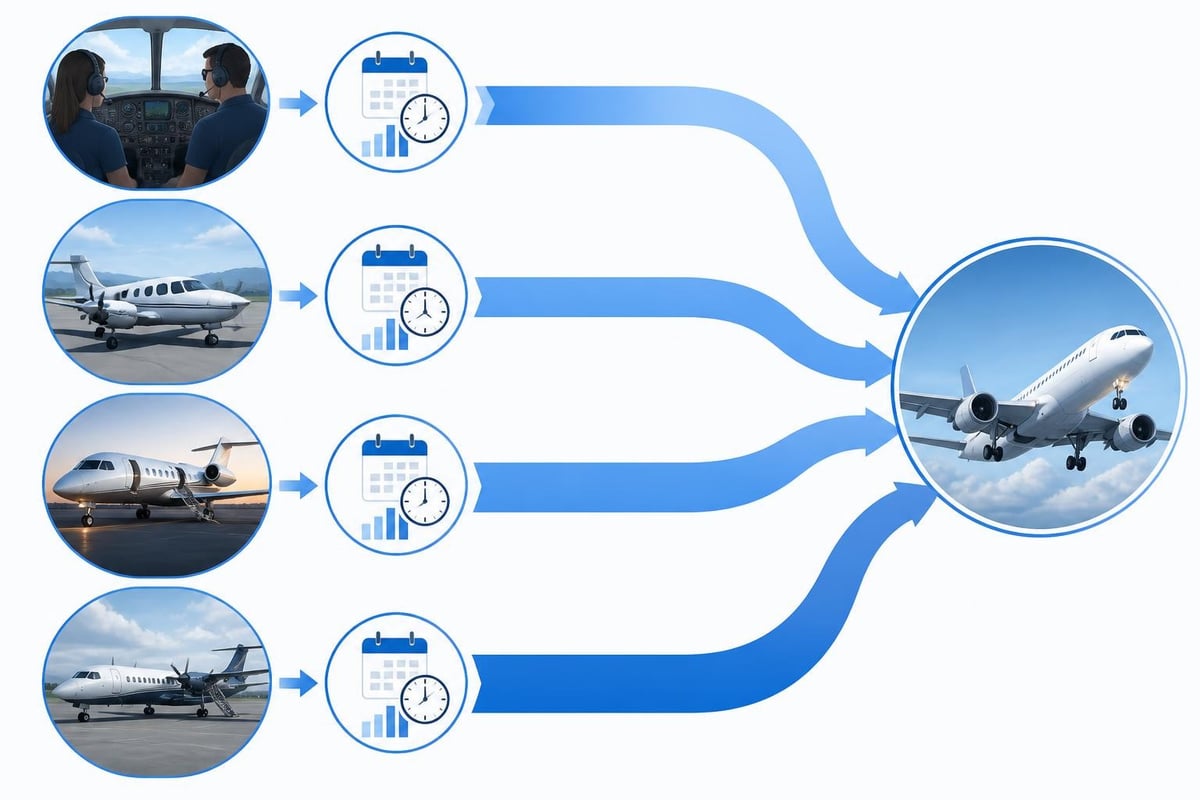
Flight Hour Regulations Vary by Authority
This article focuses on FAA regulations governing US-registered aircraft and US-certificated pilots. Other authorities have different requirements.
EASA (European Union Aviation Safety Agency) uses similar concepts but different thresholds. EASA's Part-FCL defines currency requirements differently than FAA Part 61. For instance, EASA's passenger currency follows FCL.060, requiring three takeoffs and landings in the preceding 90 days, similar to the FAA but with distinct regulatory text.
UK CAA now operates independently post-Brexit but maintains alignment with EASA Part-FCL for most requirements. UK-licensed pilots should consult the current CAP 804 and applicable retained EASA regulations.
ICAO sets international standards that most authorities adopt or adapt. ICAO Annex 1 defines flight time and experience requirements, which national authorities implement through domestic regulations.
Transport Canada, CASA (Australia), and other authorities each maintain their own flight time definitions and certificate requirements. If you hold or seek a foreign licence, verify the specific authority's current regulations.
Regulations change. The FAA updates requirements, modifies duty time rules, and adjusts currency standards. Always confirm against current official sources before making decisions based on flight hour requirements. What's accurate in 2026 may shift by 2027.
Maintaining Your Flight Hour Records Long-Term
Your logbook is a legal document. Treat it accordingly.
Keep physical logbooks in fireproof storage when not in use. Many pilots maintain one current logbook and archive completed volumes separately.
Back up digital logbooks weekly. Export to CSV or PDF and store in multiple locations. Cloud sync helps, but local backups protect against service discontinuation.
Never falsify entries. Logging time you didn't fly is fraud and grounds for certificate revocation. Exaggerating PIC time, inventing instrument approaches, or inflating cross-country hours risks your career.
Employers and insurers regularly audit logbooks. Discrepancies between your logged hours and aircraft hobbs or tach time raise red flags. Keep entries honest and contemporaneous.
Sign and date logbook pages. For digital logs, ensure the system maintains an audit trail showing when entries were created and modified.
Review totals quarterly. Even digital systems can have errors if you enter incorrect data. A quick check of category totals against expected values catches problems early.
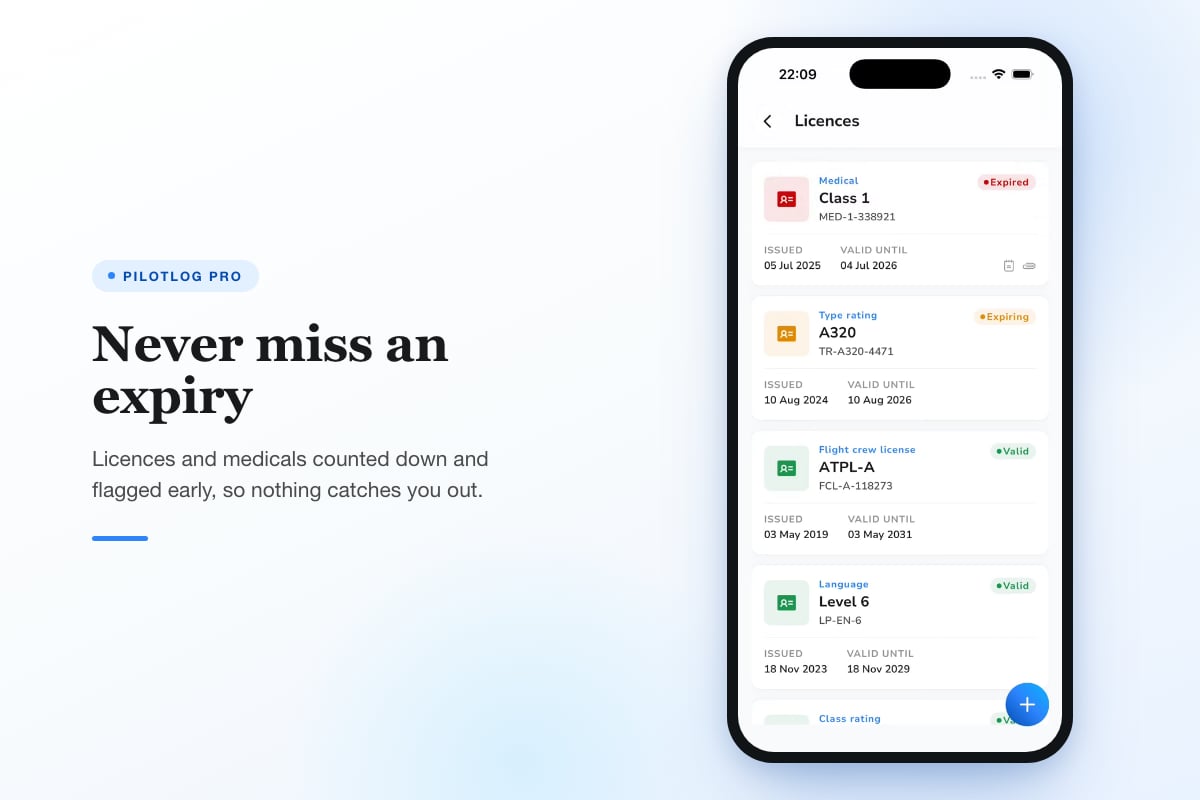
Flight hours measure your experience, determine your currency, and open career doors. Understanding minimum certificate requirements, tracking currency accurately, and monitoring duty time limits keeps you legal and ready to fly. Pilotlog tracks your hours, calculates currency automatically, and alerts you to approaching licence and medical expiries, ensuring nothing catches you by surprise whether you're a student pilot building toward your first certificate or an airline pilot managing complex duty limits across rolling 28-day windows.
- flight hours
- faa certificates
- pilot currency
- logbook tracking
- atp requirements
A logbook that keeps itself.
Join the waitlist and be first in line when Pilotlog launches.
Free to join, no spam. Unsubscribe any time.