jeppesen pilot logbook
Jeppesen Professional Pilot Logbook Review & Guide 2026
29 Sep 2026 · 13 min read
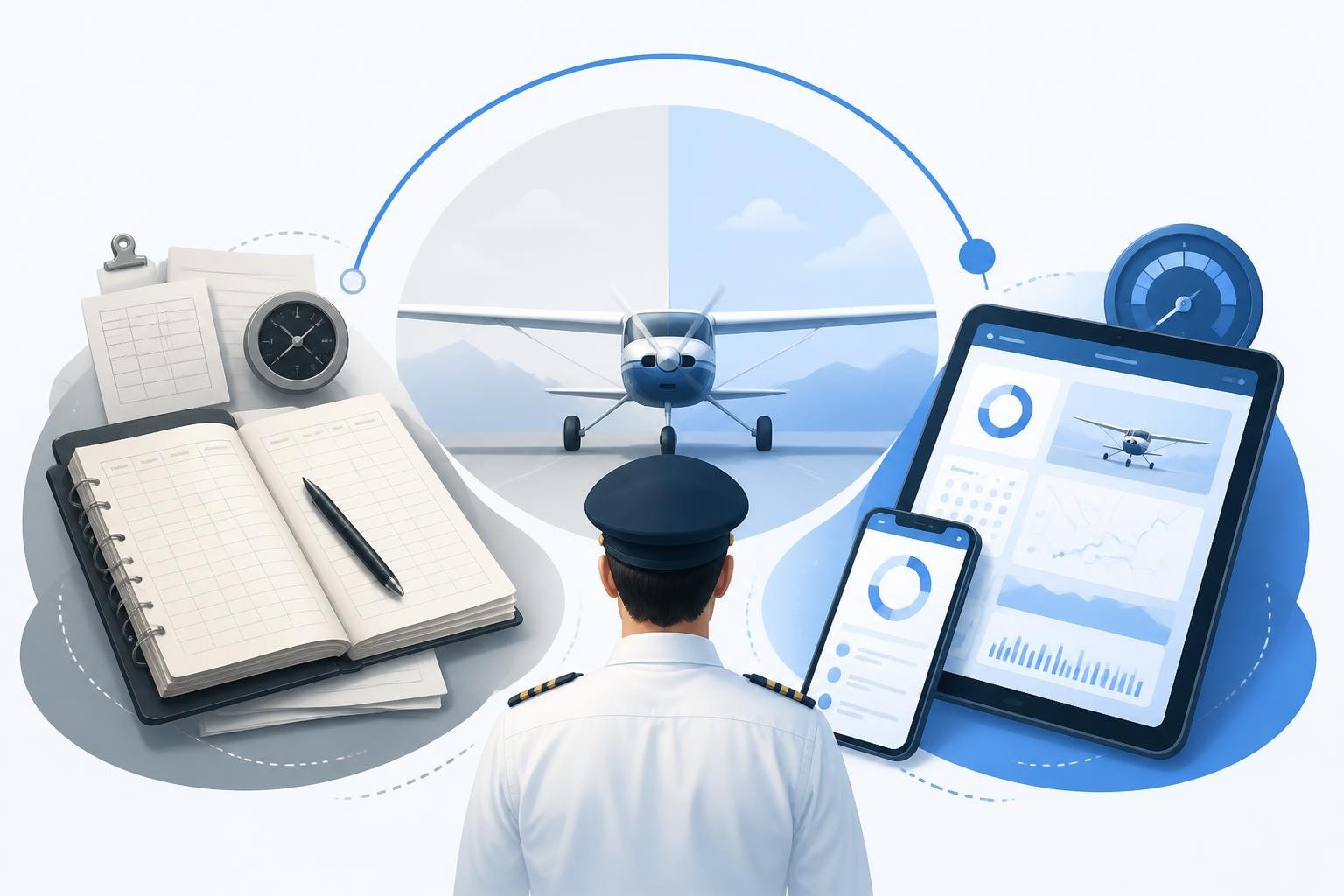
The jeppesen professional pilot logbook remains the paper logbook standard for commercial and airline pilots in 2026, despite the rise of digital alternatives. Published by Jeppesen (a Boeing subsidiary), it provides structured columns, compliance-ready layout, and durable construction that holds up through thousands of flight entries. For student pilots planning a professional career or line pilots meeting regulatory requirements, understanding how this logbook works and when it fits your operation matters more than brand loyalty.
Why the Jeppesen Professional Pilot Logbook Became Industry Standard
The jeppesen professional pilot logbook earned its reputation through thoughtful design choices that match 14 CFR § 61.51 requirements and real-world cockpit workflows. The binding lies flat when open, columns align with regulatory recordkeeping needs, and the hardcover protects entries during years of airline flying.
Jeppesen designed the layout around what examiners, chief pilots, and regulatory auditors expect to see. Each row captures one flight or lesson. Columns track date, aircraft type and registration, departure and arrival points, total flight time, and the specific categories that matter for currency: PIC time, SIC time, cross-country, night, instrument (actual and simulated), approaches, and landings (day/night).
What Sets It Apart From Generic Logbooks
Most student pilots start with an ASA or Sporty's logbook because they cost less and stock well at flight schools. The jeppesen professional pilot logbook targets pilots who need structured long-term records across multiple aircraft types, ratings, and employers.
Key differences include:
- Endorsement pages separated from flight entries for clarity during checkrides
- Type rating columns that let turbine and jet pilots track multiple aircraft categories without rewriting data
- Approach columns broken into precision and non-precision (critical for instrument currency under 14 CFR § 61.57)
- Remarks section wide enough for meaningful entries (route, unusual events, training notes) without abbreviating everything
- Page totals and carry-forward rows every 20 flights to simplify monthly audits and totaling
Airlines and major operators accept the jeppesen professional pilot logbook without question because the format has remained consistent since the 1980s. Chief pilots know where to look for specific hours, examiners recognise the columns instantly, and the layout supports both FAA and EASA recordkeeping conventions. Jeppesen publishes updates and product changes through their training and pilot supplies page, documenting any revisions to paper stock or binding methods.

How to Fill Out the Jeppesen Professional Pilot Logbook Correctly
Accuracy in your logbook protects your licence. Examiners, insurance underwriters, and hiring departments base decisions on what you record, and gaps or errors raise questions you don't want to answer during a interview or ramp check.
Required Entries Under 14 CFR § 61.51
U.S. regulations specify exactly what you must log. Each flight entry needs:
- Date of the flight
- Total flight time (or lesson time)
- Location where the flight originated and ended
- Type and identification of aircraft (make, model, registration)
- Pilot-in-command time or other flight time you're claiming (SIC, dual received, solo)
- Conditions (day, night, actual instrument, simulated instrument)
- Landings (including night landings if claiming night currency)
When logging training, also record the instructor's name, certificate number, and signature for dual received. CFIs must sign after each lesson. Endorsements for solo, checkrides, or advanced privileges go in the dedicated endorsement section, not scattered across flight rows.
Column-by-Column Best Practices
The jeppesen professional pilot logbook provides more columns than the regulation requires. Use them all.
| Column | What to Log | Why It Matters |
|---|---|---|
| From / To | ICAO or IATA codes | Proves cross-country distances; hiring departments verify |
| Aircraft Type | Exact model (C172S, PA28-181, B737-800) | Type-specific time matters for insurance and job requirements |
| PIC / SIC | Actual role, not total time | Under-logging PIC delays ATP eligibility; over-logging is falsification |
| Cross-Country | >50 nm only (student); varies by rating | Examiners verify XC time against route; don't round up |
| Night | Official night per 14 CFR § 1.1 (end of evening civil twilight to beginning of morning civil twilight) | Night currency under § 61.57 requires 3 landings in preceding 90 days |
| Instrument | Actual or simulated, logged separately | IFR currency requires 6 approaches, holding, intercepting/tracking in preceding 6 months; read more about IFR currency requirements |
| Approaches | Count each published approach flown | Examiners cross-check approach totals with remarks; don't estimate |
AOPA recommends logging every flight like a professional from day one. Sloppy habits as a student pilot create reconstruction headaches when applying for commercial or ATP certificates years later.
Maintaining Professional Standards Over Years of Flying
A jeppesen professional pilot logbook lasts 5 to 15 years depending on flight frequency. Airline first officers filling 70-90 flights per month exhaust a logbook within two years. Flight instructors teaching 800 hours annually might stretch it to four years. Weekend GA pilots can use the same book for a decade.
Totaling and Page Management
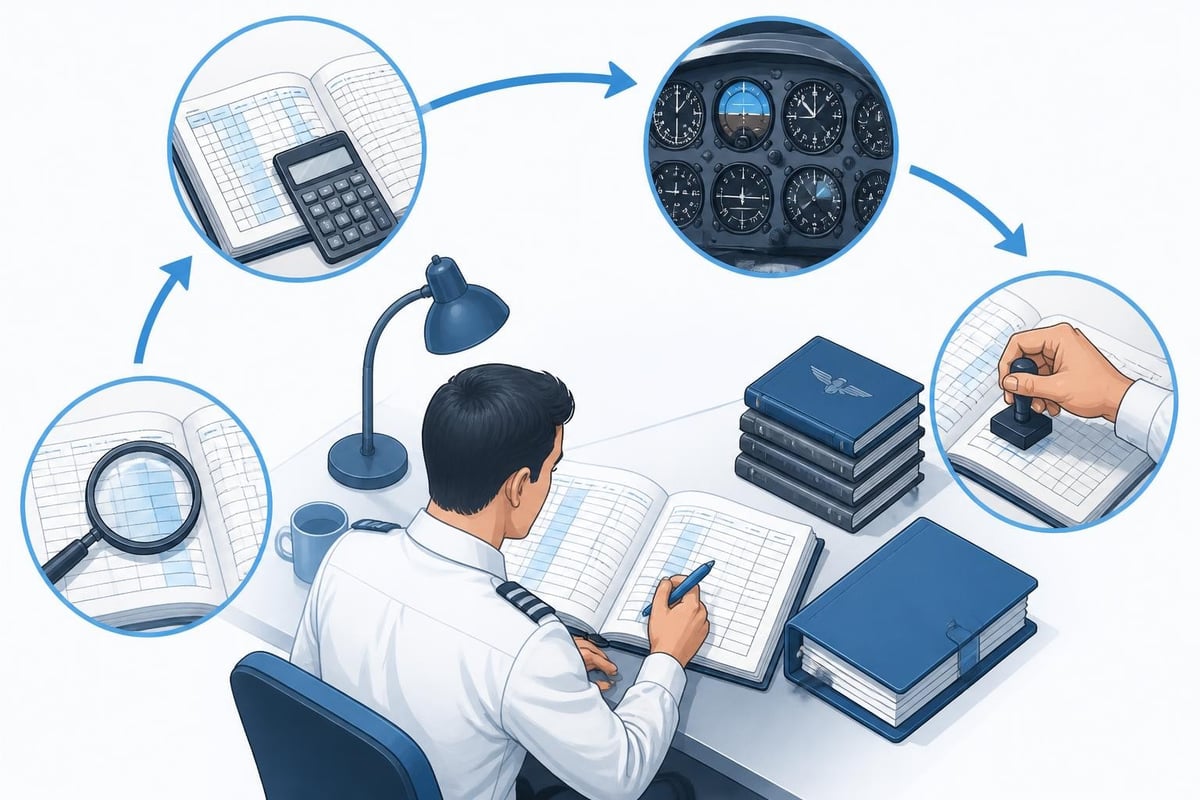
Jeppesen includes subtotal rows every 20 flights. Use them. Calculate page totals at the bottom of each page, then carry forward to the next page. This rolling total lets you answer "What are your total hours?" without adding 800 rows by hand.
At the end of each year (or every 100 hours), create a summary page showing:
- Total flight time (all categories)
- PIC and SIC time separately
- Multi-engine time
- Turbine and jet time (if applicable)
- Cross-country, night, actual instrument, simulated instrument
- Dual received and dual given (for CFIs)
- Approaches by type (ILS, RNAV, VOR, NDB)
Attach this summary when applying for jobs or insurance. Hiring managers rarely read 10 logbooks cover-to-cover; they scan summaries first, then spot-check specific entries if something looks odd.
Ink, Corrections, and Electronic Backup
Write in black or blue pen only. Pencil fades, and examiners question anything erasable. When you make a mistake, draw a single line through the error, write the correction above, and initial it. Never use correction fluid or tape. Auditors treat whited-out entries as potential falsification.
Scan or photograph every page quarterly. Store digital copies separately from the physical logbook (cloud storage, external drive, or email to yourself). If you lose the logbook in a flight bag theft or office fire, the scans let you reconstruct entries. Some pilots maintain parallel digital logs in apps like Pilotlog for this exact reason.
European pilots operating under EASA Part-FCL face similar requirements. EASA regulations accept electronic logbooks as equivalent to paper provided they meet certain auditability standards, but many airlines and training organisations still request a signed paper logbook for interviews and type ratings. The EASA Easy Access Rules for Aircrew outline what records must be available for inspection.
When Digital Logbooks Make More Sense Than Paper
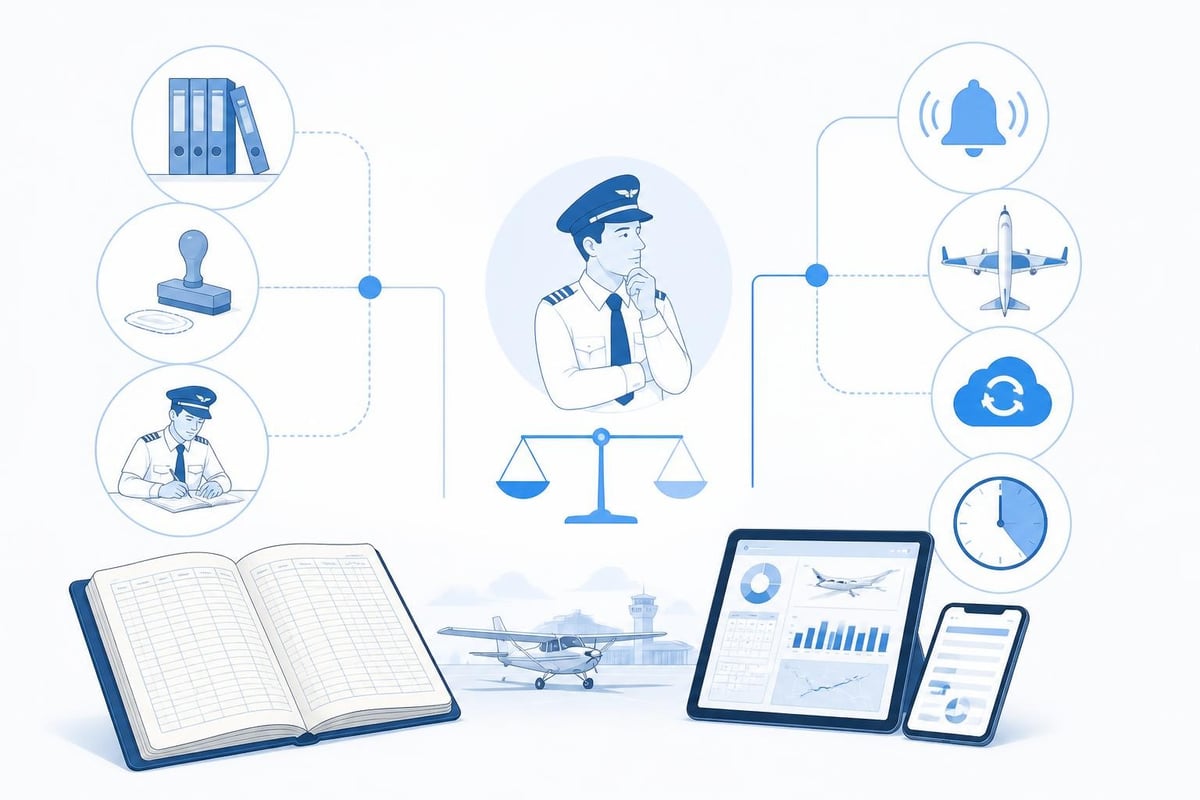
The jeppesen professional pilot logbook works brilliantly for linear record-keeping, but it cannot alert you when currency expires or calculate rolling duty limits. In 2026, professional pilots increasingly use hybrid systems: paper for the legal record, digital for currency tracking and analysis.
What Paper Cannot Do
A paper logbook is a ledger, not a database. You write entries but the book doesn't:
- Calculate 28-day or 365-day flight-time limits
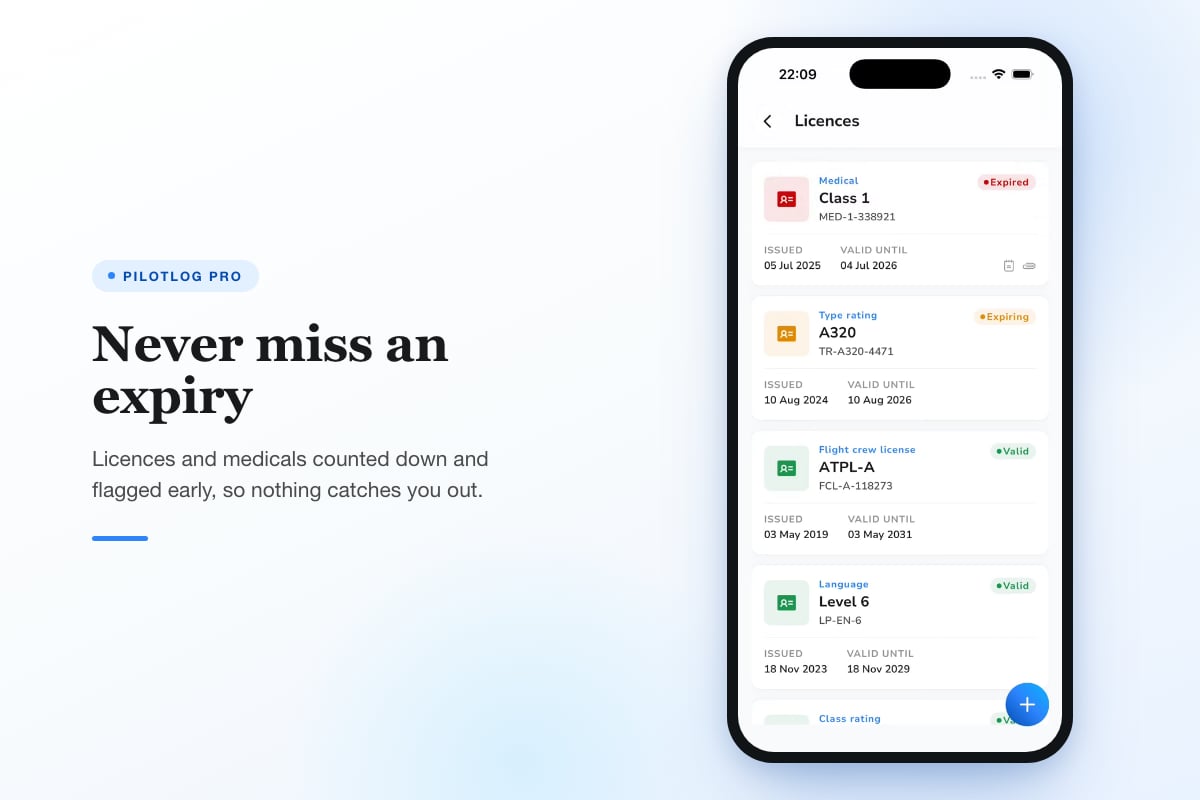
- Alert you 14 days before your Class 1 medical expires
- Track currency for multiple aircraft categories simultaneously
- Generate reports for insurance applications or job interviews
- Sync across devices or back up automatically
Every one of those tasks requires manual arithmetic, calendar-watching, or spreadsheet work. Miss a night landing and you're not current for passengers after sunset. Miss a medical renewal and you're grounded.
How Digital Complements the Jeppesen Logbook
Modern digital logbooks like Pilotlog Pro track rolling currency windows automatically. Log a flight once (often pulling data from your airline roster or flight planning app), and the system updates your 28-day totals, flags approaching currency lapses, and maintains running summaries by aircraft type. When your instrument currency window closes in 14 days, you receive an alert with time to schedule a currency flight or proficiency check.
Pilots operating under complex flight-time limitations (airline FDTLs, Part 135 duty limits, or military crew rest rules) particularly value automated tracking. Flight-time and duty-limit tracking prevents inadvertent violations that paper logbooks cannot catch until after you've exceeded a regulatory ceiling.
Regulatory Acceptance of Electronic Records
The FAA published Advisory Circular AC 120-78B outlining how electronic signatures and recordkeeping systems gain acceptance. The key requirements centre on data integrity (records cannot be altered without an audit trail), accessibility (you must produce the logbook on demand), and backup/redundancy (single-device failures cannot erase your entire flying history).
Most certificated pilots use electronic logbooks as a working tool and periodically print or export summaries into their jeppesen professional pilot logbook for archival and signature purposes. This hybrid approach leverages digital convenience while maintaining a traditional paper backup that airlines and examiners universally accept. Guidance on electronic flight bags and related operational considerations appears in FAA AC 120-76E, which indirectly supports digital logbook use as part of approved EFB workflows.
Buying and Alternatives to the Jeppesen Professional Pilot Logbook
You can order the jeppesen professional pilot logbook directly from Jeppesen's official shop, which lists current pricing, stock, and shipping options. Expect to pay £35 to £50 depending on retailer and region. Amazon, Sporty's, and Pilot Mall also stock it, though availability varies.
How It Compares to Other Paper Logbooks
| Logbook | Best For | Strengths | Weaknesses |
|---|---|---|---|
| Jeppesen Professional | Career pilots, multi-rating | Comprehensive columns, durable, recognised globally | Higher cost, heavier than student books |
| ASA Standard | Student pilots, PPL training | Affordable, simple layout, widely stocked | Fewer columns, less structured for advanced ratings |
| Sporty's Flight Log | Recreational pilots | Compact, inexpensive | Minimal endorsement pages, cramps multi-engine ops |
| MyFlightbook (digital) | Tech-comfortable pilots | Free, cloud-based, automatic totals | Requires smartphone/tablet; not all examiners trust it |
| Pilotlog (digital) | Professional currency tracking | Currency alerts, expiry warnings, FTL tracking | Requires subscription for Pro features |
Flying Magazine's 2026 review rated the jeppesen professional pilot logbook highly for commercial and ATP pilots but noted that recreational pilots rarely use all its columns. For pilots focused purely on PPL flying without plans for a professional career, a simpler ASA or Sporty's logbook might suffice.
If you've already started in another logbook, transfer summary totals to the jeppesen professional pilot logbook by creating an opening "Previous Totals" entry that itemises all carried-forward time. Some pilots keep old logbooks as archives and carry only the current Jeppesen book, supplemented by a one-page summary sheet showing lifetime totals through the previous book's end date.
Common Mistakes and How to Avoid Them
Even experienced pilots make logbook errors that create headaches during checkrides, job applications, or insurance renewals. Most mistakes trace to rushed entries, unclear handwriting, or misunderstanding regulatory definitions.
Top Recordkeeping Errors
- Over-logging PIC time: You cannot log PIC unless you are the sole manipulator of the controls in an aircraft you're rated for, or acting as PIC under §61.51(e). Airline SICs cannot log PIC on line flights unless specifically authorised.
- Miscounting cross-country time: For private pilot, cross-country means >50 nm straight-line distance from the original departure point (§61.1). For instrument and commercial, different distance and conditions apply. Don't assume every trip counts.
- Forgetting instructor signatures: Every dual-received entry requires the CFI's signature, certificate number, and expiration date. Missing signatures invalidate the training for TSA and checkride purposes.
- Rounding flight times: 1.3 hours is not the same as 1.5. Examiners compare your logbook to Hobbs or tach records. Chronic rounding suggests sloppiness or inflation.
- Unclear remarks: "Local area" tells an examiner nothing. Write "EGLL-EGSS-EGLL, practice GS/LOC approaches, crosswind landings RWY 22" instead.
Practical guidance on maintaining a digital logbook highlights how electronic systems reduce arithmetic errors and enforce data completeness, but even digital users must understand what each field means legally.
Reconstruction After Loss or Damage
If you lose your jeppesen professional pilot logbook, the FAA (or CAA, EASA, etc.) does not maintain a backup copy. Reconstruction falls entirely on you. Start by gathering:
- Flight school or airline records (many retain student and pilot records for 3-5 years)
- Insurance logbook summaries (if you submitted them for hull or liability coverage)
- Personal backups (scans, photos, or parallel digital logs)
- Aircraft rental receipts and Hobbs records (proves you flew that aircraft on that date)
- Instructor or employer attestations (signed letters confirming approximate hours and dates)
Recreate entries to the best of your ability, mark the logbook "RECONSTRUCTED" on the first page, and attach an explanation letter. Examiners will scrutinise reconstructed books closely, so start scanning or photographing pages now rather than waiting for loss.
Regulations change and interpretations vary by region and inspector. Always confirm current requirements against official FAA regulations or your national authority before relying solely on logbook practices learned from peers or online forums. Consult Pilotlog's resources for regularly updated guidance on currency, expiry tracking, and recordkeeping best practices.
Endorsement Pages and Career Milestones
The jeppesen professional pilot logbook dedicates multiple pages to endorsements separately from flight entries. This design prevents clutter and makes it easy for examiners to verify that you received the required training and sign-offs.
What Goes in Endorsements vs. Flight Entries
Endorsements (separate pages):
- Solo sign-off (first solo, solo cross-country, complex/HP aircraft)
- Checkride prerequisites (cross-country, night, instrument time, etc.)
- CFI recommendations for practical tests
- Flight reviews (biennial or annual depending on jurisdiction)
- Additional aircraft category or class authorisations
- High-performance, complex, tailwheel sign-offs
Flight entry remarks (main log rows):
- Route flown and unusual conditions encountered
- Specific manoeuvres practiced
- Approaches flown (type, runway, full or partial)
- Training received that isn't an endorsement (unusual attitude recovery, engine-out practice)
Keep endorsement language precise. The FAA publishes standardised endorsement wording in Advisory Circular AC 61-65 (current revision as of 2026). CFIs who invent their own wording create ambiguity that examiners may reject. Copy the exact regulatory text, fill in your name and dates, and have the instructor sign with certificate number and expiration date clearly visible.
Tracking Career Progression
Your logbook tells the story of your aviation career. Certain milestones matter to hiring managers and deserve clear notation:
- First solo (significant for every pilot)
- Private pilot checkride pass date
- 100 hours total time (common insurance threshold)
- 250 hours total time (commercial minimums under §61.129)
- 500 hours PIC (many job postings require this)
- 1,000 hours total and 1,500 hours total (ATP minimums in various jurisdictions)
- First turbine time, first jet time, first international flight
- Type ratings earned (B737, A320, etc.)
Some pilots add a "Career Summary" page at the front of each new logbook showing total time through the previous book, major ratings, and aircraft types flown. This one-page snapshot saves hiring managers from paging through multiple logbooks to confirm you meet minimum qualifications.
For additional context on the cost and training pathway from student to professional pilot, explore how much flight lessons cost and what becoming a private plane pilot entails. Understanding the financial and time investment helps you plan when you'll reach key milestones.
The jeppesen professional pilot logbook remains a reliable, examiner-trusted tool for pilots who value structured paper records and long-term durability. Whether you log every flight in paper alone or maintain a hybrid paper-digital workflow, accuracy and consistency protect your licence and your career. For pilots who want automated currency tracking, expiry alerts, and instant summaries without abandoning regulatory compliance, Pilotlog bridges the gap between traditional logbooks and modern operational demands. Log once, stay current, and let the system handle the details that matter.
- jeppesen pilot logbook
- paper logbook
- pilot logbook review
- faa logging requirements
- logbook best practices
A logbook that keeps itself.
Join the waitlist and be first in line when Pilotlog launches.
Free to join, no spam. Unsubscribe any time.