helicopter flying lessons
Helicopter Flying Lessons: Complete Training Guide 2026
6 Oct 2026 · 12 min read
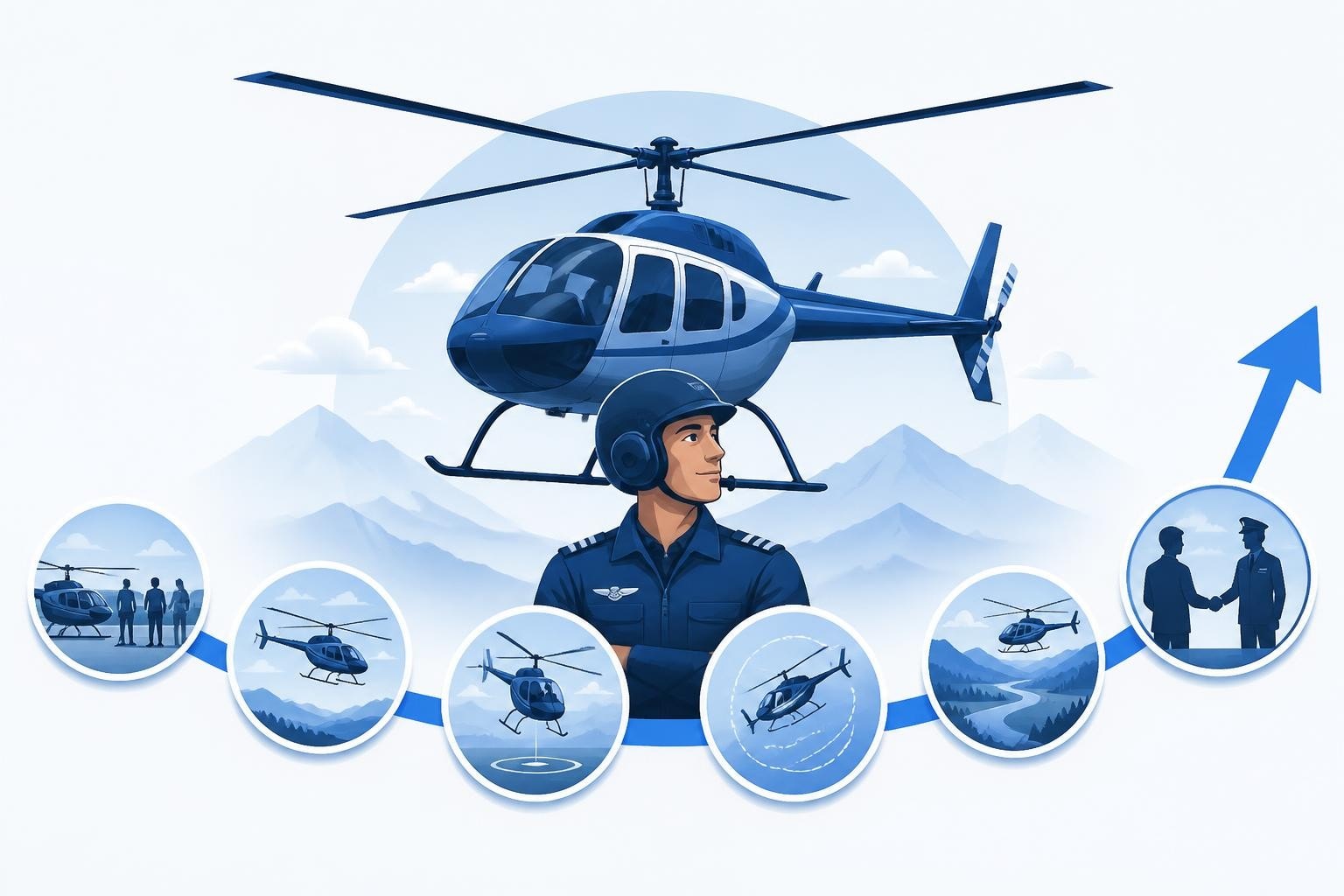
Helicopter flying lessons are structured training sessions delivered by qualified instructors that teach you to fly rotary-wing aircraft, from basic hover and circuit work through advanced maneuvers and cross-country navigation. Training follows a regulatory syllabus covering aerodynamics, controls, normal operations, emergency procedures, and airspace rules, culminating in a practical flight test and written examinations. Whether you pursue a Private Pilot Licence (Helicopters) for recreation or a Commercial Pilot Licence (Helicopters) for career flying, lessons are tailored to meet national airworthiness authority standards and build the skills, knowledge, and judgment needed to operate safely.
How Helicopter Pilot Training Is Structured
Helicopter flying lessons follow a progressive syllabus defined by your national aviation authority. In the United States, the FAA Helicopter Flying Handbook sets out core knowledge and maneuvers for student, private, and commercial pilots. In Europe, EASA Part-FCL governs training organisations and instructor qualifications, and the EASA Easy Access Rules for Aircrew detail syllabus content and minimum hour requirements. Canada's Transport Canada publishes the Helicopter Flight Training Manual TP 9982, a widely respected reference used by schools worldwide.
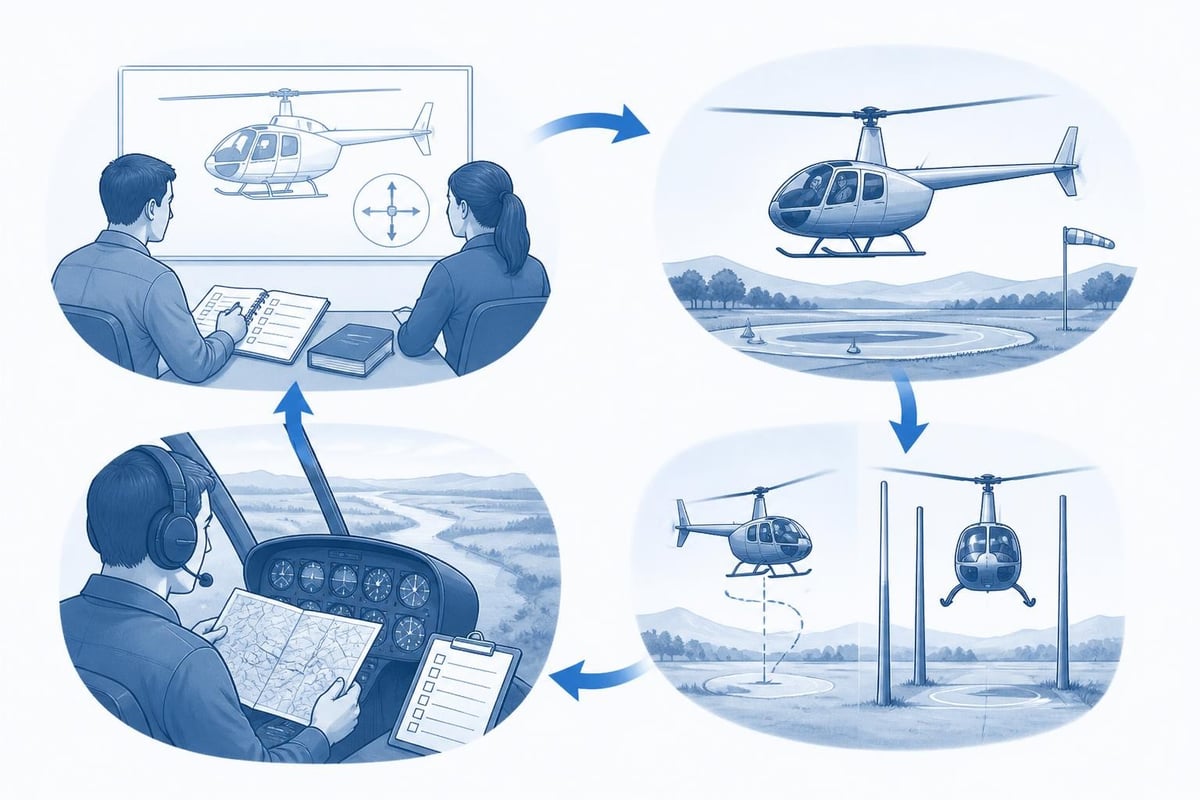
Training is divided into ground school and flight training.
Ground school covers:
- Aerodynamics and rotor systems
- Flight controls and power management
- Weight and balance
- Meteorology
- Navigation and airspace
- Emergency procedures and engine failures
- Human factors and decision-making
- Regulations and airworthiness
Flight training is taught in dual (with an instructor) and solo phases. Early lessons focus on basic control, hover, and circuits. Mid-course lessons introduce autorotations, confined areas, and limited power work. Later lessons cover cross-country navigation, night flying (for commercial syllabi), and instrument awareness.
Each lesson is logged in your pilot logbook. You record flight time, takeoffs and landings, solo time, PIC time, and specific maneuvers practiced. Accurate logs are essential for proving currency, meeting licence prerequisites, and satisfying insurance requirements. Tracking your flight hours becomes critical as you approach test minimums and build towards advanced licences.
Minimum Hour Requirements
Licence requirements vary by country and licence type. In the UK under CAA Part-FCL, a PPL(H) requires 45 hours total time, including at least 25 dual and 10 solo. The FAA in the US requires 40 hours for a Private Pilot Certificate (Helicopter), including 20 dual and 10 solo, though most students finish closer to 50-60 hours. Commercial minimums are higher: FAA requires 150 hours total time for a CPL(H), with prescribed PIC cross-country and night hours.
| Licence Type | Jurisdiction | Minimum Hours | Typical Actual Hours |
|---|---|---|---|
| PPL(H) | FAA (US) | 40 | 50-60 |
| PPL(H) | EASA / UK CAA | 45 | 50-65 |
| CPL(H) | FAA | 150 | 160-180 |
| CPL(H) | EASA / UK CAA | 135 | 150-170 |
Rules change. Always confirm current minimums against official sources before starting training.
What Happens in Your First Helicopter Flying Lesson
Most schools offer a discovery flight or introductory lesson lasting 30-60 minutes. Your first lesson typically follows this pattern:
- Pre-flight briefing: The instructor explains the flight plan, aircraft controls, safety, and what you'll do.
- Walk-around inspection: You learn to check fuel, oil, control linkages, tail rotor drive, and airframe condition.
- Start-up and taxi: The instructor starts the helicopter and taxis to the departure point while explaining the pedals, collective, and cyclic.
- Air work: Once airborne, you take the controls in straight-and-level flight, try gentle turns, and feel the hover (though hovering is rarely taught on day one).
- Landing and debrief: The instructor lands, shuts down, and debriefs what went well and what to practice next.
Discovery flights cost between £200 and £400 in the UK, or $250 to $500 in the US, depending on aircraft type. Robinson R22 and R44 trainers are most common. Schweizer 300 and Cabri G2 are also popular training platforms.
You don't need a medical certificate for a discovery flight, but you will need at least a Class 2 medical (EASA) or Third Class medical (FAA) to solo. Book your medical early so it doesn't delay solo clearance.
Core Skills Taught in Helicopter Flying Lessons
Helicopter training differs fundamentally from fixed-wing. You learn to manage power, rotor RPM, and anti-torque pedals simultaneously while maintaining aircraft attitude and position.
Hover and Hover Taxi
Hovering is the signature helicopter maneuver and the hardest to master. You hold the aircraft stationary 3-6 feet above the ground, balancing collective (vertical position and power), cyclic (lateral and fore-aft position), and pedals (heading). New students typically require 5-10 hours before they can hover solo in calm conditions.
Hover taxi follows once you can hold a steady hover. You move the helicopter slowly across the ramp or along a taxiway, maintaining height and heading. This builds precision and confidence before pattern work.
Circuits and Traffic Patterns
Helicopter circuits mirror fixed-wing patterns: upwind, crosswind, downwind, base, final, and approach to hover or landing. You learn normal takeoffs, approach angles (typically steeper than fixed-wing), and landing techniques. Most schools teach both hover taxi to takeoff and running takeoff depending on weight and density altitude.
You'll log dozens of circuits before solo. The instructor emphasizes consistent airspeeds, altitudes, and radio calls. Circuits build muscle memory and prepare you for solo pattern work.
Autorotations
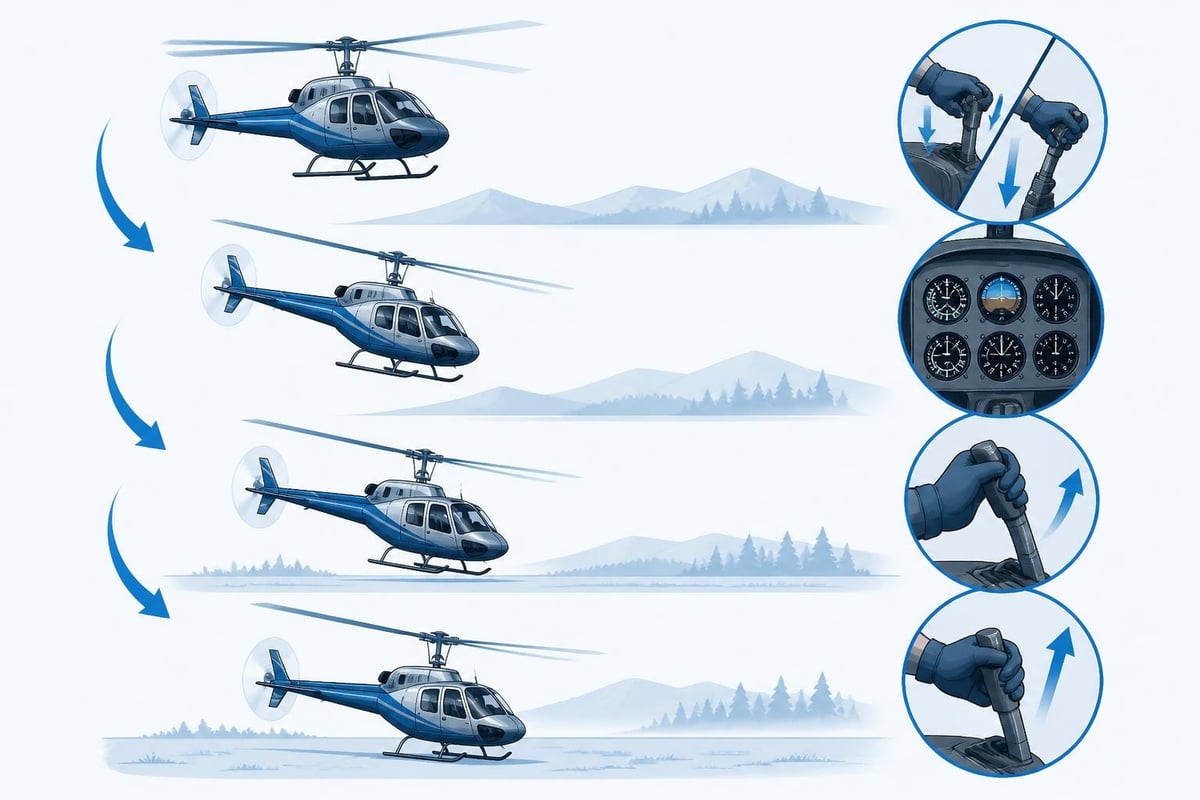
An autorotation is a controlled descent without engine power. The rotor keeps turning because upward airflow through the disc sustains rotor RPM. You enter autorotation by rolling the throttle to idle, lowering the collective, and maintaining rotor RPM in the green arc. At the bottom, you flare to reduce rate of descent and groundspeed, then cushion the landing with collective.
Autorotations are practiced from 500 feet AGL to full touchdown, and they feature on every helicopter checkride. The FAA Practical Test Standards specify tolerances for airspeed, rotor RPM, and landing point. Autorotations are non-negotiable for safe helicopter operation and are covered extensively in helicopter flying lessons.
Confined Area and Slope Operations
Helicopters operate from spaces fixed-wing aircraft cannot use: helipads, clearings, mountain ridges, and offshore platforms. You learn to assess confined areas for obstacles, wind, and escape routes. High and low reconnaissance passes precede the approach. You touch down on one skid when landing on slopes, checking weight-on-gear before committing fully.
These skills are essential for utility, emergency medical, and mountain flying. They also teach judgment and risk management in constrained environments.
Emergency Procedures
Helicopter flying lessons emphasize emergencies more than fixed-wing training. You practice:
- Engine failures at altitude and in the hover
- Tail rotor failures (simulated by restricting pedal inputs)
- Low rotor RPM recovery (collective reduction and cyclic aft)
- Vortex ring state avoidance and recovery (covered in detail by Transport Canada TP 9982)
- Systems failures: hydraulics, electrical, fuel
Each emergency has a published procedure. Repetition under instructor supervision builds the reactions needed in real events.
Choosing a Training School and Instructor
Selecting a school and instructor shapes your entire training experience. Look for:
- Regulatory approval: Ensure the school holds an Air Operator Certificate (AOC) or Part 141 / Part 61 authority from the relevant CAA or FAA.
- Fleet condition: Well-maintained R22, R44, or equivalent trainers with glass or steam gauges depending on your goals.
- Instructor experience: Minimum 500 helicopter hours PIC and a current instructor rating. Ask about their teaching style and availability.
- Syllabus transparency: Schools should provide a written syllabus, lesson plans, and progress milestones.
- Insurance and safety record: Check the school's safety record and ask about student insurance coverage during training.
AOPA student resources offer guidance on choosing schools and preparing for lessons, applicable to helicopter students as well. Visit the school, meet instructors, and ask current students about their experience before committing.
Costs and Budgeting for Helicopter Flying Lessons
Helicopter training is more expensive than fixed-wing due to higher operating costs and insurance. In the UK, expect to pay:
- £250-£350 per hour for R22 dual instruction
- £400-£550 per hour for R44 dual instruction
- Ground school: £500-£1,500 depending on format (online, classroom, or integrated)
- Exams and test fees: £150-£400 (knowledge tests, medical, checkride examiner fee)
Total cost for a PPL(H) in the UK typically ranges from £12,000 to £20,000. In the US, R22 training runs $250-$350 per hour, and total PPL(H) cost is typically $15,000 to $25,000. Commercial training (CPL(H)) costs £40,000-£60,000 in the UK or $50,000-$80,000 in the US.
Budget for extra hours. Most students exceed minimums by 10-20 hours due to weather, availability, and skill consolidation. Factor in chart subscriptions, headset, and logbook (digital logbooks like Pilotlog help track your progress and ensure nothing is missed).
For a detailed breakdown of pilot training costs across licence types, see our guide on the cost to become a pilot.
Currency and Recency in Helicopter Flying
Once licensed, you must stay current to exercise your privileges legally and safely. EASA Part-FCL.060 requires holders of a PPL(H) to complete 12 hours flight time in the preceding 12 months, including 6 hours PIC, 12 takeoffs and landings, and a training flight with an instructor. The FAA requires three takeoffs and landings in the preceding 90 days to carry passengers (14 CFR 61.57).
Night currency has separate rules. EASA requires 5 night circuits in the preceding 6 months. The FAA requires three night takeoffs and landings to a full stop in the preceding 90 days.
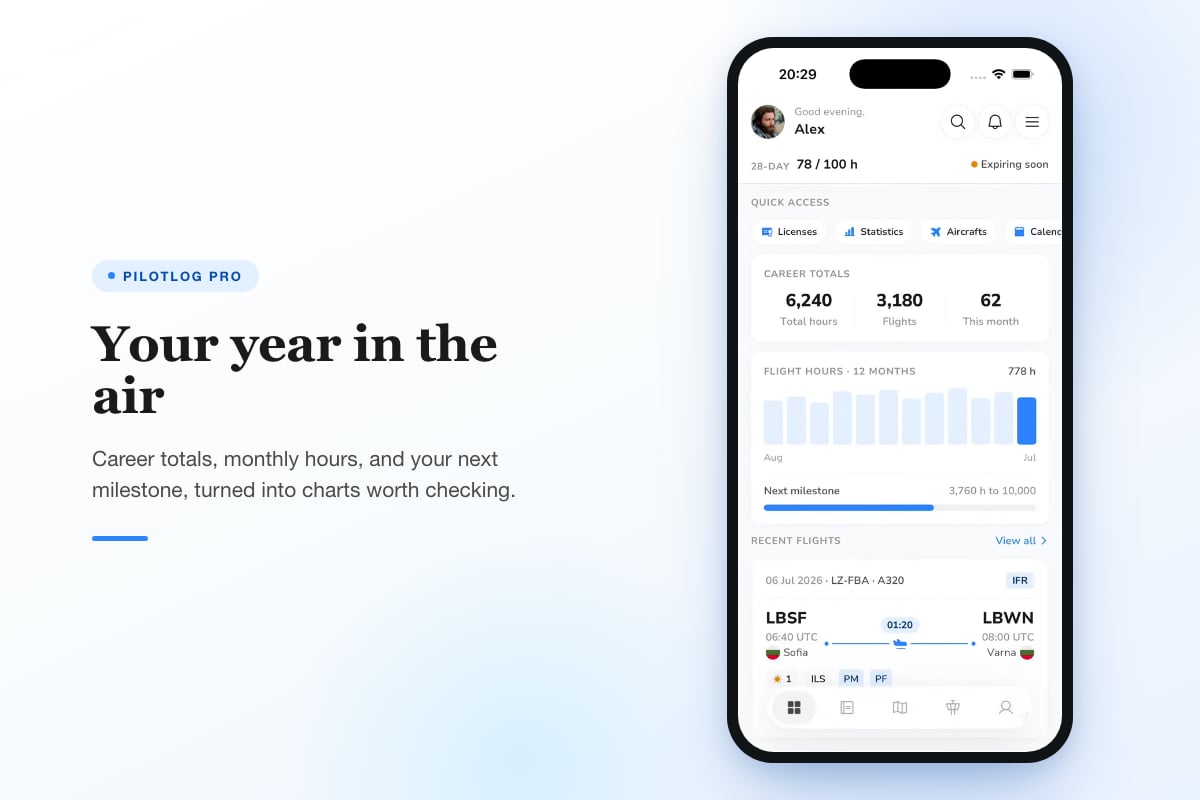
Tracking currency manually is error-prone. Pilotlog Pro automatically calculates rolling 28-day, 90-day, and 365-day totals, flags passenger and night currency lapses, and alerts you to upcoming medical and licence expiries, keeping you current, legal, and ready without spreadsheets or guesswork.
Simulator and Synthetic Training in Helicopter Flying Lessons
Flight simulation devices (FSDs) and flight training devices (FTDs) are increasingly integrated into helicopter syllabi. The FAA allows up to 2.5 hours of the 40-hour PPL(H) minimum to be logged in an approved aviation training device (ATD). EASA permits up to 5 hours in a FNPT I or II for PPL(H).
NASA research on training devices shows synthetic training is highly effective for procedures, instrument scanning, and emergency drills, though it cannot replace hands-on hover and autorotation practice. Simulators reduce training costs and allow repetition of high-risk scenarios (engine failures, weather, system malfunctions) safely.
Use simulators for:
- Instrument scanning and radio navigation
- Emergency checklist practice
- Cross-country flight planning and execution
- Unusual attitude recovery
Reserve actual aircraft time for hover, autorotations, slope work, and confined areas where tactile feedback and environmental cues are essential.
Medical and Regulatory Prerequisites
Before you can solo or take a checkride, you need:
- Medical certificate: Class 2 (EASA) or Third Class (FAA) for PPL(H). Class 1 required for CPL(H) and airline work. Validity is typically 60 months under age 40, 24 months age 40-50, and 12 months over 50 (exact rules vary by authority). Track your medical expiry to avoid lapses.
- Student pilot licence or certificate (if required by your CAA): Some jurisdictions issue a student licence; others allow training under instructor supervision without one.
- Theory exams: EASA PPL(H) has nine written exams (Air Law, Meteorology, Navigation, Human Performance, etc.). FAA requires one knowledge test covering all subjects.
- Radiotelephony endorsement (EASA Flight Radiotelephony Operator's Licence - FRTOL, or FAA endorsement).
- English language proficiency: ICAO Level 4 minimum for licence issue in most jurisdictions.
All prerequisites must be current on checkride day. Late medical renewals or lapsed theory can delay your test and add cost.
Safety and Accident Prevention in Helicopter Training
Helicopter training has unique hazards. The NTSB 2024 Annual Report highlights loss of tail rotor effectiveness, dynamic rollover, and low-level mast bumps as recurring accident causes in training helicopters. NTSB Safety Alert SA-096 addresses wake turbulence and other environmental hazards.
Key safety practices during helicopter flying lessons:
- Weight and balance: Always confirm the helicopter is within limits before flight. R22 and R44 are sensitive to CG position.
- Wind limits: Respect published crosswind and tailwind limits. Tail rotor authority decreases in strong quartering tailwinds.
- Rotor RPM discipline: Keep rotor RPM in the green arc. Low RPM recovery is time-critical and requires immediate collective reduction.
- Pre-takeoff checks: Complete a full control check, instrument scan, and lookout before every lift-off.
- Fuel management: Helicopters burn 15-25 gallons per hour. Plan for reserves and confirm fuel quantity visually, not just by gauge.
Your instructor will brief these points repeatedly. Ask questions, chair-fly procedures at home, and review accident case studies to understand how small errors cascade.
Progressing from PPL(H) to Commercial and Beyond
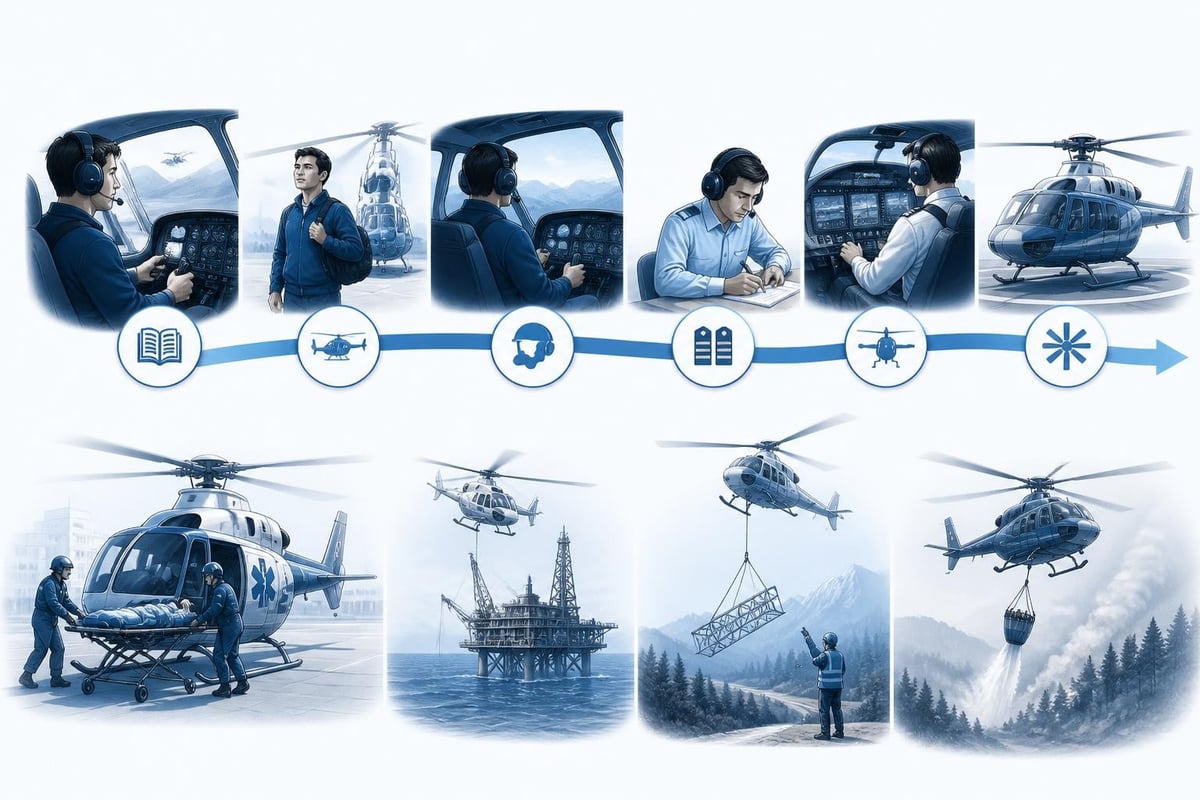
Many pilots start helicopter flying lessons for recreation and later pursue commercial ratings. The progression typically looks like this:
- PPL(H): 45-50 hours, solo and dual training, basic VFR skills.
- Hour building: Fly as PIC, take friends, explore new airfields. Log 100-150 hours.
- CPL(H): Advanced training (mountain flying, long-line, night, limited panel). Typically 150-180 total hours at course completion.
- Instructor rating: Many build hours by teaching. Requires CPL(H) plus instructor course.
- Type ratings: Turbine or multi-engine helicopters (e.g., Bell 206, AS350) require type-specific training and checkrides.
- Airline or commercial operations: EMS, offshore oil, firefighting, and utility work require 500-1,000 hours PIC and specific endorsements.
Each step requires meticulous logging. Lost or inaccurate logbook entries can delay job applications, insurance underwriting, or type-rating approval. A digital logbook for pilots ensures every flight is recorded with timestamps, aircraft registration, and duty codes, ready for export or audit.
Differences Between Recreational and Professional Training Goals
If you're learning to fly helicopters purely for recreation, your training will focus on safe VFR operation, personal skill, and enjoyment. You may stop at PPL(H) and fly for pleasure, using your licence to explore backcountry sites or visit friends by air. For insights on non-commercial flying, see our article on the recreational pilot licence and how it compares to PPL privileges.
Professional training adds complexity: night operations, mountain flying, confined-area precision, limited-panel instrument work, and advanced emergencies. Commercial pilots must demonstrate higher standards in every maneuver and pass more rigorous oral and practical exams. Training is also longer and more expensive, but it opens career doors in utility, tourism, law enforcement, and emergency services.
Decide your goal early. It affects aircraft choice (piston vs turbine exposure), instructor selection (airline-experienced vs recreational), and budgeting. You can always upgrade later, but a clear plan from day one saves time and money.
Helicopter flying lessons provide structured, progressive training that builds the skills, knowledge, and judgment needed to operate rotary-wing aircraft safely and legally, whether your goal is private recreation or a professional career. Once you start logging flight time, Pilotlog keeps track of every hour, currency requirement, and expiry automatically, so you stay current, legal, and focused on flying instead of spreadsheets.
- helicopter flying lessons
- ppl(h) training
- cpl(h) requirements
- learn to fly helicopter
- pilot logbook
A logbook that keeps itself.
Join the waitlist and be first in line when Pilotlog launches.
Free to join, no spam. Unsubscribe any time.