aviation maintenance log
Aviation Maintenance Log Book Guide for Pilots
20 Sep 2026 · 12 min read

An aviation maintenance log book is the permanent legal record of every inspection, repair, modification, and airworthiness directive carried out on an aircraft, engine, or propeller. The book proves your aircraft is legal to fly and protects your investment when you sell. Without complete, accurate logbook entries, an aircraft cannot be returned to service after maintenance, and gaps can ground you until they are resolved. This article explains what goes in the log, who signs it, and how modern tools help you track it.
What an Aviation Maintenance Log Book Actually Records
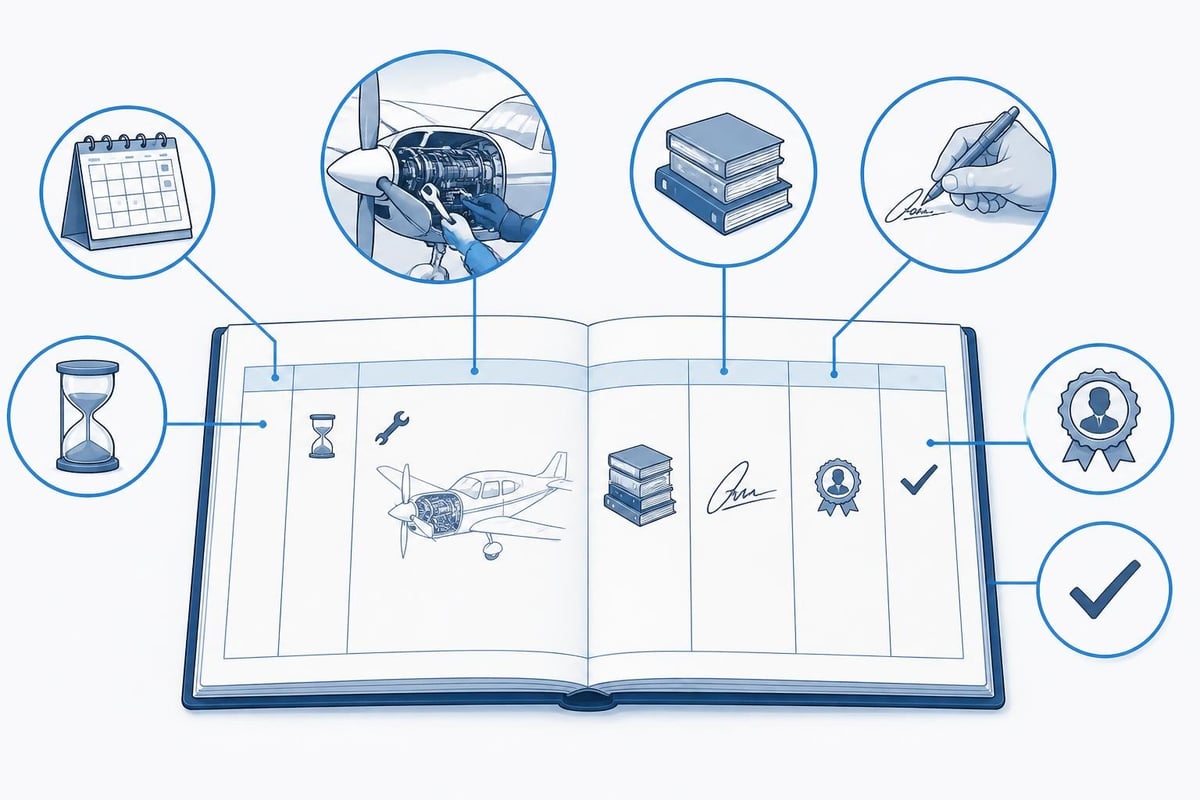
Every aircraft has at least three logbooks: one for the airframe, one for the engine, and one for each propeller or rotor. The FAA Pilot's Handbook guidance on maintenance records explains that each book must capture the full history from new or zero time. Each entry shows the date, total time in service, the work performed, and the signature and certificate number of the person approving the aircraft for return to service.
Key items recorded include:
- Annual inspections (or 100-hour inspections for hire and training)
- Airworthiness Directives (ADs), one-time or recurring, with compliance date and method
- Major repairs and alterations, supported by FAA Form 337 or EASA Form 1
- Component replacements (alternators, magnetos, avionics) with part numbers and serial numbers
- Service bulletins and manufacturer recommended maintenance
- Weight and balance updates when equipment is added or removed
Under FAA Advisory Circular AC 43-9D, each maintenance entry must be clear enough that another mechanic or inspector can understand exactly what was done and whether it was completed properly. Vague entries like "repaired fuel system" are not acceptable; the regulation requires detail such as "replaced fuel selector valve P/N 12345, rigged and leak-checked per manufacturer service manual section 28-10-01."
Who Signs and Approves Logbook Entries
Only certificated and appropriately rated mechanics, repair stations, or the aircraft owner (for preventive maintenance under Part 43 Appendix A) may make entries in an aviation maintenance log book. For major work, an A&P (Airframe and Powerplant) mechanic with inspection authorisation or a repair station must sign the return-to-service statement. The signature certifies that the work was done in accordance with approved data and the aircraft meets airworthiness standards.
For European-registered aircraft, EASA Part-M continuing-airworthiness rules require that a Part-145 approved organisation or a qualified certifying staff member signs the Certificate of Release to Service (CRS). The CRS references the maintenance organisation approval number and confirms the work complies with the approved maintenance programme and applicable airworthiness directives. EASA also accepts electronic signatures provided the system meets traceability and audit requirements set out in Easy Access Rules for Continuing Airworthiness.
Both FAA and EASA require the logbook entry to remain with the aircraft permanently. Losing a logbook does not make the aircraft unairworthy, but it does complicate proving compliance history. Reconstructing records from maintenance shop copies, invoices, and 337 forms is time-consuming and may reduce resale value.
Why Accurate Logbooks Matter for Safety and Value
Maintenance records directly affect three things: legal airworthiness, safety of flight, and resale price. An aircraft without a complete log trail cannot prove it has met mandatory inspections and AD compliance. Regulators may issue a ferry permit to fly it for the sole purpose of getting it to a facility for inspection, but normal operations are not legal.
Safety investigations routinely examine logbooks. NTSB accident docket reviews show that missing or incomplete maintenance entries can obscure recurring defects, unapproved repairs, or overdue inspections that contributed to failures. Investigators compare logbook entries against actual aircraft condition, parts installed, and time since last overhaul. Discrepancies raise red flags about overall maintenance quality.
From a financial standpoint, an aircraft with pristine, unbroken logbook history commands a premium. Buyers and lenders look for:
| Logbook Feature | Impact on Value |
|---|---|
| Continuous entries from new or rebuild | +10% to +15% |
| All ADs complied with and documented | Baseline requirement |
| Major repairs with 337 forms on file | Neutral if properly done, negative if missing |
| Missing pages or gaps in time | -15% to -30% or unsellable |
| Electronic logs with audit trail | Increasingly accepted, especially for fleet aircraft |
Pilots who track flight time carefully understand that accurate records protect both personal currency and aircraft value. The same discipline applies to the aviation maintenance log book.
Paper vs. Electronic Maintenance Logs
Traditional paper logbooks remain the norm for general aviation. They are durable, require no technology, and meet all regulatory requirements when stored properly. The drawback is vulnerability to fire, loss, or water damage. Smart owners scan every page after each entry and store backup copies in a separate location or cloud service.
Electronic logbooks are now widely used in commercial and airline operations. IATA's Electronic Logbook Implementation Roadmap outlines best practices for transitioning from paper to digital systems, including data integrity controls, audit trails, digital signatures, and regulatory acceptance procedures. The roadmap emphasises that electronic logs must prevent unauthorised alteration, provide time-stamped entries, and produce an auditable copy on demand.
Under both FAA and EASA rules, electronic maintenance logs are acceptable if they meet specific criteria:
- Entries are made by authorised personnel only
- Each entry is time-stamped and attributed to a named individual
- The system prevents editing of completed entries without an audit trail
- Backup and recovery procedures ensure no data loss
- The authority (FAA or EASA) has approved the system or it follows acceptable means of compliance
IATA's Digital Aircraft Operations programme provides industry standards (such as Spec 2000 XML schemas) that enable electronic logbook data to transfer between operators, maintenance organisations, and authorities. For pilots who own their aircraft, several third-party applications now offer electronic logbook modules that sync with maintenance shops and generate compliant PDF reports.

How Pilots Use Maintenance Logs Day to Day
As pilot-in-command, you verify airworthiness before every flight. That means checking the maintenance log to confirm:
- The annual or 100-hour inspection is current. Count forward from the last inspection date. An annual expires 12 calendar months later; a 100-hour expires at 100.0 hours of operation (plus 10-hour grace if flying to the inspection location).
- All applicable ADs are complied with. Cross-check the aircraft and engine serial numbers against the AD list. Recurring ADs must be performed again at the specified interval.
- No open discrepancies. If the last entry notes an unresolved squawk, the aircraft is not airworthy until a mechanic makes a corrective entry or defers the item under an approved minimum equipment list.
- Transponder, altimeter, and static system checks are current (24 calendar months for IFR operations).
- ELT battery is in date (marked on the unit and logged at installation or replacement).
Some pilots keep a one-page summary of the last inspection date, AD compliance dates, and next-due items in their flight bag or aircraft documents folder. This speeds up the pre-flight check and reminds you when the next inspection is approaching.
For aircraft operated under hire or for training, the 100-hour requirement applies. If you fly 15 hours per week, that inspection will be due every seven weeks. Keeping a running tally of tach or Hobbs time since last inspection prevents you from exceeding the limit. Many flight schools and clubs use digital logbook systems that alert them as aircraft approach inspection due dates, reducing the risk of an inadvertent overflight.
Common Logbook Pitfalls and How to Avoid Them
Even experienced owners and mechanics occasionally make logbook errors. Here are the most frequent issues and practical fixes:
Incomplete return-to-service statements. The mechanic forgets to write "I certify that this aircraft has been inspected in accordance with an annual inspection and found to be in airworthy condition," or omits the date, signature, or certificate number. Without all elements, the entry is not valid. Always review the entry before the mechanic leaves and ask for corrections immediately.
Missing AD compliance records. An AD was complied with years ago, but no logbook entry was made or the page was lost. Reconstruct the record using maintenance shop invoices, old 337 forms, or parts receipts. If reconstruction is impossible, the AD must be re-performed or the aircraft inspected to verify compliance, then documented properly.
Vague descriptions. "Repaired landing gear" does not meet AC 43-9D standards. Insist on specifics: "Replaced nose landing gear oleo strut P/N 56789, serviced with MIL-PRF-5606 hydraulic fluid to 3 inches extension per service manual Fig. 5-12, operational check satisfactory."
Mixing airframe and engine hours. Some entries show only tach time or only Hobbs time. Maintain consistency and always log total time in service for the component. If the engine was overhauled at 1500 hours and now shows 234 hours since major overhaul (SMOH), the logbook entry should state "Engine total time 1734.0, SMOH 234.0."
Not transferring logs during sale. Buyers expect every logbook from day one. Negotiate beforehand whether copies or originals transfer, and whether missing logs will be reconstructed or reflected in the sale price.
Keeping physical and scanned backups in multiple locations (home safe, cloud storage, and with your insurance company or lender) mitigates most risks. Some pilots photograph new entries with their phone immediately after each inspection and upload to a secure folder.

Integrating Maintenance Records with Your Flight Log
An aviation maintenance log book and your personal pilot logbook work together to build a complete picture of aircraft and pilot currency. Each time you log a flight, you add hours to the aircraft's total time. That number must match the tach or Hobbs reading the mechanic uses when writing the next maintenance entry.
Discrepancies between your logged hours and the aircraft's official time can arise from multiple pilots, tach versus Hobbs differences, or data entry errors. Before each annual, reconcile your flight hours with the aircraft tach. If you show 78.5 hours since the last annual but the tach shows 81.2, find the source: did another pilot fly without logging, or did you forget to record a cross-country leg?
Pilotlog Pro helps you track both your personal currency and the aircraft's time to next inspection. When you log each flight, the app accumulates aircraft hours automatically. Set an alert for your next 100-hour or annual inspection due date, and the system will flag it in advance so you can schedule downtime without surprises. That same discipline ensures you stay current for passengers, night operations, and IFR approaches, all tied to the same accurate flight-time data that feeds your maintenance planning.

Regulatory Differences: FAA, EASA, and Other Authorities
While the principle of continuous maintenance records is universal, details vary. FAA Part 43 and Part 91 specify retention and content for U.S.-registered aircraft. ICAO Annex 6 and 8 guidance set global standards that most countries adopt with local variations. EASA Part-M and Part-145 impose stricter continuing-airworthiness management for European-registered aircraft, including mandatory maintenance programmes and oversight by a Continuing Airworthiness Management Organisation (CAMO) for larger aircraft.
Key differences include:
| Aspect | FAA (U.S.) | EASA (EU/UK) |
|---|---|---|
| Logbook format | Not specified; industry standard books acceptable | Technical log defined in Part-M Appendix II; may be electronic |
| Inspection interval | Annual or 100-hour (if for hire) | Varies by maintenance programme; can be condition-based |
| Return-to-service signature | A&P mechanic or IA, or Part 145 repair station | Part-145 organisation or qualified certifying staff; CRS required |
| Electronic logs | Acceptable if meets AC 120-78A guidance | Acceptable if Part-M Subpart I and Part-145 requirements met |
| Retention period | Indefinite for airworthiness records; 1 year for routine entries (Part 91.417) | Indefinite for major work; 2 years after release for maintenance records (Part-M.A.305) |
UK CAA maintenance and engineering publications offer downloadable technical log templates and guidance that align with EASA rules but include UK-specific acceptable means of compliance. Pilots operating on both sides of the Atlantic must ensure their logbooks meet the stricter of the two standards.
Rules change. Always confirm current requirements against official CAA, FAA, or EASA sources before making operational decisions based on this article.
Preparing Logbooks for Sale or Transfer
When you sell an aircraft, the buyer will audit every logbook page. Prepare by:
- Scanning every page to PDF, organized by airframe, engine, and propeller. Offer the scans on a USB stick or cloud link at closing.
- Creating an AD compliance matrix that lists each applicable AD, compliance method, date, and logbook page reference. This spreadsheet saves the buyer hours of work.
- Summarising major events such as engine overhauls, propeller strikes, or damage history, with page references for each entry.
- Including all 337 forms in chronological order, matching logbook entries for STCs, major repairs, and alterations.
- Noting any missing pages and providing reconstruction documents (shop invoices, old annual sign-offs) if available.
Buyers often hire a pre-purchase inspector who will cross-check your logs against the actual aircraft. Discrepancies such as an AD marked compliant but no corresponding parts installed, or an entry claiming a new magneto but the data plate shows an old serial number, will kill the deal or reduce the price.
Transparency wins. If a page is missing, say so upfront and explain what you have done to reconstruct the record. Buyers appreciate honesty and will negotiate fairly when they know the full picture.
A complete and accurate aviation maintenance log book proves your aircraft is legal, safe, and valuable. Keep entries detailed, back up every page, and verify compliance before every flight. Pilotlog makes it easy to track your hours and upcoming inspections alongside your personal flight records, so nothing catches you by surprise. Log your next flight and set your alerts today.
- aviation maintenance log
- aircraft logbook
- maintenance records
- faa airworthiness
- pilot logbook app
A logbook that keeps itself.
Join the waitlist and be first in line when Pilotlog launches.
Free to join, no spam. Unsubscribe any time.