pilots licence cost
Pilots Licence Cost UK & Worldwide (2026 Guide)
22 Aug 2026 · 13 min read
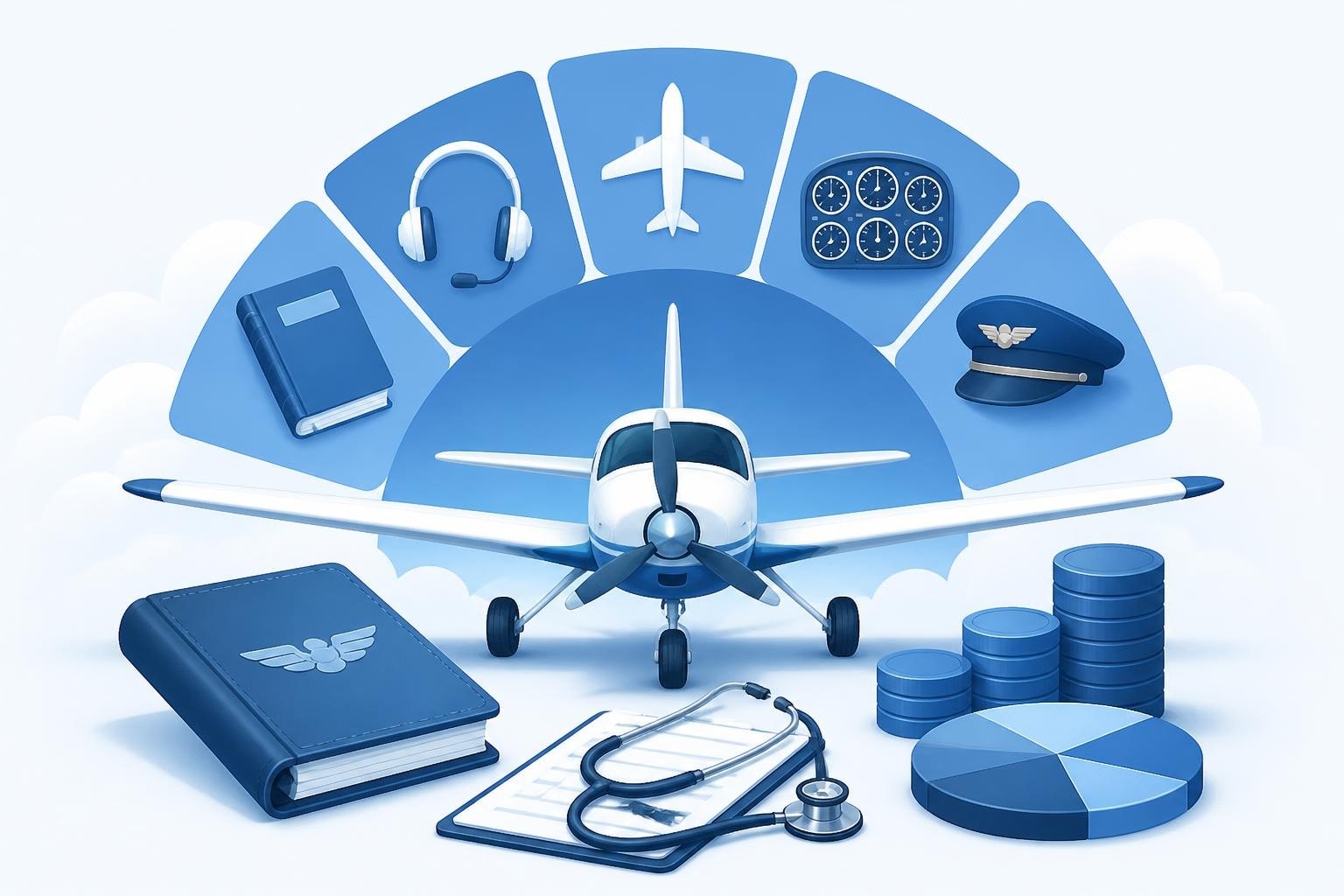
The pilots licence cost depends on which licence you pursue, where you train, and how quickly you complete the required hours. A UK Private Pilot Licence (PPL) typically costs £10,000 to £15,000, while a Commercial Pilot Licence (CPL) runs £30,000 to £50,000, and a full Airline Transport Pilot Licence (ATPL) integrated course can exceed £90,000 to £120,000. Training costs vary by aircraft type, instructor rates, medical certification, examination fees, and how efficiently you fly through the syllabus.
What Drives Pilots Licence Cost
Every licence follows a prescribed syllabus with minimum flight hours, ground school, and examination requirements. The actual cost depends on variables you can control and those you cannot.
Flight Time and Aircraft Rental
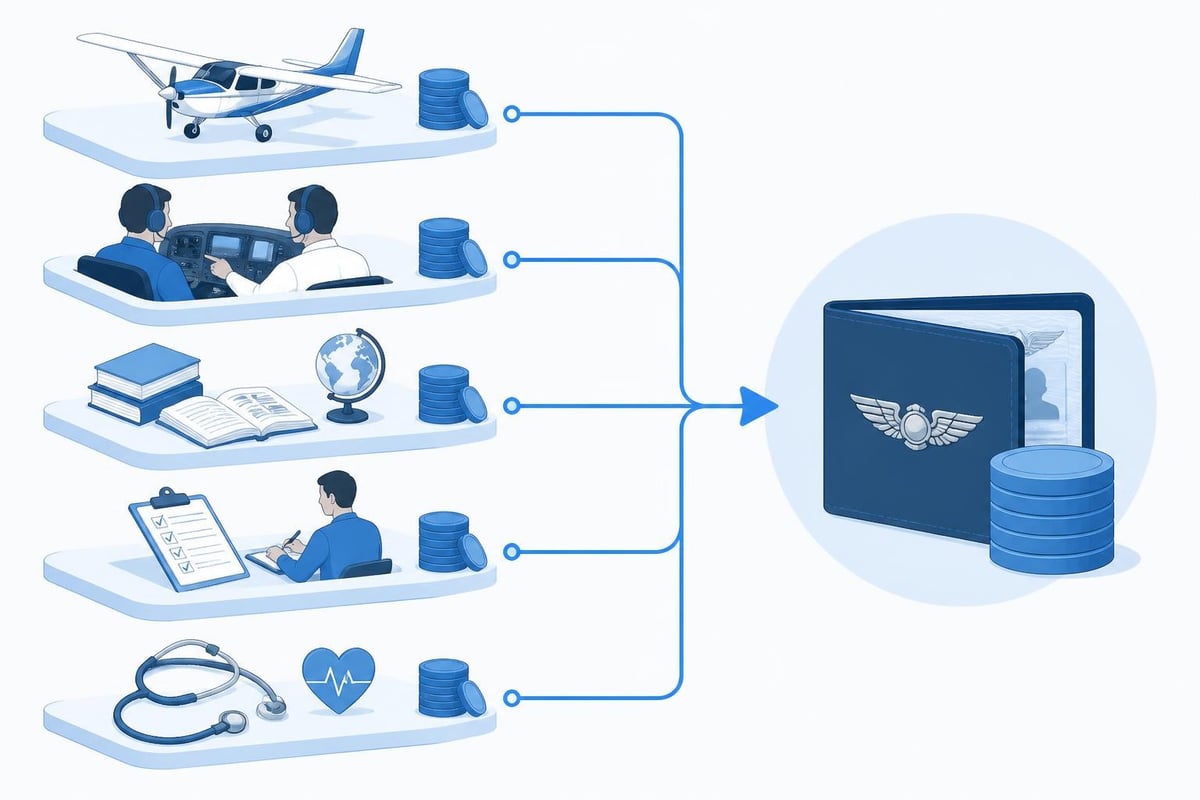
Flight time is the largest single expense. Aircraft rental in the UK averages £140 to £200 per hour for single-engine piston aircraft used in PPL training, while twin-engine aircraft for multi-engine rating or CPL training can cost £280 to £400 per hour.
Key cost factors include:
- Hourly aircraft rental rate (wet or dry hire)
- Fuel surcharges and airport landing fees
- Minimum flight hours vs actual hours to reach test standard
- Aircraft availability and weather delays
Most students fly more than the regulatory minimum. The UK CAA requires 45 hours minimum for PPL under EASA Part-FCL.PPL.H, but the national average is closer to 55 to 65 hours because students need additional time to meet the proficiency standard for the skill test.
Instructor Fees
Instructors charge separately from aircraft rental. UK instructor rates range from £40 to £65 per hour depending on qualifications and location. Some schools bundle instructor fees into their hourly rate; others itemise them separately.
Instructor costs appear in:
- Pre-flight briefings (typically 30 minutes per lesson)
- In-flight instruction (the full flight hour)
- Post-flight debriefs (15 to 30 minutes)
- Ground school and exam preparation sessions
A 60-hour PPL course with 1.5 hours of instructor time per flight hour (briefing, flight, debrief) totals 90 instructor hours at £50 per hour, adding £4,500 to the pilots licence cost.
Ground School and Theory Exams
Ground instruction covers nine subjects for PPL (Air Law, Aircraft General Knowledge, Flight Performance and Planning, Human Performance, Meteorology, Navigation, Operational Procedures, Principles of Flight, Communications). Theory exam fees and course materials add to the total.
| Licence Type | Number of Exams | Exam Fees (UK) | Ground Course Cost |
|---|---|---|---|
| PPL (EASA) | 9 exams | £300-400 | £800-1,200 |
| CPL (EASA) | 13 exams | £900-1,200 | £3,000-5,000 |
| ATPL (EASA) | 14 exams | £1,000-1,400 | £4,000-8,000 |
Ground school can be classroom-based, distance learning, or a blend. Distance courses cost less but require more self-discipline. Classroom courses include instructor-led sessions and often have higher pass rates on first attempts.
PPL Pilots Licence Cost Breakdown
The Private Pilot Licence lets you fly single-engine aircraft (SEP) under VFR, carrying passengers but not for hire or reward. It is the foundation licence and entry point for most pilots.
UK PPL Cost (EASA Part-FCL)
Minimum requirements (EASA Part-FCL.PPL.H):
- 45 flight hours total
- 25 hours dual instruction
- 10 hours supervised solo (including 5 hours solo cross-country)
- 1 solo cross-country flight of at least 150 nm with two full-stop landings at different aerodromes
Typical actual costs in 2026:
- Flight training (55 hours at £180/hour): £9,900
- Instructor fees (85 hours at £50/hour): £4,250
- Ground school course: £1,000
- Theory exams (9 papers): £350
- Class 2 medical: £150
- Skill test (examiner fee): £400
- Books, charts, materials: £300
- Total: £16,350
Most UK schools quote £12,000 to £16,000 for PPL, with variation based on location (London-area schools cost more) and student aptitude. Schools in less congested airspace may offer lower rates because training flights spend less time taxiing and in the circuit.
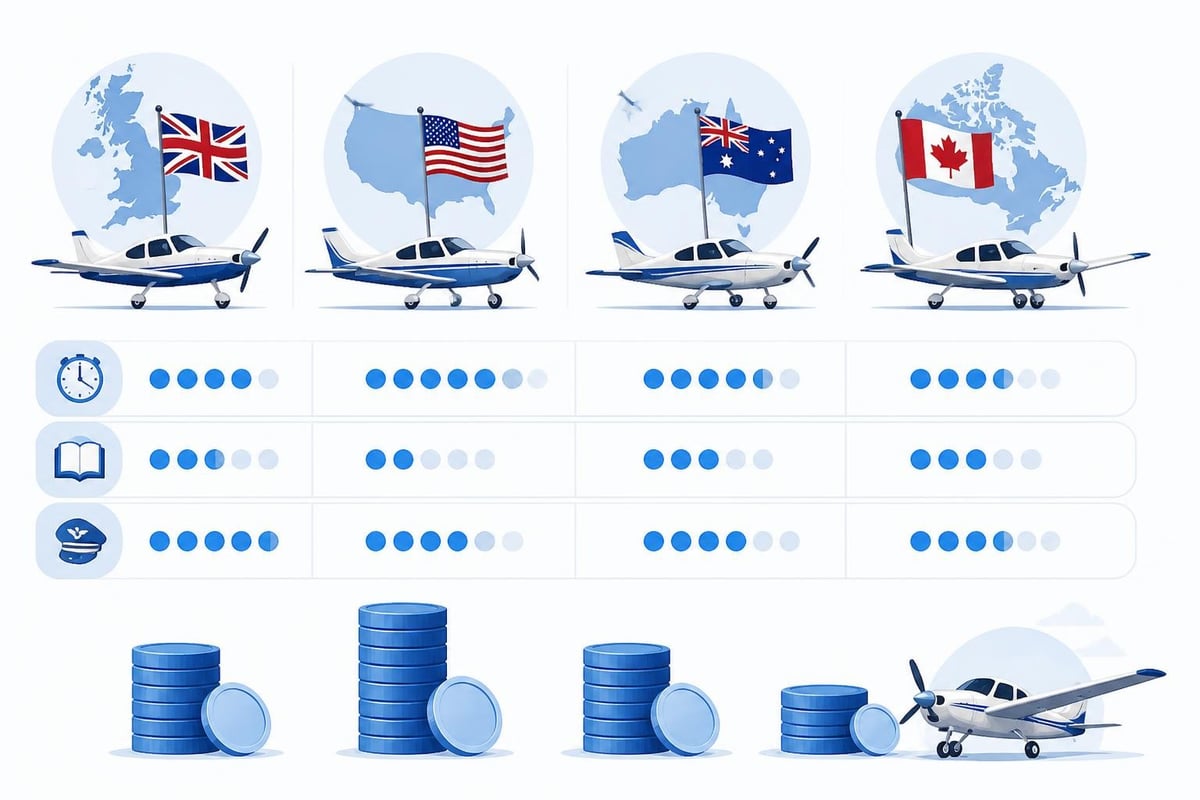
US PPL Cost Comparison
The FAA Private Pilot certificate requires a minimum of 40 hours (14 CFR Part 61) but averages closer to 60 to 70 hours nationally. Aircraft rental in the US ranges from $120 to $180 per hour, and instructor fees run $50 to $80 per hour.
US PPL typical cost:
- Flight training (65 hours at $150/hour): $9,750
- Instructor fees (65 hours at $65/hour): $4,225
- Ground school: $500
- FAA written exam: $175
- Checkride (DPE fee): $600
- Medical (Class 3): $150
- Materials: $400
- Total: $15,800
Comparative data shows significant variation by region, with coastal cities costing 20 to 30 percent more than rural or Midwest locations due to higher aircraft and instructor rates.
CPL and ATPL Pilots Licence Cost
Professional licences require substantially more training and cost. The CPL allows you to fly for hire or reward, while the ATPL is required to act as pilot-in-command on multi-crew aircraft for airlines.
CPL Training Costs
The Commercial Pilot Licence builds on the PPL and adds instrument rating (IR), multi-engine rating (MEP), and advanced flight manoeuvres.
EASA CPL minimum requirements (Part-FCL.CPL):
- 200 hours total flight time (including PPL hours)
- 100 hours as PIC
- 20 hours cross-country as PIC (including one 300 nm flight with two full-stop landings)
- 5 hours night flight
- 10 hours instrument instruction
If you already hold PPL (55 hours), you need approximately 145 additional hours for CPL. With IR and MEP ratings, total additional training reaches 180 to 200 hours.
UK CPL cost (modular, building on PPL):
- Additional flight hours (150 hours at £220/hour average): £33,000
- Instructor fees (200 hours at £55/hour): £11,000
- CPL ground school and exams: £4,500
- IR training (55 hours): included in flight hours above
- MEP rating (12 hours at £350/hour twin): £4,200
- Skill tests (CPL, IR, MEP): £1,800
- Total additional cost: £54,500
Combined with PPL, total cost to CPL is approximately £70,000 to £75,000 via modular training in the UK.
ATPL Integrated Course Cost
Integrated ATPL courses take students from zero hours to frozen ATPL (ready for airline type rating once you have 1,500 hours). These courses are full-time, typically 18 to 24 months, and include all theory, PPL, CPL, IR, and MEP training.
European integrated ATPL courses range from €90,000 to €130,000 (£75,000 to £110,000) depending on the school and country. Detailed breakdowns show how theory, flight hours, and examinations split across the total.
Typical UK integrated ATPL cost:
- ATPL theory (14 exams, distance or classroom): £7,000
- PPL phase (45 hours): £10,000
- Single-engine hour building (100 hours): £18,000
- IR training (55 hours): £18,000
- CPL training (25 hours): £6,000
- MEP rating and time (30 hours twin): £12,000
- MCC course (multi-crew cooperation): £3,500
- Skill tests and examiner fees: £2,500
- Accommodation, materials, medicals: £8,000
- Total: £85,000 to £100,000
Some schools exceed £120,000 for ATPL integrated courses with more flight hours, glass-cockpit aircraft, or simulator time. Comparing countries for pilot training reveals that weather, airspace complexity, and regulatory requirements affect both cost and training quality.
Hidden Costs and Budget Overruns
Published course prices rarely capture the full pilots licence cost. Budget for contingencies and additional expenses that appear during training.
Common Hidden Expenses
Medical certification renewals: Class 1 medicals (required for CPL/ATPL) cost £300 to £450 and must be renewed annually under age 40, every six months over age 40 (EASA Part-MED).
Re-examinations: Theory exam resits cost £30 to £100 per paper. Skill test failures require additional training hours and a re-test fee (£350 to £500).
Weather delays: Poor weather can ground students for weeks, extending course duration and adding accommodation or living costs for full-time students.
Currency gaps: If you pause training, you may need refresher flights to regain proficiency. A six-month gap often requires 5 to 10 hours of dual instruction before continuing.
Hour building: CPL requires 200 total hours. After completing the CPL course at 150 hours, you need another 50 hours. Solo hour building in a basic aircraft costs £110 to £140 per hour (total £5,500 to £7,000).
Licence and rating renewals: SEP class rating must be revalidated every two years with one hour of dual instruction and a proficiency check (cost £250 to £400).
Financing and Payment Plans
Flight schools offer payment plans, but they typically charge interest or require upfront deposits. Some options include:
- Pay-as-you-fly: Pay per lesson. Flexibility but no discount. Risk of price increases mid-course.
- Block booking: Pre-pay 10 to 20 hours at a discounted rate (5 to 10 percent off). Locks in pricing.
- Full course payment: Pay the entire course upfront for the largest discount (10 to 15 percent). Risk if the school closes.
- Flight training loans: Specialist lenders offer loans for pilot training at interest rates of 6 to 12 percent APR. Requires credit checks.
Some airlines sponsor cadets through ATPL training in exchange for a bond (typically 3 to 5 years of service). Sponsorships are competitive and may require partial self-funding.
How to Reduce Training Costs
You can lower the pilots licence cost without compromising safety or quality by training efficiently and making strategic choices.
Fly More Frequently
Students who fly three to four times per week progress faster and need fewer total hours than those flying once per week. Frequent flying builds muscle memory and reduces the need for revision of previous lessons.
Example: A student flying twice per week takes 6 months to reach 55 hours PPL, with an average of 58 hours total (3 hours extra for revision). A student flying weekly takes 12 months and averages 68 hours (13 hours extra). The difference is 10 hours at £180, saving £1,800.
Choose Your Location Strategically
Training at a smaller airfield with less congestion reduces taxi time, hold delays, and circuit queues. An airfield with a single grass runway may charge £130 per hour vs £200 at a busy controlled airport.
Annual weather also matters. Southern England and the Channel Islands have better VFR weather availability than Scotland, reducing weather-related delays.
Self-Study for Theory
Distance learning ground schools cost 40 to 60 percent less than classroom courses. If you are disciplined, self-study with online question banks and video courses covers the syllabus at lower cost. Budget extra time for subjects like meteorology and navigation, which benefit from instructor explanation.
Use Simulators Where Permitted
EASA Part-FCL allows up to 5 hours of FNPT (Flight and Navigation Procedures Trainer) time to count toward PPL and 20 hours toward CPL. Simulator time costs £80 to £120 per hour, roughly half the cost of aircraft time. Use simulators for instrument procedures and emergency training.
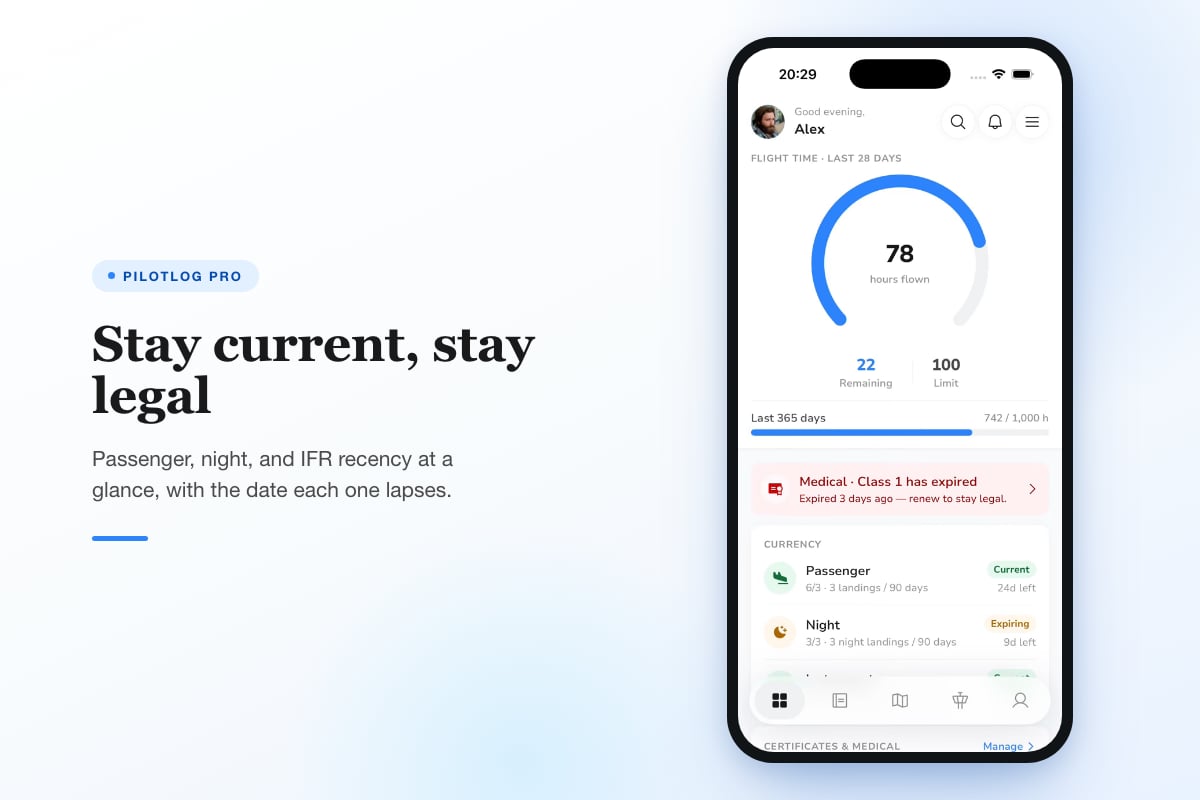
Once you start logging flights, keeping accurate records of your hours, currency, and licence expiries becomes essential. Pilotlog Pro tracks rolling flight-time and duty limits, passenger and IFR currency with lapse dates, and flags licence and medical expiry alerts early so you stay legal throughout training and beyond.
Cost Comparison by Licence Type
Summarising the pilots licence cost across the most common pathways helps you plan your budget and training timeline.
| Licence Type | Min. Flight Hours | Typical Actual Hours | UK Cost Range | US Cost Range |
|---|---|---|---|---|
| PPL (EASA/FAA) | 45 (EASA) / 40 (FAA) | 55-65 (EASA) / 60-70 (FAA) | £12,000-16,000 | $14,000-18,000 |
| CPL (modular from PPL) | 200 total (145 beyond PPL) | 200-220 total | £50,000-60,000 (additional) | $50,000-65,000 (additional) |
| ATPL (integrated 0-frozen ATPL) | ~200 flight hours | 200-220 | £85,000-120,000 | $80,000-110,000 |
| Instrument Rating (IR) | 50 hours instrument time | 55-60 | £15,000-20,000 | $12,000-16,000 |
| Multi-engine rating (MEP) | 6 hours min | 10-12 | £3,500-5,000 | $3,000-4,500 |
These figures represent 2026 pricing and assume standard progression without significant delays or re-examinations. FAA data on training costs highlights proposals to reduce costs through increased simulator use, which may lower future expense if regulators adopt broader simulator credit.
Budgeting for Your Pilot Training
Build a realistic training budget by itemising every cost and adding a 15 to 20 percent contingency for overruns, weather delays, and unforeseen expenses.
Sample PPL Budget with Contingency
- Flight training (60 hours budgeted at £185/hour): £11,100
- Instructor fees (95 hours at £52/hour): £4,940
- Ground school course: £1,000
- Theory exams (9 exams): £350
- Medical (Class 2): £150
- Books, charts, headset, kneeboard: £400
- Skill test (examiner): £400
- Contingency (15%): £2,700
- Total budget: £21,040
This conservative budget assumes 60 hours flight time (above the 55-hour average) and includes funds for one or two exam resits or extra dual lessons before the skill test.
Tracking Training Costs and Hours
Maintain a spreadsheet or use a digital pilot logbook to track flight hours, lesson costs, and cumulative spending. Accurate records help you compare actual costs against your budget, identify cost overruns early, and provide evidence if you claim training expenses on taxes (if applicable under professional pilot training rules).
Recording your hours correctly from day one also ensures your logbook meets regulatory standards for licence applications. Understanding how to fill out your pilot logbook prevents errors that could delay your skill test or licence issue.
International Training and Licence Conversion
Training abroad can reduce costs if you choose a country with lower rates and favourable weather, but you must consider licence conversion requirements if you plan to fly in your home country.
Popular Low-Cost Training Destinations
United States (Part 61 or Part 141 schools): FAA licences cost less than EASA equivalents due to lower hourly rates and fewer regulatory hours for PPL. However, converting an FAA PPL to EASA PPL requires additional theory exams and a skill test difference check.
Australia: CASA PPL training costs AUD $18,000 to $22,000 (£9,500 to £11,500), and year-round VFR weather enables fast completion. Licence conversion to EASA requires theory exams and flight test.
South Africa and Spain: Both offer EASA training at lower cost than the UK. Spanish schools charge €8,000 to €12,000 for PPL (£6,800 to £10,200), with excellent weather and English instruction.
Licence conversion complexity: If you train under FAA or CASA and later want an EASA licence, budget time and cost for conversion exams, paperwork, and a validation flight test. Total conversion cost can reach £2,000 to £4,000, eroding some of the savings.
Is the Pilots Licence Cost Worth It?
The financial investment in pilot training is substantial, but the return depends on your goals. Recreational pilots value the freedom and skill. Professional pilots view training as an investment in a career with salaries that, over time, offset the initial outlay.
Airline first officers in the UK earn £30,000 to £50,000 in their first year, rising to £60,000 to £90,000 by year five. Captains on long-haul aircraft can exceed £120,000 annually. Amortised over a 30-year career, the cost-per-year of ATPL training is manageable.
For private pilots, compare the cost of ownership or rental. If you fly 50 hours per year in a rented aircraft at £180 per hour, you spend £9,000 annually. Adding £15,000 for PPL training means your first two years cost £33,000 total, but subsequent years cost only the hourly rental.
Regulatory requirements, medical standards, and currency rules mean the cost does not end at licence issue. Budget for recurrent training, rating renewals, and medical exams throughout your flying life. Staying current requires regular flight time, and tracking those requirements ensures you do not let ratings lapse, which would require expensive re-training.
The pilots licence cost in 2026 ranges from £12,000 for a basic PPL to over £100,000 for integrated ATPL training, with flight hours, instructor fees, and examinations forming the bulk of the expense. Smart planning, frequent flying, and accurate tracking reduce overruns and keep you on budget. Once you start training, Pilotlog helps you log every flight, monitor your currency, and receive early alerts for licence and medical expiries so you stay current, legal, and ready without costly lapses or surprises.
- pilots licence cost
- ppl cost uk
- cpl atpl cost
- flight training cost
- pilot license comparison
A logbook that keeps itself.
Join the waitlist and be first in line when Pilotlog launches.
Free to join, no spam. Unsubscribe any time.