flight lessons cost
Flight Lessons Price: What Pilots Pay in 2026
28 Sep 2026 · 13 min read
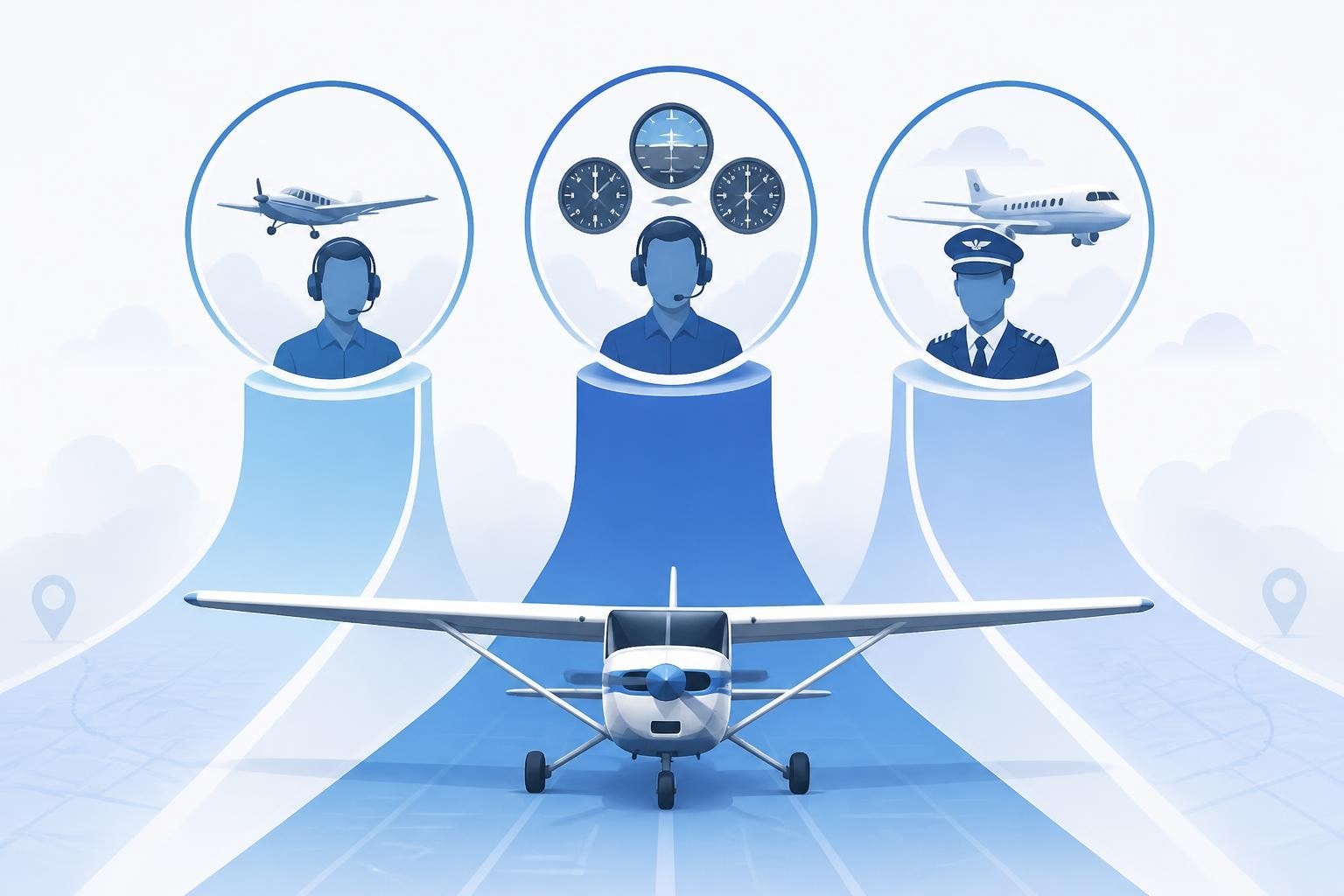
Flight lessons price varies widely across the United States, but you should expect to pay between $150 and $300 per hour for dual instruction in 2026, depending on aircraft type, location, and instructor qualifications. A private pilot licence typically requires 50 to 70 flight hours (the FAA minimum is 40 hours under 14 CFR § 61.109), which translates to $7,500 to $21,000 in total training costs when you factor in aircraft rental, instructor fees, ground school, and exam fees. Understanding the full cost structure before you start training helps you plan realistically and avoid surprises halfway through.
What Determines Flight Lessons Price
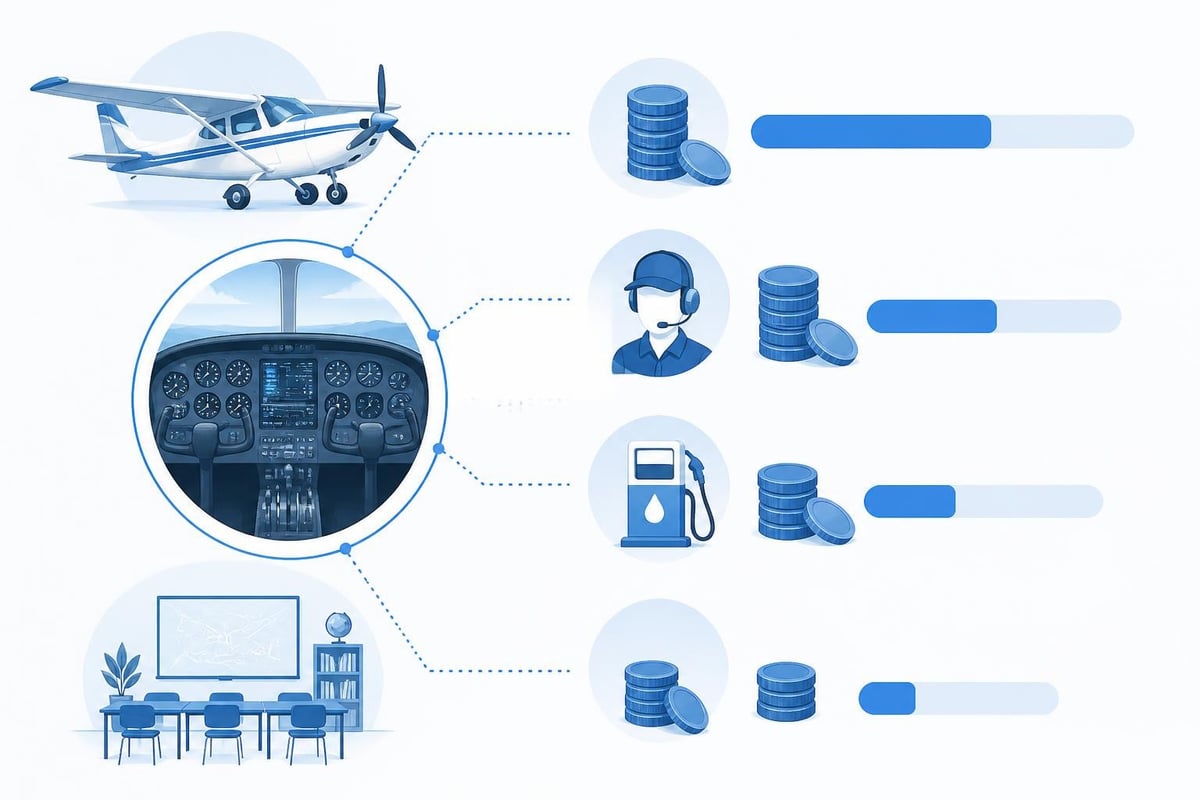
The flight lessons price you pay depends on several measurable factors, each contributing to the hourly rate your school charges. Aircraft type matters most: a Cessna 152 rents for $100 to $140 per hour wet (fuel included), while a Cessna 172 costs $130 to $200 per hour, and complex aircraft like a Piper Arrow can exceed $250 per hour. Instructor fees sit on top of aircraft rental, typically $50 to $80 per hour for a certificated flight instructor (CFI) and $60 to $100 per hour for a more experienced CFI with instrument or multi-engine ratings.
Location shapes pricing dramatically. Schools near major metropolitan airports charge premium rates because of higher operating costs, insurance, and hangar fees. Rural airports often offer lower rates but may have fewer aircraft or less frequent instructor availability. According to Redbird Flight's 2025 State of Flight Training report, median dual instruction rates in the Northeast and West Coast are 18 to 25 percent higher than in the Midwest and South.
Hourly Rates vs. Package Deals
Most flight schools offer two pricing models: pay-as-you-go hourly rates or discounted block time. Paying per lesson gives you flexibility but costs more per hour. Block-time packages (for example, 10 hours prepaid) reduce the hourly rate by 5 to 15 percent and lock in pricing against future rate increases. A $180-per-hour lesson might drop to $165 if you buy a 20-hour block.
Read the fine print carefully. Some packages are non-refundable, and others expire after 12 months. If you pause training or switch schools, you risk losing the prepaid balance. The AOPA Student Field Guide recommends starting with a smaller block to test the school and instructor before committing larger sums.
Breaking Down Total Training Costs
Flight lessons price is only one slice of your total certificate cost. Ground school, study materials, headset, medical certificate, written exam fees, checkride fees, and examiner costs all add up. For a private pilot licence, expect these additional expenses:
- Ground school: $300 to $800 (online courses) or $1,000 to $2,000 (in-person classroom)
- Study materials and apps: $200 to $400 (books, charts, ForeFlight subscription)
- Headset: $250 to $1,000 (passive to ANR models)
- Class 3 medical: $100 to $200 (AME fee)
- FAA written exam: $175 (fixed fee, paid at testing center)
- Checkride fee: $600 to $900 (DPE fee, varies by region)
When you add these to 50 to 70 flight hours at $150 to $300 per hour, realistic PPL costs range from $10,000 to $25,000. The FAA's 2024 research on financial barriers in aviation careers puts the median private pilot certificate cost at $14,200, with significant regional variation.
| Training Item | Low Estimate | High Estimate |
|---|---|---|
| Flight lessons (60 hrs) | $9,000 | $18,000 |
| Ground school | $300 | $2,000 |
| Materials & headset | $450 | $1,400 |
| Medical, exams, checkride | $875 | $1,275 |
| Total PPL cost | $10,625 | $22,675 |
How Lesson Frequency Affects Cost
Flying two to three times per week keeps skills sharp and reduces total hours needed because you spend less time re-learning from the previous lesson. Students who fly once a week often need 60 to 70 hours to meet proficiency standards, while those flying three to four times weekly may solo earlier and finish closer to the 50-hour mark. The difference of 10 to 20 hours at $200 per hour is $2,000 to $4,000 in savings.
Budget consistency matters as much as frequency. Gaps of two or more weeks between lessons force instructors to review basic maneuvers, effectively doubling your time (and cost) to proficiency. The EAA Mentor Pilot Handbook advises students to commit to a steady schedule before starting rather than stopping and restarting multiple times.
Instrument and Commercial Training Costs
After your private licence, instrument and commercial ratings carry their own flight lessons price structures. An instrument rating requires a minimum of 40 hours under 14 CFR § 61.65(d), though most pilots need 50 to 60 hours to reach proficiency. Instrument instruction costs more because you need a CFII (certificated flight instructor – instrument) and often train in IFR-certified aircraft with advanced avionics. Expect $12,000 to $18,000 total for an instrument rating, including 15 to 20 hours of ground instruction and examiner fees.
Commercial pilot training (14 CFR § 61.129) requires 250 total flight hours, including 100 hours PIC and specific cross-country, night, and complex-aircraft time. If you already have 100 hours post-PPL, you need roughly 100 to 150 additional hours, plus 10 hours in a complex or technically advanced aircraft (TAA). At $200 to $280 per hour (complex aircraft plus instructor), budget $25,000 to $40,000 for commercial training. FlightCents' 2026 cost breakdown reports median commercial certificate costs of $32,500 when starting with an instrument rating already in hand.
Multi-Engine and Type Ratings
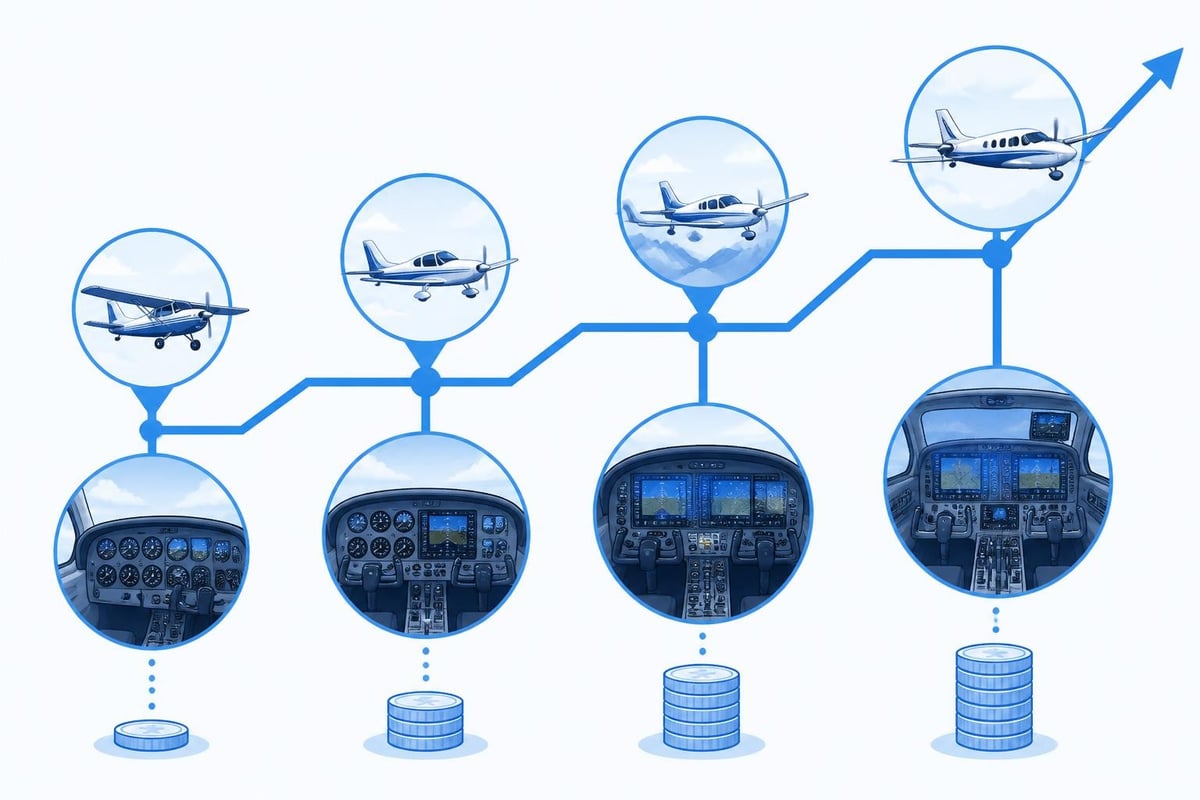
Multi-engine add-ons and type ratings push flight lessons price into premium territory. A multi-engine rating averages 10 to 15 hours at $300 to $450 per hour for the aircraft plus $75 to $100 instructor fee, totaling $4,500 to $8,000. Type ratings for turbine or jet aircraft range from $8,000 for a CE-500 to over $30,000 for larger jets, depending on whether you train in a full-motion simulator or the actual aircraft.
These advanced ratings are often employer-sponsored for airline and corporate pilots, so out-of-pocket cost is less common. If you are self-funding, confirm the rating meets your career needs before committing, as requirements and accepted types vary by airline and operator.
Reducing Your Flight Lessons Price
Several strategies can cut your total training bill without compromising quality or safety. Flying at non-towered airports with lower operating costs often saves $20 to $40 per hour on aircraft rental. Sharing ground-school costs with other students or using high-quality online courses (Sporty's, King Schools) instead of in-person classes saves $500 to $1,500.
Scholarships and grants offer substantial help. The AOPA Flight Training Scholarships award up to $10,000 annually to qualifying students, and the EAA scholarships page lists the Ray Aviation Scholarship (up to $11,000) and other regional awards. These are competitive but can cover 40 to 80 percent of private pilot costs for recipients.
- Fly with flying clubs that share aircraft ownership among members, reducing hourly wet rates by 15 to 30 percent
- Use simulator time (at $50 to $80 per hour) for instrument procedures and emergency training, which FAA regulations allow to count toward certain hour requirements
- Combine ground instruction with other students to split the instructor's hourly fee
- Negotiate block-time discounts of 10 to 15 percent when prepaying 20 or more hours
- Minimize cross-country training flights during peak fuel-price periods
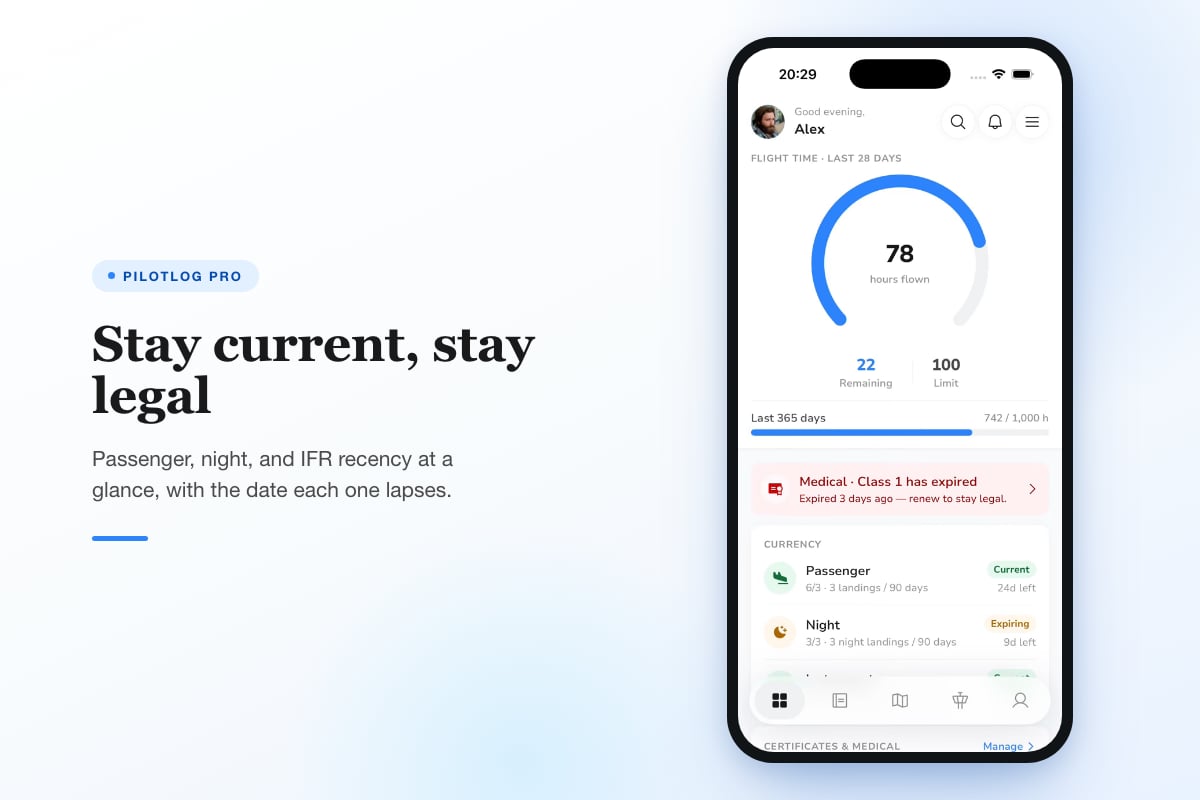
Tracking your hours carefully ensures you are not paying for duplicate training or uncredited time. Pilotlog Pro keeps a digital record of every lesson, automatically tracking rolling currency, cross-country hours, and night time so you and your instructor know exactly where you stand against certificate requirements.
What You Pay for Beyond the Hobbs Meter
Flight lessons price is often quoted per "Hobbs hour" (engine running), but not all training time shows on the Hobbs meter. Pre-flight briefings, post-flight debriefs, and ground instruction are billed separately, typically at the instructor's hourly rate. A one-hour flight lesson often consumes 90 minutes to two hours of your day (and budget) when you include briefing, pre-flight inspection, debrief, and logbook endorsements.
Some schools charge for aircraft rental from block-out to block-in (chocks to chocks), which includes taxi time. Others use tach time (engine RPM-based), which runs slower than Hobbs time and can save 10 to 15 percent on rental costs for the same flight. Clarify billing method before your first lesson to avoid surprises.
Insurance, Fuel Surcharges, and Hidden Fees
Flight schools build insurance into the hourly wet rate, but some assess separate renter's insurance fees ($200 to $500 annually) or require you to carry non-owned aircraft liability coverage. Fuel surcharges appear when Jet-A or avgas prices spike; schools add $5 to $15 per flight hour as a temporary surcharge rather than repricing the entire fleet.
Exam fees and DPE costs are almost always separate. The FAA written exam is $175 per attempt, and the practical test (checkride) costs $600 to $900 paid directly to the designated pilot examiner. Budget an additional $200 to $400 for checkride aircraft rental (1.5 to 2.5 hours) on top of the examiner fee. Understanding your flight records helps you present a complete training history to the examiner, which can streamline the oral portion of the checkride and reduce billable aircraft time.
Regional and Seasonal Price Variations
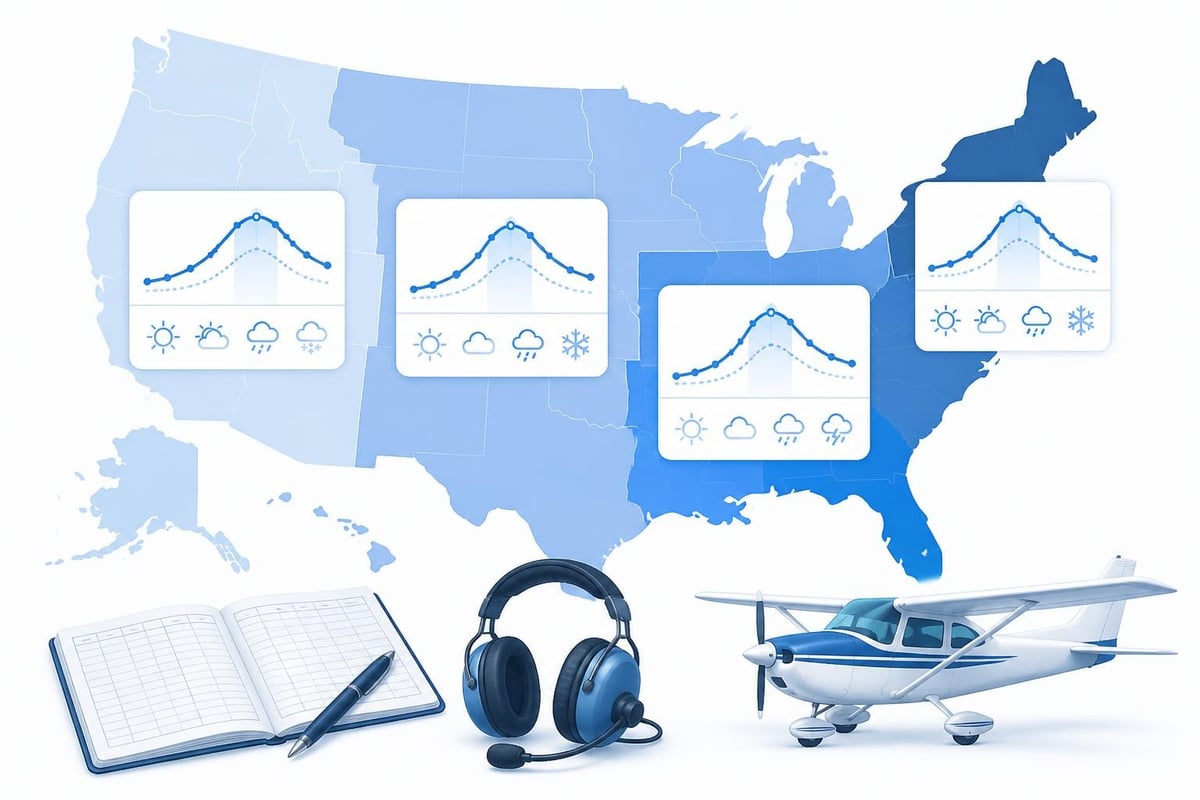
Flight lessons price fluctuates by region and season. Coastal and urban areas (Los Angeles, New York, Miami) see hourly rates 20 to 40 percent higher than Midwest or Southern airports. Weather also plays a role: schools in Arizona, Southern California, and Florida operate year-round with minimal cancellations, while Northern states see reduced winter availability and longer calendar time to finish training.
Seasonal demand affects pricing too. Summer months (May through August) are peak training season, and some schools raise rates by 5 to 10 percent or have limited instructor availability. Training in shoulder seasons (March-April, September-October) can reduce wait times and, occasionally, unlock off-peak discounts.
| Region | Typical Dual Rate (C-172) | Weather Impact | Annual Training Months |
|---|---|---|---|
| Northeast | $210 - $280 | Moderate snow/ice | 8 - 9 |
| Southeast | $180 - $240 | Minimal | 11 - 12 |
| Midwest | $160 - $220 | Winter cancellations | 7 - 9 |
| Southwest | $190 - $260 | Year-round VFR | 12 |
| West Coast | $220 - $300 | Coastal fog/marine layer | 10 - 11 |
Financing Options and Long-Term Planning
Most flight schools accept credit cards, and some partner with financing companies (Flight Training Finance, Sallie Mae) offering pilot-training loans at 6 to 12 percent APR over three to seven years. A $15,000 loan at 8.5 percent for five years costs roughly $305 per month, adding $3,300 in interest over the life of the loan.
Compare loan terms carefully. Variable-rate loans start lower but can climb if interest rates rise. Fixed-rate loans cost slightly more up front but provide budget certainty. Some lenders offer deferred payments while you are in training, though interest usually accrues during deferral.
Self-funding remains the lowest-cost option if you can save in advance. Setting aside $500 to $1,000 monthly for 12 to 18 months lets you pay cash and avoid interest charges. The FAA's financial-barriers research notes that students who budget and save before starting have 30 percent higher completion rates than those who finance on the fly.
Quality vs. Cost Trade-offs
Cheap flight lessons price does not always mean good value. A school charging $140 per hour with outdated aircraft, inexperienced instructors, and poor maintenance may cost you more in the long run through repeated lessons, safety incidents, or training interruptions. The FAA Safety Briefing (March–April 2026 issue) highlights how inadequate training quality leads to checkride failures, requiring additional dual instruction and re-examination fees that can add $2,000 to $5,000 to your total cost.
Look for schools with:
- Well-maintained aircraft with glass cockpits or modern avionics (transition to airline or commercial flying is easier)
- Instructors with at least 500 hours and strong pass rates (ask for their students' first-time checkride success percentage)
- Structured syllabi aligned with FAA Airman Certification Standards (ACS)
- Transparent billing with itemized invoices after every lesson
- Positive safety record and no recent NTSB incidents involving training flights
Paying $20 to $40 more per hour for a quality school with a 90 percent first-time pass rate saves money compared to a cheaper school with a 60 percent pass rate, where you might need an additional 10 hours and a second checkride attempt.
Part 61 vs. Part 141 School Costs
FAA-approved Part 141 schools follow a structured curriculum and can certificate private pilots in 35 hours (versus the 40-hour Part 61 minimum under 14 CFR § 61.109). This five-hour saving at $200 per hour is $1,000 less in flight time, but Part 141 schools often charge higher hourly rates and require you to purchase their ground school and materials package. Total cost usually ends up similar or slightly higher, though calendar time to finish is often shorter because of the structured schedule.
Part 61 schools offer more flexibility. You can fly when you want, switch instructors, and tailor training to your pace. Students with irregular schedules or who need extra time on specific maneuvers often prefer Part 61. Students aiming for an airline career and planning to use VA benefits or other federal funding may need a Part 141 school because those programs require FAA-approved curricula.
Tracking Training Hours and Currency
Once you hold a licence, ongoing proficiency and currency requirements mean flight lessons price is not a one-time expense. Pilots must complete a flight review every 24 months (14 CFR § 61.56), which costs $300 to $600 (one to two hours dual plus ground). Night currency (three takeoffs and landings to a full stop within 90 days, per 14 CFR § 61.57(b)) and instrument currency (six approaches, holding, and intercepting/tracking in the preceding six months, per 14 CFR § 61.57(c)) require regular practice flights.
Keeping a detailed digital logbook ensures you know exactly when currency lapses. Pilotlog tracks rolling 90-day and six-month currency windows automatically, alerting you 14 to 30 days before a currency expires so you can schedule a proficiency flight or IPC without last-minute scrambling. This visibility helps you budget for recurrent training and avoid expensive gaps when you discover mid-flight-planning that you are not current.
Understanding flight time limits and currency requirements is essential for career pilots managing duty periods and recency alongside training costs.
Planning for Certificate Add-Ons
Your initial private pilot licence is the foundation, but most pilots add ratings over time. Budgeting for the full career path helps you allocate funds efficiently. A realistic progression might look like this:
- Private pilot licence: $10,000 to $22,000 (50 to 70 hours dual, ground school, checkride)
- Instrument rating: $12,000 to $18,000 (50 to 60 hours including 15 dual instrument)
- Commercial pilot: $25,000 to $40,000 (build to 250 hours, complex time, commercial checkride)
- CFI/CFII: $8,000 to $15,000 (right-seat training, spin endorsement, examiner fees)
- Multi-engine: $4,500 to $8,000 (10 to 15 hours in twin, MEI checkride)
Total career investment from zero hours to commercial multi-engine instructor can reach $60,000 to $100,000. Spreading this over three to five years and leveraging scholarships, employer sponsorship (for CFI or later ratings), and consistent monthly budgets makes it achievable without crippling debt.
Pilots transitioning from recreational pilot certificates or sport pilot licences can credit some hours toward private pilot requirements, reducing duplication and cost. Similarly, pilots who earned a private plane pilot licence can use those hours toward the commercial 250-hour requirement, though additional specific training (night, cross-country, complex) is still needed.
Flight lessons price in 2026 spans a wide range, but realistic budgeting and smart choices keep training affordable and achievable. Track every hour, maintain steady lesson frequency, and leverage scholarships to reduce your total investment. Once you start logging flights, Pilotlog keeps your hours, currency, and expiries organized so you stay legal, current, and ready for every flight without manual calculations or missed deadlines.
- flight lessons cost
- ppl cost
- flight training budget
- pilot license price
- instrument rating cost
A logbook that keeps itself.
Join the waitlist and be first in line when Pilotlog launches.
Free to join, no spam. Unsubscribe any time.