flight records
Flight Records: What Pilots Must Keep and Why
30 Jul 2026 · 11 min read
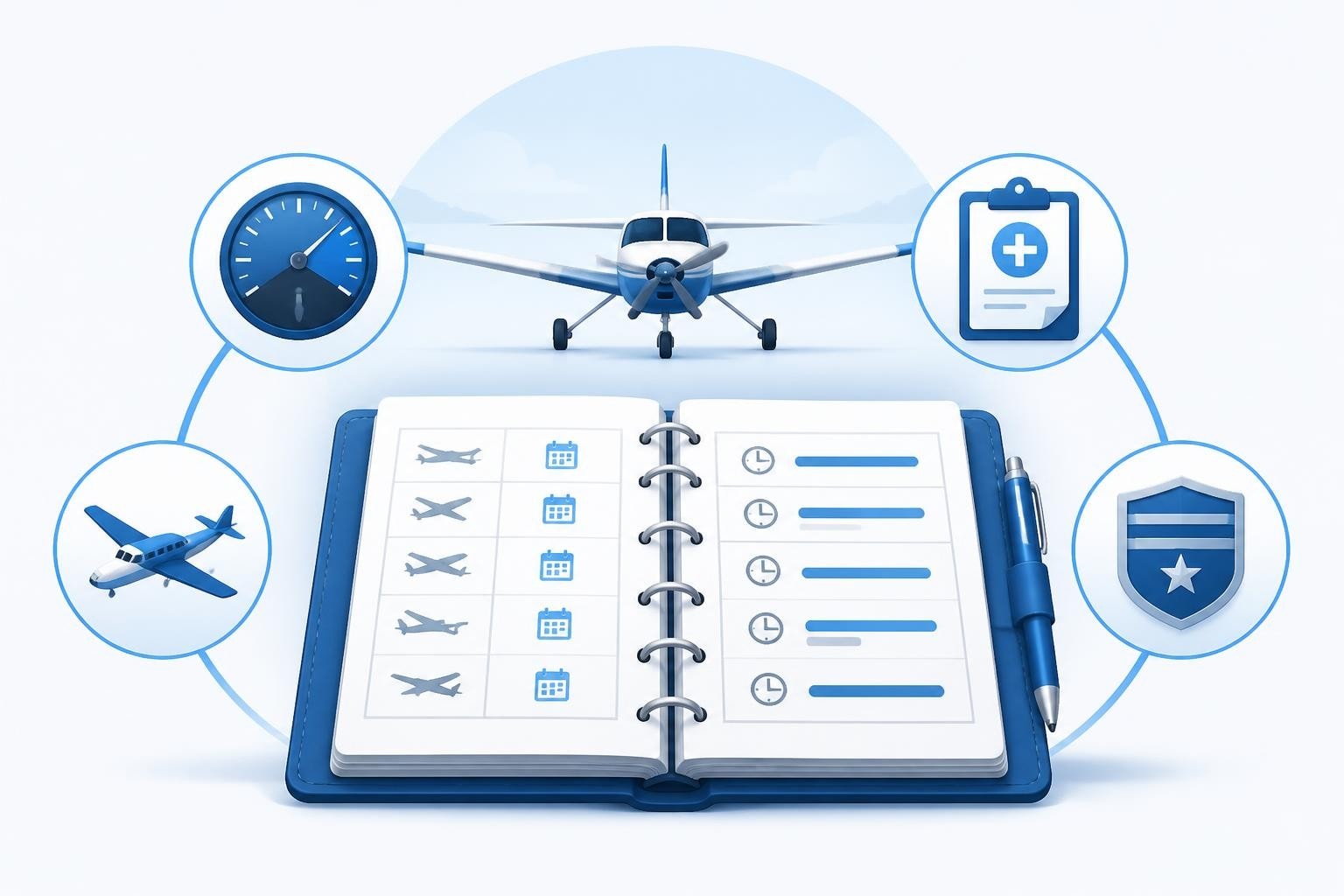
Flight records are the legal and professional proof of your flying experience, currency, and compliance. Every pilot must maintain accurate records of flight time, endorsements, currency events, and medical examinations. These records satisfy regulatory requirements, prove your qualifications to insurers and operators, and track your progress toward certificates and ratings. Whether you fly once a month or daily, keeping detailed flight records is not optional.
Why Flight Records Matter
Flight records serve three critical functions. First, they prove compliance with aviation regulations. Second, they document your experience for job applications, insurance claims, and certificate upgrades. Third, they help you track currency requirements so you stay legal to carry passengers or fly under instrument conditions.
Regulators worldwide mandate that pilots maintain records of flight time and training. The FAA requires pilots to keep logbooks documenting total time, solo time, cross-country flights, night operations, and instrument training. These records must be available for inspection and retained indefinitely. Without accurate flight records, you cannot prove you meet the requirements for certificate upgrades, currency obligations, or medical fitness.
Legal Requirements for Pilot Records
Aviation authorities specify exactly what flight records you must keep. In the United States, 14 CFR §61.51 requires pilots to log all flight time used to meet the requirements for a certificate, rating, or flight review. You must record date, total flight time, location, type and identification of aircraft, and the name of the PIC if you were not the pilot.
Key records include:
- Total flight time by category and class
- PIC time, solo time, and dual instruction received
- Cross-country flights with departure and arrival points
- Night flight time and night takeoffs and landings
- Instrument time (actual or simulated)
- Endorsements for training and currency
The FAA's records management initiative provides detailed guidance on retention schedules. While personal pilot logbooks fall outside federal record schedules, best practice is to retain them permanently. Many operators and insurance companies require complete career records when you apply.

What Goes Into Flight Records
Complete flight records track more than total hours. Each entry should capture the information you need to prove currency, claim experience, and demonstrate qualifications.
Basic Flight Entry Data
Every flight entry needs core information. Record the date, aircraft make and model, aircraft registration, departure and arrival airports, and flight time. Flight time means the time from when the aircraft first moves under its own power to when it comes to rest at the destination. This differs from block time or Hobbs time in some cases.
| Field | Required? | Purpose |
|---|---|---|
| Date of flight | Yes | Legal requirement, currency tracking |
| Aircraft type | Yes | Category/class time, type ratings |
| Registration | Yes | Identifies specific aircraft |
| Route | Yes (cross-country) | Proves distance requirements |
| Flight time | Yes | Total time for certificates |
| Night time | If applicable | Night currency, ratings |
| Instrument time | If applicable | IFR currency, ratings |
| Landings | If applicable | Passenger currency |
Beyond the basics, you should record conditions. Log whether the flight was VFR or IFR, day or night, and whether you acted as PIC, SIC, or dual student. For instrument flights, note approaches flown, holding procedures, and whether conditions were actual or simulated.
Currency and Endorsement Records
Flight records must track currency events that expire on rolling timelines. To carry passengers, you need three takeoffs and landings in the same category and class within the preceding 90 days. For night passenger operations, those landings must occur between one hour after sunset and one hour before sunrise. Your IFR currency requires six approaches, holding, and intercepting/tracking courses in the preceding six months.
These currency requirements are not one-time achievements. They expire and must be renewed through recent flight experience. Accurate flight records let you calculate exactly when currency will lapse and plan recency flights before it does.
Endorsements also belong in your flight records. Every instructor sign-off for a flight review, instrument proficiency check, or high-performance checkout should be logged with the instructor's name, certificate number, and signature. These endorsements prove you are current and authorized for specific operations.
Aircraft Records Versus Pilot Records
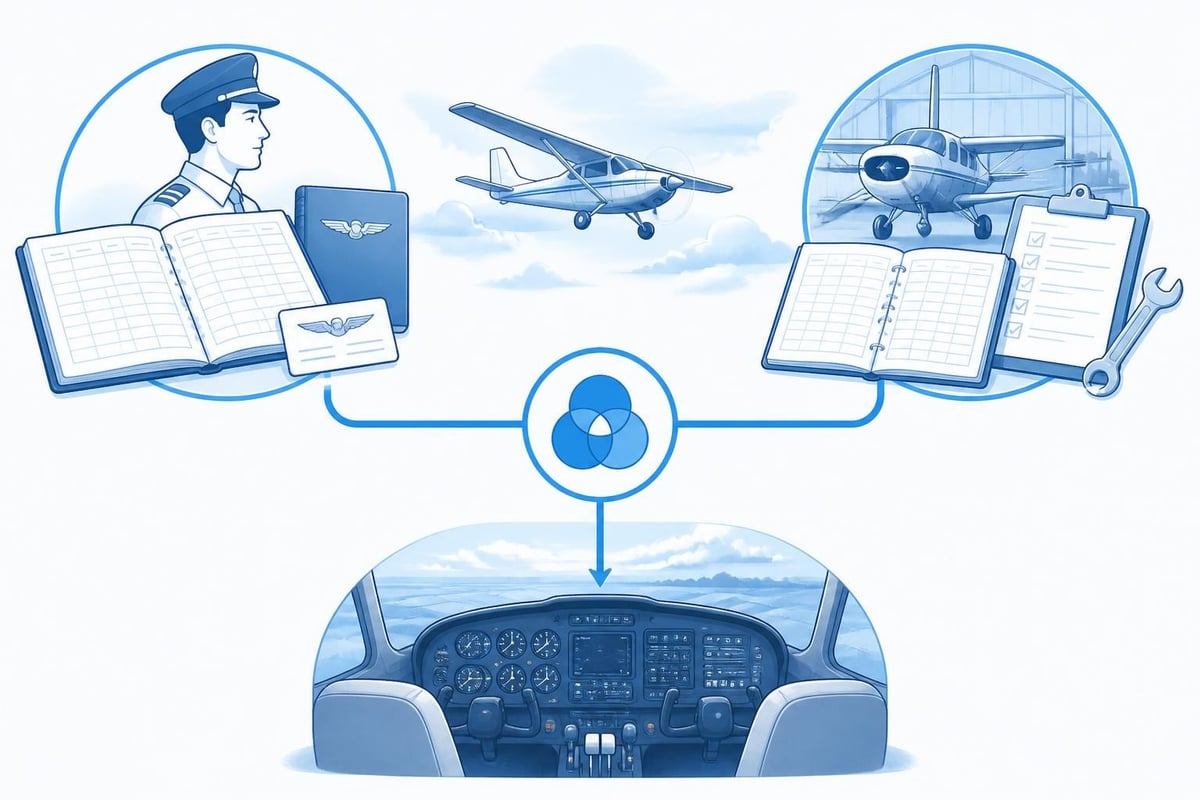
Flight records exist for both aircraft and pilots, but they serve different purposes. Aircraft records document the condition, maintenance status, and airworthiness of the machine. Pilot records document your qualifications and currency.
Aircraft Maintenance Records
Aircraft owners and operators must maintain detailed maintenance records that include total time in service, current status of life-limited parts, time since last overhaul, and compliance with airworthiness directives. These records transfer with the aircraft and affect its value and insurability.
Regulations like 14 CFR §125.225 and 14 CFR §135.152 mandate flight data recorders for certain aircraft. These recorders capture parameters like altitude, airspeed, heading, and control inputs. They provide objective evidence for accident investigation but are not the same as pilot logbooks.
Aircraft records management follows strict legal standards, with defined retention periods and security protocols. Pilots rarely manage these records unless they own the aircraft, but you should verify that the aircraft you fly has current maintenance records before every flight.
Digital Flight Records
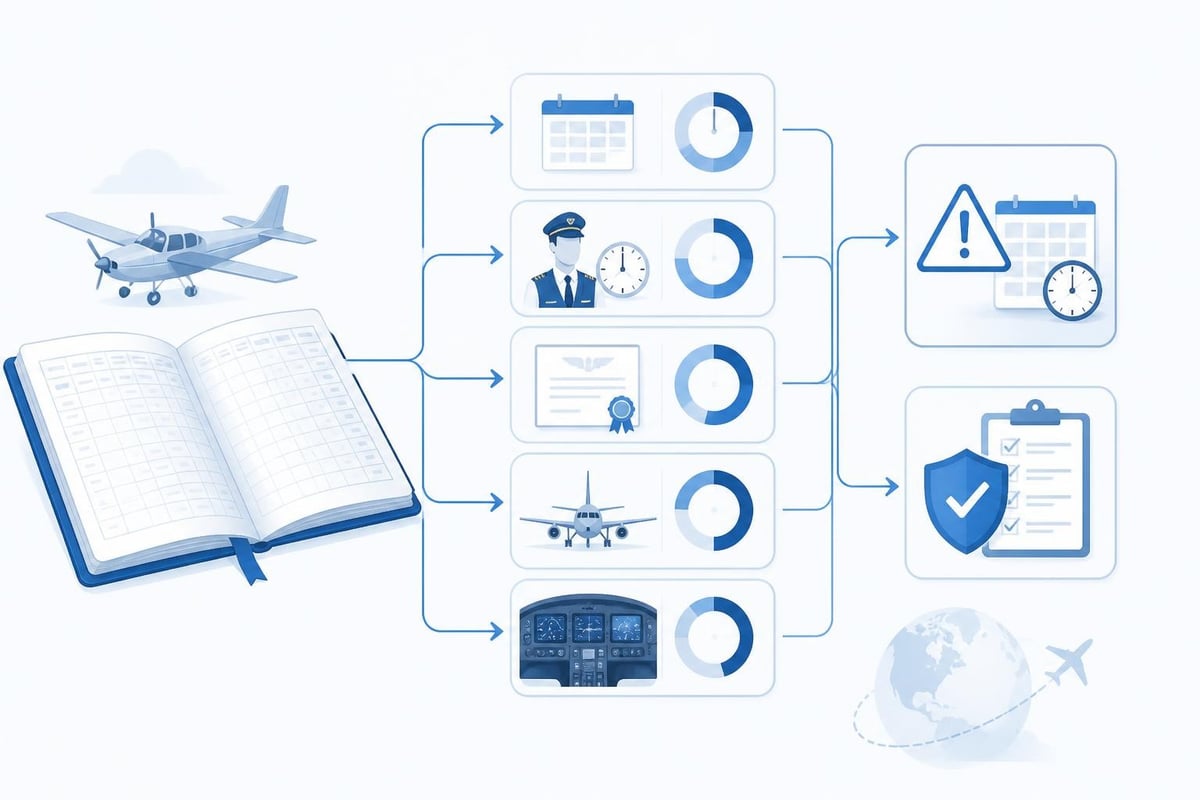
Digital logbooks have transformed how pilots maintain flight records. Instead of handwritten entries in paper books, you log flights on your phone or tablet. The software calculates totals, tracks currency, and alerts you to upcoming expiries.
Benefits of Digital Logs
Digital tools eliminate arithmetic errors. When you log a flight, the system updates your category totals, class totals, and currency counters automatically. You cannot transpose numbers or miscalculate rolling 90-day periods. This accuracy matters when you are trying to prove you had exactly 1,500 hours for an ATP certificate or 75 hours of instrument time for a rating.
Digital flight records offer:
- Automatic currency tracking with lapse-date alerts
- Backup and sync across devices
- Export to multiple formats (PDF, CSV, Excel)
- Integration with medical and licence expiry dates
- Career statistics and trend analysis
- Searchable history (find every flight in a specific aircraft)
Choosing the best digital logbook depends on your flying profile. Student pilots need tools that track training requirements. Commercial pilots need duty-time limits and multi-crew logging. Airline pilots need bulk import and roster integration.
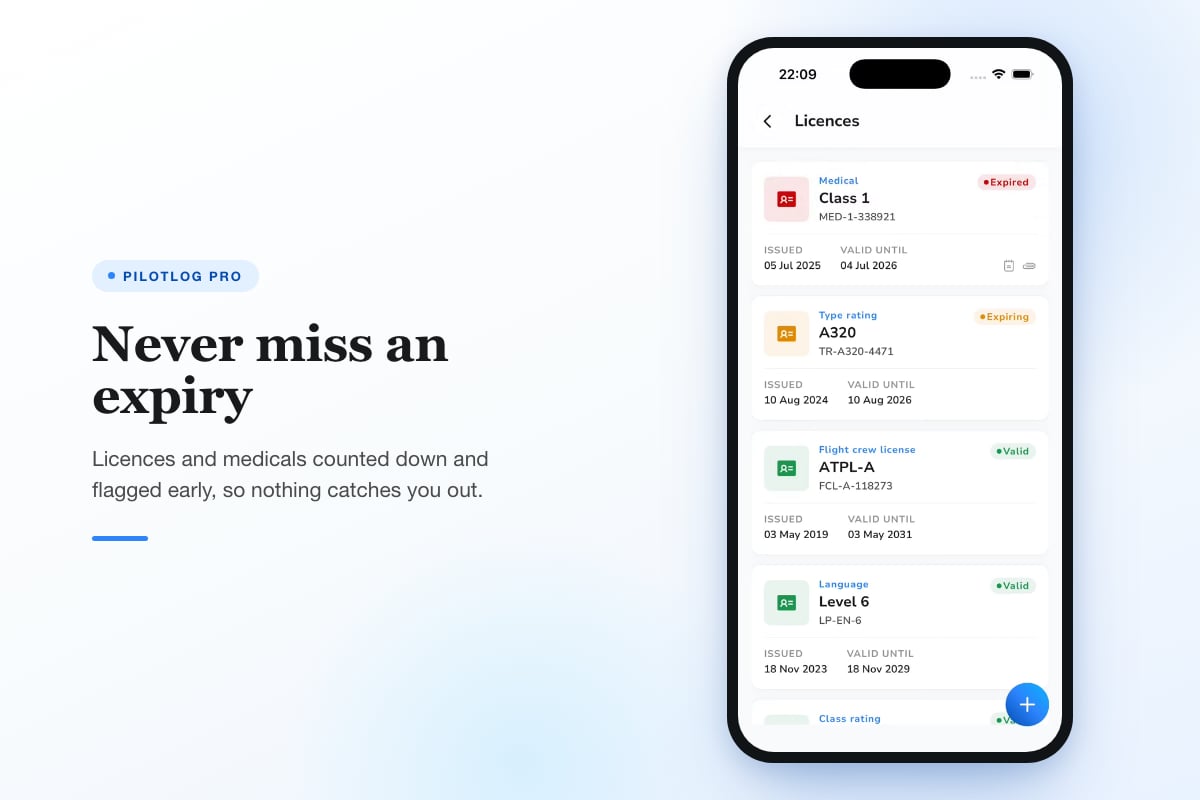
Pilotlog Pro tracks rolling 28-day and 365-day flight-time and duty limits alongside passenger, night, and IFR currency. It flags licence and medical expiries early and offers full logbook export. Built for pilots across the whole career, it keeps you current, legal, and ready. Learn more at the pricing page.
Retention and Backup
Flight records are irreplaceable. If your logbook is destroyed, you lose proof of thousands of hours and decades of experience. Paper logbooks can burn, get soaked, or simply disappear. Digital records need protection too.
Best practice is to maintain multiple backups. Keep the original (paper or digital), a scanned or exported copy in cloud storage, and a periodic printout or PDF archive. Some pilots send an annual PDF to a personal email account as an off-site backup.
FAA retention rules for aircraft records distinguish between temporary and permanent records, but personal pilot logbooks should be kept forever. They are your professional resume and legal defence.
Common Flight Records Mistakes
Even experienced pilots make errors in flight records. These mistakes can delay certificate applications, create insurance disputes, or raise questions during ramp checks.
Incomplete Entries
Skipping fields is the most common mistake. You log the date and aircraft but forget to note whether the flight was day or night, VFR or IFR. Later, when you need to prove 50 hours of cross-country PIC time, you cannot determine which flights qualify because you did not record the route or distances.
Complete every entry the day you fly. Record all required fields plus any information that might matter later. If you flew three instrument approaches, note the type (ILS, RNAV, VOR) and airport. If you completed a night cross-country, record departure and arrival airports with distances.
Arithmetic Errors
Manual logbooks accumulate errors. You misread a total, skip a carry digit, or add incorrectly. Over hundreds of flights, these errors compound. Your logged total might differ from the true total by ten or twenty hours.
Digital logbooks eliminate this problem but introduce new risks. If you enter 3.5 hours instead of 1.5 hours, the system will carry that error forward into all your totals. Review every entry before saving it.
Lost Currency Data
Many pilots log total time but ignore currency tracking. They record 1.2 hours and three landings but do not note whether the landings were day or night, full-stop or touch-and-go. Six months later, they cannot prove they are current to carry passengers at night.
Track currency explicitly. Use dedicated columns or notes to record the landings, approaches, and holds that renew your authorizations. A currency cheat sheet helps you remember what to log.
Flight Records for Professional Pilots
Professional flying demands higher standards for flight records. Airlines, charter operators, and corporate flight departments audit pilot logbooks during hiring and recurrent training. Incomplete or questionable records cost jobs.
Multi-Crew Operations
When you fly as SIC or PIC in a crew environment, your flight records must distinguish between roles. Log SIC time, PIC time, and PICUS time separately. Note whether you were the pilot flying or pilot monitoring for each leg.
Multi-crew entries should include:
- Your role (PIC, SIC, PICUS)
- Crew member names
- Duty time (on-duty, flight duty, rest)
- Take-off and landing counts by pilot flying
- Approach and hold counts if under IFR
Some airlines provide automated logbook downloads from crew scheduling systems. These downloads are accurate but often lack detail for currency tracking. Cross-reference them with your personal records.
Duty Time Limits
Professional pilots must track duty periods and flight time limits. Regulations impose rolling limits (e.g., 100 hours in 672 consecutive hours) and calendar limits (e.g., 1,000 hours in a calendar year). Exceeding these limits is a serious violation.
Digital logbooks calculate rolling limits automatically. They flag upcoming limit conflicts before you accept a trip. This feature is critical for on-demand charter and corporate pilots who build their own schedules.
Verification and Audits
Your flight records will be inspected. Hiring managers review them. Inspectors request them during ramp checks. Insurance companies audit them after incidents. The records must withstand scrutiny.
Logbook Endorsements
Instructors must sign your logbook to validate training and endorsements. Each signature should include the instructor's certificate number, expiry date, and a clear statement of what you are authorized to do. Vague endorsements like "checkout complete" do not prove anything.
Before you log solo time or PIC time, verify you have the required endorsements. A solo endorsement expires 90 days after issue. If you log solo time without a current endorsement, those flights are not legal.
Expiry Audits
Certificates, ratings, medicals, and flight reviews all expire. Track them in your flight records so you get advance warning. Most pilots discover expiries too late, when they show up for a flight and realize their medical lapsed yesterday.
Use an expiry checkride audit to review all your dates annually. Update your records with renewals, new endorsements, and rating additions. Keep copies of medical certificates, knowledge test results, and checkride approvals with your logbook.
Building a Complete Record System
Flight records are more than a regulatory obligation. They are your professional archive. Build a system that captures everything you might need later.
Supplementary Records
Beyond the logbook, keep supplementary records. Save copies of:
- Medical examination reports
- Knowledge test results
- Checkride notices and certificates
- Instructor endorsements and ground school diplomas
- Insurance checkout forms
- Employer training records
These documents support your logbook entries. If an insurer questions your high-performance time, you can produce the checkout form. If a future employer doubts your instrument time, you can show the IPC endorsements.
Annual Review
Review your flight records annually. Verify totals, confirm backups, and update currency tracking. Check that recent endorsements are recorded and that expiry dates are accurate. This review catches errors early and ensures your records are audit-ready.
Many pilots perform this review during their birthday month or at year-end. Schedule it, set a reminder, and treat it as seriously as an annual inspection.
Flight records are the foundation of your flying career, proving experience, ensuring compliance, and tracking currency across thousands of hours. Whether you log in paper or digital format, accuracy and completeness matter every time you make an entry. Pilotlog automates the tracking, calculates your currency, and alerts you to upcoming expiries so your records stay current and you stay legal. Log a flight in seconds on iOS or Android and let the system handle the rest.
- flight records
- pilot logbook
- faa requirements
- currency requirements
- logbook endorsements
A logbook that keeps itself.
Join the waitlist and be first in line when Pilotlog launches.
Free to join, no spam. Unsubscribe any time.