flight colleges
Flight Colleges: Choosing the Right Path to Your Licence
22 Sep 2026 · 12 min read

Flight colleges are dedicated training organisations that offer structured, often accelerated pathways from zero hours to commercial or airline transport pilot licences. They combine ground school, simulator sessions, and flight instruction under a single roof, typically holding approvals from national aviation authorities to deliver Part 141 programs (FAA) or ATO certificates (EASA). Unlike independent instructors working under Part 61 rules, flight colleges provide a standardised curriculum, fleet access, and administrative support designed to take you from ab-initio through to a frozen ATPL or full CPL-IR in 12 to 24 months.
What Flight Colleges Offer
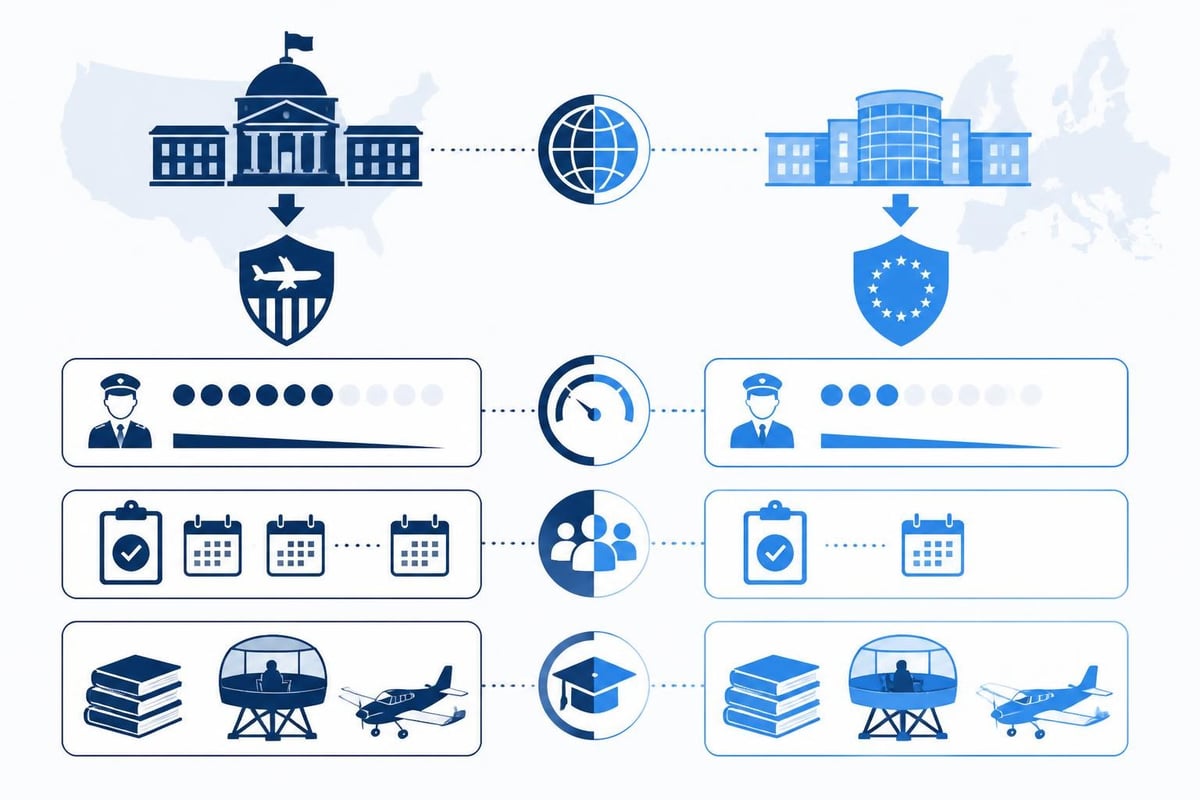
Flight colleges differ from freelance instruction in both scope and regulatory oversight. Most hold an Air Training Organisation (ATO) certificate under EASA Part-DTO or Part-FCL, or FAA Part 141 approval, meaning their syllabuses, facilities, and instructors meet strict audit standards. This oversight translates into consistent training quality and, in many cases, reduced minimum hour requirements for certain licences.
Integrated vs Modular Training
Flight colleges usually offer two delivery models:
- Integrated (ab-initio) courses take zero-hour students through to frozen ATPL in one continuous programme, typically 12 to 18 months. EASA's Airline Transport Pilot Integrated Course Manual sets design benchmarks for these pathways.
- Modular courses let you complete each licence separately (PPL, CPL, IR, ME, ATPL theory) at your own pace, spreading cost and allowing part-time enrolment.
Integrated programmes demand full-time commitment and upfront capital but compress calendar time. Modular training offers flexibility and pay-as-you-go cash flow but can stretch to three or four years if you hold another job.
Curriculum and Approvals
Flight colleges build syllabuses around national or regional regulations. In the United States, the FAA outlines differences between Part 61 and Part 141 schools: Part 141 programs reduce commercial-licence minimums from 250 hours to 190 hours, provided the college holds current approval and meets frequent audits. In Europe, EASA Part-FCL prescribes both integrated and modular routes, and colleges must comply with EASA's AMC and Guidance Material for aircrew to maintain their ATO certificates.
Key Factors When Choosing a Flight College
Fleet and Facilities
Walk the ramp and check tail numbers. A well-maintained fleet with modern avionics reduces cancellations and prepares you for glass-cockpit airline operations. Ask about:
- Average aircraft age and maintenance intervals
- Availability of technically advanced aircraft (TAA) for instrument training
- Simulator types and FSTD approvals (FNPT II, FFS)
- Spare capacity when aircraft go unserviceable
Colleges with newer Cessna 172s, Piper Archers, or Diamonds equipped with G1000 or Garmin GTN systems give you transferable skills. Multi-engine fleets should include at least one twin for the CPL-ME rating and, ideally, a Seneca or Baron for complex-aircraft time.
Instructor Qualification and Retention
Instructor turnover can disrupt continuity. Check average instructor tenure and qualifications. Under FAA AC 61-65K, flight and ground instructors must hold current certificates and meet recency requirements. EASA Part-FCL requires Flight Instructor (FI) and Instrument Rating Instructor (IRI) ratings with regular revalidation.
Ask how many students each instructor manages concurrently. Ratios above 10:1 can slow progress. Colleges that employ senior instructors or examiners on staff signal investment in quality and offer consistency through phase checks and standardisation.
Pass Rates and Timeframes
Request recent skill-test and checkride pass rates for each licence stage. Colleges should publish or disclose first-time pass percentages for PPL, CPL, IR, and ATPL theory. Completion timelines matter too: if an integrated course advertises 14 months but the median graduate takes 20, factor weather delays, fleet availability, and scheduling into your budget.
| Metric | Good Benchmark | Red Flag |
|---|---|---|
| PPL first-time pass rate | ≥ 85 % | < 70 % |
| Average integrated completion | ≤ 18 months | > 24 months |
| Instructor:student ratio | ≤ 8:1 | > 12:1 |
| Fleet spare capacity | ≥ 20 % | < 10 % |
Safety Management and Culture
Modern flight colleges implement Safety Management Systems (SMS) aligned with ICAO SMS guidance. An active safety culture means transparent incident reporting, just-culture policies, and regular safety briefings. Tour the operations room: check for a visible safety board, recent METAR and NOTAM postings, and evidence of flight-risk assessment tools.
Ask whether the college participates in voluntary safety programmes (FAA ASAP, EASA occurrence reporting) and how they handle recurrent training for instructors.
Costs and Financing
Flight colleges typically quote package prices for integrated courses ranging from £80,000 to £130,000 in the UK, €90,000 to €150,000 in mainland Europe, and $70,000 to $100,000 in the United States. These figures cover tuition, aircraft hire, examiner fees, and licensing. Modular students pay per hour: expect £150 to £200 for single-engine instruction, €180 to €240 for twins, and $150 to $180 in the US.
What's Included
Read the contract line by line. Standard packages should cover:
- Ground-school tuition and materials (ATPL theory, human performance)
- Minimum flight hours for PPL, CPL, IR, ME, and MCC
- Simulator sessions (FNPT or FFS)
- Initial skill-test and examiner fees
- CAA or FAA licensing application fees
Extras often billed separately include resits, additional flight hours beyond minimums, accommodation, uniform, headset, and airline-interview prep. Budget 10 to 20 per cent contingency for weather delays and skill-test retakes.

Financing Options
Many colleges partner with banks or specialist aviation lenders to offer student loans. Interest rates vary: in 2026 UK loans for pilot training range from 6 to 12 per cent APR depending on credit history. U.S. students may access federal loans if the college holds Title IV eligibility.
Alternative funding includes:
- Airline cadet schemes: carriers sponsor students in exchange for bonded service (typically three to five years).
- Scholarships and bursaries: organisations like the Honourable Company of Air Pilots, Women in Aviation International, and the Royal Aeronautical Society offer merit-based awards.
- Employer sponsorship: some corporate flight departments or charter operators fund ratings in return for employment contracts.
Before signing a loan, calculate monthly repayments and compare against realistic first-officer salaries. New-hire regional FO pay in the UK averages £25,000 to £35,000; U.S. regional carriers now start around $80,000 thanks to recent contract improvements documented in IATA's workforce analyses.
Flight Colleges vs Independent Instruction
Independent Part 61 training offers maximum flexibility. You choose your instructor, aircraft, and pace, often at lower hourly rates than college packages. This suits pilots who fly recreationally, build hours slowly, or prefer tailored mentoring. However, Part 61 requires the full statutory minimums (e.g. 250 hours for FAA CPL, 200 hours for EASA CPL), and you coordinate your own ground school, checkrides, and administration.
Flight colleges compress calendar time through structured scheduling, in-house examiners, and guaranteed aircraft access. The trade-off is cost: colleges charge premium rates to cover overhead, fleet depreciation, and instructor salaries. For career-focused students aiming at airlines, the time saving and integrated Multi-Crew Cooperation (MCC) course often justify the investment.
Part-time modular students can blend both approaches: complete PPL with an independent instructor, then enrol in a college's CPL-IR modular course once they hold 150 hours and ATPL theory credits.
Geographic and Regulatory Considerations
United States
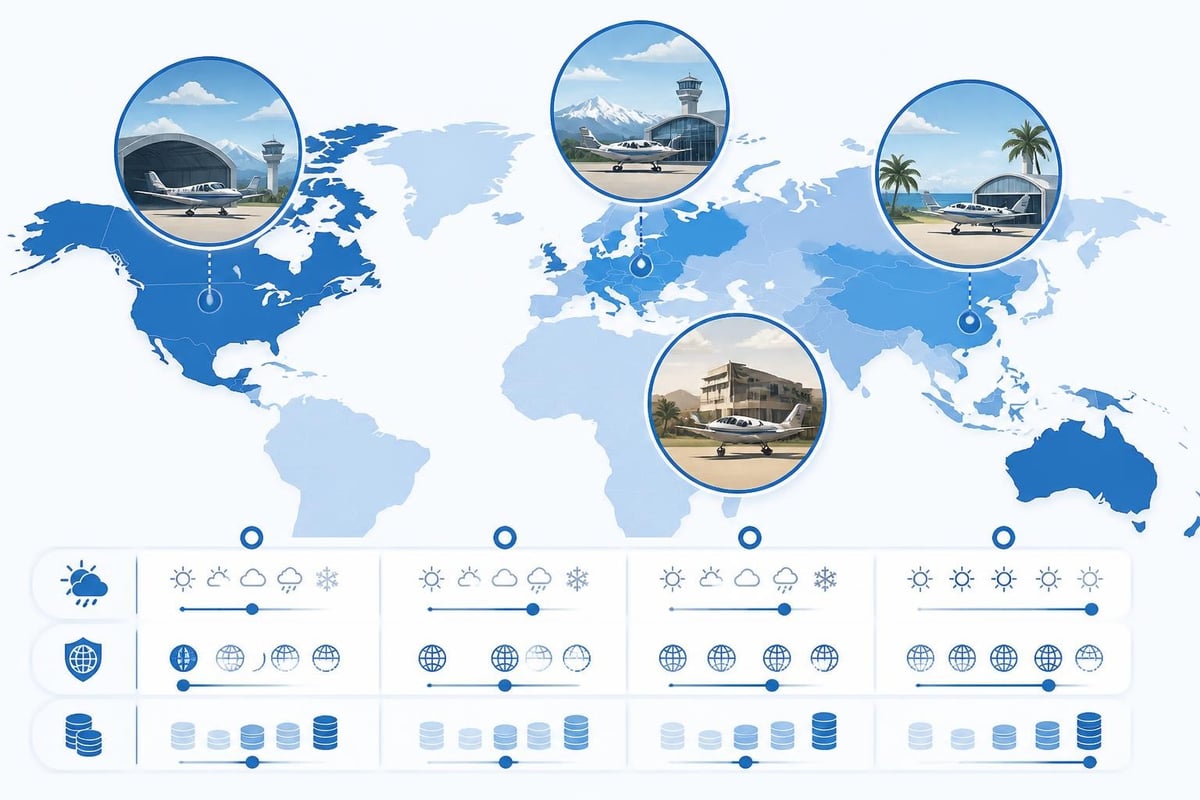
The FAA approves Part 141 flight colleges across all 50 states. Sun-belt locations (Arizona, Florida, Texas) offer year-round VFR weather, accelerating training. Northern colleges face seasonal slowdowns but may offer lower costs and better exposure to IMC and winter operations.
International students need an M-1 visa and TSA clearance for flight training. Processing takes four to eight weeks, so apply early. Graduates earn FAA licences that require conversion or validation in other jurisdictions; EASA recognises FAA CPL for credit toward an EASA licence under Part-FCL but mandates additional ground exams.
Europe
EASA-member states host dozens of ATOs in Spain, Greece, the UK, and Scandinavia. Spanish colleges offer low costs and consistent weather; UK colleges provide access to busy controlled airspace and English-language ATC. Post-Brexit, UK CAA licences require EASA conversion for EU airline jobs, but EASA licences remain valid across all member states.
EASA integrated ATPL requires 195 hours flight time (including 100 PIC) plus frozen ATPL theory, followed by an A330 or A320 type rating and airline MCC before line training. Modular routes demand 200 hours flight time, night rating, CPL, IR, and ME before frozen ATPL status.
Rest of World
Australia, Canada, and New Zealand offer flight colleges with high English-language standards and ICAO-compliant training. Licence conversion to EASA or FAA typically requires theory exams and a skills test. ICAO's World Air Transport data shows Asia-Pacific demand growing fastest, driving expansion of colleges in the Philippines, Malaysia, and India targeting both domestic and international students.
Tracking Progress Through Training
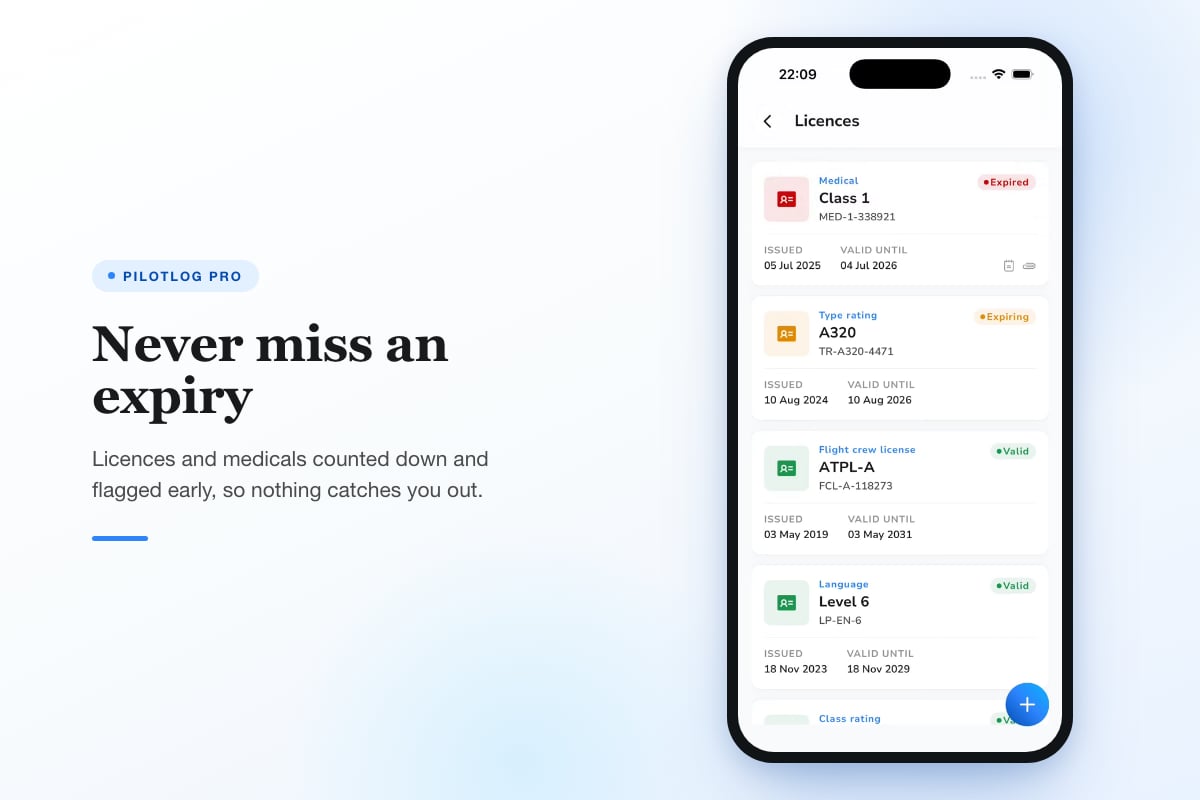
Flight colleges provide progress reports and stage checks, but you remain responsible for your own currency and compliance. From the first solo to the CPL skill test, you will accumulate hundreds of flights, ratings, endorsements, and expiry dates. Many students lose track of night-currency windows, instrument-approach recency, or medical renewal dates in the intensity of full-time training.
Pilotlog Pro helps you stay ahead by automatically calculating rolling currency (90 days for passengers under EASA FCL.060, 28-day and 365-day limits for commercial ops) and flagging licence and medical expiries well before they lapse. Log each flight in seconds on mobile, and the app tracks your progress toward hour requirements, night PIC, and instrument approaches without manual sums. That visibility matters when you are juggling CPL phase checks, IR renewals, and job applications.
What to Ask Before You Enrol
Schedule a visit and ask direct questions:
- What is your current median time-to-completion for integrated students? Compare against advertised duration.
- How many aircraft are currently unserviceable, and what is your dispatch reliability over the past six months? Look for honesty and data.
- May I speak to a current student and a recent graduate? Independent testimonials reveal culture and support.
- What is your policy on resits and additional hours? Understand costs if you need extra training.
- Do you offer job-placement support or airline partnerships? Some colleges guarantee interviews or run type-rating sponsorships.
- Is your ATO or Part 141 certificate current, and when was your last audit? Verify compliance with the regulator.
Walk the flight line, sit in the briefing rooms, and attend a ground-school session if possible. A college's atmosphere and instructor engagement tell you more than glossy brochures.
Diversity and Inclusion Initiatives
Aviation has historically struggled with representation. IATA's 25by2025 report tracks progress toward gender balance, and many flight colleges now offer targeted scholarships for women, minorities, and underrepresented groups. Look for colleges that publish diversity data and actively recruit from non-traditional backgrounds.
Programs partnering with schools, offering mentorship, or running outreach events signal commitment beyond tokenism. Inclusive colleges benefit all students through richer peer groups and broader perspectives on crew resource management.
Emerging Technologies and Competency-Based Training
Flight colleges increasingly adopt virtual-reality briefings, advanced FSTDs, and competency-based training and assessment (CBTA) frameworks promoted by IATA training resources. CBTA shifts focus from prescriptive hour-building to demonstrated competencies in threat and error management, automation, and decision-making.
The FAA and EASA both recognise CBTA syllabuses, and colleges investing in Level D simulators or FNPT II devices with motion platforms can deliver more effective instrument and upset-recovery training than aircraft alone. Check whether the college holds approval for credit toward licence requirements in synthetic devices; under EASA rules, up to 40 hours of CPL training may be FNPT II time.
Regulatory updates in 2024, documented in the Federal Register on FSTD technologies, clarify approval pathways for VR and mixed-reality trainers, signalling future curriculum evolution.
Verifying Credentials and Reputation
Before transferring a deposit, verify the college's credentials:
- FAA: Search the college name on the FAA's Part 141 pilot-school list and confirm approval dates.
- EASA: Check the national authority's ATO registry (UK CAA, DGAC France, AESA Spain).
- Student reviews: Read forums, LinkedIn groups, and independent review sites, but weigh outliers against patterns.
- Financial stability: Ask whether the college holds student-fund protection or bonding (required in the UK under CAA rules for integrated courses).
Contact the regulator directly if you have doubts. In the UK, the CAA maintains a public register of ATOs and will confirm approval status. Scams and unaccredited colleges exist; due diligence protects your investment.
Regulatory requirements change. Always confirm current minimums, validity periods, and currency rules against the latest official publications from your national authority before making training decisions.
Making Your Decision
Choosing among flight colleges is a balance of cost, location, quality, and career goals. If you aim for a legacy or low-cost carrier, an integrated college with airline partnerships and MCC may be the fastest route. If you value flexibility or cannot commit full-time, modular training through a reputable ATO lets you build ratings around work or family.
Compare at least three colleges, visit campuses, and request detailed cost breakdowns. Factor accommodation, travel, and living expenses into total outlay. Calculate the opportunity cost of full-time training (lost salary) versus slower modular progress. Your decision shapes not only your licence timeline but your professional network and foundational skills for decades ahead.
For further context on training costs, see our guide on flight lessons cost and explore helicopter pathways in our helicopter pilot licence article.
Flight colleges provide structured, certified pathways from zero hours to frozen ATPL, blending ground school, simulator, and flight instruction under regulatory oversight. Your choice depends on budget, timeline, flexibility, and career ambitions. Once you start logging dual, solo, and PIC time, keeping accurate records and tracking currency becomes essential. Pilotlog handles the detail so you can focus on flying: log every sector in seconds, monitor rolling currency, and receive alerts before licences or medicals expire. Available on iOS and Android, it grows with you from student to first officer and beyond.
- flight colleges
- integrated vs modular
- pilot training
- atpl course
- part 141
A logbook that keeps itself.
Join the waitlist and be first in line when Pilotlog launches.
Free to join, no spam. Unsubscribe any time.