endorsement logbook
Endorsement Logbook: What Pilots Must Record & Track
1 Oct 2026 · 13 min read
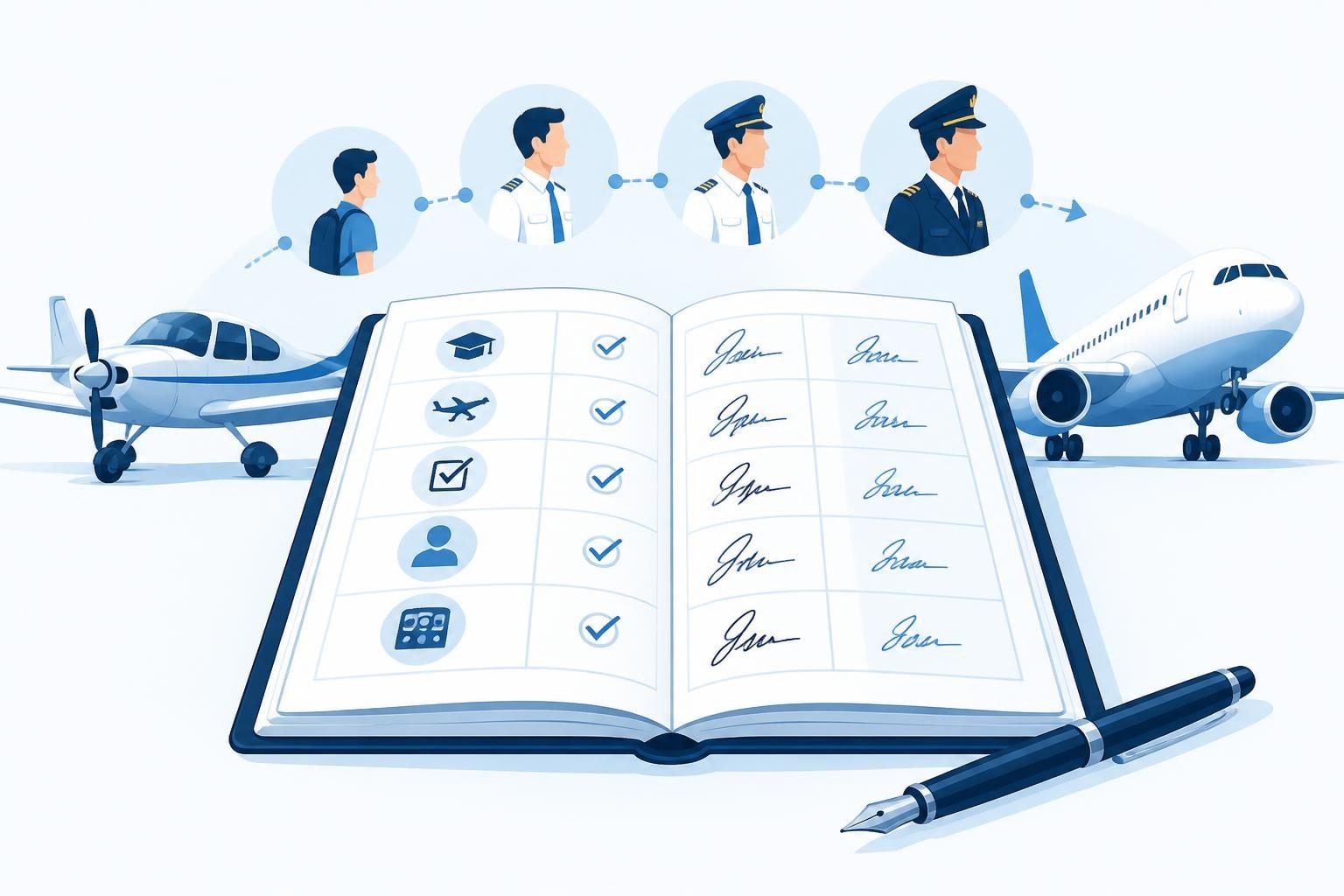
An endorsement logbook is the record of instructor signatures, authorisations, and training completions that prove you are legal to fly specific aircraft, operations, or tests. Endorsements range from pre-solo sign-offs and checkride recommendations to differences training and instrument proficiency checks. Both paper and digital logbooks must preserve these entries so that examiners, authorities, and employers can verify your qualifications at any time.
Why Endorsements Matter in Your Logbook
Endorsements are not optional administrative tasks. They are legal proof that a qualified instructor has assessed your competency and authorised you to act as pilot in command or sit for a test. Under 14 CFR § 61.51, pilots must log training and aeronautical experience in a manner acceptable to the Administrator, and endorsements form part of that record. An examiner will reject your application if the required endorsement is missing or incorrectly worded.
Beyond compliance, your endorsement logbook tells the story of your training. It shows who taught you, when you achieved recency, and which aircraft types or authorisations you hold. Employers and insurance underwriters often scrutinise endorsements to confirm transition training or differences endorsements for complex aircraft. If the signature is illegible or the date is unclear, you may be asked to repeat the training.
Key reasons pilots need complete endorsement records:
- Proof of instructor sign-off for solo, cross-country, or checkride eligibility
- Demonstration of differences training when transitioning between aircraft types
- Evidence of instrument proficiency checks (IPC) or flight reviews
- Legal defence if a regulator questions your authority to conduct a flight
- Career documentation for hiring panels and insurers

What the Regulations Say About Logbook Endorsements
United States regulations spell out exactly what must appear in an endorsement logbook. FAA Advisory Circular 61-65K provides the current guidance and recommended sample endorsements for nearly every training scenario. Each endorsement must include the instructor's signature, certificate number, certificate expiry date, and the nature of the training or authorisation.
Under 14 CFR § 61.189, flight instructors must sign the logbook of each person to whom they provide training and retain a record of that endorsement. This dual requirement ensures both student and instructor maintain proof. If an instructor fails to endorse correctly, the student cannot proceed to the next stage, and the instructor may face enforcement action.
In Europe, EASA Easy Access Rules for Aircrew (Regulation (EU) No 1178/2011) set similar standards. Part-FCL AMC1 FCL.050 describes acceptable logbook formats and the requirement for instructor or examiner signatures to validate training. Electronic logbooks are explicitly allowed provided they preserve the integrity of the record and cannot be altered without audit trail.
Minimum data required in every endorsement:
- Date of the endorsement
- Description of the training or authorisation
- Instructor name, certificate number, and expiry
- Instructor signature (or digital equivalent with audit trail)
- Aircraft registration or simulator identifier (where applicable)
Common Endorsements Pilots Encounter
Your endorsement logbook will accumulate dozens of entries over a career. Some appear only once (your first solo), while others recur every 24 months (flight reviews) or sooner (instrument currency checks). Understanding which endorsements you need and when they expire keeps you current and ready.
Pre-Solo and Solo Cross-Country
Before you fly solo, an instructor must endorse your logbook to confirm you have received and demonstrated competency in pre-solo manoeuvres and procedures. FAA Advisory Circular 61-65K lists the exact wording for this endorsement, typically valid for 90 days. If you do not solo within that window, you need a fresh endorsement.
Solo cross-country flights require an additional endorsement. The instructor must confirm you have planned the route, understand weather minimums, and are prepared for that specific flight. This endorsement is flight-specific, not a blanket authorisation for all cross-country routes.
Knowledge and Practical Test Recommendations
Before sitting a knowledge test or checkride, your instructor must endorse your logbook to certify you have received the required training and are prepared. AOPA's checkride endorsements guide provides sample wording and explains the 60-day validity window for practical test endorsements. If you fail the test or do not attempt it within 60 days, you need a new endorsement.
Examiners check these endorsements before beginning the oral or flight portion. Missing or expired endorsements halt the checkride immediately, often forfeiting the examination fee.
Flight Reviews and Instrument Proficiency Checks
Under 14 CFR § 61.56, pilots must complete a flight review every 24 months to act as pilot in command. The instructor endorses your logbook upon satisfactory completion, resetting your flight review currency. Similarly, if your IFR currency lapses beyond six months, you need an instrument proficiency check (IPC). The examiner or instructor endorses your logbook, and your instrument privileges are restored.
Both endorsements are straightforward but critical. Without them, you are not legal to fly, even if you logged the required manoeuvres. The endorsement is the proof.
Differences and Transition Training
When you move between aircraft with different systems (e.g., glass cockpit to steam gauges, retractable gear to fixed), you may need a differences endorsement. In the United Kingdom, the CAA provides guidance on differences training for single-engine piston class ratings, explaining what must be logged and endorsed. For example, transitioning to an aircraft with EFIS requires documented training and an instructor signature.
Larger aircraft or type ratings demand formal transition training and a logbook endorsement from the chief pilot or training captain. Employers and insurers review these endorsements to confirm you met the operator's standards before acting as pilot in command on that type.

How to Organise and Preserve Endorsements
A well-organised endorsement logbook saves time during checkrides, job interviews, and authority ramp checks. Paper logbooks traditionally include a dedicated endorsements section at the back, separate from flight entries. Digital logbooks must replicate this structure, ensuring endorsements are searchable and exportable.
Best practices for managing endorsements:
- Date every entry clearly using day/month/year format to avoid ambiguity
- File endorsements chronologically so the most recent appears first or last consistently
- Cross-reference flight entries by noting the logbook page or flight record number in the endorsement
- Scan or photograph paper endorsements as a backup in case the logbook is lost or damaged
- Verify instructor details immediately after the endorsement is signed, while the instructor is still present
If an instructor makes an error (wrong date, missing certificate number), ask them to correct it immediately. Crossing out and initialling corrections is acceptable, but multiple corrections raise questions during audits. A clean, legible endorsement reflects professionalism.
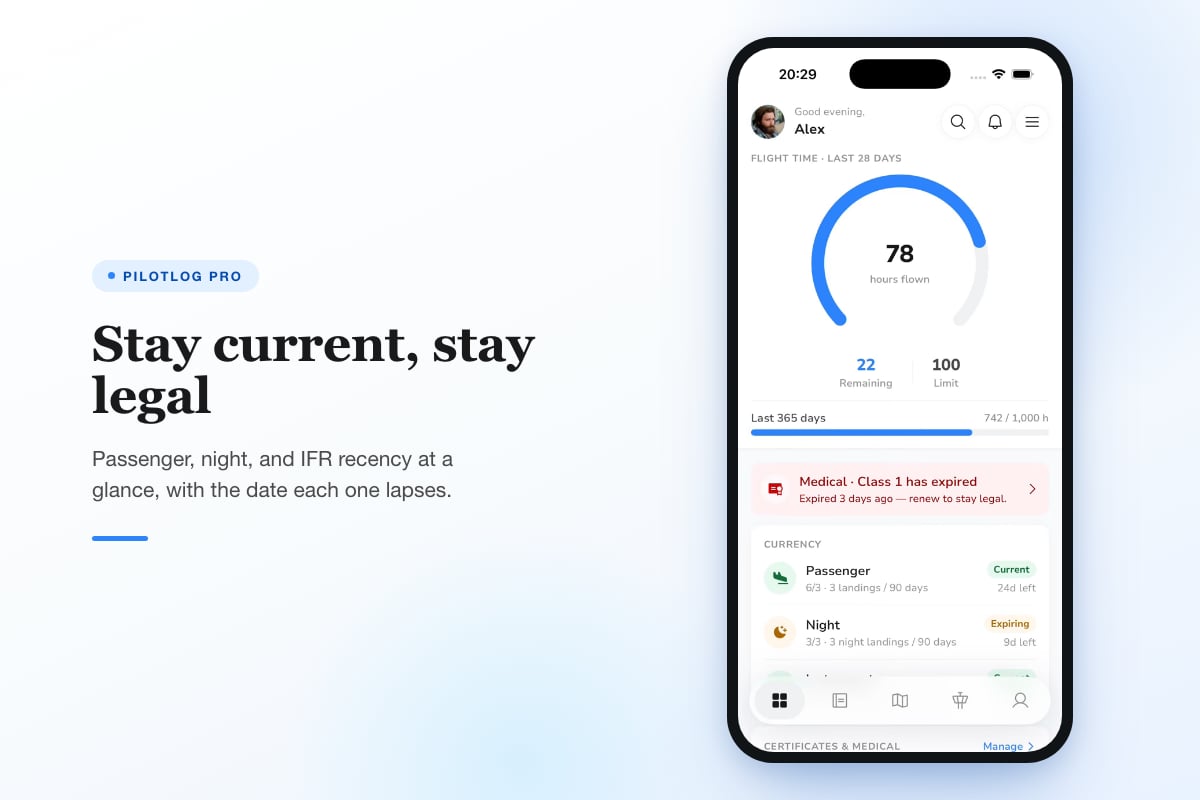
Pilotlog Pro captures endorsements digitally and links them to the relevant flight or training event, so you always have proof of currency and authorisation. The platform tracks expiry dates for flight reviews, IPC deadlines, and medical certificates, alerting you before they lapse.
Digital Endorsement Logbooks and Regulatory Acceptance
Electronic logbooks are now widely accepted by the FAA, EASA, and most national authorities. EASA guidance on acceptable logbook formats confirms that digital records are valid provided they include an audit trail and cannot be altered without evidence. This means each endorsement must be timestamped, attributed to a specific instructor, and protected from unauthorised editing.
The FAA's Dynamic Regulatory System maintains centralised guidance on logbook practices, including electronic formats. Many examiners and inspectors now accept tablet-based logbooks during checkrides, provided the endorsements are complete and the device is accessible without internet connectivity.
| Feature | Paper Logbook | Digital Logbook |
|---|---|---|
| Portability | Bulky, single copy | Cloud sync, multiple devices |
| Backup | Manual scan/photo | Automatic cloud backup |
| Search | Page-by-page | Instant keyword search |
| Endorsement audit trail | Handwritten signature | Timestamped digital signature |
| Regulatory acceptance | Universal | Widely accepted (FAA, EASA) |
Digital endorsement logbooks also simplify currency tracking. Instead of manually counting landings or instrument approaches, the system calculates rolling totals and flags when endorsements or recency requirements are about to expire. This reduces administrative burden and prevents accidental currency lapses.
Common Endorsement Errors and How to Avoid Them
Even experienced instructors occasionally make mistakes when endorsing a logbook. These errors can delay checkrides, prompt regulator questions, or create legal liability if an incident occurs. Understanding the most frequent errors helps you spot them before they cause problems.
Typical endorsement mistakes:
- Missing certificate expiry date: The instructor signs but forgets to include when their CFI certificate expires
- Illegible signature: A rushed scrawl that cannot be matched to the printed name
- Wrong regulation cited: The endorsement references an outdated or incorrect CFR section
- Ambiguous date format: Writing "3/5/26" without clarifying whether it means March 5 or May 3
- No logbook page reference: The endorsement is on a sticky note or loose sheet with no link to the main logbook
AOPA's flight instructor resources include sample endorsements with every required field highlighted. Instructors should keep this resource handy and students should cross-check endorsements against the samples before the instructor leaves.
If you discover an error later, contact the instructor and ask them to provide a corrected endorsement. Most will gladly oblige. If the instructor is unavailable or their certificate has expired, you may need to repeat the training with a current instructor.
Endorsements for Advanced Ratings and Type Training
As you progress beyond a private pilot licence, endorsement complexity increases. Commercial, multi-engine, and airline transport pilot training all require multiple endorsements covering specific manoeuvres, systems knowledge, and operational scenarios. Type rating courses for turbine aircraft generate a series of endorsements documenting ground school, simulator sessions, and line training under supervision.
For helicopter pilots, endorsements often cover autorotations, confined-area operations, and external-load training. Each skill set demands a separate logbook entry and instructor signature. Commercial helicopter operators scrutinise these endorsements during hiring to confirm you met Part 135 or equivalent standards.
Advanced endorsements you may encounter:
- Complex aircraft sign-off (retractable gear, flaps, controllable propeller)
- High-performance aircraft endorsement (more than 200 horsepower)
- Tailwheel endorsement for conventional-gear aircraft
- High-altitude endorsement for operations above 25,000 feet
- Type rating endorsement following successful completion of a type course
Each endorsement has specific prerequisites outlined in regulation. For example, the FAA requires at least 10 hours in make and model (or similar) for a complex endorsement, and the instructor must log that time in your endorsement logbook alongside the sign-off.
How Long to Keep Your Endorsement Logbook
Regulations do not specify a retention period for pilot logbooks, but the practical answer is: forever. Your endorsement logbook is your career record and the only proof of training for historical events. If you apply for a job 20 years after obtaining a rating, the employer may request proof of your initial training. If you are involved in an incident, investigators will examine your entire logbook history to establish experience and currency.
Some instructors ask how long they must retain copies of endorsements they issue. Under 14 CFR § 61.189, instructors must maintain records for at least three years. However, many keep electronic copies indefinitely as professional insurance against future liability claims.
Digital logbooks make permanent retention trivial. Cloud backups ensure the data survives device loss, and export functions let you generate PDF archives for offline storage. If you transition from paper to digital, scan every page of your old logbooks and import the endorsements so nothing is lost.
Real-World Example: Building an Endorsement Timeline
Consider a student pilot working toward a private pilot licence in 2026. On 15 March 2026, the instructor endorses the logbook for pre-solo training. The student solos on 20 March and begins cross-country planning. On 10 April, the instructor provides a solo cross-country endorsement for a specific route. The student completes the flight on 12 April.
By June, the student has accumulated 42 hours total time, 10 hours solo, and 5 hours solo cross-country. On 5 June, the instructor endorses the logbook for the private pilot knowledge test, which the student passes on 8 June. On 1 July, after 50 total hours and satisfactory stage checks, the instructor provides the practical test endorsement. The student's checkride is scheduled for 15 July.
This timeline generates five distinct endorsements in just four months:
- Pre-solo training (15 March)
- Solo authorisation (20 March)
- Solo cross-country (10 April)
- Knowledge test recommendation (5 June)
- Practical test recommendation (1 July)
Each entry includes the instructor's name, certificate number (e.g., CFI 1234567 expires 31 December 2026), signature, and a brief description of the training provided. The student keeps a digital backup and verifies every detail before the checkride. On 15 July, the examiner reviews the endorsement logbook, confirms all requirements are met, and the student earns the private pilot licence. The examiner adds a final endorsement: "Private Pilot Practical Test Passed, 15 July 2026."

Endorsement Audits and Authority Inspections
Regulators conduct ramp checks and logbook audits to verify pilots meet currency and training requirements. During these inspections, the authority examiner will ask to see your endorsement logbook and cross-check entries against your flight time. Missing endorsements, expired flight reviews, or illegible signatures can result in enforcement action, including suspension of privileges.
Professional flight instructor organisations emphasise that endorsements are not just paperwork. They represent the instructor's professional judgement that you are competent and safe. An instructor who signs off a student who is not ready puts both their certificate and the student's life at risk. This "tough love" approach ensures endorsements carry weight.
If an inspector questions an endorsement, be prepared to contact the instructor and provide corroborating evidence such as training receipts, flight school records, or aircraft rental logs. Digital logbooks with automatic timestamps and instructor account verification make audits faster and less stressful. The regulator can see exactly when the endorsement was recorded and by whom.
Tracking Currency Alongside Endorsements
Endorsements and currency are closely linked but distinct. An endorsement proves you completed training; currency proves you remain proficient through recent experience. For example, an instrument rating endorsement confirms you passed the checkride, but IFR currency requires six approaches, holding, and tracking within the preceding six months.
Pilotlog's currency tracking calculates rolling totals for passenger currency (three takeoffs and landings in 90 days), night currency, and instrument approaches. The system flags upcoming expiries so you can plan refresher flights or IPCs before your privileges lapse. When you complete an IPC, you log the flight and attach the examiner's endorsement digitally, keeping all records in one place.
Currency items that work alongside endorsements:
- Passenger currency (90-day takeoff/landing requirement)
- Night currency (90 days, three night landings to a full stop)
- IFR currency (six approaches, holding, tracking in six months)
- Flight review (24 calendar months)
- Medical certificate (varies by class and pilot age)
By linking endorsements to currency events, you create a complete picture of your legal status. If your flight review expires tomorrow and you have not scheduled it, your digital logbook sends an alert. When you complete the review, the instructor's endorsement resets the clock.
Notes on Regulatory Changes and Official Sources
Aviation regulations evolve. The FAA updates advisory circulars, EASA amends Part-FCL, and national authorities issue new guidance. The endorsement requirements described here reflect current standards as of October 2026, but you should always confirm against official sources before relying on any rule.
For United States pilots, the FAA's Advisory Circular 61-65K remains the authoritative reference. For European pilots, the EASA Easy Access Rules are updated regularly. Both are available free online.
When in doubt, consult your instructor, examiner, or the regulator's official helpline. An hour spent verifying an endorsement now can save months of remedial training later.
Your endorsement logbook is the legal proof of every instructor sign-off, authorisation, and milestone in your flying career. Keeping it accurate, complete, and accessible ensures you remain current and ready for any checkride, audit, or employment check. Pilotlog captures every endorsement digitally, links it to the relevant flight, and alerts you before currency or endorsements expire, so you always fly legal and confident.
- endorsement logbook
- pilot endorsements
- faa ac 61-65k
- flight review endorsement
- instructor sign-off
A logbook that keeps itself.
Join the waitlist and be first in line when Pilotlog launches.
Free to join, no spam. Unsubscribe any time.