airplane flying handbook
Airplane Flying Handbook: Your Complete Guide (2026)
15 Sep 2026 · 15 min read
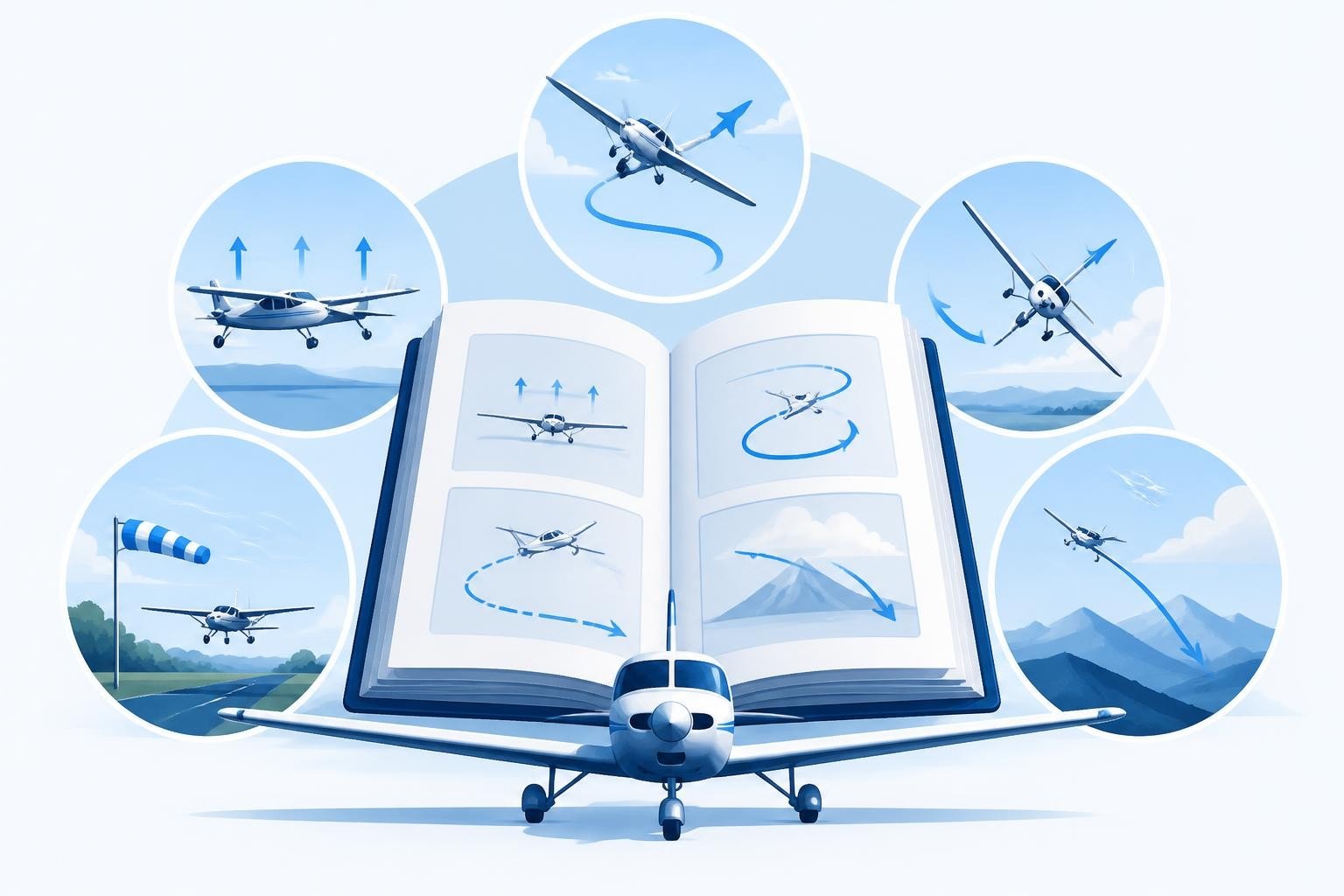
The airplane flying handbook is the foundational reference document published by the FAA that every pilot, from student to airline captain, should know inside out. Officially titled FAA-H-8083-3, this comprehensive manual codifies standardised techniques, procedures, and best practices for operating aeroplanes safely and efficiently. Whether you are preparing for your private pilot checkride, brushing up on commercial maneuvers, or teaching the next generation of aviators, the airplane flying handbook remains your go-to resource for everything from preflight planning to advanced upset recovery.
What Is the Airplane Flying Handbook?
The FAA Airplane Flying Handbook is an official publication designed to help pilots master the fundamental techniques required to safely operate aeroplanes. FAA-H-8083-3 covers ground operations, takeoffs, climbs, maneuvers, stalls, landings, and emergencies with systematic explanations and diagrams. The current edition reflects modern training standards, including upset prevention and recovery training (UPRT) guidance, glass-cockpit procedures, and refined stall-recognition techniques.
You will find chapters dedicated to each phase of flight, from the first walkaround inspection to complex crosswind landings and night operations. The handbook does not replace your aircraft's pilot operating handbook (POH) or flight manual, but it provides the framework for how to apply those specific instructions safely and consistently. Think of it as the playbook that translates regulatory knowledge into real-world stick-and-rudder skills.
Why Every Pilot Needs It
Student pilots rely on the airplane flying handbook to build a solid foundation, learning the exact sequences for steep turns, slow flight, and power-off stalls before their first solo. Commercial pilots revisit chapters on chandelles, lazy eights, and emergency descents to meet practical test standards (PTS) and aeronautical experience requirements. Flight instructors use the handbook as a teaching syllabus, ensuring lesson plans align with FAA standards and students develop correct habits from day one.
The handbook also serves as a refresher tool. If you have not flown in months and need to review crosswind landing techniques or spin recovery procedures, the airplane flying handbook provides step-by-step guidance you can trust. Pilots transitioning from one aircraft type to another will find universal principles that apply across the fleet, from a Cessna 172 to a Piper Arrow.
Core Chapters and How to Use Them
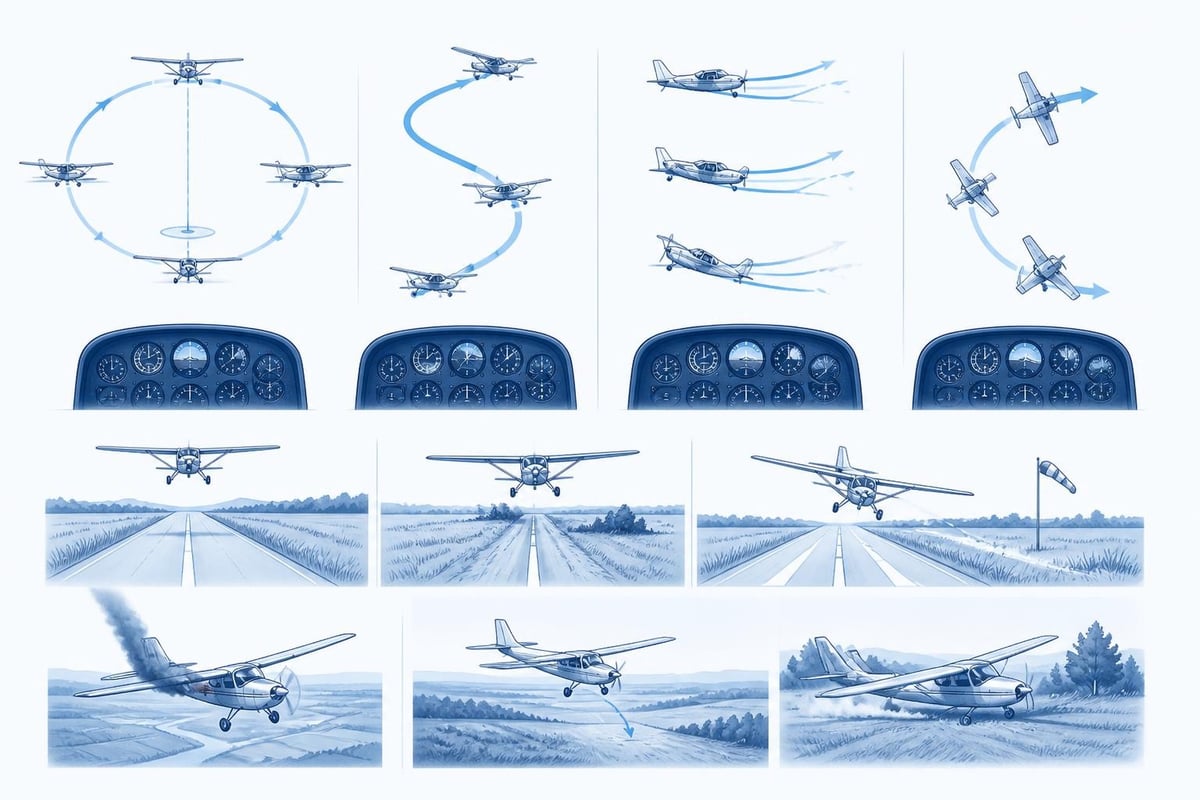
The airplane flying handbook is organized into logically sequenced chapters that mirror the progression of pilot training. Each chapter builds on the previous one, starting with basics and advancing to complex operations.
Chapter Breakdown
| Chapter | Topic | Typical Use |
|---|---|---|
| 1-2 | Introduction & Ground Operations | Pre-solo student review, ramp safety refreshers |
| 3-4 | Basic Flight Maneuvers & Slow Flight | PPL training, currency practice, instructor prep |
| 5 | Stalls | Stall recognition, recovery techniques, checkride prep |
| 6 | Spins | Spin awareness, prevention, CFI spin endorsement study |
| 7-8 | Takeoff & Landing | Short/soft field techniques, crosswind practice |
| 9 | Ground Reference Maneuvers | PPL practical test, low-altitude precision work |
| 10-11 | Performance & Night Operations | Cross-country planning, night currency maintenance |
| 12-13 | Commercial Maneuvers & Emergencies | CPL checkride, advanced maneuver practice |
Start with the chapter relevant to your immediate goal. Preparing for your instrument rating checkride? Chapter 11 on transitions to instrument flight is your first stop. Need to practice commercial maneuvers before your CPL practical test? Chapter 12 lays out chandelles, lazy eights, and eights-on-pylons with precise bank angles, altitudes, and tolerances.
Applying Handbook Techniques in the Real World
The airplane flying handbook describes how to execute maneuvers, but you must adapt those techniques to your specific aircraft and conditions. For example, the handbook outlines a generic steep turn at 45° bank, maintaining altitude within ±100 feet and airspeed within ±10 knots. In a Cessna 172, you might add one increment of power and trim slightly nose-up. In a Piper Warrior, the same maneuver may require two increments and more back pressure. Your POH and instructor will fine-tune the technique, but the airplane flying handbook gives you the baseline.
Always cross-reference the handbook with current regulations. Rules change, and pilots should confirm procedures and limits against official FAA and EASA sources before flight. The EASA UPRT guidance and UK CAA air operations templates reflect similar principles but with differences in training syllabi and documentation requirements.
Stall Recognition, Recovery, and Modern UPRT
Chapter 5 of the airplane flying handbook addresses stalls in detail, and the 2016 and later editions incorporate lessons learned from fatal loss-of-control accidents. The Colgan Air Flight 3407 crash in 2009 highlighted critical gaps in stall recognition and recovery training, prompting the FAA to revise its guidance. The updated airplane flying handbook now emphasises early stall warning cues, immediate reduction of angle of attack, and minimising altitude loss during recovery.
Updated Stall Recovery Procedure
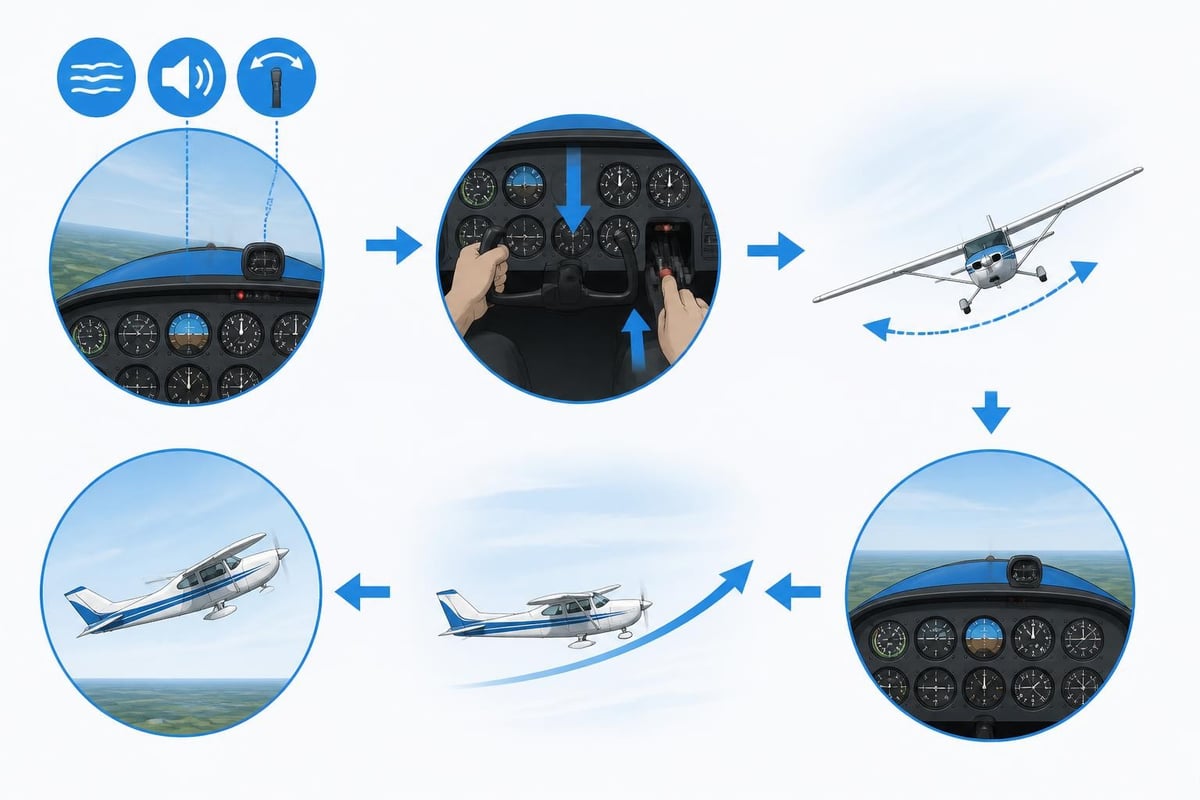
The handbook teaches a clear recovery sequence:
- Reduce angle of attack immediately (push forward on the yoke).
- Add maximum power (throttle full forward unless engine limits apply).
- Level the wings (coordinated aileron and rudder).
- Return to desired flight path (smoothly pitch to climb attitude once flying speed is regained).
This differs from older training that prioritised minimising altitude loss over recovering from the stall itself. The modern approach recognises that an unrecovered stall can develop into a spin or aggravated stall, often with fatal results. The airplane flying handbook now explicitly states that recovering control is more important than saving a few hundred feet of altitude.
Upset Prevention and Recovery Training (UPRT)
Modern editions of the airplane flying handbook integrate UPRT concepts, teaching pilots to recognise unusual attitudes and apply appropriate recovery techniques. UPRT addresses scenarios beyond the training environment: wake turbulence rolls, pitch-over after a bird strike, or inadvertent entry into IMC. The handbook provides a framework for understanding upset dynamics, recognising flight-path deviation early, and applying recovery inputs that work across a range of aircraft types.
UPRT complements traditional stall and spin training by expanding the envelope. You learn not just how to recover from a wings-level stall at 3,000 feet AGL, but how to recognise and recover from a 60° bank descent at low altitude or a nose-high, low-airspeed condition during a go-around. These scenarios are rare but survivable if you have practiced the correct recovery technique.
Using the Handbook Alongside Your Digital Logbook
Tracking your progress through the airplane flying handbook's training syllabus is where a digital logbook becomes invaluable. As you complete maneuvers and checkride requirements, logging each flight accurately ensures you meet aeronautical experience requirements and maintain currency for passengers, night, and IFR operations.
Pilotlog Pro tracks rolling currency for night landings, IFR approaches, and passenger-carrying privileges, flagging lapses before they catch you by surprise. When you are working through commercial maneuvers from Chapter 12 of the airplane flying handbook, Pro's logbook captures every chandelle, lazy eight, and steep spiral, building an audit trail for your CPL application and practical test. It also monitors flight time limits if you fly commercially, keeping you legal across 28-day and 365-day windows.

By logging each training flight with specific maneuvers and conditions, you create a living record that shows not just total hours but proficiency trends. If you have logged 15 power-off stalls in the past 30 days, your recency is solid. If your last crosswind landing was 90 days ago and you are planning a trip to a coastal airport with gusting winds, you know you need practice. The airplane flying handbook tells you how to do it; your logbook tells you when you last did it.
Practical Example: Preparing for a PPL Checkride
Imagine you are a student pilot with 48 total hours, 12 of which are solo. Your checkride is scheduled in three weeks. The airplane flying handbook is your primary study guide for the practical test.
Week One: Maneuver Review
You start with Chapter 4 (slow flight and stalls) and Chapter 7 (takeoffs and landings). Your instructor assigns specific pages for each lesson, and you read the procedures the night before each flight. On day two, you practice slow flight at 2,500 feet: reduce power to 1,500 RPM, trim for level flight at 50 knots, and maintain altitude within ±100 feet while executing shallow turns. The airplane flying handbook describes the sight picture, control inputs, and common errors (overcontrolling the pitch, forgetting to add power in turns). You compare your performance against the handbook standard and note corrections in your pilot logbook.
On day four, you practice power-on stalls. The handbook prescribes the setup: slow to 50 knots, establish a climb attitude, and increase back pressure until the stall occurs. Recovery is immediate: lower the nose, add full power, level the wings. You log the flight, recording three stalls and your instructor's feedback: "Good angle-of-attack reduction, but delay in adding power." Next session, you nail the full sequence.
Week Two: Ground Reference and Landings
Chapter 9 covers turns around a point, S-turns across a road, and rectangular courses. The airplane flying handbook explains wind correction angles and how to maintain a constant radius. You fly these maneuvers solo on day eight, logging 1.2 hours of dual and 0.8 solo. Wind is 15 knots from the west; you adjust your bank and crab angles to track the planned ground path. The handbook diagrams match exactly what you see outside: steeper bank downwind, shallow bank upwind.
Landings are next. You practice short-field and soft-field techniques from Chapter 7. The airplane flying handbook specifies the short-field approach: full flaps, approach speed at 1.3 V_S0, power to idle over the threshold, touchdown in the first 200 feet. You log 12 landings in one session, mixing short-field, soft-field, and normal three-point touchdowns. Your logbook shows steady improvement: first two were long, next eight within tolerance, final two on target.
Week Three: Checkride Prep and Mock Oral
You reread the entire airplane flying handbook, focusing on explanations of aerodynamics, collision avoidance, wake turbulence, and emergency procedures. The DPE will ask scenario questions: "How do you recover from a spin?" or "What are the indications of an accelerated stall?" The handbook provides the answers. You quiz yourself using the FAA front matter and chapter list as a checklist.
On checkride day, you reference the airplane flying handbook during the oral exam when asked about go-around procedures and crosswind landing techniques. You cite chapter and page numbers where appropriate, demonstrating that you know the source material. During the flight portion, every maneuver follows the handbook standard: steep turns within 100 feet and 10 knots, stalls with prompt recovery, landings on target. You pass, and the airplane flying handbook moves from your training bag to your reference shelf, where it will stay for the rest of your flying career.
Advanced Applications: CFI and Commercial Training
The airplane flying handbook is not just for students. Flight instructors use it as a teaching framework, building lesson plans around its chapters and cross-referencing explanations during ground school. If a student struggles with slow flight, you turn to Chapter 4 together, reviewing the control inputs and sight pictures illustrated in the handbook.
Commercial pilots preparing for the CPL practical test revisit Chapters 12 and 13 for chandelles, lazy eights, eights-on-pylons, and emergency descents. The airplane flying handbook specifies exact entry airspeeds, bank angles, and recovery altitudes. A chandelle, for example, begins at maneuver speed, rolls to 30° bank, and ends at minimum controllable airspeed with a 180° heading change and maximum altitude gain. You practice until the maneuver matches the handbook description within practical test standards: heading ±10°, altitude at completion within 100 feet of the entry altitude plus the gain.
Teaching with the Handbook
As a CFI, you assign reading before each lesson and debrief using the airplane flying handbook as a reference. If a student makes a common error (for example, fixating on the altimeter during slow flight instead of using outside references), you show them the relevant paragraph in the handbook that explains the correct scan pattern. This reinforces learning and builds a habit of consulting authoritative sources rather than guessing or relying solely on memory.
The AOPA training resources and lesson plan libraries complement the airplane flying handbook, providing scenario-based exercises and real-world applications. Together, these resources form a complete training syllabus that produces safe, competent pilots.
Staying Current and Refreshing Skills
Even experienced pilots return to the airplane flying handbook when they need a refresher. If you have not practiced short-field landings in six months and need to fly into a 2,000-foot strip next week, reviewing Chapter 7 the night before gives you the procedure and technique to fly it safely. If you are transitioning from VFR-only to instrument flying, Chapter 11 bridges the gap, explaining attitude instrument flying, unusual attitude recovery, and partial-panel techniques.
Currency is more than meeting the regulatory minimum of three takeoffs and landings in 90 days (14 CFR 61.57). True proficiency requires regular practice of the full range of maneuvers, not just pattern work. The airplane flying handbook sets the standard for what "proficient" looks like: steep turns within tolerance, stalls with immediate recognition and recovery, crosswind landings on centerline. By practicing these maneuvers regularly and logging them in your digital logbook, you maintain both legal currency and real-world competence.
The currency cheat sheet helps you track passenger, night, and IFR recency, but the airplane flying handbook tells you how to conduct those flights safely. If your night currency has lapsed and you need three full-stop landings to carry passengers after sunset, you review the night operations chapter before heading to the airport. You brief yourself on night illusions, lighting systems, and the importance of a stabilised approach when visual references are limited. The result: three smooth landings and restored currency, all flown to handbook standards.
Common Pitfalls and How to Avoid Them
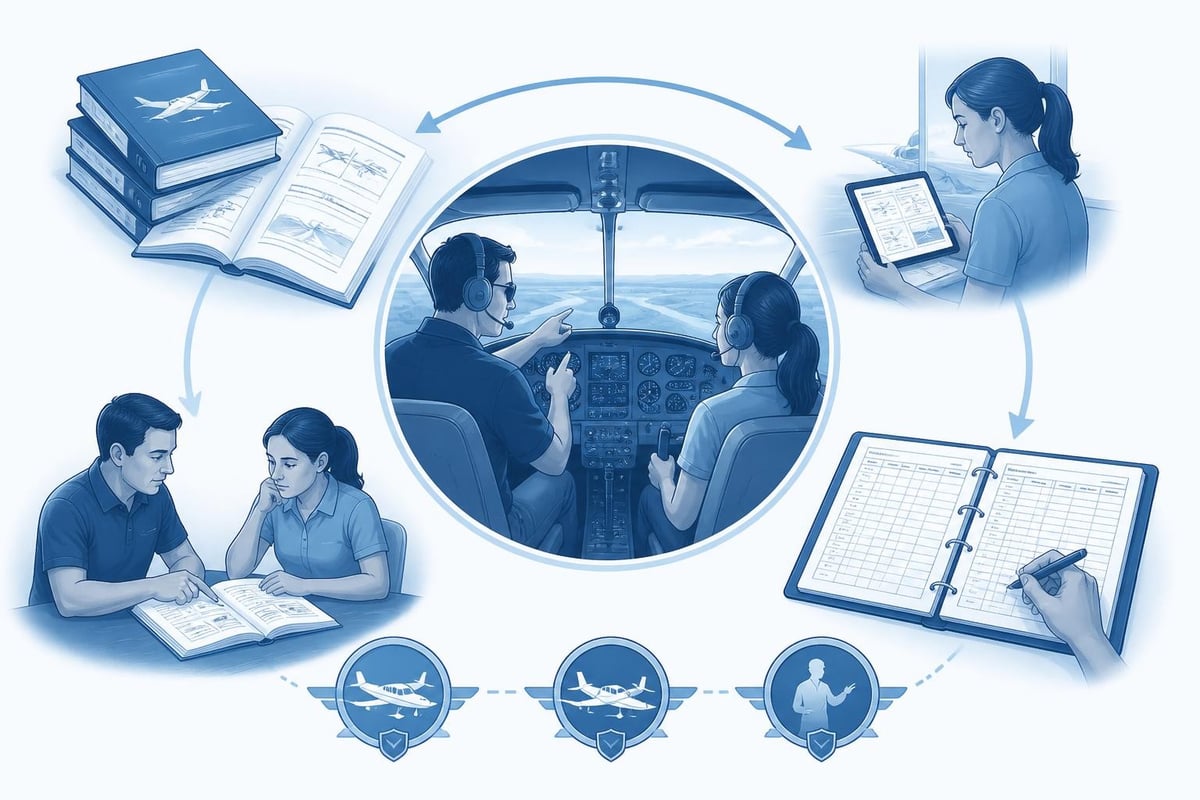
Pilots sometimes treat the airplane flying handbook as optional reading, relying instead on word-of-mouth techniques or YouTube videos. This can lead to bad habits and non-standard procedures that fail during checkrides or, worse, in an emergency.
Mistake 1: Ignoring the Handbook After the PPL
Many pilots assume the airplane flying handbook is only for students. In reality, it is a career-long reference. If you are preparing for a flight review or instrument proficiency check, the handbook provides the baseline for evaluating your skills. Examiners and instructors use it to judge whether your techniques are current and correct.
Mistake 2: Not Adapting Techniques to Aircraft Type
The airplane flying handbook describes generic procedures. You must adapt them to your aircraft's POH. A Cessna 182 requires different power settings and trim inputs than a Piper Cherokee, even though the maneuver sequence is the same. Always fly your aircraft by its book, using the airplane flying handbook as the conceptual framework.
Mistake 3: Skipping the "Why" Behind Procedures
The handbook explains not just what to do but why it works. Understanding the aerodynamics of a slip versus a skid, or why coordinated aileron and rudder prevent a spin during stall recovery, makes you a better pilot. Skim the explanations and you miss the foundation that helps you adapt when conditions change.
Mistake 4: Failing to Review After Long Breaks
If you have not flown in three months, your skills have eroded. Before your next flight, revisit the relevant chapters of the airplane flying handbook and chair-fly the procedures. Mental rehearsal combined with handbook review rebuilds proficiency faster than jumping straight into the cockpit unprepared.
Accessing the Airplane Flying Handbook in 2026
The FAA publishes the airplane flying handbook as a free PDF, available for download from the official FAA page and mirrored on sites like Skybrary. You can read it on your tablet in the cockpit, print chapters for ground school, or load the full PDF on your phone for quick reference.
The current edition (FAA-H-8083-3B as of 2026) reflects the latest training standards, including updated stall recovery guidance and UPRT integration. Older editions may contain outdated procedures, so always confirm you are using the most recent version. The FAA updates handbooks periodically to incorporate accident lessons, regulatory changes, and advances in training technology.
For pilots outside the United States, the airplane flying handbook remains a valuable reference even if your licence is issued by EASA, the UK CAA, or another authority. The fundamental aerodynamics and maneuver techniques are universal. You will need to cross-reference local regulations and training syllabi, but the core skills, slow flight, stalls, crosswind landings, emergency procedures, are the same worldwide.
Beyond the Handbook: Continued Learning
The airplane flying handbook is one piece of a larger knowledge base. It works alongside the Pilot's Handbook of Aeronautical Knowledge (FAA-H-8083-25), Instrument Flying Handbook (FAA-H-8083-15), and your aircraft's POH to build a complete picture of safe flying. As you advance through ratings and endorsements, from private to instrument to commercial to CFI, each handbook provides the next layer of depth.
Stay curious and keep learning. Aviation technology evolves, regulations change, and new training methods emerge. The airplane flying handbook is updated to reflect these changes, and you should revisit it regularly. Whether you are a student working toward first solo, a weekend flyer brushing up on crosswind technique, or a CFI refining your teaching, the handbook is your constant companion.
Rules change, and pilots should confirm procedures and hour requirements against current official FAA, EASA, and national authority sources before making currency or training decisions. The airplane flying handbook is authoritative for technique and best practice, but always verify regulatory compliance with the current FARs, EASA Part-FCL, or your local civil aviation rules.
The airplane flying handbook is the single most important reference for mastering the art and science of flying aeroplanes, from your first lesson to your last flight. By studying its chapters, practicing the techniques, and logging your progress, you build the proficiency and confidence every safe pilot needs. Pilotlog keeps you current and legal while you put those handbook lessons into practice, tracking every flight, currency, and expiry so you can focus on flying well. Log a flight in seconds, and let Pilotlog handle the rest.
- airplane flying handbook
- faa-h-8083-3
- pilot training
- stall recovery
- uprt
A logbook that keeps itself.
Join the waitlist and be first in line when Pilotlog launches.
Free to join, no spam. Unsubscribe any time.