ppl flying
PPL Flying: Hours, Currency & What You Need to Know
27 Oct 2026 · 16 min read

A Private Pilot Licence (PPL) grants you the privilege to act as pilot in command of aircraft in the category and class for which you are rated, but it comes with specific limitations and currency requirements. PPL flying means flying non-commercial, private operations under visual flight rules, carrying passengers only when you meet recent experience requirements, and maintaining medical fitness and licence validity. Understanding what PPL flying entails, from the initial privileges through to staying current and legal, is essential for every private pilot.
What Does PPL Flying Actually Mean
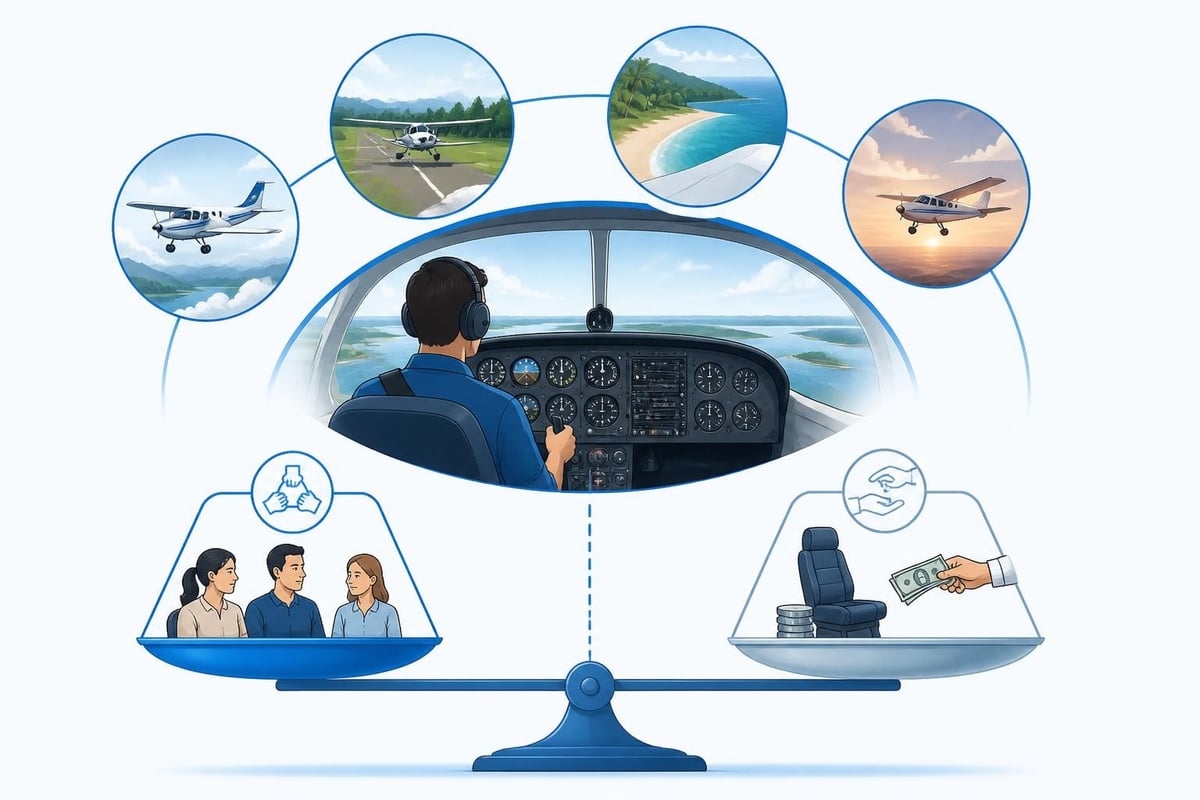
PPL flying refers to operating an aircraft under the privileges of a Private Pilot Licence. The licence permits you to fly as pilot in command or co-pilot of aircraft in non-commercial operations, meaning you cannot fly for hire or compensation beyond limited cost-sharing arrangements.
Under EASA Part-FCL, a PPL holder may act as PIC or co-pilot on non-commercial flights and may receive cost-sharing contributions from passengers toward direct operating expenses. In the United States, the FAA Airman Certification Standards define similar boundaries: private pilots may not pay less than their pro-rata share of fuel, oil, airport fees, and rental when carrying passengers.
The practical reality of ppl flying involves:
- Single-pilot VFR operations in aircraft for which you hold a valid class or type rating
- Passenger carriage once you meet recency requirements (three take-offs and landings within 90 days in the same category and class)
- No commercial compensation except cost-sharing or specific exceptions like flight instruction if you also hold a flight instructor rating
- Ongoing currency and medical validity as mandated by the issuing authority
These boundaries keep ppl flying distinct from commercial aviation while still offering significant freedom to travel, build hours, and share flight experiences.
Licence Requirements and Initial Privileges
To begin ppl flying, you must first earn the licence. Training syllabuses vary by jurisdiction, but the core knowledge and skill requirements are broadly similar.
Training Hours and Standards
EASA Part-FCL PPL(A) requires a minimum of 45 hours total time, including at least 25 hours dual instruction and 10 hours supervised solo (FCL.205.A and FCL.210.A). The UK Civil Aviation Authority applies the same EASA framework across approved training organisations.
In the United States, 14 CFR § 61.109 specifies 40 hours minimum for Part 61 training (though the national average is closer to 60-70 hours). Those 40 hours must include 20 hours with an instructor and 10 hours solo, plus specific cross-country, instrument, and night requirements.
| Requirement | EASA PPL(A) | FAA PPL (Part 61) |
|---|---|---|
| Total minimum hours | 45 | 40 |
| Dual instruction | 25 | 20 |
| Solo | 10 supervised | 10 |
| Cross-country (solo) | 5 hours, one ≥270 km | 5 hours, one ≥150 nm |
| Instrument time | 5 hours (dual) | 3 hours (dual) |
| Night (if included) | 5 hours total | 3 hours dual + 10 TO/LDG solo |
The FAA Pilot's Handbook of Aeronautical Knowledge provides foundational theory covering aerodynamics, weather, navigation, and human factors that underpin both the written knowledge test and practical flight training.
Skill Test and Licence Issue
PPL flying begins once you pass both the written knowledge exam and a practical skill test (checkride) with an examiner. EASA calls this a skill test conducted to FCL.125; the FAA terms it a practical test per the relevant ACS.
After licence issue, your privileges are valid provided you maintain:
- Medical fitness (EASA Class 2 medical certificate or FAA third-class medical)
- Licence validity (EASA licences require a valid medical and SEP revalidation; FAA certificates do not expire but require a flight review every 24 months per 14 CFR § 61.56)
- Recency of experience for carrying passengers or operating under specific conditions (night, complex aircraft, etc.)
Understanding how flight lessons near you translate into ongoing licence privileges helps you plan both initial training and career progression.
Currency and Recent Experience for PPL Flying
Currency rules ensure that ppl flying remains safe. Regulations distinguish between the validity of your licence (a legal document) and your recency of experience (practical competence in specific operations).
Passenger-Carrying Currency
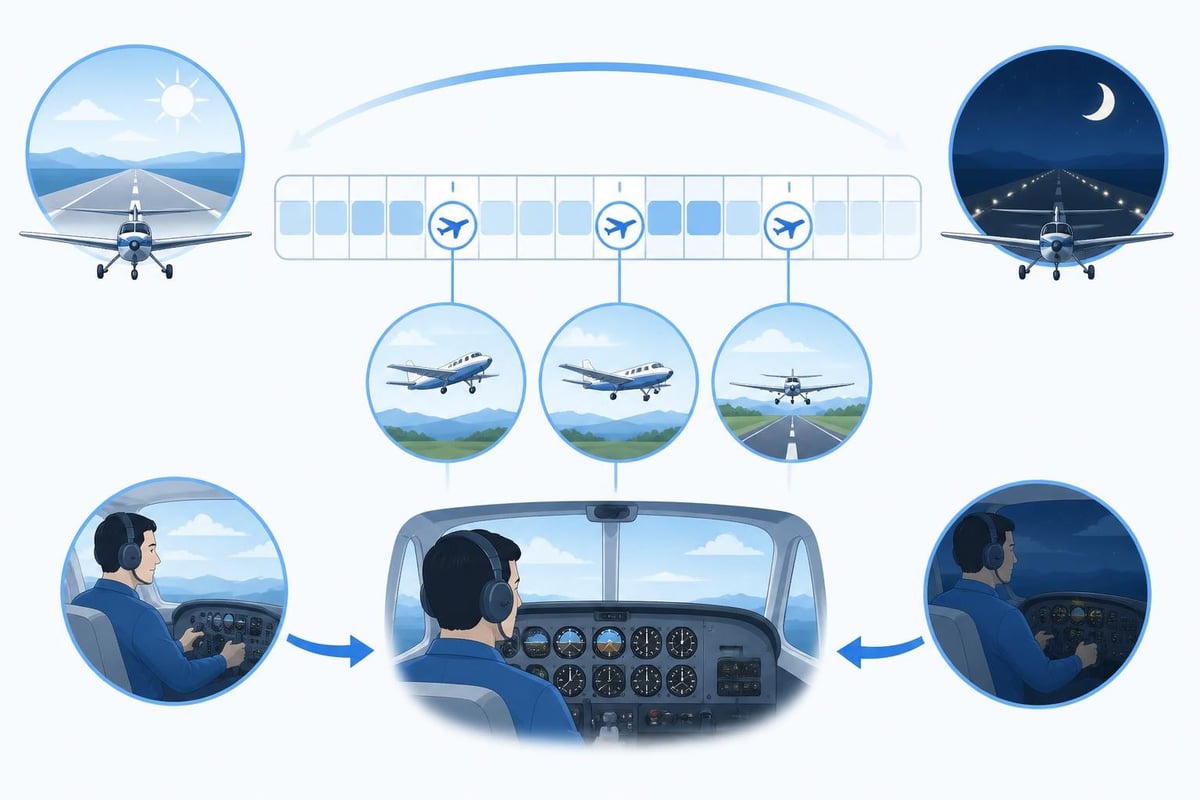
EASA FCL.060 states that to carry passengers, a pilot must have completed three take-offs and three landings in the preceding 90 days in an aircraft of the same class or type. If those 90 days lapse, you may still fly solo to regain currency, but you cannot carry passengers until the three cycles are complete.
The FAA imposes an identical 90-day rule under 14 CFR § 61.57(a): three take-offs and landings within the preceding 90 days in the same category, class, and type (if a type rating is required). For night passenger-carrying currency, those three cycles must occur between one hour after sunset and one hour before sunrise, and must include full-stop landings in an aeroplane (§ 61.57(b)).
In practice this means:
- A lapse of 91 days without flying removes passenger privileges
- You may restore currency by flying three solo circuits before carrying anyone
- Night recency is tracked separately and requires specific night take-offs and landings
Many pilots fly regularly enough that the 90-day window never becomes an issue. For those who fly less often, careful planning and a quick recency flight keep privileges current.
Class and Type Ratings, Revalidation, and Instrument Currency
Beyond basic passenger currency, ppl flying involves maintaining ratings and endorsements specific to the aircraft you fly.
Single-engine piston (SEP) revalidation under EASA Part-FCL requires either:
- One hour with an instructor, including approach and landing training, within the three months before expiry (FCL.740.A), or
- Twelve hours flight time in SEP aeroplanes in the preceding twelve months, including six hours PIC, twelve take-offs and landings, and a training flight with an instructor.
FAA pilots do not revalidate individual class ratings but must complete a flight review every 24 calendar months (14 CFR § 61.56): minimum one hour ground and one hour flight with an authorised instructor covering manoeuvres and procedures.
Instrument currency (if you hold an instrument rating) requires six instrument approaches, holding, and intercepting/tracking courses in the preceding six months (FAA § 61.57(c); EASA IR revalidation per FCL.625). Letting this lapse requires an instrument proficiency check (IPC) before resuming IFR operations.
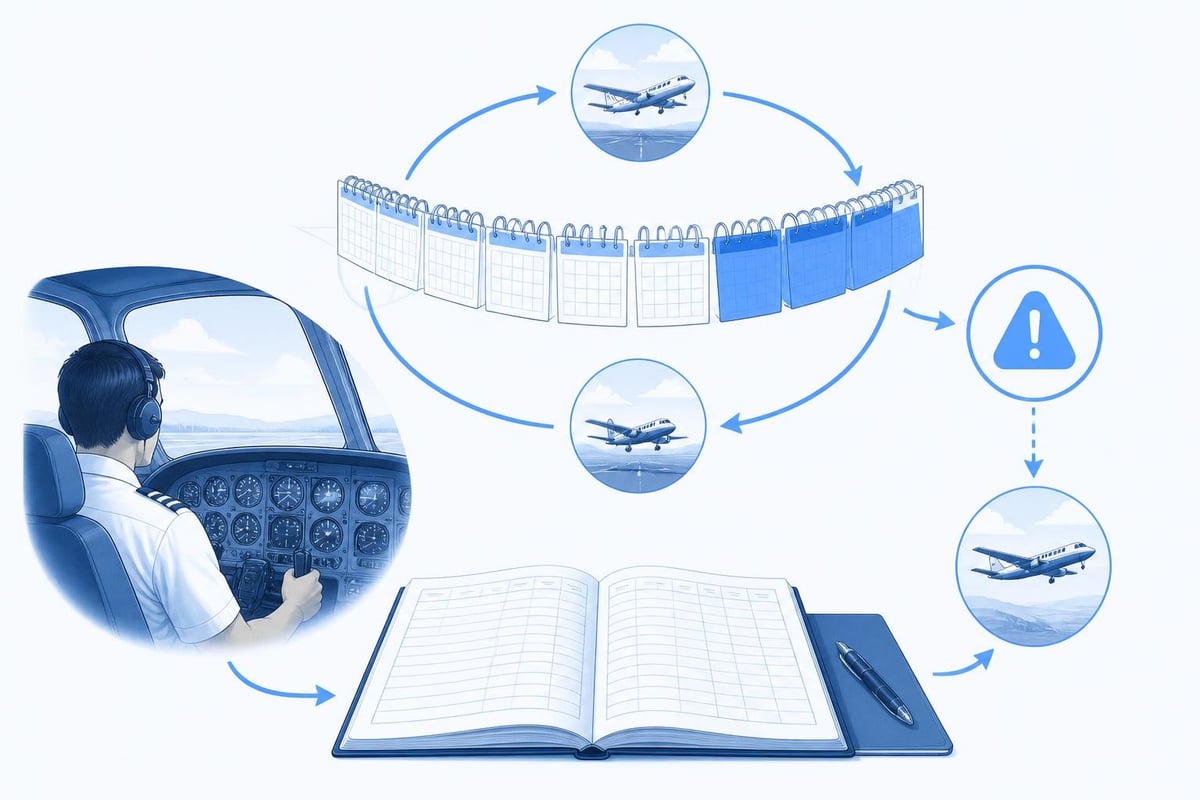
Keeping on top of these overlapping windows is where digital tracking makes a difference. Pilotlog Pro monitors rolling 28-day and 365-day totals, calculates passenger and IFR currency automatically, and flags upcoming revalidation and medical expiry dates so nothing catches you by surprise.
Practical Aspects of PPL Flying: Planning, Weather, and Decision-Making
PPL flying is as much about sound decision-making as stick-and-rudder skill. Every flight begins with thorough planning, weather assessment, and weight-and-balance calculations.
Preflight Planning and Weather
Before each flight, you are required to familiarise yourself with all available information concerning that flight (EASA ORO.GEN.105; FAA § 91.103). This includes:
- NOTAMs for departure, destination, and alternate airfields
- Weather (METARs, TAFs, SIGMETs, area forecasts)
- Fuel requirements including reserves
- Airfield and runway information (lengths, surfaces, lighting)
- Weight and balance within approved limits
The NOAA Aviation Weather Center provides official briefings for U.S. flights, while EASA states use national met services and EUROCONTROL products. Accurate weather interpretation is critical; VFR minima and personal minimums often differ, and making a no-go decision on the ground is always safer than continuing into deteriorating conditions.
SKYbrary safety guidance highlights common GA hazards such as controlled flight into terrain (CFIT), airspace infringements, and VFR-into-IMC encounters. These remain leading accident causes in ppl flying, as documented in the NTSB 2024 Annual Report.
Weight, Balance, and Performance
Every flight must be within the aircraft's approved mass and centre-of-gravity envelope. PPL flying includes calculating:
- Zero fuel mass (empty weight plus passengers, baggage, and equipment)
- Total mass at take-off (ZFM plus fuel)
- CG position to ensure it falls within limits throughout all phases
Performance calculations follow: runway length required for take-off and landing at actual conditions (altitude, temperature, wind), climb gradient to clear obstacles, and fuel burn to destination plus required reserves.
For example, a Cessna 172S at 2,450 lb on a 25 °C day at a sea-level runway needs approximately 1,500 feet ground roll for take-off at maximum weight (slightly less if lighter or with headwind). Pilots interpolate these figures from the aircraft's performance charts in the pilot's operating handbook.
Building Hours and Staying Proficient
PPL flying is often a stepping stone. Many pilots use their licence to build hours toward commercial ratings, instructor qualifications, or simply to explore and travel.
Hour-Building Strategies
Accumulating flight hours as a private pilot requires planning and often cost discipline. Common strategies include:
- Regular local flights to maintain currency and build PIC time (circuits, local area familiarisation, practice approaches)
- Cross-country trips that count toward advanced rating requirements (e.g., the 50 hours cross-country PIC needed for FAA commercial or instrument ratings)
- Cost-sharing with other pilots to split fuel and rental costs on longer trips
- Flying club or group ownership to reduce hourly aircraft costs
Hour-building is most effective when it is purposeful. Each flight can target a specific skill: precision landings, navigation without GPS, crosswind practice, or short-field operations. Keeping a structured digital pilot logbook helps you track not just total hours but also specific experience categories needed for future ratings.
Continuing Education and Safety
Proficiency in ppl flying is maintained through regular practice and recurrent education. Flight Safety Foundation resources and AOPA training guidance offer safety seminars, scenario-based training modules, and human-factors courses that keep you sharp between formal checkrides.
Many pilots fly with an instructor once or twice a year beyond the required flight review or revalidation, focusing on weak areas, new aircraft systems, or advanced techniques. This kind of voluntary recurrent training reduces accident risk and builds confidence.
Recording and Tracking PPL Flying
Accurate logbook records are both a regulatory requirement and a practical necessity. Your logbook is the legal proof of your experience, currency, and qualification for ratings and endorsements.
Regulatory Logbook Requirements
EASA Part-FCL (FCL.050) requires pilots to maintain a reliable record of flight time and duty periods. The logbook must include:
- Date and flight time (block or airborne as applicable)
- Departure and arrival aerodromes
- Aircraft type and registration
- Capacity (PIC, dual, SPIC, etc.)
- Conditions (day, night, IFR, VFR)
- Remarks (specific training exercises, endorsements, examiner signatures)
FAA § 61.51 mandates similar detail, specifying that you must log all time used to meet experience, recency, or currency requirements.
Why Digital Logbooks Matter for PPL Flying
A digital pilot logbook streamlines the record-keeping burden and automates compliance tracking. Instead of manually totalling columns and calculating currency windows, the system does it for you.
For ppl flying, this means:
- Automatic currency calculations: passenger recency (90-day), night currency, instrument currency
- Rolling totals: 28-day duty limits (if you later fly commercially), 365-day summaries, career totals
- Expiry alerts: licence revalidation, medical renewal, endorsement expiries flagged weeks in advance
- Export and backup: full logbook export for job applications, insurance, or authority audits
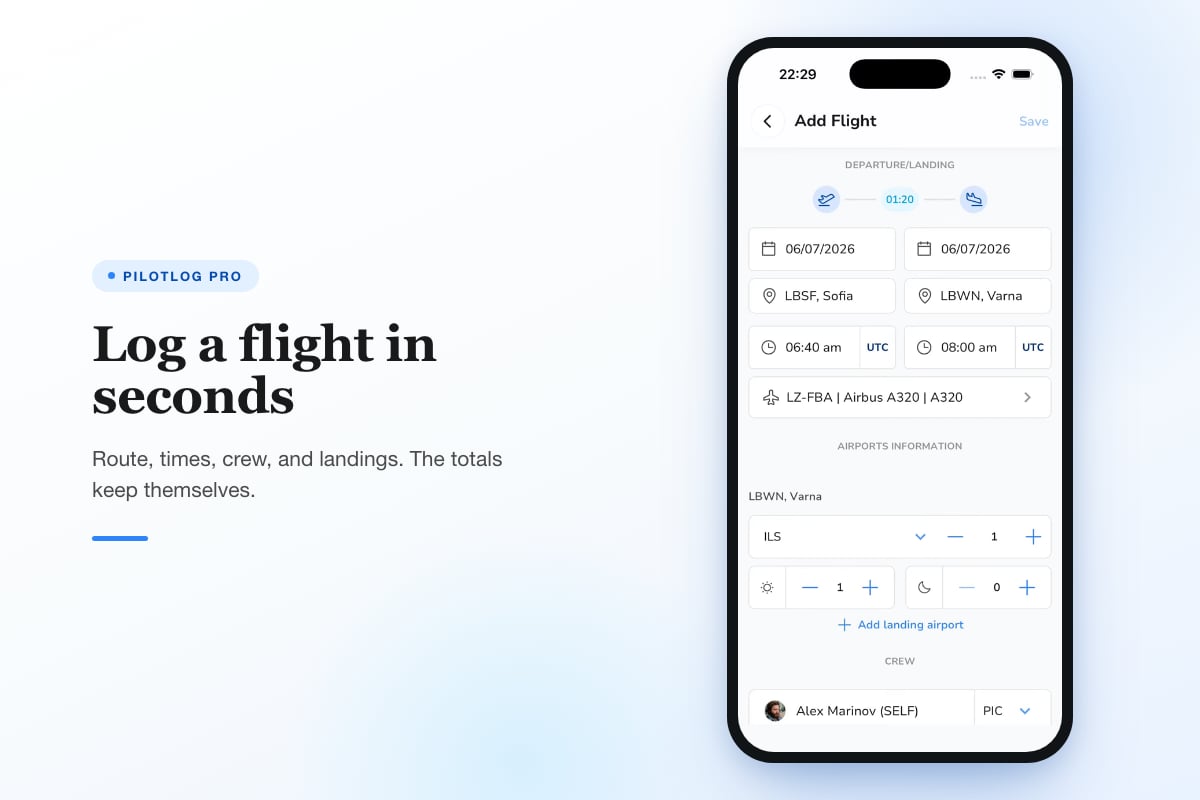
Many pilots begin with paper during training (often required by flight schools) and migrate to digital once they earn the licence. The transition is straightforward: enter historical flights once, then log new flights in seconds from your phone.
Airspace, Regulations, and Staying Legal
PPL flying takes place within a complex airspace system. Understanding where you may fly, under what conditions, and what clearances or transponder equipment you need is fundamental.
Controlled vs. Uncontrolled Airspace
In the United States, airspace is classified A through G. Private pilots under VFR typically operate in Class E (controlled, but no ATC clearance required for VFR) and Class G (uncontrolled). Entry into Class B, C, or D requires two-way radio communication and, in Class B, an explicit ATC clearance.
EASA airspace follows ICAO classification similarly: Class D and E are common for general aviation VFR, while Class A is IFR-only. Controlled airspace around major airports often extends to significant altitudes, and inadvertent infringement is a common violation.
Staying legal means:
- Pre-flight airspace briefing using current charts and NOTAMs
- Transponder with Mode C or Mode S (required in most controlled airspace and above certain altitudes)
- Appropriate radio communication and standard phraseology
- Awareness of temporary restricted areas (TRAs, danger areas, military exercise zones)
Maintenance of Competence and Rule Changes
Aviation regulations evolve. For instance, the FAA introduced ADS-B Out mandates in Class A, B, and C airspace and above 10,000 feet MSL in the United States (effective January 2020). EASA similarly phased in ADS-B requirements. Staying current with rule changes is part of responsible ppl flying.
Pilots should confirm currency and medical requirements against the latest official publications from the CAA, FAA, or EASA as rules and validity periods may change. This article reflects regulations as understood in October 2026 and should not substitute for official guidance.
Example: Tracking a Month of PPL Flying
Consider a pilot who completed PPL training three months ago and now flies regularly from a local airfield. Over the past 28 days, she logged:
- 8 flights totalling 12.4 hours
- 6 flights in a Cessna 172 (single-engine piston land)
- 2 flights in a Piper PA-28 (same class)
- 14 take-offs and 14 landings, all day VFR
- 2 flights with an instructor (1.8 hours dual) working on short-field and crosswind technique
- 10.6 hours as PIC
Her logbook shows:
| Date | Aircraft | Reg | Departure | Arrival | Duration | PIC | Dual | Day | Night | TO/LDG |
|---|---|---|---|---|---|---|---|---|---|---|
| 30 Sep 26 | C172 | G-ABCD | EGBJ | EGBJ | 1.2 | 1.2 | – | 1.2 | – | 3/3 |
| 03 Oct 26 | C172 | G-ABCD | EGBJ | EGTK | 0.9 | 0.9 | – | 0.9 | – | 1/1 |
| 03 Oct 26 | C172 | G-ABCD | EGTK | EGBJ | 0.8 | 0.8 | – | 0.8 | – | 1/1 |
| 07 Oct 26 | PA28 | G-WXYZ | EGBJ | EGBJ | 1.1 | – | 1.1 | 1.1 | – | 2/2 |
| 12 Oct 26 | C172 | G-ABCD | EGBJ | EGHR | 1.5 | 1.5 | – | 1.5 | – | 1/1 |
| 12 Oct 26 | C172 | G-ABCD | EGHR | EGBJ | 1.6 | 1.6 | – | 1.6 | – | 1/1 |
| 19 Oct 26 | PA28 | G-WXYZ | EGBJ | EGBJ | 0.9 | – | 0.7 | 0.9 | – | 2/2 |
| 25 Oct 26 | C172 | G-ABCD | EGBJ | EGBJ | 1.3 | 1.3 | – | 1.3 | – | 3/3 |
From this data she can see:
- Passenger currency: valid (14 take-offs and landings in the past 90 days, all in SEP land)
- Total PIC in past 28 days: 10.6 hours
- SEP revalidation: not due (licence valid until March 2027, and she has flown 12.4 hours in the past 12 months with well over the minimum TO/LDG)
- Medical expiry: Class 2 valid until December 2026
If she plans to carry passengers on a night flight next month, she will need to log three night take-offs and full-stop landings first to establish night passenger currency.
This kind of granular tracking is automatic when you log flights in Pilotlog; each entry updates your rolling totals and recency windows in real time.
Medical Certificates and Fitness to Fly
PPL flying requires you to hold a valid medical certificate and to be medically fit before each flight.
Medical Certificate Classes and Validity
EASA Class 2 medical certificates are required for private pilots exercising PPL privileges. Validity depends on age:
- Under age 40: 60 months
- Age 40-49: 24 months
- Age 50 and over: 12 months
FAA third-class medical certificates follow a similar age-based structure under 14 CFR § 61.23:
- Under age 40: 60 calendar months
- Age 40 and over: 24 calendar months
BasicMed (United States only) offers an alternative for pilots flying aircraft under 6,000 lb and fewer than six seats, requiring only a general physician exam every 48 months and an online medical education course every 24 months (§ 61.113(i) and § 61.23(c)(3)).
Pilots must also self-certify fitness before every flight. If you are taking medication, fatigued, or unwell, you are not legal to fly even if your medical certificate is in date. This personal responsibility is fundamental to safe ppl flying.
Renewing and Planning Ahead
Medical expirations can creep up unexpectedly, especially for younger pilots on the five-year cycle. Missing the renewal date by even one day grounds you until a new exam is complete.
Digital alerts solve this. A system that flags your medical expiry 60 or 90 days in advance gives you time to book an Aviation Medical Examiner (AME) appointment, complete the exam, and renew without any gap in validity.
Common Pitfalls and How to Avoid Them in PPL Flying
Experience and accident data reveal recurring mistakes among private pilots. Awareness and proactive habits reduce risk.
VFR into IMC
Flying VFR into instrument meteorological conditions remains a leading cause of fatal accidents. Weather can change rapidly, and continued VFR flight into cloud, fog, or reduced visibility often ends in spatial disorientation and loss of control.
Prevention steps:
- Obtain a full weather briefing and understand forecast trends
- Set personal VFR minima higher than regulatory minimums (e.g., 5 km visibility and 2,000 feet cloud base rather than the legal 1,500 m and clear of cloud)
- Plan an out (turning back or diverting before conditions deteriorate)
- File a flight plan or use flight following so ATC can assist if needed
If you encounter IMC inadvertently and hold no instrument rating, declare an emergency and request radar vectors or a surveillance approach.
Currency Lapses
Letting passenger currency, medical, or SEP revalidation lapse is inconvenient and may require additional training or check flights to restore privileges. Regular flying and proactive calendar management prevent this.
A certified flight instructor can conduct the refresher flight or revalidation training needed. Scheduling it a month before expiry avoids any gap in legality.
Incomplete or Inaccurate Logbook Records
Sloppy record-keeping leads to problems during licence applications, insurance claims, or authority ramp checks. Every flight must be logged accurately, with all required fields completed and endorsements signed where necessary.
Digital logbooks enforce structure: mandatory fields, validation checks, and automatic totals mean you cannot skip essential data. Full export capability also ensures you always have a backup.
PPL flying offers freedom, skill-building, and the foundation for a lifelong aviation journey. Staying current and legal requires careful tracking of flight time, take-offs and landings, medical validity, and revalidation dates across multiple overlapping windows. Pilotlog simplifies that task: log your flights in seconds on iOS or Android, and let the system track your currency, alert you to upcoming expiries, and keep your logbook audit-ready at all times.
- ppl flying
- pilot currency requirements
- easa part-fcl
- 90-day rule
- private pilot licence
A logbook that keeps itself.
Join the waitlist and be first in line when Pilotlog launches.
Free to join, no spam. Unsubscribe any time.