ppl requirements
Plane Licence: Requirements, Types and Validity (2026)
3 Nov 2026 · 9 min read
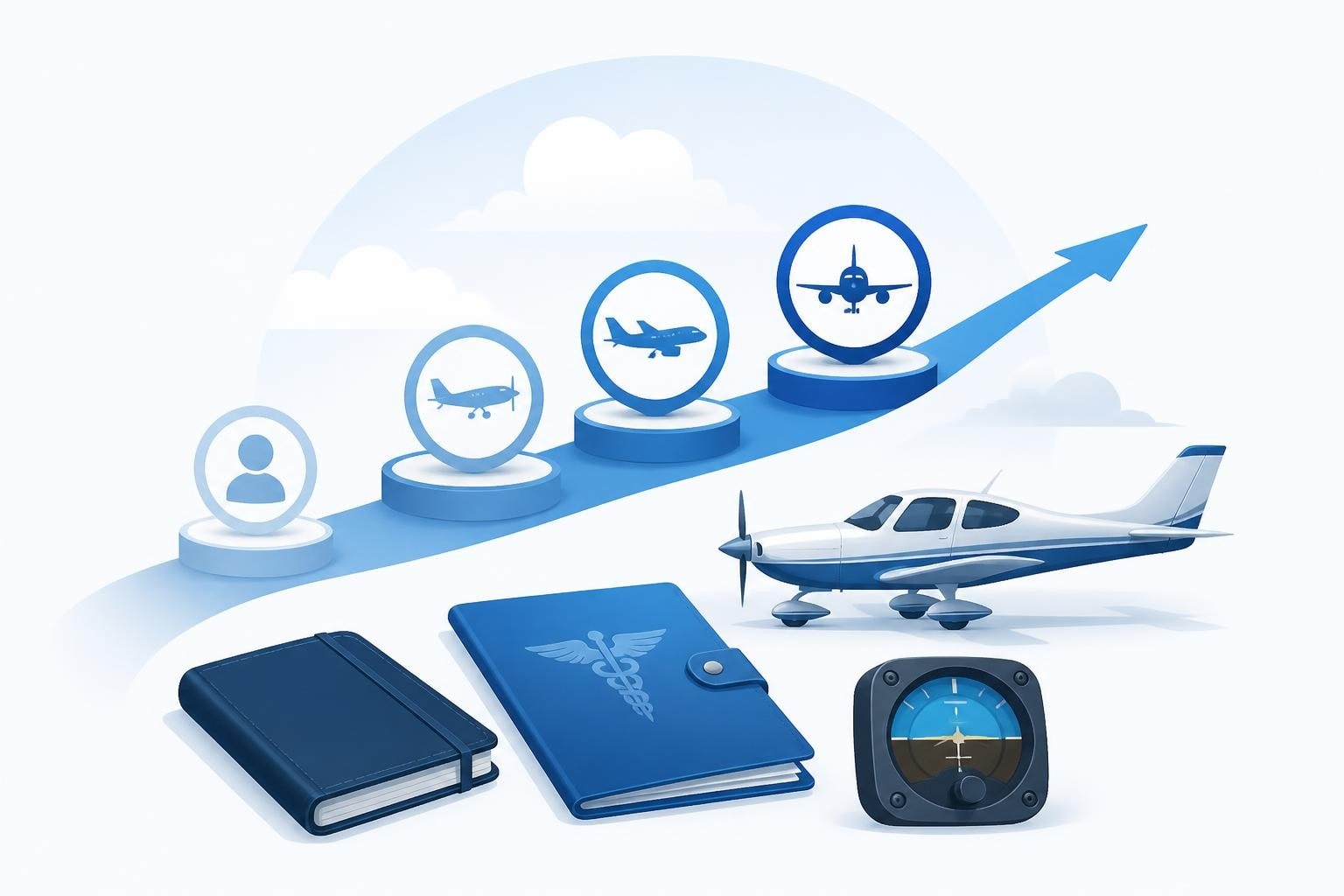
A plane licence is a legal certificate issued by a civil aviation authority that permits an individual to act as pilot in command or crew member on an aircraft. The most common initial plane licence is the Private Pilot Licence (PPL), which allows you to fly aircraft for non-commercial purposes. Different licence categories exist for commercial operations, instrument flight, and multi-engine aircraft, each with specific training, examination, and currency requirements set by your national regulator.
Licence Categories and Authority
The type of plane licence you hold depends on the issuing authority and your intended operation. EASA Part-FCL governs pilot licensing across European Union member states, while the FAA sets certification standards for the United States under 14 CFR Part 61. The UK CAA applies EASA-derived rules with post-Brexit modifications under its Licensing and Training Simplification (LaTS) programme.
Common licence categories include:
- Student Pilot Licence (SPL) or Student Pilot Certificate (FAA): permits solo flight under supervision
- Private Pilot Licence (PPL): non-commercial privileges, day VFR initially
- Commercial Pilot Licence (CPL): allows remunerated flight operations
- Airline Transport Pilot Licence (ATPL): required for airline first officers and captains
- Type Ratings: specific aircraft type endorsements (e.g. A320, B737)
- Instrument Rating (IR) or Instrument Flight Rules Rating: IFR flight in controlled airspace and IMC
Each plane licence specifies privileges, limitations, and required ratings. Your licence document (or electronic equivalent under ICAO Annex 1 standards) lists valid aircraft categories, class or type ratings, and any restrictions.
Initial Requirements for a Private Pilot Licence
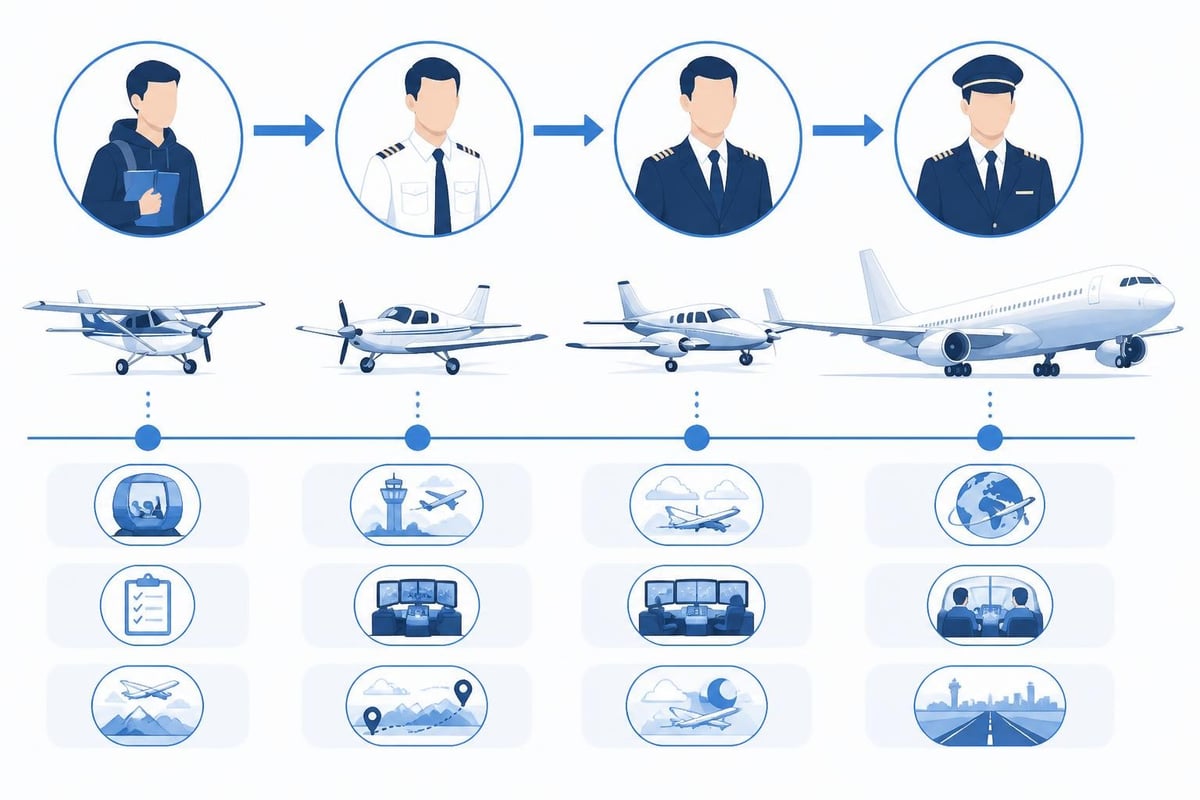
The PPL is the foundational plane licence for most pilots. Under EASA Part-FCL.210, you must be at least 17 years old, complete a minimum of 45 hours flight training (including 25 hours dual and 10 hours supervised solo), and pass nine theoretical knowledge examinations plus a practical skill test.
The FAA requires 40 hours total time under 14 CFR 61.109 (20 hours dual, 10 hours solo) for a Private Pilot Certificate. Both authorities mandate specific cross-country, night, and instrument training components.
Core training elements:
- Pre-flight preparation and planning
- Aircraft handling and stall recovery
- Navigation (dead reckoning, radio navigation)
- Emergency procedures (engine failure, forced landing)
- Solo cross-country flights (typically 150+ nautical miles EASA, 150+ statute miles FAA)
| Requirement | EASA Part-FCL.210 | FAA 14 CFR 61.109 |
|---|---|---|
| Minimum age | 17 years | 17 years |
| Total hours | 45 hours | 40 hours |
| Dual instruction | 25 hours | 20 hours |
| Solo time | 10 hours | 10 hours |
| Cross-country solo | 5 hours (270 km total) | 5 hours (150 sm with legs >50 sm) |
All applicants must hold a valid medical certificate appropriate to the licence. The training concludes with a skills test administered by an examiner, covering all PPL privileges and manoeuvres.
Medical Certification Standards
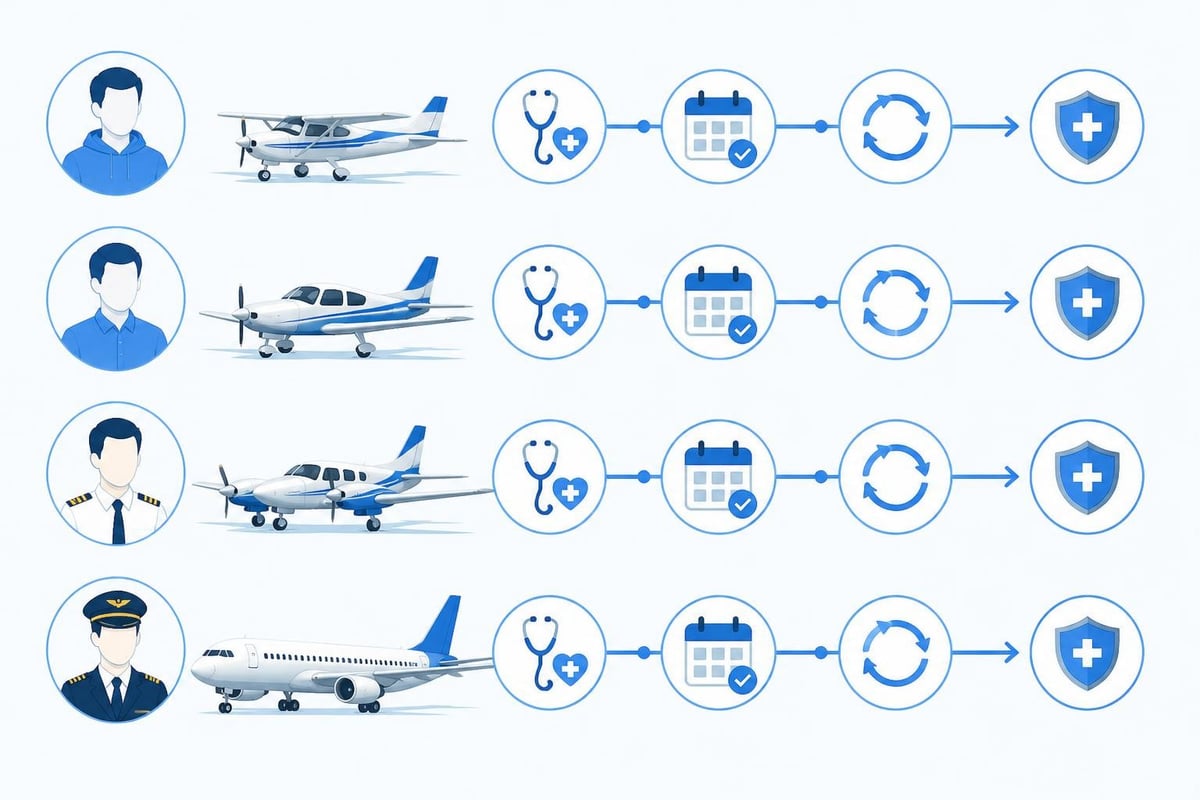
A plane licence is not valid unless you hold a current medical certificate. EASA Part-MED defines Class 1 (ATPL/CPL), Class 2 (PPL, SPL), and LAPL medical standards. The FAA issues First Class (ATP), Second Class (Commercial), and Third Class (Private) medicals, with BasicMed available for certain operations under Part 68.
EASA Medical Validity
- Class 1 (multi-pilot operations): 12 months if under 40 years; 6 months if 40 or older
- Class 2 (single-pilot commercial, PPL): 60 months until age 40; 24 months until age 50; 12 months thereafter
- LAPL medical: 60 months until age 40; 24 months thereafter
FAA Medical Validity
- First Class: 12 months (6 months for operations requiring First Class after age 40)
- Second Class: 12 months
- Third Class: 60 months if under 40; 24 months if 40 or older
FAA Aviation Medical Examiners conduct assessments under detailed protocols. Certain conditions require special issuance or a Statement of Demonstrated Ability (SODA). Always verify your medical validity before acting as PIC.
Keeping track of medical expiry dates alongside flight currency is essential. Pilotlog Pro automatically flags medical expiries early, displays days remaining, and sends alerts before your certificate lapses, ensuring you never miss a renewal deadline.
Licence Validity and Revalidation
A plane licence itself does not expire, but the ratings and privileges on it do. The most critical is the SEP class rating (single-engine piston) or type rating for larger aircraft.
Under EASA Part-FCL.740, an SEP class rating is valid for 24 months. To revalidate, you must complete within the 12 months before expiry:
- 12 hours flight time as PIC, co-pilot, or dual, including
- 6 hours as PIC
- 12 take-offs and landings
- A proficiency check with an instructor or examiner (not required if you have flown 12 hours PIC in the preceding 12 months and completed refresher training)
Worked Example: SEP Revalidation
Your SEP rating expires on 31 January 2027. Within the 12 months from 1 February 2026 to 31 January 2027 you must log:
- 12 hours total SEP time
- 6 hours PIC SEP
- 12 take-offs and 12 full-stop landings
- Refresher training and proficiency check with an instructor (unless the 12 PIC hours already meet the alternative route)
Suppose you flew:
- March 2026: 3.5 hours PIC, 4 sectors = 4 T/O, 4 landings
- July 2026: 2.0 hours dual, 2 sectors = 2 T/O, 2 landings
- October 2026: 4.8 hours PIC, 6 sectors = 6 T/O, 6 landings
- December 2026: 2.1 hours PIC (including refresher with instructor), 2 sectors = 2 T/O, 2 landings
Total: 12.4 hours (8.4 PIC + 2.0 dual + 2.0 dual/refresher), 14 take-offs, 14 landings. You have met the hours and sectors. The instructor signs your logbook confirming the refresher training, and your rating is revalidated for a further 24 months from 31 January 2027 (expiry now 31 January 2029).
The FAA's approach under 14 CFR 61.56 requires a Flight Review every 24 calendar months: at least 1 hour ground and 1 hour flight with a CFI, covering manoeuvres and procedures. Additionally, to carry passengers you must have made 3 take-offs and landings (day) in the preceding 90 days in the same category, class, and type (if a type rating is required). Night currency requires 3 night take-offs and landings to a full stop within the preceding 90 days (14 CFR 61.57).
| Currency Rule | Authority | Requirement | Validity |
|---|---|---|---|
| SEP class rating | EASA FCL.740 | 12 hrs, 12 T/O+L, 6 hrs PIC or proficiency check | 24 months |
| Flight Review | FAA 61.56 | 1 hr ground + 1 hr flight with CFI | 24 months |
| Passenger currency (day) | FAA 61.57(a) | 3 T/O + 3 landings in 90 days | Rolling 90 days |
| Passenger currency (night) | FAA 61.57(b) | 3 night T/O + 3 full-stop landings in 90 days | Rolling 90 days |
Converting a Foreign Licence
If you hold a plane licence from another state, you may convert or validate it under bilateral agreements. The FAA permits foreign-licensed pilots to apply for a U.S. certificate under 14 CFR 61.75, provided the foreign licence is current and the applicant meets English language proficiency and knowledge/practical test requirements (or qualifies for exemptions). Testing requirements vary depending on reciprocity.
EASA allows conversion of certain third-country licences to Part-FCL licences, subject to credit for previous training and additional examinations. UK CAA publishes conversion pathways for Commonwealth and other foreign licences on its pilot licensing pages. Always verify the specific conversion route with the issuing authority.
Maintaining accurate records of your foreign and converted licences, ratings, and flight time is simpler with a unified digital logbook like Pilotlog, which supports multiple licence types and jurisdictions in one platform.
Record Keeping and Documentation
Your plane licence is valid only when supported by current records. You must retain your licence document (physical or electronic under ICAO standards), medical certificate, and logbook endorsements for ratings, currency, and privileges. Logbook entries must show date, aircraft type and registration, departure and arrival points, flight time (including PIC, dual, solo, and instrument time), and signatures for training or check-rides.
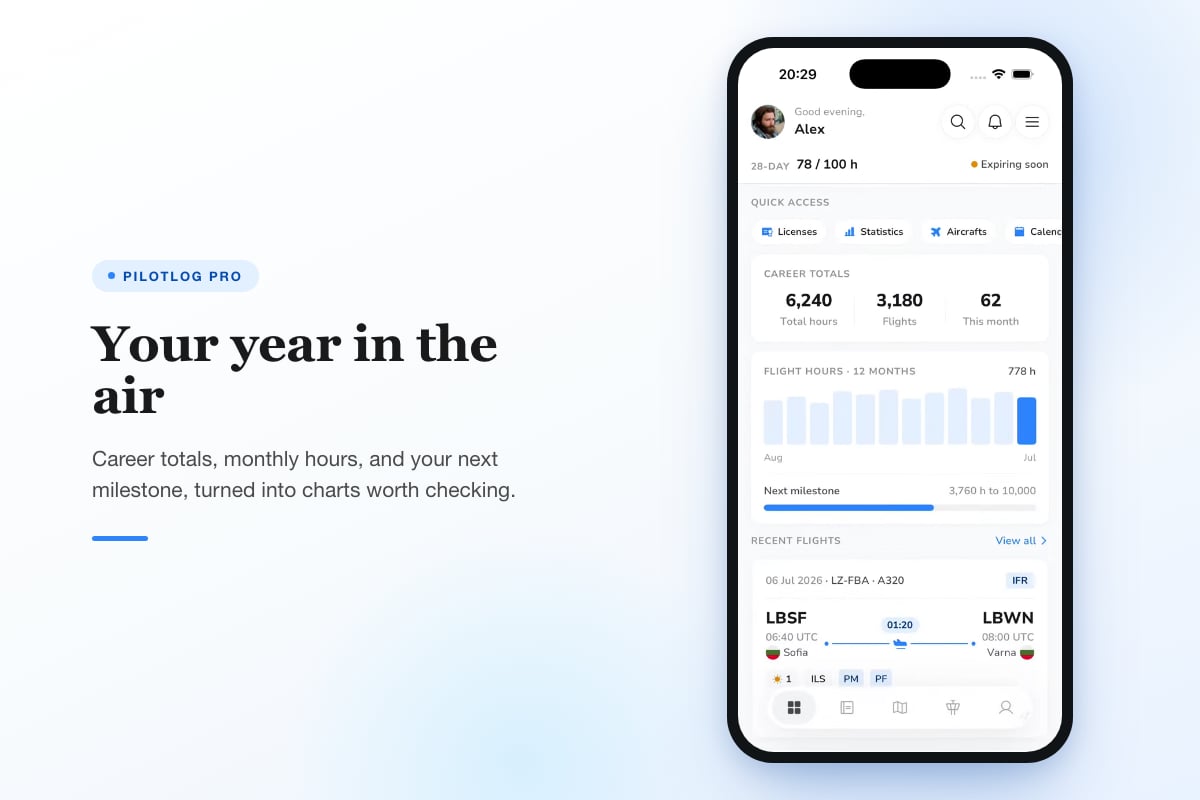
Digital logbooks offer advantages for tracking complex currency rules. Automatic calculation of rolling 28-day, 90-day, and 365-day totals ensures you remain compliant with duty-time limits and recency requirements. Alerts for upcoming revalidations, medicals, and instrument currency prevent inadvertent lapses.
Essential records to maintain:
- Licence and ratings: current privileges, issue and expiry dates
- Medical certificate: class, issue date, expiry date
- Logbook: all flight time, endorsements, instructor signatures
- Proficiency checks: dates, examiner details, outcome
- Ground training: completion certificates, theory exam results
Regulators may inspect these documents during ramp checks or application processes. Keep digital backups and ensure entries are contemporaneous and accurate.
Summary: Key Steps to Obtaining and Maintaining a Plane Licence
- Meet eligibility: minimum age (typically 17 for PPL), language proficiency, and medical fitness
- Complete training: structured syllabus with approved school or instructor (45 hours EASA, 40 hours FAA for PPL)
- Pass examinations: theory exams (9 subjects EASA; knowledge test FAA) and practical skill test
- Obtain medical: Class 1/2 (EASA) or First/Second/Third Class (FAA), valid throughout training and operations
- Maintain currency: revalidate ratings every 24 months (EASA) or complete Flight Review every 24 months (FAA)
- Track recency: 90-day passenger currency (FAA), rolling 28-day and 90-day limits for commercial operations
- Keep records: logbook, endorsements, certificates current and accessible
Frequently Asked Questions
How long does it take to get a plane licence?
Typical PPL training takes 6 to 12 months for part-time students and 2 to 3 months for full-time accelerated courses. The timeline depends on weather, aircraft availability, your study pace, and the minimum hours required (45 EASA, 40 FAA). CPL and ATPL integrated courses may take 12 to 24 months.
Can I fly internationally with my plane licence?
Yes, provided your licence is issued by an ICAO contracting state and you comply with the destination country's regulations. You may need to meet specific endorsements, language proficiency (ICAO Level 4 English minimum), or obtain temporary validations. Some states accept EASA or FAA licences directly; others require conversion.
What happens if my plane licence rating expires?
If an EASA class or type rating expires, you must complete renewal requirements, which are more extensive than revalidation (additional training, proficiency check, and potentially a skill test). FAA does not have expiring certificates, but your Flight Review and medical must be current to exercise privileges. Always revalidate before expiry to avoid extra training.
A plane licence opens pathways from private flying through to airline operations, but only if you stay current, legal, and organised. Regulations vary by authority, ratings lapse if not revalidated, and medical certificates expire on fixed schedules. Track every hour, currency window, and expiry date with Pilotlog, the digital logbook that alerts you before deadlines, calculates rolling limits automatically, and keeps your records ready for inspections or job applications. Nothing catches you by surprise.
- ppl requirements
- pilot licence types
- easa part-fcl
- faa medical certificate
- sep rating revalidation
A logbook that keeps itself.
Join the waitlist and be first in line when Pilotlog launches.
Free to join, no spam. Unsubscribe any time.