flight lessons
Plane Flying Lessons: Costs, Structure & What to Expect
2 Nov 2026 · 9 min read
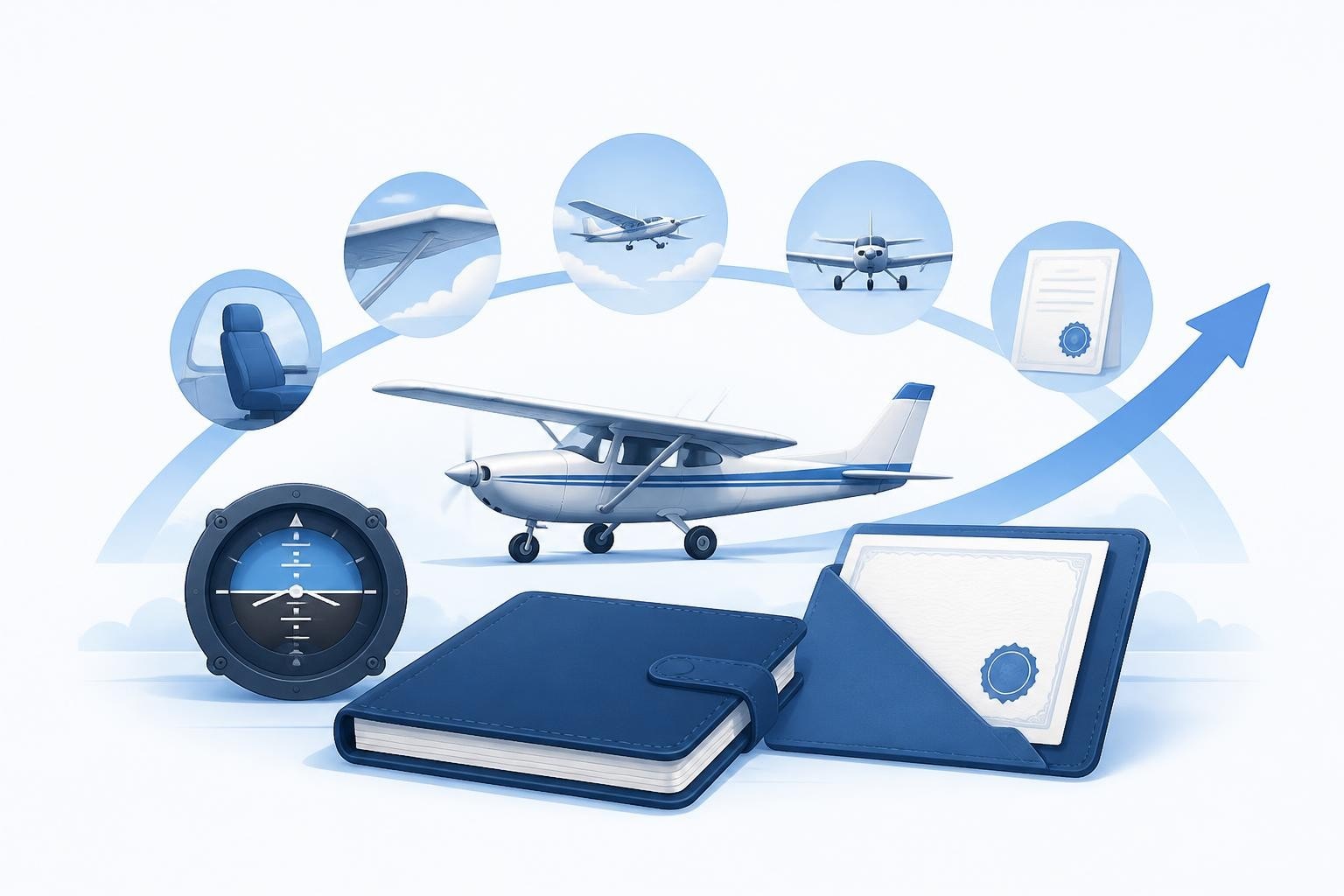
Plane flying lessons are structured training sessions delivered by a certificated flight instructor (CFI or FI) to teach you how to safely operate an aircraft, progress through pre-solo, solo, and cross-country phases, and meet the aeronautical experience requirements for your target licence. Most students begin with a Part-FCL PPL(A) syllabus requiring a minimum 45 hours (100 hours typical) or a 14 CFR Part 61 Private Pilot certificate requiring 40 hours minimum (60–75 hours typical). Each lesson typically lasts 60–90 minutes and comprises pre-flight briefing, airborne instruction, and post-flight debrief, with you logging each flight and the instructor signing your logbook to validate the training.
What Happens in a Typical Lesson
Every lesson begins with a ground briefing. Your instructor will outline the exercise (for example, slow flight and stall recovery), review the manoeuvres you will practice, check weather and NOTAMs, and answer questions. Most schools allocate 15–30 minutes for this briefing.
You then walk to the aircraft, complete the pre-flight inspection together, and fly the lesson. Early lessons cover basic aircraft control: straight-and-level, climbs, descents, turns, and the primary effect of each control surface. Later lessons introduce take-offs, circuits, landings, emergency procedures, navigation, and radio work.
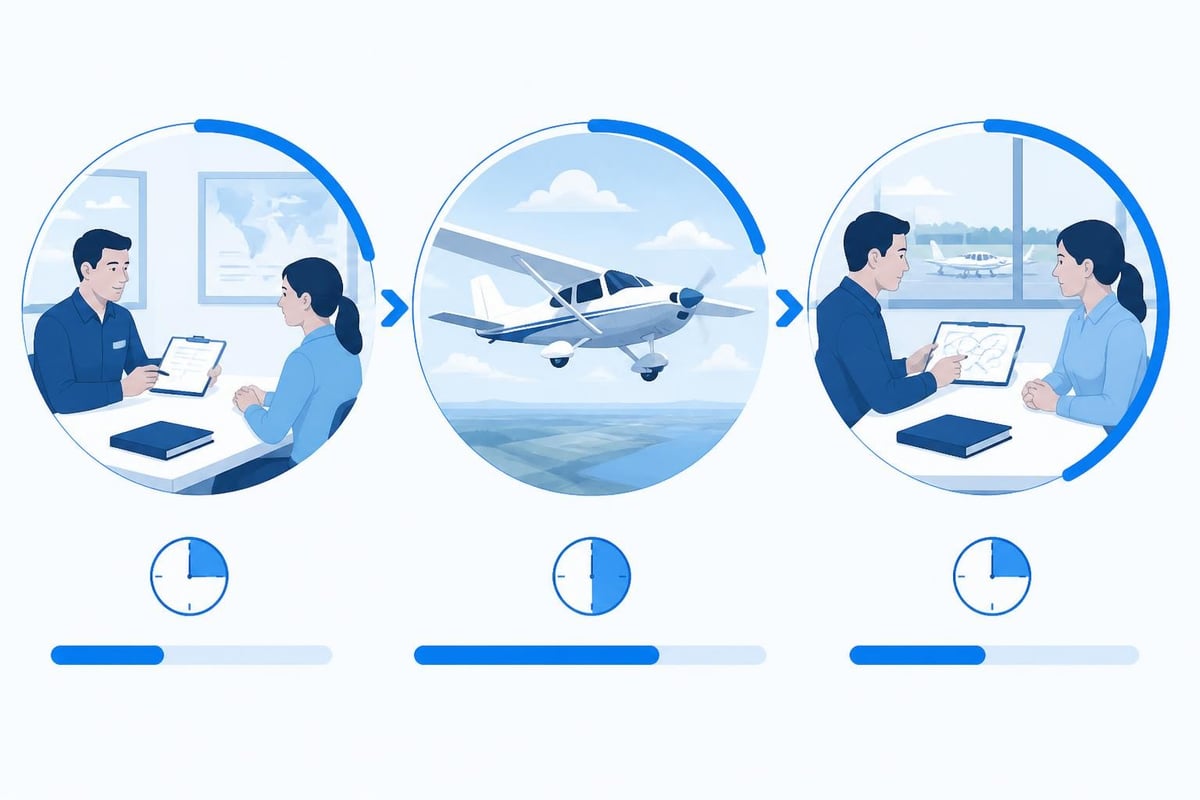
After landing and shutdown, the debrief follows. Your instructor will review what went well, identify areas to improve, and plan the next lesson. This debrief is critical: it cements the learning and guides your study between flights. You log the flight that day: date, aircraft registration, departure and arrival aerodromes, total time, and whether you flew dual or solo. The instructor signs your logbook, confirming the training content and your performance.
Costs and Budgeting for Training
Flight training costs vary by region, aircraft type, and lesson frequency, but transparency helps you plan. According to AOPA guidance on flight training costs, U.S. students in 2026 typically spend $12,000–$16,000 for a Private Pilot certificate, covering 60–75 hours of aircraft hire and instructor fees. In the United Kingdom, expect £10,000–£14,000 for a Part-FCL PPL(A), assuming 50–60 hours in a Cessna 152 or Piper PA-28 and instructor rates of £50–65 per hour.
Main cost drivers:
- Aircraft rental (wet rate, including fuel): $130–180/hour in the U.S.; £140–200/hour in the UK
- Flight instructor: $50–75/hour (U.S.); £50–65/hour (UK)
- Ground instruction and pre-solo exams: typically 15–25 hours
- Books, charts, and materials: $300–500
- Medical certificate: Class 2 (EASA) £100–150; Class 3 (FAA) $75–150
- Skills test / checkride: $500–800
| Cost Element | U.S. (14 CFR) | UK/EASA (Part-FCL) |
|---|---|---|
| Aircraft (per hour) | $130–180 | £140–200 |
| Instructor (per hour) | $50–75 | £50–65 |
| Medical exam | $75–150 | £100–150 |
| Typical total to licence | $12,000–16,000 | £10,000–14,000 |
Flying twice per week keeps the learning fresh and reduces the total hours you need, saving money overall. Long gaps between lessons mean re-learning skills, which adds hours and cost.
Regulatory Requirements and Lesson Content
Under EASA Part-FCL, a PPL(A) requires at least 45 hours total time, including 25 hours dual instruction and 10 hours supervised solo (5 hours solo cross-country, including one flight of at least 270 km with two full-stop landings at aerodromes different from departure). Fourteen CFR Part 61.109 requires at least 40 hours total time: 20 hours dual and 10 hours solo, including 5 hours solo cross-country and one solo cross-country of at least 150 nautical miles with three full-stop landings.
The FAA Airplane Flying Handbook and EASA syllabi both break training into clear phases:
- Pre-solo (15–20 hours): aircraft control, traffic patterns, take-offs, landings, emergency procedures, and solo check
- Solo consolidation (5–10 hours): supervised solo circuits and local area solo
- Navigation and cross-country (10–15 hours): dual navigation, solo cross-country flights, and diversion practice
- Advanced and exam preparation (10–15 hours): advanced manoeuvres, instrument appreciation, review of all exercises, and mock skills test
Each lesson builds on the last. You will not progress to solo until your instructor is confident you can handle the aircraft safely in the circuit and manage an emergency. For those looking to understand the costs in more detail, our guide on private pilot cost breaks down typical budgets and cost-saving strategies by region.
Choosing a Flight School and Instructor
AOPA's student pilot hub recommends visiting multiple schools, asking about aircraft availability, instructor consistency, and syllabus structure. Check the school's approval: Part-FCL Approved Training Organisation (ATO) in Europe, or Part 141 / Part 61 school in the U.S. ATOs and Part 141 schools follow a structured syllabus with regulatory oversight, while Part 61 schools offer more flexibility.
Ask prospective instructors how many students they have soloed in the past 12 months and what their pass rate is on first-attempt skills tests. A good instructor adapts teaching to your learning style, provides clear pre-flight briefs, debriefs thoroughly, and keeps detailed records of your progress. Finding a flight instructor who matches your goals and communication style makes a significant difference to how quickly you learn.
Questions to ask a school:
- What is the fleet composition and average aircraft availability?
- Is the syllabus Part-FCL ATO, Part 141, or Part 61?
- What is the typical time-to-licence for students flying twice per week?
- Are instructors assigned or do I book a different CFI each time?
- What is included in the advertised package price (exams, books, landing fees)?
Tracking Your Progress and Currency
Every lesson adds to your total time, and you must log each flight accurately. Dual instruction, solo time, cross-country, night, and instrument time all count toward licence requirements and future currency. Under Part-FCL.060(b), to carry passengers you need three take-offs and three landings in the preceding 90 days in the same class or type; 14 CFR 61.57(a) requires the same. These are rolling currency windows, and missing them means you cannot legally carry passengers until you complete the landings.
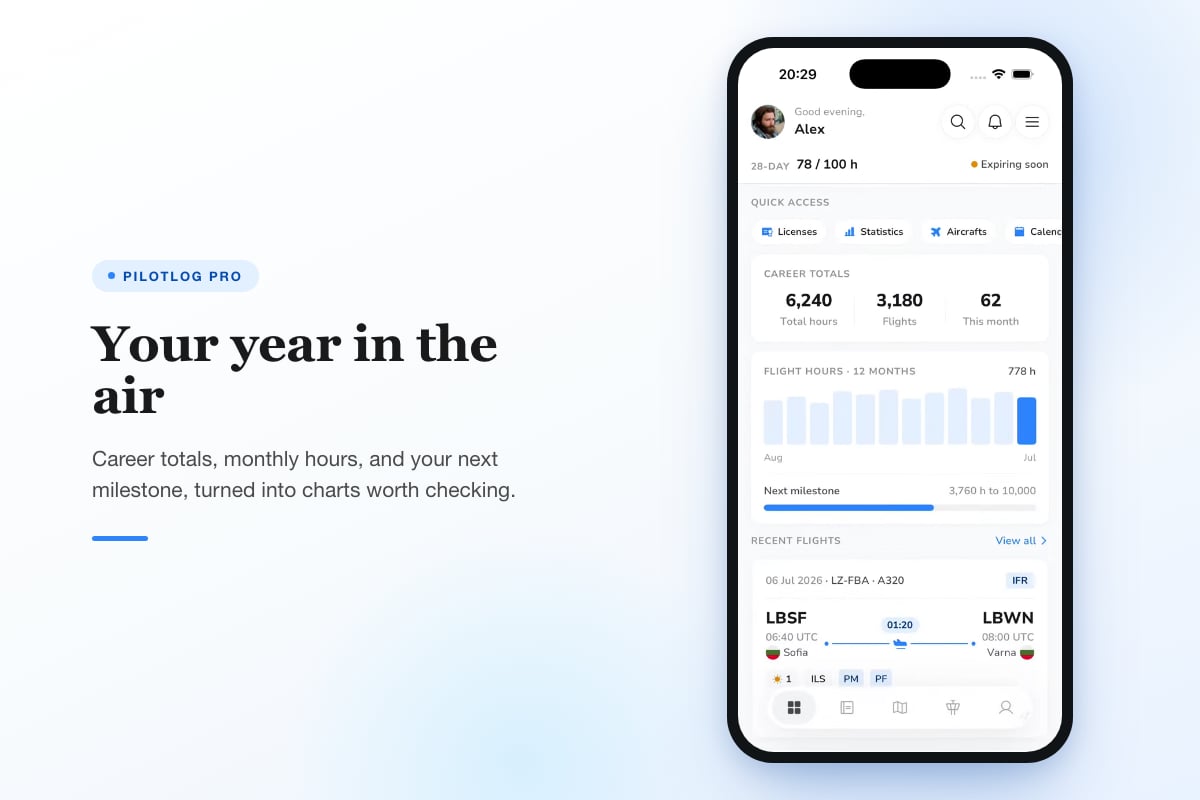
From your first lesson, build the habit of logging flights on the day you fly: date, aircraft registration, route, total time, and role (dual or PIC). As you accumulate hours, you will need to prove currency for passenger-carrying, night operations, and IFR privileges. Pilotlog Pro automatically tracks rolling 28-day and 365-day limits, passenger and night currency with lapse dates, and sends alerts for licence and medical expiries well before they catch you by surprise. It allows you to log a flight in seconds and view trends, career stats, and milestones across your entire training and beyond, from student through to airline crew.
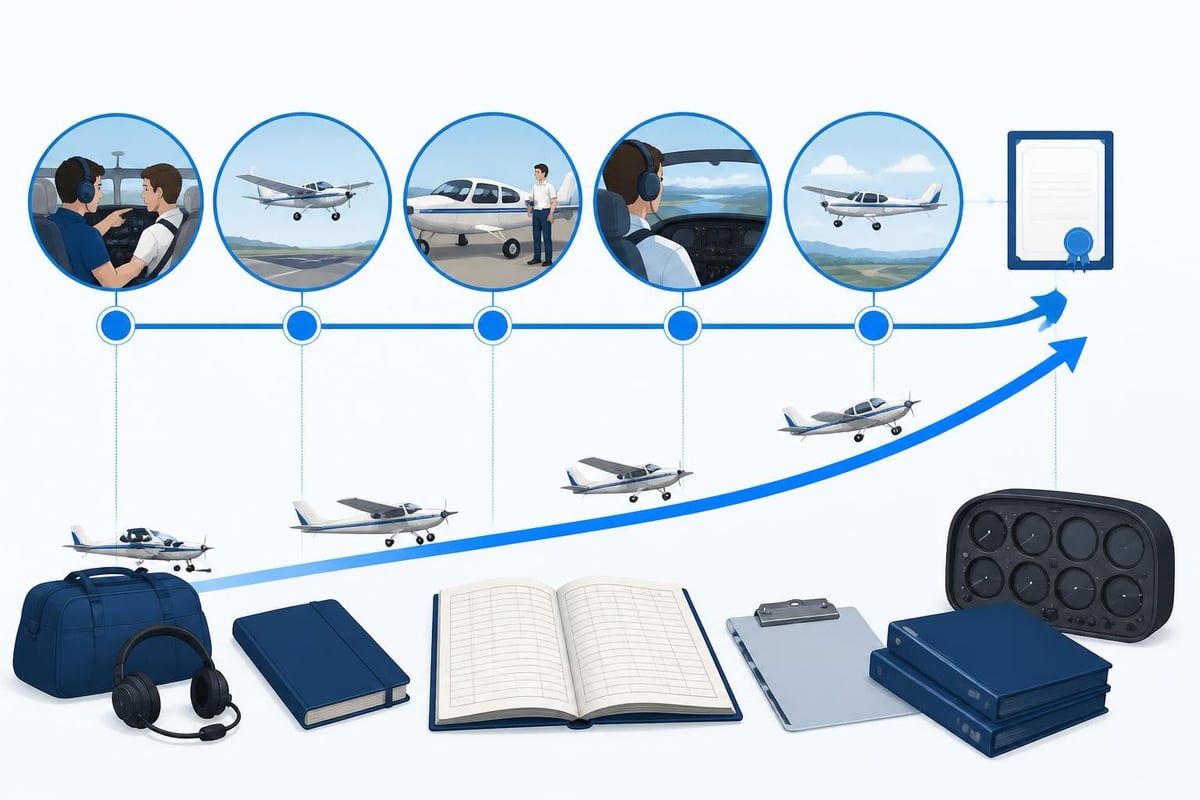
Most students reach first solo between 10 and 20 hours. That moment when the instructor steps out and you fly three circuits alone is unforgettable, but it is also a legal and logbook milestone: you log it as solo PIC time, and it counts toward your 10 hours solo requirement. Recording each lesson and its content (Exercise 10: slow flight and stalls; Exercise 15: navigation to EGBJ) helps you and your instructor see progress and plan the next phase.
Practical Tips for New Students
Fly frequently. Twice per week is the minimum to maintain momentum; three times per week accelerates learning and reduces total hours. Gaps of two weeks or more mean you spend the first 20 minutes of the next lesson re-learning the previous one.
Study between lessons. Ground school and self-study complement airborne training. Read the relevant chapter in the Airplane Flying Handbook or your school's training manual before each lesson. Watch instructional videos from organisations like EAA Learn to Fly to see manoeuvres demonstrated and explained.
Chair-fly every lesson. Sit in a chair at home, close your eyes, and mentally rehearse the lesson: talk yourself through the radio calls, control inputs, visual checks, and checklist items. This costs nothing and builds muscle memory.
| Tip | Benefit |
|---|---|
| Fly 2–3 times per week | Reduces total hours needed by 20–30%; saves money and accelerates solo |
| Study before each lesson | Maximises airborne time practising, not learning theory aloft |
| Chair-fly at home | Builds muscle memory and procedural flow at zero cost |
| Log flights the same day | Ensures accuracy and simplifies licence application documentation |
| Review debrief notes | Focuses your study and next lesson preparation on weak areas |
Ask questions. If you do not understand why the aircraft yaws during a climbing turn or how the mixture control affects engine performance, ask. Good instructors welcome questions; they show you are thinking like a pilot, not just following instructions.
Skills Test and Beyond
The training culminates in a skills test (Part-FCL) or practical test / checkride (14 CFR). The FAA Airman Certification Standards and EASA examiner guidance specify the tasks you must complete and the tolerances: altitude ±100 feet, heading ±10°, airspeed ±10 knots. The examiner will ask you to plan a cross-country flight, demonstrate manoeuvres, simulate emergencies, and show you can operate the aircraft safely and accurately.
After passing, you hold a licence but you are not a finished product. Currency rules apply immediately. You must complete three take-offs and landings every 90 days to carry passengers. Night currency requires three take-offs and landings to a full stop at night (one hour after sunset to one hour before sunrise, 14 CFR 61.57(b); night is defined in Part-FCL as the period between the end of evening civil twilight and the beginning of morning civil twilight). Your medical has a validity period: five years if you are under 40 (Class 2 EASA); five years if under 40 (Class 3 FAA); two years if 40 or over.
Continuing to log every flight, track currency, and set reminders for expiries is not bureaucracy, it is professionalism. The same habits you build during plane flying lessons will keep you legal and safe for the rest of your flying career.
Frequently Asked Questions
How many lessons does it take to fly solo?
Most students fly solo after 10–20 hours of dual instruction, typically 15–25 individual lessons. Progress depends on lesson frequency, weather, and how quickly you master aircraft control and emergency procedures. Your instructor will send you solo only when confident you can handle the circuit and an engine failure safely.
Can I train for a PPL while working full-time?
Yes. Flying twice per week in the evenings or at weekends is common and effective. Many students complete a PPL in 8–12 months while working. Block bookings (a week of intensive training) during annual leave can accelerate progress through navigation and cross-country phases.
Do plane flying lessons expire if I take a break?
No. Logged hours never expire, but currency does. If you stop training for several months, expect to spend 3–5 hours refreshing basic handling and circuits before resuming where you left off. Long gaps increase total hours and cost, so try to maintain at least one flight every three weeks during training.
Plane flying lessons are the foundation of your aviation career, building the skills, habits, and logbook hours you need for every certificate and rating that follows. From your first dual lesson to your skills test, accurate logging and currency tracking are essential for meeting regulatory requirements and staying legal. Pilotlog keeps your training records organised, tracks rolling currency windows, and alerts you to upcoming medical and licence expiries, so you can focus on flying, not spreadsheets.
- flight lessons
- ppl training
- flight training cost
- learn to fly
- flight instructor
A logbook that keeps itself.
Join the waitlist and be first in line when Pilotlog launches.
Free to join, no spam. Unsubscribe any time.