logbook requirements
My Flight Logbook: What to Log, Why It Matters, and How
25 Jul 2026 · 12 min read
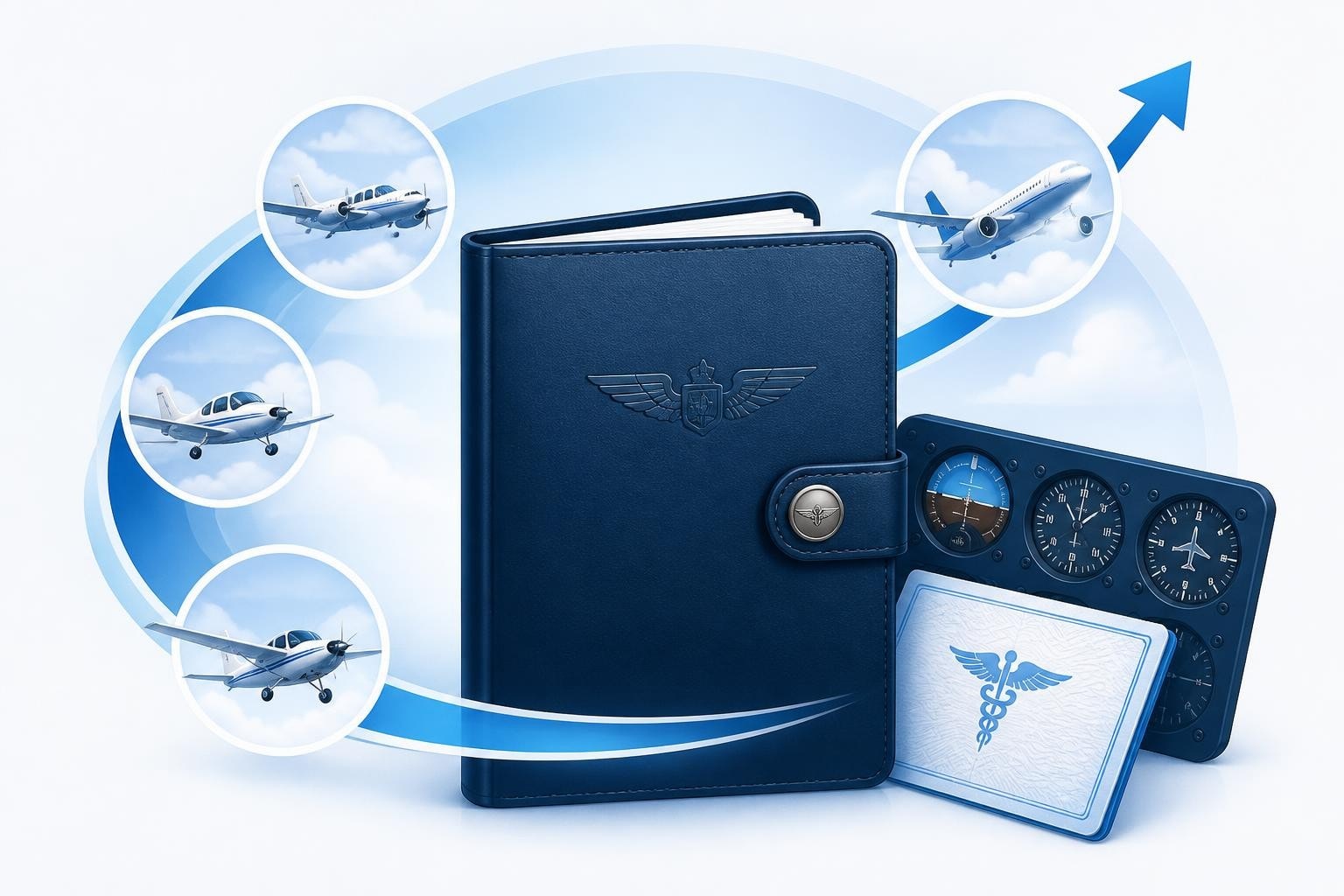
Your flight logbook is the official record of every hour you fly, every rating you earn, and every endorsement you hold. It proves you meet legal currency requirements, supports licence applications, and documents your progression from first solo to command. Whether you keep a paper book or use digital tools, accuracy and completeness in my flight logbook directly affect your ability to fly legally and advance your career.
Legal Requirements for My Flight Logbook
Aviation regulators mandate specific logbook entries to prove compliance with training, currency, and operating rules. Under FAA 14 CFR § 61.51, US pilots must record date, total flight time, location of departure and arrival, type and identification of aircraft, and the name of a safety pilot if required. EASA Part-FCL AMC1 FCL.050 sets similar requirements for European pilots, including details of route, training exercises, and any instructor signature.
Mandatory entries for every flight include:
- Date of flight
- Aircraft make, model, and registration
- Departure and arrival aerodromes
- Total flight time (block to block or Hobbs)
- PIC, SIC, or dual received
- Day or night
- Conditions (VFR, IFR, simulated instrument)
Students and pilots building hours toward ratings must also log specific training elements. Cross-country time requires a landing at a point more than 50 nautical miles from departure (25 nm for helicopters under EASA). Instrument time splits into actual IMC and simulated approaches under a view-limiting device. Solo time, dual instruction, and ground training all require separate columns.
What Counts as Loggable Time
You may log PIC time when you are the sole manipulator of the controls of an aircraft for which you are rated, act as PIC on a flight requiring more than one pilot, or serve as PIC under supervision. This creates scenarios where two pilots on the same flight log PIC differently. A safety pilot in VMC logs PIC if rated and acting as PIC, while the pilot under the hood logs PIC as sole manipulator.

Flight time begins when the aircraft first moves under its own power for the purpose of flight and ends when it comes to rest after landing. The FAA allows this interpretation from the Chief Counsel's legal opinions, though some insurers and employers prefer Hobbs time or a more conservative block-to-block standard. EASA explicitly defines flight time as block to block in Part-FCL.
Different time categories serve different purposes:
| Time Category | What It Proves | Typical Requirement |
|---|---|---|
| Total flight time | Overall experience | 1,500 hours for ATP |
| PIC | Command authority | 250 hours for CPL |
| Cross-country | Navigation skill | 50 hours for IR |
| Instrument | IFR proficiency | 40 hours for IR |
| Night | Night operations | 5 hours for PPL (FAA) |
| Multi-engine | Type experience | 10 hours for ME rating |
Tracking Currency in My Flight Logbook
Currency requirements ensure pilots maintain recent experience in specific operations. The FAA passenger currency rule under 14 CFR § 61.57(a) requires three takeoffs and landings in the preceding 90 days in the same category, class, and type (if required). Night currency demands three takeoffs and landings to a full stop between one hour after sunset and one hour before sunrise.
Instrument currency under 14 CFR § 61.57(c) requires six instrument approaches, holding procedures, and intercepting and tracking courses within the preceding six calendar months. If currency lapses, you must complete an instrument proficiency check with an examiner or authorized instructor. Tracking IFR currency becomes complex when mixing actual and simulated approaches across multiple aircraft types.
EASA rules differ slightly. FCL.060 requires three takeoffs and three landings in the preceding 90 days for passenger carriage in single-pilot aeroplanes. For multi-pilot operations, recency requirements shift to operator-specific checks and line checks rather than individual currency tracking.
Rolling Time Windows and Grace Periods
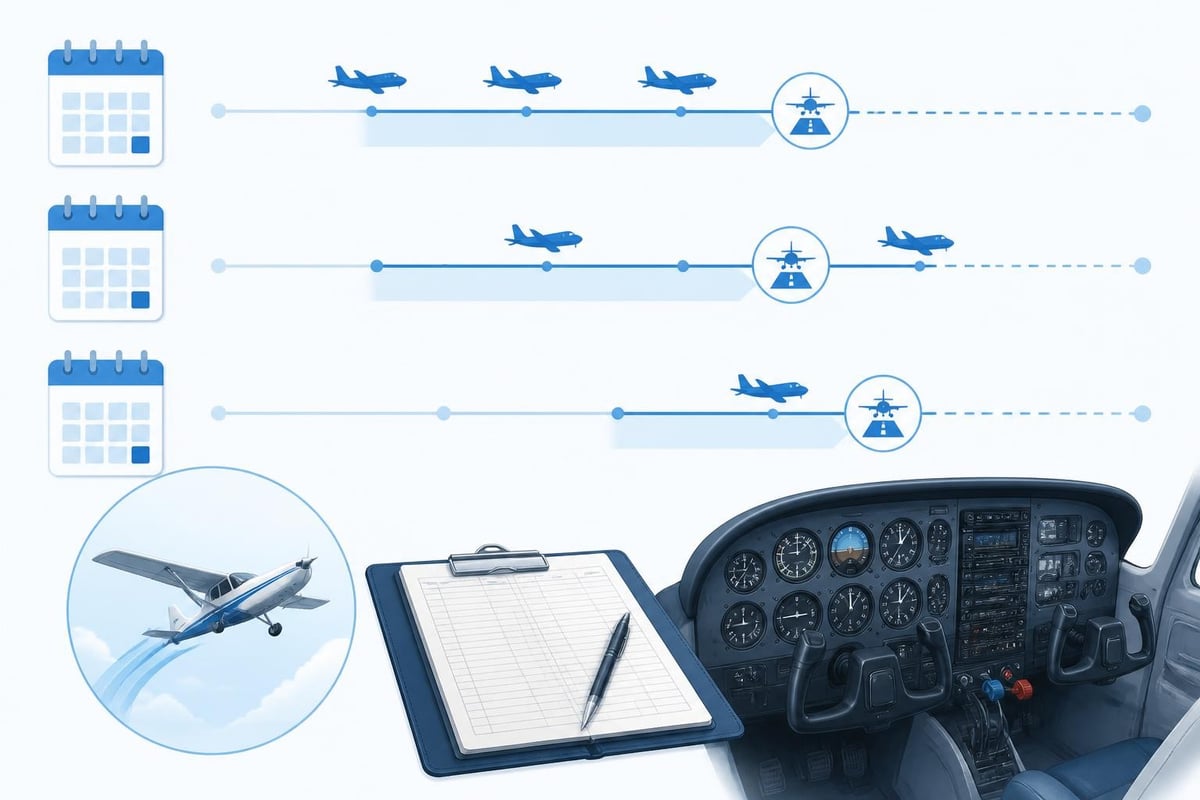
Many pilots misunderstand how rolling windows work. The 90-day passenger currency window rolls daily. If your last three landings occurred on April 27, May 15, and June 3, you remain current through September 1 (90 days from June 3). One landing on August 20 extends currency through November 18.
Common currency windows include:
- 90 days for passenger carriage (FAA and EASA)
- 6 calendar months for instrument currency (FAA)
- 24 calendar months for flight reviews or proficiency checks (FAA)
- 12 months for licence revalidation (EASA SEP/TMG)
The flight review under 14 CFR § 61.56 requires one hour ground and one hour flight every 24 calendar months. Calendar months mean if you complete a review on March 15, 2024, it expires at the end of March 2026, not on March 15, 2026. This grace period can add significant time.
Recording Endorsements and Ratings
My flight logbook must contain evidence of all training endorsements, ratings, and authorizations. Instructors sign specific regulatory endorsements for solo flights, knowledge test eligibility, practical test readiness, and complex or high-performance aircraft. These signatures with dates and CFR references prove compliance when an examiner or inspector reviews your logbook.
Type ratings, instrument ratings, and multi-engine privileges require logbook entries with examiner signatures and certificate numbers. Maintaining a professional logbook means organizing endorsements chronologically or in a dedicated section where they remain visible during checkrides and audits.
Some endorsements expire or supersede earlier ones. A commercial pilot practical test recommendation replaces the private pilot equivalents. A complex aircraft endorsement from 2015 remains valid indefinitely unless regulations change. Keep original endorsements even after upgrades to document your complete training history.
Licence and Medical Expiries
Pilots must track multiple expiry dates beyond flight currency. A first-class medical certificate expires at the end of the 6th month for ATP operations if you are under 40, or the end of the 12th month for commercial operations. Second-class medicals last 12 months for commercial privileges, 60 months for private privileges if issued before age 40.
EASA Class 1 medicals expire after 12 months under age 40, reducing to 6 months over age 60. UK CAA and EASA Part-MED set these periods, and they cannot be extended. Missing a medical expiry grounds you immediately, even if you have current flight time and ratings.
Recording expiry dates in my flight logbook provides a backup to certificates and cards. Many pilots note medical expiry, flight review due date, and instrument currency status on the inside cover or in a summary page. Digital logbooks can automate these alerts, but the legal record still resides in your entries.
Common Mistakes and How to Avoid Them
Incomplete or inaccurate logbook entries create problems during checkrides, insurance claims, and job applications. The most common error is failing to record required flight details like route, aircraft registration, or instructor signatures. Examiners regularly reject applicants who cannot prove 50 hours of cross-country PIC because they logged only total cross-country time without specifying PIC.
Falsifying logbook entries violates 14 CFR § 61.59 and can result in certificate suspension or revocation. This includes logging time not actually flown, claiming PIC when not rated, or recording instrument approaches not completed. The FAA investigates logbook discrepancies seriously, and penalties for falsified records can end careers.
Frequent logbook mistakes:
- Recording only total time without breaking out PIC, dual, or solo
- Failing to specify which approaches count toward instrument currency
- Logging night time during civil twilight instead of official night
- Missing instructor signatures on required endorsements
- Calculating cross-country incorrectly (not meeting 50 nm requirement)
- Forgetting to record simulated instrument time with safety pilot name
Corrections require a single line through the error, the correction written nearby, and your initials with the date. Never erase, white out, or obliterate entries. Best practices for maintaining flight records emphasize writing in permanent ink and making entries soon after each flight while details remain fresh.
Paper vs Digital: Managing My Flight Logbook
Traditional paper logbooks provide a tangible, legally accepted record that requires no power or software. They work in any location and many pilots value the physical connection to their flying history. Paper logbooks require manual totalling, offer no backup if lost or damaged, and become cumbersome after hundreds of hours.
Digital logbooks transform data entry and currency tracking. Most platforms calculate totals automatically, flag approaching currency lapses, and sync across devices. They generate reports for job applications, export data for insurance, and back up to cloud storage. Choosing the best digital logbook depends on features, platform compatibility, and regulatory compliance.
The FAA accepts electronic logbooks if they meet the requirements of 14 CFR § 61.51(h): records must be reliable, readily accessible, and provide a legible record of all required information. EASA guidance under AMC1 FCL.050 similarly permits digital records provided they can produce a complete, accurate printout.
Transitioning from Paper to Digital
Digitizing an existing paper logbook requires entering historical data or scanning pages. Manual entry ensures accuracy and lets you categorize time correctly from the start. Scan services process pages quickly but may miss nuances like instructor signatures or endorsement details.
Start by photographing every page of your paper logbook before beginning any transfer. Export digital data regularly and store backups in multiple locations. Some pilots maintain both paper and digital records during transition periods, entering each flight in both systems until confident in digital reliability.
Many pilots who grew up with paper logbooks now rely entirely on digital platforms. The time saved in calculations, currency tracking, and report generation outweighs any concerns about technology dependence. Regulators increasingly expect digital fluency, and airlines often request logbook data in electronic formats.
Using My Flight Logbook for Career Progression
Your logbook tells your professional story. Airlines, corporate operators, and insurance underwriters review total time, PIC in type, multi-engine experience, and instrument time to assess qualifications. A well-organized logbook speeds up applications and presents you as detail-oriented.
Key experience thresholds for career advancement:
| Position | Typical Minimum | Notable Requirements |
|---|---|---|
| First Officer Regional | 1,500 total | 500 XC, 100 night, 75 instrument |
| First Officer Cargo | 1,200 total | 250 multi, 100 PIC |
| First Officer Major | 3,000 total | 1,000 multi-turbine, ATP |
| Captain Regional | 3,500 total | 1,500 PIC, type rating |
| Corporate PIC | 2,500 total | 500 multi PIC, jet experience |
Record every instructional flight, ferry flight, and positioning leg. These hours count toward totals and demonstrate diverse experience. Note unusual conditions like severe weather, international operations, or challenging airports. These details support interview answers and show breadth beyond raw numbers.
Some pilots maintain separate logs for specific aircraft or ratings to simplify job applications requiring time in type. A helicopter pilot working on fixed-wing ratings might keep dual logs. A multi-engine instructor separates complex single-engine, multi-engine, and turbine time for clarity.

How Digital Tools Simplify Logbook Management
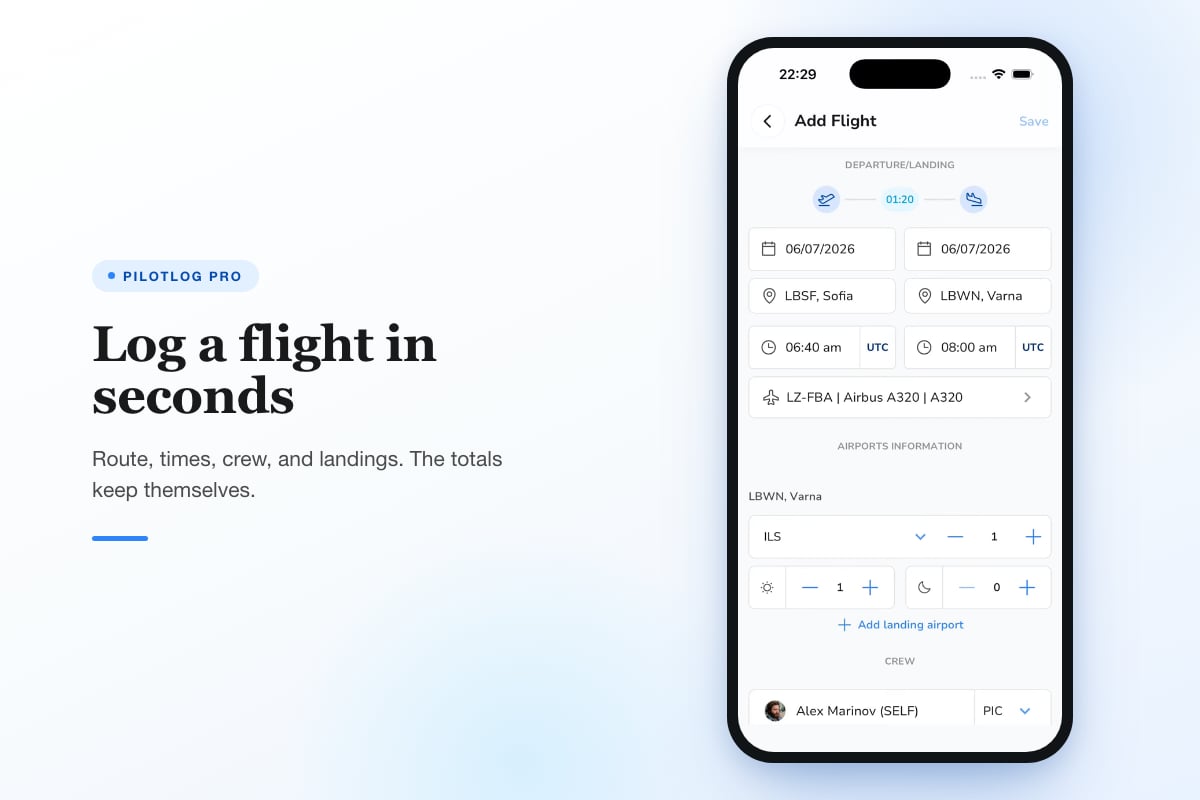
Modern digital logbooks automate calculations, warn of approaching currency lapses, and sync data across devices. Pilots log a flight in seconds by selecting aircraft, route, and time, then the software calculates all breakdowns. This removes arithmetic errors and ensures currency tracking remains current.
Pilotlog Pro tracks rolling 28-day and 365-day limits for commercial operations, flags passenger and instrument currency with exact lapse dates, and sends alerts for licence and medical expiries before they become critical. Built for pilots from students to airline crew, it combines quick logging with comprehensive career tracking including trends, milestones, and full logbook export.
Advanced features include custom fields for company-specific requirements, automatic duty time calculations, and integration with scheduling systems. Some platforms import flights from ForeFlight or other EFBs, reducing duplicate entry. Export options produce formatted PDFs for interviews, spreadsheets for personal analysis, or CSV files for airline portals.
Alerts prevent lapses. Set a medical expiry reminder for 30 days before expiration and you have time to book an AME appointment. Currency warnings at 75 days for the 90-day passenger rule let you schedule a proficiency flight before lapsing. Instrument currency alerts at five months prompt an IPC or six approaches before the six-month deadline.
Backup and Record Retention
The FAA does not specify how long to retain logbook records, but practical considerations suggest indefinitely. You need historical data to prove total time for ratings, demonstrate experience for job applications, and verify training for insurance. EASA requires records for licencing purposes to remain available.
Digital backups should follow the 3-2-1 rule: three copies, two different media types, one offsite. Export your logbook monthly to a PDF and spreadsheet. Store copies in cloud storage, an external drive, and email to yourself. Paper logbooks should be scanned annually and copies stored separately from the original.
Insurance claims, accident investigations, and certificate actions may require logbook evidence years after flights occur. Pilots involved in incidents need complete records to demonstrate currency, training, and authorization at the time. Lost logbooks can be reconstructed from receipts, instructor records, and FBO billing, but prevention through regular backup is simpler.
If you lose a paper logbook, contact every instructor, flight school, and examiner who signed it. Request copies of their records showing your flights and endorsements. The FAA can provide records of checkrides and certificate issuance, but not routine training flights. Reconstruction takes months and may never fully recover all hours.
Regulations Change: Confirm Current Requirements
Aviation regulations evolve. Hour requirements for ratings, currency windows, and medical standards change through rulemakings and administrative updates. The specific requirements and regulation numbers in this article reflect rules current as of July 2026, but pilots should verify against official sources before relying on any summary for compliance.
Check the current FAA regulations directly, consult EASA Part-FCL for European rules, or contact your national aviation authority for definitive guidance. Flight schools, designated examiners, and aviation attorneys can clarify complex situations. Never rely solely on secondary sources when legal compliance is at stake.
My flight logbook remains the foundation of your aviation career and legal compliance. Accurate entries, regular updates, and proper backups ensure you can prove currency, support rating applications, and document experience when opportunities arise. Whether you prefer paper, digital, or a hybrid approach, disciplined logbook management protects your privileges and advances your goals.
Maintaining my flight logbook with accuracy and consistency keeps you current, legal, and ready for every flight and career opportunity. Pilotlog automates the tracking, alerts, and calculations that matter most, letting you focus on flying while ensuring nothing slips through. Available on iOS and Android, it logs flights in seconds and monitors the details that keep you in the air.
- logbook requirements
- loggable time
- currency tracking
- flight time categories
- pilot endorsements
A logbook that keeps itself.
Join the waitlist and be first in line when Pilotlog launches.
Free to join, no spam. Unsubscribe any time.