logbook review
Jeppesen Pro Pilot Logbook Review 2026 | What You Need to Know
10 Sep 2026 · 11 min read

The Jeppesen Pro Pilot Logbook remains one of the most recognised paper logbooks in aviation, trusted by thousands of pilots across the United States and worldwide. For decades, this structured format has helped pilots satisfy regulatory recordkeeping requirements under 14 CFR §61.51, which mandates that pilots maintain an accurate, permanent record of flight time, aircraft type, and other operational data. Whether you are a student pilot logging your first solo or a professional maintaining thousands of hours, understanding what the Jeppesen Pro Pilot Logbook offers and how it compares to modern digital solutions matters for staying current and compliant.
What Is the Jeppesen Pro Pilot Logbook?
The Jeppesen Pro Pilot Logbook is a hardbound, paper-based flight record designed to provide pilots with a standardised format for logging flight time, endorsements, and currency. Published by Jeppesen, a Boeing subsidiary known for charts and pilot supplies, this logbook includes pre-printed columns for date, aircraft type, departure and arrival points, total flight time, landings, instrument approaches, and more.
Each entry occupies one line, with space for remarks and instructor signatures. The logbook typically includes summary pages where you can total hours by aircraft category, class, and type, making it easier to meet insurance, hiring, or regulatory requirements. A typical Jeppesen Pro Pilot Logbook holds around 250 to 300 individual flight entries, depending on the edition.
Core Features and Layout
The logbook opens with sections for personal details, medical certificate dates, and endorsement pages. The main body consists of ruled columns:
- Date of flight
- Aircraft make and model
- Aircraft identification (registration)
- Route (departure and arrival airport codes)
- Total time of flight
- Pilot-in-command (PIC) hours
- Second-in-command (SIC) hours
- Dual received
- Solo flight time
- Cross-country time
- Night hours
- Instrument time (actual and simulated)
- Ground training
- Day and night landings
- Instructor signature and certificate number
Additional columns may include turbine time, tailwheel, seaplane, and multi-engine hours, depending on the edition. Jeppesen periodically updates the logbook layout, as noted in Jeppesen Aviation Training Product Updates, to reflect evolving training requirements and regulatory changes.

Regulatory Compliance and Acceptance
Under U.S. federal regulations, 14 CFR §61.51 requires every pilot to log flight time for the purposes of meeting experience requirements and demonstrating currency. The regulation does not prescribe a specific format or medium. It states only that the record must be reliable, legible, and contain the required data elements.
The Jeppesen Pro Pilot Logbook meets these criteria and is accepted by the FAA, airlines, insurance underwriters, and charter operators. Many hiring managers and check pilots are familiar with its layout, which can streamline interviews and line checks. The FAA has also published guidance on electronic recordkeeping (Advisory Circular AC 120-78A), confirming that paper and electronic records are both acceptable provided they are accurate, tamper-evident, and retrievable.
International Recognition
The Jeppesen Pro Pilot Logbook is widely recognised in Canada, Europe, and other jurisdictions. Transport Canada, for example, allows pilots to maintain records electronically or on paper, as confirmed in SI 400-001 Flight Crew Licensing guidance. EASA Part-FCL similarly does not mandate a specific logbook format, though it requires pilots to record enough detail to demonstrate compliance with currency and experience rules.
| Regulatory Authority | Paper Logbook Accepted? | Electronic Logbook Accepted? | Key Requirement |
|---|---|---|---|
| FAA (United States) | Yes | Yes | Must contain data per §61.51 and be legible |
| Transport Canada | Yes | Yes | Must be reliable and complete |
| EASA (Europe) | Yes | Yes | Must demonstrate compliance with Part-FCL |
How the Jeppesen Pro Pilot Logbook Supports Currency Tracking
Recording flight time is only half the battle. Pilots must also track currency for carrying passengers, instrument approaches, night operations, and type ratings. The Jeppesen Pro Pilot Logbook provides space to log these details, but it does not calculate or alert you to currency lapses.
For example, to carry passengers in a single-engine aircraft under visual flight rules (VFR), you must complete three takeoffs and landings in the same category, class, and type (if a type rating is required) within the preceding 90 days, per §61.57(a). If you want to carry passengers at night, those three takeoffs and landings must occur between one hour after sunset and one hour before sunrise, and they must include full-stop landings in a tailwheel aircraft if you fly one.
Manual Calculation and the Risk of Oversight
When using a paper logbook, you tally these figures by hand or spreadsheet. A pilot with 78 of 100 hours logged since their last instrument proficiency check must count approaches by type (ILS, RNAV, VOR) and verify that six approaches and holding procedures occurred within the preceding six calendar months (§61.57(c)). Miss one month in your count, and you could inadvertently fly IFR with expired currency.
Professional pilots managing duty and flight-time limits face even greater complexity. Rolling 28-day and 365-day windows, rest requirements, and standby duty all require continuous monitoring. The Jeppesen Pro Pilot Logbook records the data, but you must build and maintain your own tracking system to stay legal.

Advantages of the Jeppesen Pro Pilot Logbook
Despite the rise of digital alternatives, paper logbooks retain distinct advantages. Here are the key benefits pilots cite:
- No reliance on batteries, internet, or software updates. Your logbook works anywhere, anytime.
- Familiar format recognised by examiners, hiring managers, and insurance companies. The Jeppesen layout is a de facto industry standard.
- Physical signature and endorsement trail. Instructors sign directly in the book, creating a permanent, tamper-evident record.
- Simple, one-time purchase. No subscription fees or account management.
- Backup and redundancy culture. Many pilots keep paper logs as a backup even when they use digital tools.
Tangible Record and Tradition
There is something reassuring about a hardbound book that cannot be deleted by a server failure or lost to a forgotten password. For pilots who value simplicity and tradition, the Jeppesen Pro Pilot Logbook delivers a straightforward, proven solution. AOPA highlights the importance of backup records in "The 'oh no' moment", noting that even pilots who embrace digital logging should maintain a secondary archive.
Limitations and Practical Challenges
Paper logbooks come with trade-offs. Understanding these limitations helps you decide whether the Jeppesen Pro Pilot Logbook is the right fit for your operation.
No Automated Calculations or Alerts
The logbook does not calculate totals, track currency windows, or send alerts when your Class 1 medical expires in 14 days. You must manually sum columns, count landings, and track dates. For a pilot with 200 flights in a year, this becomes time-consuming and error-prone.
Limited Space and Long-Term Storage
A typical Jeppesen Pro Pilot Logbook holds around 250 to 300 flights. A commercial pilot averaging 75 flights per month will fill the book in under four months. You then need to purchase a new book, label it clearly, and store all previous volumes in a safe, accessible location. Over a 30-year career, you could accumulate a shelf of logbooks.
Difficulty Extracting Reports and Summaries
Airlines, charter operators, and insurers often request detailed breakdowns: total turbine time, PIC hours in type, night cross-country, and so on. Extracting these figures from multiple paper logbooks means flipping pages, adding columns, and risking transcription errors. The process can take hours.
Vulnerable to Physical Loss or Damage
Fire, flood, theft, or simple misplacement can destroy a paper logbook. Reconstructing lost logbooks is possible using old receipts, maintenance records, and operator archives, but it is labour-intensive and may not recover every hour. The FAA does not require you to prove every flight, but gaps in your record complicate applications, check rides, and employment verification.
| Challenge | Impact | Mitigation |
|---|---|---|
| Manual calculations | Time-consuming, error-prone | Maintain a separate spreadsheet or use digital backup |
| Limited space | Need multiple volumes over a career | Label and store securely |
| No alerts | Miss currency or expiry deadlines | Set calendar reminders |
| Physical loss | Permanent data loss | Photocopy pages or scan regularly |
Comparing the Jeppesen Pro Pilot Logbook to Digital Solutions
Digital logbooks have become the norm for many pilots, especially those managing complex schedules or international operations. Tools like Pilotlog allow you to log a flight in seconds, then automatically track rolling flight-time and duty limits, passenger and IFR currency, and licence and medical expiry dates.
Speed and Automation
A digital logbook calculates totals instantly. Add one flight, and the system updates your 28-day rolling total, counts your night landings, and flags that your instrument currency expires in 12 days. You receive alerts on your phone, ensuring nothing catches you by surprise. For pilots juggling multiple aircraft types, frequent line checks, and shifting regulations, automation eliminates guesswork.
Data Portability and Reporting
Digital logbooks export to PDF, spreadsheet, or industry-standard formats (EASA, FAA 8710). You can generate a custom report showing PIC hours in glass-cockpit multi-engine aircraft for a specific date range, then email it to an insurer in minutes. This flexibility is critical when applying for jobs, renewing insurance, or undergoing audits.
Backup and Recovery
Cloud-based logbooks sync across devices and store encrypted backups. Lose your phone, and your logbook remains intact on the server. Many pilots maintain both digital and paper records, using the paper book as a legal backup and the digital tool for day-to-day tracking and reporting. This hybrid approach combines the reliability of paper with the speed and intelligence of software.
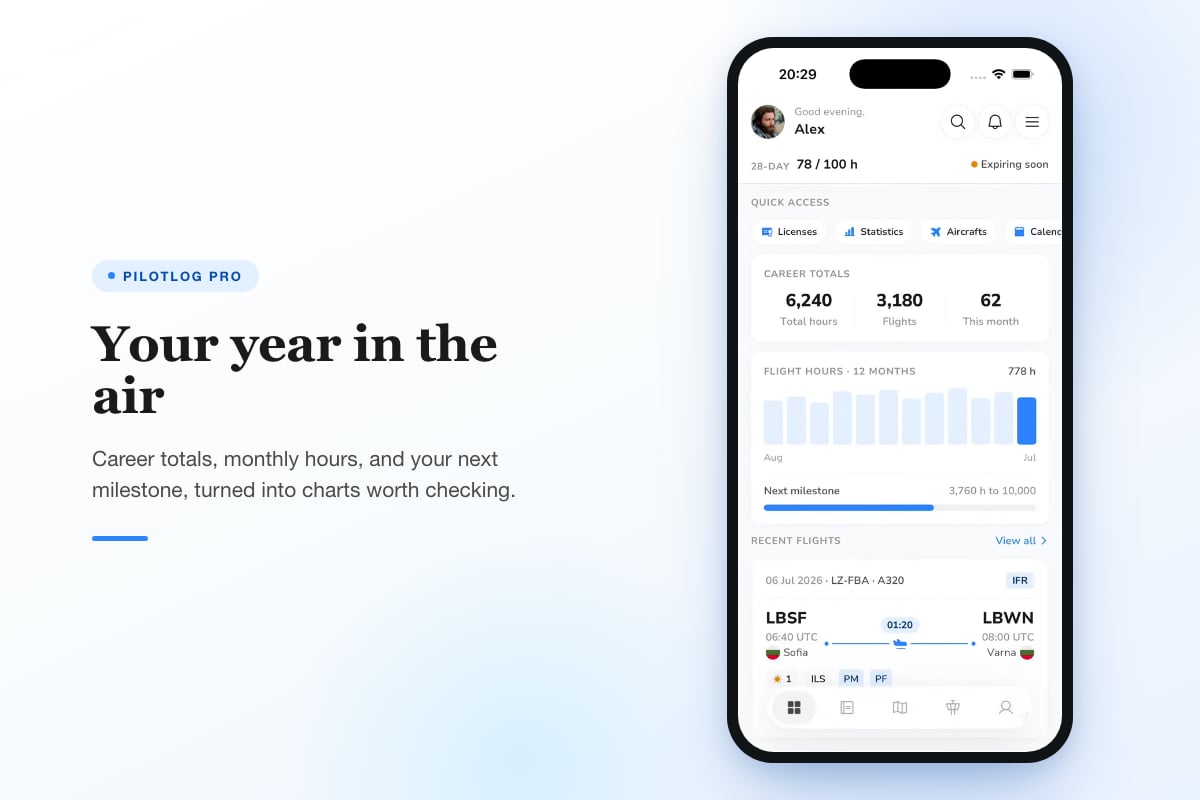
Pilotlog Pro takes this further by tracking not just flight hours but also rolling 28-day and 365-day flight-time and duty limits, passenger and night currency with lapse dates, and licence and medical expiry alerts flagged early. You get career stats, trends, milestones, and full logbook export, all built for pilots across the whole career, from students to airline crew. For pilots who need more than a static record, Pilotlog Pro delivers active oversight and peace of mind.
Practical Tips for Using the Jeppesen Pro Pilot Logbook
If you choose to maintain a Jeppesen Pro Pilot Logbook, follow these best practices to maximise accuracy and longevity.
- Write legibly in permanent ink. Use a fine-tip pen that will not bleed or fade over decades.
- Log flights promptly. Record each flight within 24 hours while details are fresh.
- Use airport identifiers consistently. ICAO codes (EGLL, KJFK) are unambiguous and internationally recognised.
- Total each page and carry forward totals to the next page. This creates a running audit trail.
- Photocopy or scan completed pages regularly. Store digital copies in a secure cloud folder.
- Record instructor signatures and certificate numbers for every endorsement. This validates training and meets regulatory requirements.
- Cross-reference with maintenance logs and receipts. If you ever need to reconstruct your logbook, aircraft records provide corroborating evidence.
Maintaining a Backup System
Even if you prefer paper, consider a simple spreadsheet or digital logbook as a secondary record. NBAA emphasises proper recordkeeping in Mastering the Logbook, noting that professional pilots and business aviation operators rely on redundant records to support safety, compliance, and operational continuity.
Who Should Use the Jeppesen Pro Pilot Logbook in 2026?
The Jeppesen Pro Pilot Logbook still serves specific pilot populations well:
- Student pilots and low-time private pilots who log flights infrequently and prefer a simple, one-time purchase.
- Pilots who value physical records and want a tangible, permanent archive.
- Backup-minded pilots who use digital tools daily but maintain a paper logbook for redundancy and legal security.
- Pilots in regions with limited internet connectivity or those who fly in environments where electronic devices are impractical.
For high-time pilots, commercial operators, or anyone managing complex currency and duty limits, a digital logbook offers significant time savings and risk reduction. Many professionals now keep the Jeppesen Pro Pilot Logbook as a ceremonial or backup record while relying on digital tools for active tracking.
Final Considerations and Regulatory Notes
Rules and requirements change. The figures and regulation references in this article are current as of September 2026, but you should always confirm against official sources such as the eCFR or your national civil aviation authority before making decisions about currency, endorsements, or recordkeeping.
The Jeppesen Pro Pilot Logbook is a proven, reliable tool that has served pilots for decades. It meets all regulatory requirements, is widely accepted, and provides a permanent, physical record of your flying career. However, it offers no automation, no alerts, and no built-in intelligence. In 2026, pilots have more options than ever, and the best choice depends on your flying frequency, operational complexity, and personal preferences.
For detailed guidance on tracking IFR currency, managing flight time limits, or understanding what makes a good pilot logbook, explore the resources and tools designed to keep you current, legal, and ready for every flight.
The Jeppesen Pro Pilot Logbook remains a trusted, regulatory-compliant choice for pilots who value simplicity and physical records. However, modern digital tools offer speed, automation, and active oversight that paper cannot match. Pilotlog keeps you current and legal with instant currency tracking, expiry alerts, and automatic calculations, so you can focus on flying, not paperwork.
- logbook review
- jeppesen logbook
- pilot logbook
- paper vs digital logbook
- currency tracking
A logbook that keeps itself.
Join the waitlist and be first in line when Pilotlog launches.
Free to join, no spam. Unsubscribe any time.