helicopter flying lessons
Helicopter Flying Lessons Near Me: Complete 2026 Guide
21 Sep 2026 · 15 min read
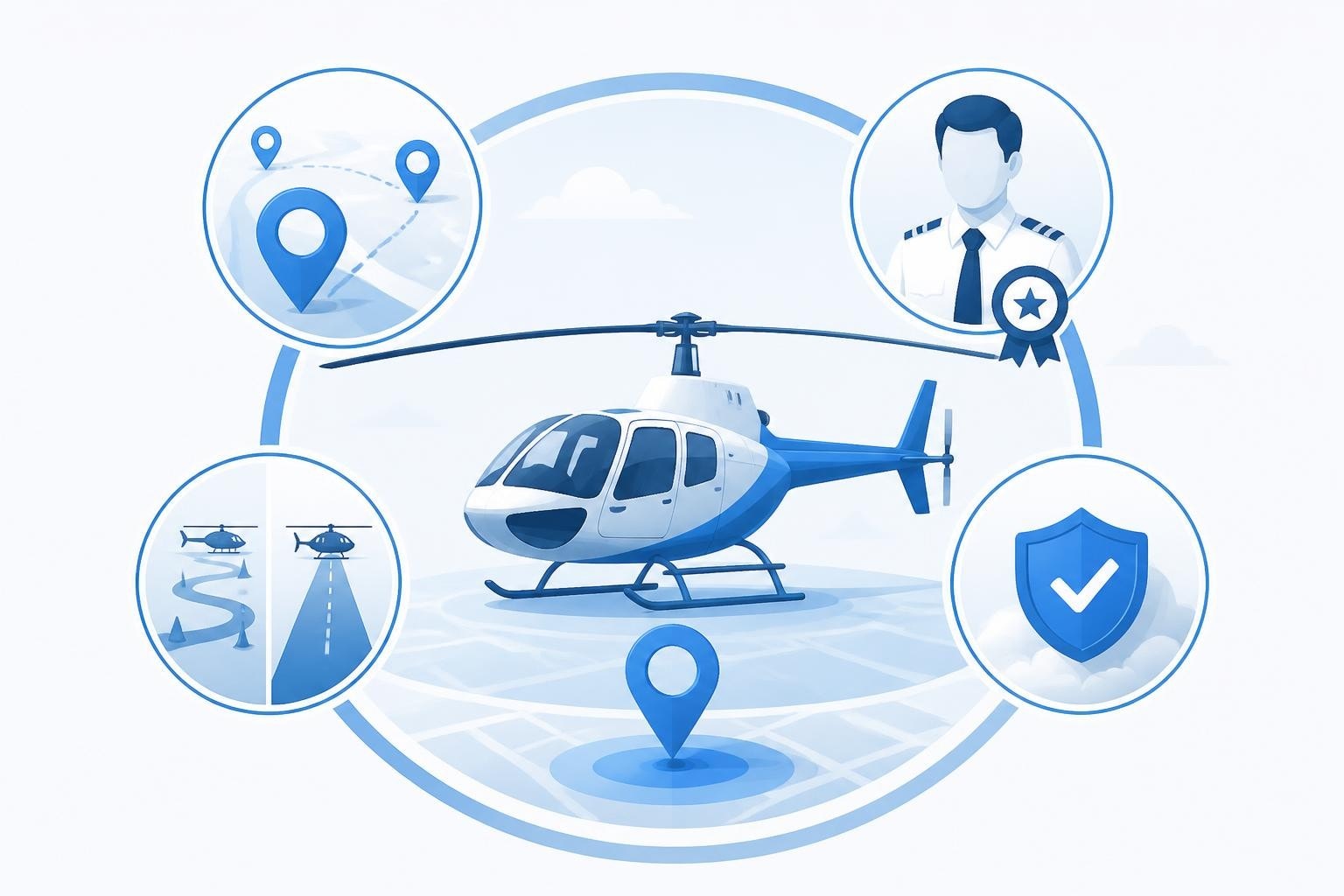
Searching for helicopter flying lessons near me starts with understanding your local options and what training route fits your schedule, budget, and career goals. In 2026 most cities have one or more helicopter flight schools within 50 miles, ranging from small owner-operator outfits to larger Part 141 academies. The key is matching the school's equipment, instructor availability, and regulatory structure to your needs, then verifying their safety record and scheduling flexibility before you commit to training.
How Helicopter Flight Training Works
Helicopter training for a private pilot licence (rotorcraft category) follows a structured syllabus, whether you train under Part 61 or Part 141 regulations. The FAA requires a minimum of 40 flight hours under Part 61 (or 35 hours under an approved Part 141 course), at least 20 of which must be dual instruction and 10 solo. Those figures are minimums; most students need 50 to 70 hours to reach checkride proficiency.
You will start with basic hover work and transitions, then progress through autorotations, cross-country navigation, and simulated emergencies. Each lesson builds on the previous one, and your instructor signs you off for each phase. A medical certificate (Class 3 or higher, or BasicMed if eligible) and a student pilot certificate are required before solo flight.
Typical training milestones include:
- Hover patterns and pedal turns (lessons 1 to 8)
- Confined-area takeoffs and approaches (lessons 9 to 15)
- Autorotations to a landing (lessons 16 to 25)
- Solo pattern work and local cross-countries (lessons 26 to 35)
- Long solo cross-country (at least 50 nautical miles each leg)
- Night flight (3 hours dual, including 10 takeoffs and landings)
- Final stage check and checkride prep (lessons 36 to 50)
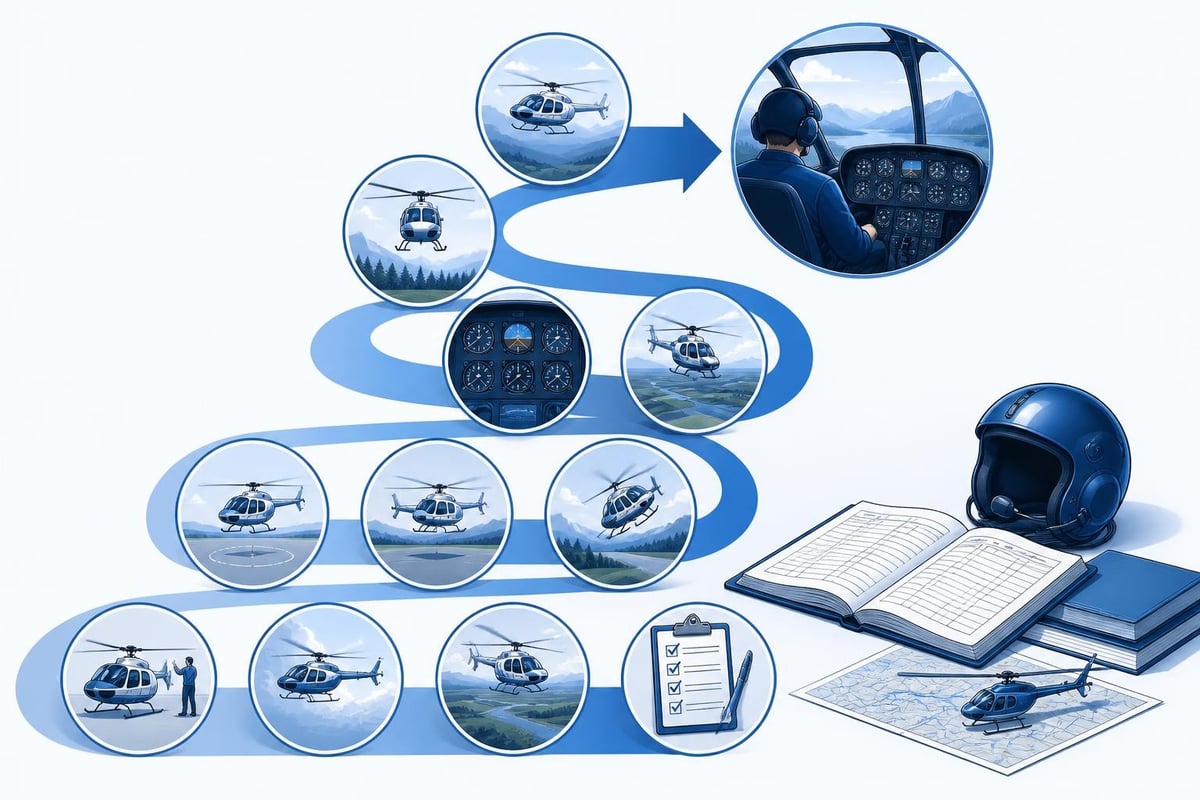
Understanding this timeline helps when you evaluate helicopter flying lessons near me. Schools that fly year-round will move you through the syllabus faster than seasonal operators, and full-time students finish sooner than those flying once or twice a week.
Finding and Vetting Local Helicopter Schools
Start by searching the FAA's online database for certified rotorcraft schools within your radius. Most flight-school websites list their aircraft (Robinson R22 and R44 are the most common trainers), instructor credentials, and whether they operate under Part 61, Part 141, or both. A Part 141 school follows an FAA-approved training syllabus and typically offers more structure; Part 61 allows flexibility in lesson sequencing and is often preferred by working professionals. Plane & Pilot magazine's comparison outlines the pros and cons of each.
Checklist for evaluating schools:
- Safety record - ask for accident/incident history and check the NTSB database for serious events.
- Instructor qualifications - look for CFI-H (certificated flight instructor, helicopter) with at least 500 rotorcraft hours and experience in the aircraft you will fly.
- Aircraft condition and maintenance - inspect the logbooks during your discovery flight; ask when the last 100-hour inspection was completed.
- Scheduling availability - confirm how many aircraft and instructors are available; you want to fly at least twice a week to retain skills.
- Written-test prep - check if ground school is included or if you study independently using online courses.
Most schools offer a 30-minute discovery flight (often called an introductory lesson) for $150 to $250. Use it to assess the instructor's teaching style, the aircraft's condition, and the school's professionalism. If the helicopter smells of fuel, the instructor rushes the pre-flight brief, or the office cannot answer basic questions about costs, keep looking.
Part 61 vs Part 141: Which Fits Your Schedule?
Part 61 training suits pilots who need flexibility. You can train at your own pace, skip lessons when work or weather intervenes, and change instructors if needed. Part 141 schools require you to follow a fixed syllabus and pass stage checks, but they often finish students faster and can offer restricted ATP minimums (750 hours instead of 1,000) if you plan a commercial helicopter career.
| Aspect | Part 61 | Part 141 |
|---|---|---|
| Minimum hours (PPL-H) | 40 | 35 |
| Syllabus flexibility | High | Low (FAA-approved course) |
| Stage checks | Informal (instructor discretion) | Formal, recorded |
| Cost (typical) | $12,000 to $18,000 | $10,000 to $16,000 (faster completion) |
| Ideal for | Working professionals, weekend flyers | Full-time students, career track |
When comparing helicopter flying lessons near me, ask each school which regulation they use and whether they can accommodate your schedule. A Part 61 school 15 miles closer to home may save more time and money than a Part 141 academy 60 miles away, even if the hourly rate is slightly higher.
Cost Breakdown and Budgeting for Helicopter Training
Helicopter training is expensive. Expect to spend $12,000 to $20,000 for a private licence in 2026, with most of that going to aircraft rental. An R22 rents for $250 to $400 per flight hour (wet rate, fuel included), and dual instruction adds $60 to $90 per hour. Solo time is cheaper (aircraft only), but you still need 10 hours minimum.
Sample budget for 50 flight hours (realistic average):
- 40 hours dual (R22 at $320/hr + instructor at $75/hr): $15,800
- 10 hours solo (R22 at $320/hr): $3,200
- Ground instruction (20 hours at $75/hr): $1,500
- Knowledge test fee: $175
- Checkride (examiner fee): $700
- Books, headset, medical exam: $500
- Total: $21,875
Costs vary by region. Helicopter flying lessons near me in high-cost-of-living areas (Los Angeles, New York, Seattle) run 20 to 30 percent above the national average, while schools in the South or Midwest may charge less. Some schools offer block-time discounts (buy 10 hours, save 5 percent) or finance packages.
Track every lesson as you go. Pilotlog helps you monitor actual spend against budget and ensures you log every tenth and every hour correctly. Students who log consistently avoid disputes over hobbs time and can prove their progress when switching schools.

Hidden Costs to Plan For
Beyond the advertised hourly rate, budget for weather delays (missed lessons you still pay a cancellation fee for), repeat checkride attempts (the national first-time pass rate for rotorcraft is around 80 percent), and additional cross-country hours if you need more practice. Many students also add 5 to 10 hours of checkride prep with a senior instructor, which can cost $450 to $900.
Insurance and membership fees are rare for students (the school's policy covers you), but you will need a headset ($200 to $1,200 depending on model) and current charts or an EFB subscription ($100 to $200 per year). Some schools include these in a starter kit; others expect you to bring your own.
Medical Certificate and Regulatory Requirements
Before you solo, you must hold a valid medical certificate or qualify under BasicMed (if you previously held a medical and your last exam was after July 14, 2006). For most students a Class 3 medical is straightforward: an Aviation Medical Examiner (AME) checks your vision, hearing, cardiovascular health, and history. The exam costs $75 to $200 and is valid for 60 months if you are under 40, or 24 months if you are 40 or older.
If you have a disqualifying condition (certain medications, past DUI, or cardiovascular issues), consult an AME before paying for lessons. The FAA may issue a special issuance, but the process takes months. Students who discover a medical issue after investing thousands in training face significant setbacks.
Common medical gotchas:
- ADHD medication (requires documentation of off-medication function)
- Sleep apnea (requires treatment compliance data)
- Diabetes (requires stable control and specialist reports)
- Past substance-related incidents (extensive documentation and abstinence proof)
Most helicopter schools will not solo you without seeing your medical certificate, so complete the exam early. The AOPA's field guide for flight students walks you through the medical process step by step.
What to Expect in Your First Lessons
Your first helicopter flying lesson near me will likely last 60 to 90 minutes: 20 minutes of ground brief, 30 to 40 minutes in the aircraft, and 10 minutes debrief. The instructor handles takeoff and demonstrates basic hover inputs, then lets you feel the controls while they keep the aircraft stable. Expect to feel overwhelmed; the helicopter responds to every tiny movement, and coordination between cyclic, collective, and pedals takes hours to develop.
Most students need 5 to 10 hours before they can hold a steady hover unassisted. During that time you will practice pedal turns, forward and sideways movement at low altitude, and the transition from hover to forward flight. Each lesson ends with the instructor demonstrating the maneuver again so you see what proficiency looks like.
Staying Current as Training Progresses
Between lessons, chair-fly each maneuver and review the Rotorcraft Flying Handbook (FAA-H-8083-21). The more you understand the aerodynamics and control mechanics on the ground, the less expensive practice time you waste in the air. Some students use flight simulators (even basic ones) to reinforce coordination, though nothing replicates the physical feedback of a real helicopter.
Once you have logged your first few lessons, start tracking currency in a digital logbook so you can see your progress toward each milestone. Knowing you have 12.4 hours dual and 0.8 hours solo keeps you focused on what remains before your first supervised solo. Many students underestimate how motivating it is to see their totals climb week by week.
Checkride Preparation and the Practical Test
The private pilot helicopter checkride has an oral exam (1 to 2 hours) and a flight test (1 to 1.5 hours). The examiner will ask about airspace, weather minimums, systems (engine, transmission, fuel), emergency procedures, and weight-and-balance calculations. The flight portion includes normal and crosswind takeoffs, confined-area work, autorotations, and a simulated engine failure at altitude. The current FAA Airman Certification Standards for rotorcraft list every task and the performance criteria.
Oral exam topics (typical):
- Rotorcraft aerodynamics (translating tendency, gyroscopic precession, dissymmetry of lift)
- Systems and limitations (engine overspeed limits, rotor RPM ranges, transmission chip detector)
- Weight and balance (loading charts, CG envelope, high-DA operations)
- Airspace and cloud clearances (Class G, Class E, special-use airspace)
- Aeronautical decision-making (risk management, go/no-go decisions)
Your instructor will conduct at least one mock checkride before endorsing you for the real test. Use that session to identify weak areas and drill them until they are automatic. Examiners expect you to explain why you perform each action, not just demonstrate it. For example, during an autorotation you should state your glide speed, planned touchdown point, and criteria for flaring without prompting.
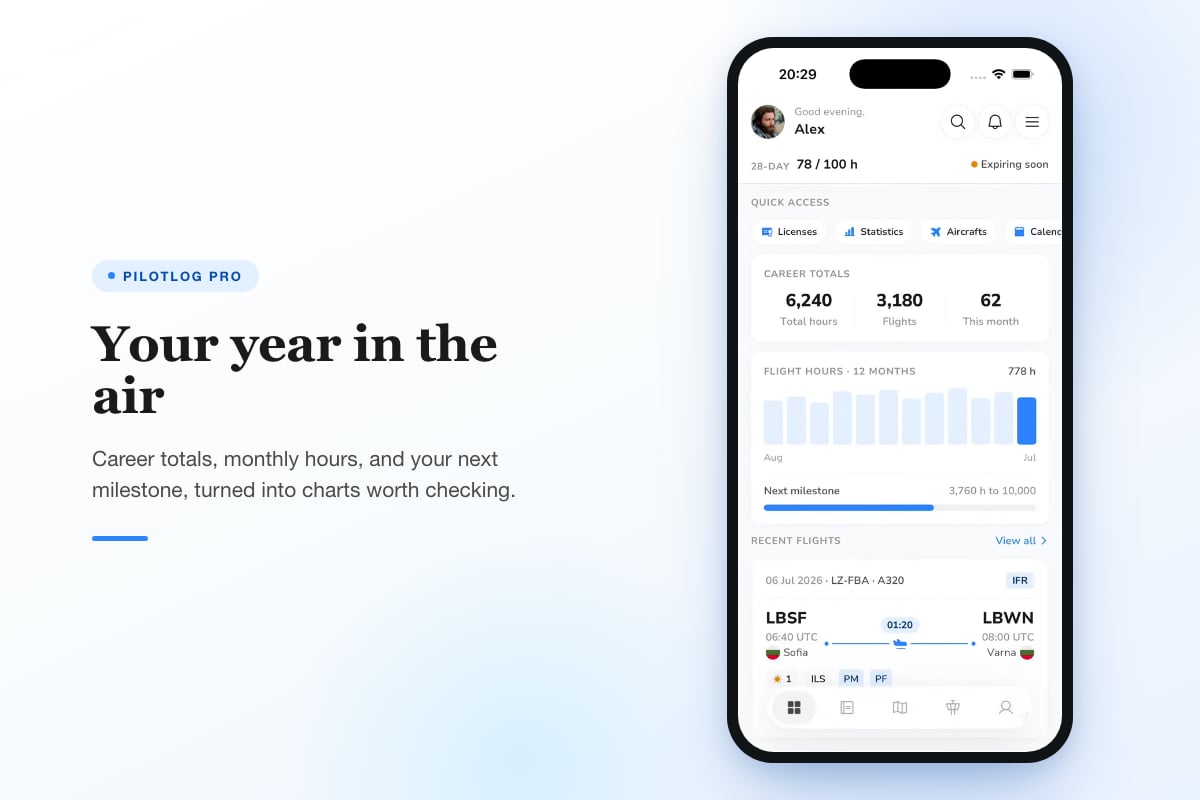
As you rack up hours toward your checkride, Pilotlog Pro automatically tracks rolling currency windows and flags upcoming expiries, so you always know when your solo endorsement or medical is due. It also logs each lesson's maneuvers and cross-country legs, building a complete record you can export for your checkride or future training.
Safety Culture and Ongoing Learning
Helicopter safety depends on disciplined decision-making, thorough pre-flight inspections, and conservative weather limits. The Vertical Aviation Safety Team publishes best practices and safety-technology surveys that highlight common accident precursors: low-altitude loss of tail-rotor effectiveness, wire strikes during low reconnaissance, and dynamic rollover during slope landings. Reading these reports as a student builds situational awareness that will serve you throughout your flying career.
Many schools encourage students to join safety programs like the FAA's WINGS program or to attend local helicopter association meetings. These events cover topics like mountain flying, confined-area techniques, and night operations, all of which go beyond the private-licence syllabus but improve your overall competence.
Safety habits to build from lesson one:
- Always complete a full walk-around, even on short hops (loose panels, leaking fluids, and bird nests appear overnight).
- Brief every flight, including emergency procedures and abort criteria.
- Never exceed your own proficiency limits, even if the aircraft and weather permit it.
- Track maintenance and inspection due dates so you never fly an out-of-annual helicopter.
- Debrief each lesson honestly; if you rushed a checklist or skipped a radio call, acknowledge it and plan to correct it.
Your instructor models these behaviors, but the best pilots internalize them early. When you search for helicopter flying lessons near me, prioritize schools whose instructors emphasize safety over schedule pressure.
International and Alternative Training Routes
Pilots outside the United States should note that helicopter licensing differs by country. The UK Civil Aviation Authority, for example, requires a minimum of 45 hours for a PPL(H), and EASA member states follow Part-FCL regulations that specify different currency rules. If you plan to fly internationally, confirm which licence your school issues and whether it can be converted or validated abroad.
Some students start with an R22 type rating and later transition to an R44 or larger aircraft for commercial training. Others complete their private licence in one state, then move for a commercial course elsewhere. Digital logbooks make these transitions seamless, especially if you track aircraft type, instructor endorsements, and complex vs. simple rotorcraft hours from day one.
Seasonal and Weather Considerations
Helicopter training availability varies by season. Schools in northern climates may reduce operations in winter due to snow and icing, while desert schools sometimes pause during extreme summer heat when density altitude degrades performance. When evaluating helicopter flying lessons near me, ask about year-round availability and whether the school has indoor ground-school facilities for weather days.
Plan for weather cancellations. A realistic training timeline is 6 to 12 months for a private licence if you fly twice a week, longer if you are limited to weekends. Students who train in the spring and summer often finish faster due to better weather and longer daylight hours.
Choosing the Right Aircraft for Training
Most schools use Robinson R22s for initial training (two seats, piston engine, relatively low operating cost) or R44s (four seats, more stable, higher weight limit). The R22 is lighter on the controls and teaches precise inputs; the R44 is more forgiving and closer to what you might rent post-licence. Some schools also operate Schweizer 300s or Enstrom helicopters, though these are less common.
R22 vs R44 comparison:
| Feature | Robinson R22 | Robinson R44 |
|---|---|---|
| Seats | 2 | 4 |
| Useful load | ~240 kg (530 lb) | ~360 kg (794 lb) |
| Hourly rate (typical) | $280 to $360 | $380 to $500 |
| Rotor inertia | Low (requires immediate response) | Higher (more forgiving) |
| Best for | Students focused on precision | Larger pilots or those planning to carry passengers |
If you are taller than 6'2" or weigh more than 100 kg (220 lb), confirm the school's R22 weight-and-balance limits before booking. Many heavier pilots train in an R44 from the start, which costs more per hour but avoids the need to retrain in a larger aircraft later.
Your choice of aircraft also affects insurance and rental availability after you earn your licence. An R22 endorsement is standard, but if you train exclusively in an R44, you may need additional transition training before renting an R22 elsewhere.
Building a Training Schedule That Works
Consistency beats intensity in helicopter training. Students who fly twice a week retain skills better than those who cram four lessons into a weekend then skip two weeks. If you can only train on weekends, expect to spend 30 to 50 percent more time overall as you re-learn each maneuver after a gap.
Sample schedules:
- Full-time student: 5 lessons per week, 50 hours in 10 weeks, licence in 3 months
- Part-time professional: 2 lessons per week, 50 hours in 25 weeks, licence in 6 to 7 months (accounting for weather)
- Weekend-only pilot: 1 lesson per week, 50 hours in 50 weeks, licence in 12 to 15 months (longer due to skill decay)
Discuss your availability with the school before signing a contract. Some schools require a minimum commitment (e.g., two lessons per week) to reserve instructor time. Others operate on a pay-as-you-go basis but may have limited weekend slots.
Flight-time tracking becomes essential once your schedule fills with lessons, solo flights, and cross-countries. Logging each session immediately after landing ensures you capture hobbs time, maneuvers practiced, and any endorsements your instructor gives. Accurate logs also simplify invoicing and prevent disputes over billed hours.
Ground School and Knowledge Test Prep
The FAA knowledge test for private pilot rotorcraft covers 60 multiple-choice questions drawn from aerodynamics, weather, regulations, navigation, and helicopter systems. You need a score of 70 percent or higher to pass. Most students study for 4 to 8 weeks using online courses (Sporty's, King Schools, or Gleim) or in-person ground school if the flight school offers it.
Your instructor must endorse you for the knowledge test after confirming you have completed ground training and are ready. Book the test through a PSI or CATS testing center; the fee is $175 in 2026. Results are valid for 24 months, so if you pass the written but delay flight training, you must checkride before the expiry date or retake the test.
Study tips for the knowledge test:
- Focus on rotorcraft-specific questions (autorotations, vortex ring state, retreating blade stall).
- Memorize the legend for sectional charts and understand airspace symbology.
- Practice weight-and-balance calculations until you can solve them in under two minutes.
- Review the Rotorcraft Flying Handbook chapters on aerodynamics and systems.
- Take at least three full-length practice tests to identify weak areas.
Passing the knowledge test does not replace understanding the material. Examiners frequently ask oral-exam questions based on topics you missed on the written test, so review your test report and fill those gaps before checkride day.
Finding the right helicopter flying lessons near me is about matching your goals, schedule, and budget to a school that prioritizes safety, maintains its aircraft, and employs experienced instructors. Whether you train Part 61 for flexibility or Part 141 for structure, logging every flight and tracking your progress ensures you stay on pace and within budget. Once you have earned your licence, Pilotlog keeps you current with automatic currency tracking, medical and licence expiry alerts, and a complete flight history across every aircraft you fly.
- helicopter flying lessons
- rotorcraft training
- part 141 vs part 61
- helicopter pilot license
- r22 training cost
A logbook that keeps itself.
Join the waitlist and be first in line when Pilotlog launches.
Free to join, no spam. Unsubscribe any time.