helicopter flying handbook
Helicopter Flying Handbook: Your Essential Pilot Guide
19 Sep 2026 · 12 min read
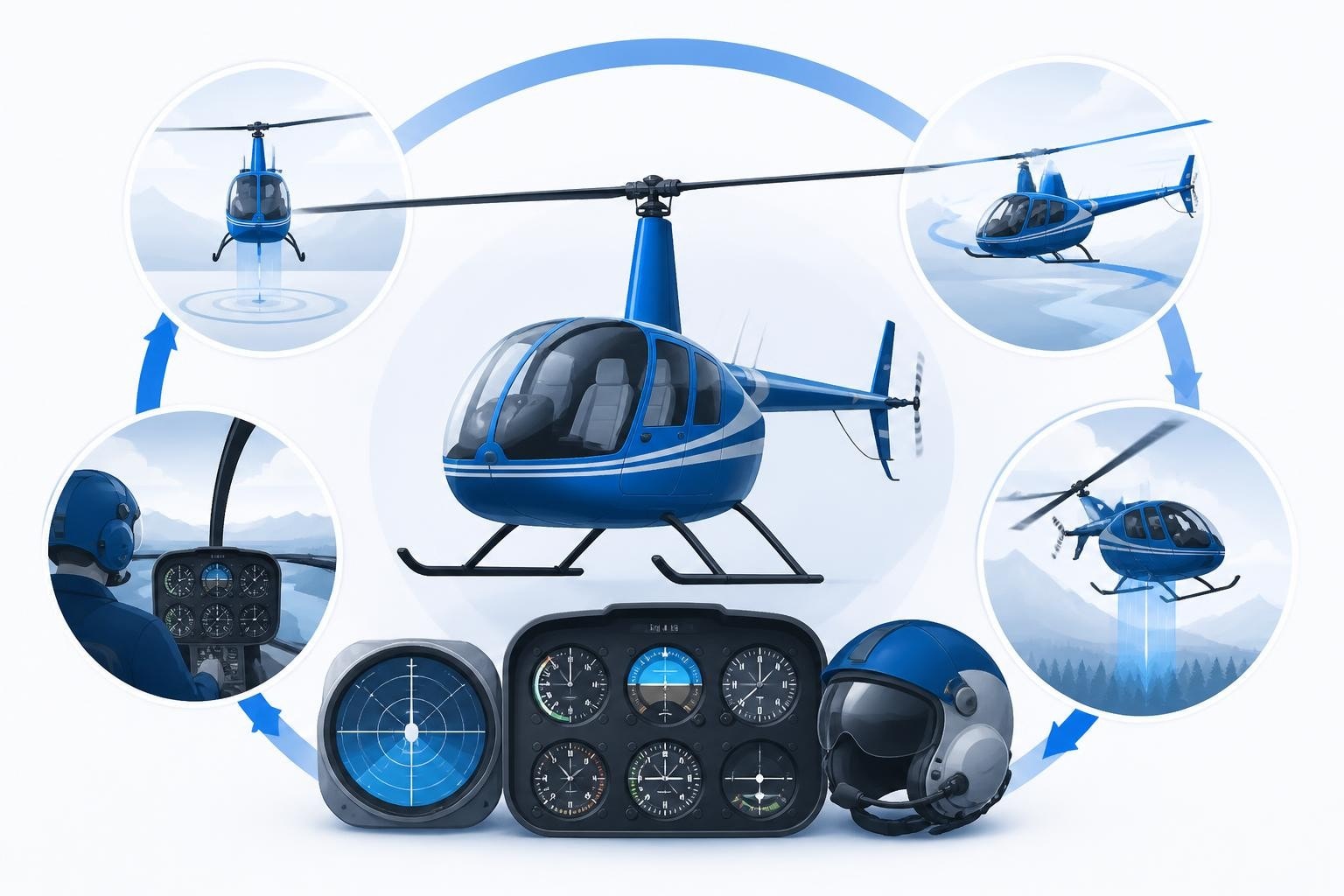
The helicopter flying handbook is the FAA's core reference document for rotorcraft pilots. Published as FAA-H-8083-21B, it covers fundamental aerodynamics, flight maneuvers, emergencies, and instructional best practices for helicopter operations. Every student and licensed helicopter pilot should keep this handbook current and refer to it regularly.
This reference manual serves as both training text and operational guide. You will find detailed explanations of rotor systems, aerodynamic principles, and step-by-step procedures for every maneuver tested during practical exams. The handbook supports both initial training and recurrent study, making it indispensable across your entire rotorcraft career.
What the Helicopter Flying Handbook Covers
The FAA's official Helicopter Flying Handbook spans nearly 300 pages of detailed instruction. It begins with helicopter aerodynamics and progresses through advanced operations and emergency procedures.
Core chapters include:
- Aerodynamics of flight and rotor systems
- Flight controls and their effects
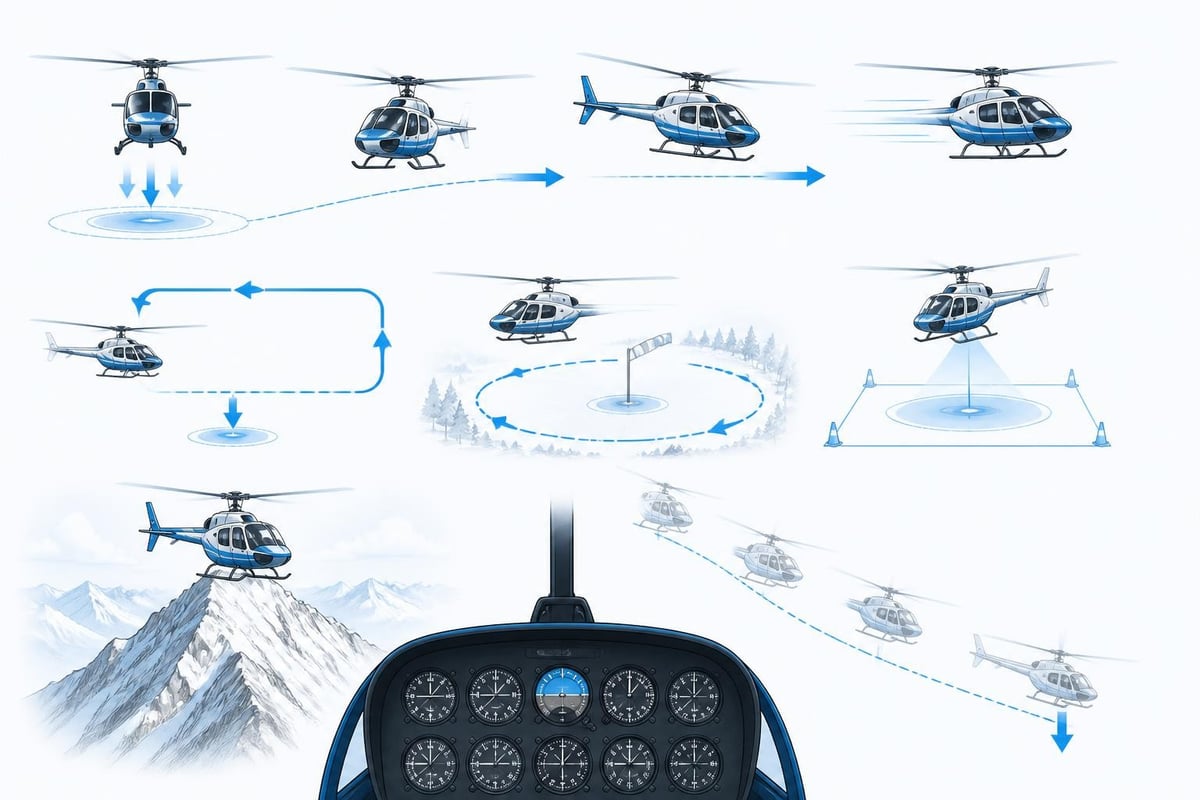
- Basic maneuvers: hover, taxi, takeoff, landing
- Forward flight, turns, and traffic patterns
- Advanced maneuvers: slope operations, pinnacle approaches, confined areas
- Emergency procedures: autorotations, systems failures, power recovery
- Attitude instrument flying fundamentals
- Night and cross-country operations
Each section builds on previous material. You cannot master confined area approaches without first understanding translational lift, ground effect, and power management. The handbook structures this progression deliberately.
How to Use the Handbook During Training
Student pilots should read assigned chapters before each lesson. Your instructor will reference specific pages during briefings. After flight, review the same sections while memory is fresh. This cycle reinforces learning faster than passive reading alone.
For example, before your first autorotation practice, read Chapter 11 completely. Note the entry procedure: lower collective smoothly, maintain rotor RPM with throttle adjustment, establish a glide at the recommended airspeed (typically 60-70 knots depending on aircraft). During the flight, you will experience these steps. Afterward, reread the chapter and compare your performance against the standard.
Many flight schools structure their syllabi around the helicopter flying handbook's chapter order. Your ground school lessons likely follow the same sequence: aerodynamics first, then basic control, then hovering, then forward flight. This alignment makes the handbook your primary study text.
Aerodynamics and Flight Controls Explained
Chapters 2 and 3 form the foundation. Understanding translational lift, dissymmetry of lift, and retreating blade stall prevents confusion later. The handbook explains why helicopters behave differently at speed versus in hover.
| Concept | Effect | Practical Application |
|---|---|---|
| Translational lift | Increased efficiency above 16-24 knots | Reduced power required for forward flight |
| Dissymmetry of lift | Advancing blade generates more lift | Cyclic feathering compensates automatically |
| Transverse flow effect | Lateral vibration during transition | Normal feedback; maintain heading control |
| Ground effect | Reduced induced drag near surface | Hover requires less power in ground effect |
Key control inputs:
- Collective controls rotor blade pitch and power
- Cyclic tilts the rotor disc and controls direction
- Anti-torque pedals control heading and counter main rotor torque
- Throttle maintains rotor RPM (governor in many modern aircraft)
These controls interact constantly. Raising collective increases power demand, which causes yaw unless you add pedal. The helicopter flying handbook dedicates entire sections to coordination exercises that build this muscle memory.
Digital tools help track your training hours and maneuver practice. Many pilots use an electronic logbook to record which maneuvers they practiced each lesson, building a clear picture of progress toward solo and checkride requirements.
Basic and Advanced Maneuvers
The handbook divides maneuvers by complexity. Basic maneuvers include:
- Vertical takeoff and landing
- Hovering turns (360° spot turns)
- Hovering taxi forward, backward, sideward
- Normal takeoff to a hover and from a hover
- Traffic pattern operations
- Approaches to landing (normal, steep, shallow)
Advanced maneuvers require environmental awareness and precise control:
- Slope operations: Landing and takeoff on uneven terrain with proper cyclic positioning to prevent rollover
- Pinnacle and ridgeline approaches: Managing limited touchdown areas with consideration for wind, obstacles, and escape routes
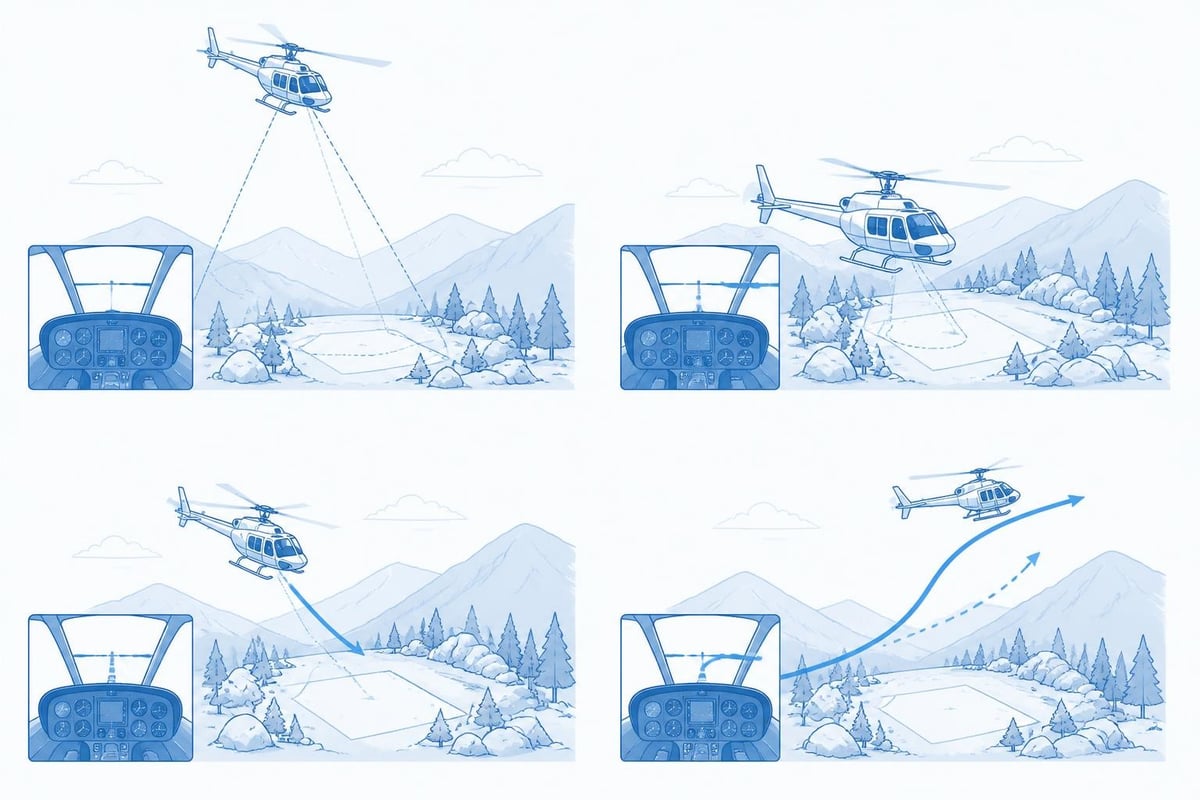
- Confined area operations: Assessing approach and departure angles, identifying hazards, managing power margins
Each maneuver description includes recommended entry parameters, control inputs, common errors, and completion standards. For a confined area approach, the handbook specifies a high reconnaissance at 500 feet AGL minimum, followed by a low reconnaissance at 100-200 feet to confirm surface conditions and obstacles, then the approach itself at a steep angle with constant groundspeed control.
Emergency Procedures and Autorotations
Chapter 11 covers emergencies comprehensively. Autorotation is the critical skill: descending under rotor momentum alone after engine failure. The helicopter flying handbook breaks this into phases.
Autorotation phases:
- Entry: Immediate collective reduction, maintain rotor RPM in green arc (typically 90-110%), adjust throttle to prevent overtorque
- Descent: Establish glide at best-glide airspeed, select landing area, manage energy with cyclic and collective
- Flare: Cyclic aft to reduce groundspeed and descent rate, timing critical
- Touchdown: Level helicopter with cyclic, cushion landing with collective as rotor RPM decays
You practice power recovery autorotations repeatedly during training: enter autorotation, descend to 50-100 feet, then apply power and climb away. Full touchdown autorotations require instructor supervision and appropriate aircraft.
The handbook also covers tail rotor failures, stuck pedals, hydraulic failures, and systems malfunctions. Each emergency includes symptoms, immediate actions, and follow-up procedures. Memorizing these flows saves lives. Review them monthly, not just before checkrides.
Correlation with Airman Certification Standards
The FAA Airman Certification Standards (ACS) for rotorcraft ratings reference the helicopter flying handbook throughout. Every practical test standard includes a "Skills" section describing maneuver tolerances: heading ±10°, altitude ±100 feet, airspeed ±10 knots.
The ACS tells you what you must demonstrate. The helicopter flying handbook tells you how to perform each task correctly. For example, the Private Pilot Helicopter ACS requires hovering with heading control ±10° and position within 4 feet. The handbook explains the control inputs and visual references needed to achieve that precision.
Examiners expect you to know handbook procedures. During the oral exam, questions about systems, aerodynamics, and emergency procedures all draw from this source. If you explain autorotation entry using handbook terminology (lower collective smoothly, maintain rotor RPM, establish glide), you demonstrate proper training foundation.
| Rating | Key Handbook Chapters | ACS Reference Tasks |
|---|---|---|
| Private Pilot | 1-11 (fundamentals through emergencies) | Hovering, takeoffs, landings, autorotations |
| Commercial | 1-13 (adds attitude instrument flying) | Advanced maneuvers, pinnacle/confined, limited power |
| Flight Instructor | All chapters plus instructional techniques | Teaching methods, common student errors, safety |
International Rotorcraft References
While the helicopter flying handbook is FAA-specific, other authorities publish similar guidance. EASA member states use national training manuals aligned with Part-FCL requirements. The UK CAA, for instance, publishes guidance on specialized operations.
European pilots training for mountain or hoist operations often reference the EASA Helicopter Hoist Pilot Training Guide, which complements the FAA handbook's emergency procedures with human factors and crew resource management specific to rescue missions. Search and rescue helicopter crews in the UK also follow CAA CAP 999 guidance for operational approvals and safety procedures.
The core aerodynamic principles remain universal. Whether you train under FAA, EASA, or Transport Canada rules, rotor systems behave identically. The helicopter flying handbook's explanations of retreating blade stall, vortex ring state, and loss of tail rotor effectiveness apply to all helicopter operations worldwide.
Tracking Training Progress and Currency
Helicopter pilots face specific currency requirements. For passenger carriage, FAA regulations require three takeoffs and landings within the preceding 90 days. If those landings were not to a full stop, you need additional full-stop landings. For night passenger carriage, you need three takeoffs and landings to a full stop at night in the preceding 90 days.
The helicopter flying handbook emphasizes maintaining proficiency beyond minimum currency. Chapter 13 recommends regular practice of emergency procedures, confined area operations, and advanced maneuvers even after earning your certificate. Skills decay without use.
Recommended recurrent training intervals:
- Autorotations: monthly practice recoveries, quarterly full touchdowns (with instructor)
- Confined areas and pinnacles: every 60-90 days if not flying these operationally
- Instrument skills: every 30 days minimum for currency, more frequently for proficiency
- Night operations: every 60 days to maintain sharpness
Many professional helicopter pilots log every flight with detailed maneuver notes to track which skills they have practiced recently. Pilotlog Pro tracks rolling 90-day currency automatically, calculates your next required flights for passenger carriage, and flags when specific currencies or ratings approach expiry, ensuring you stay legal without manual counting. This automation lets you focus on flying rather than spreadsheet management.

Safety Analysis and Real-World Application
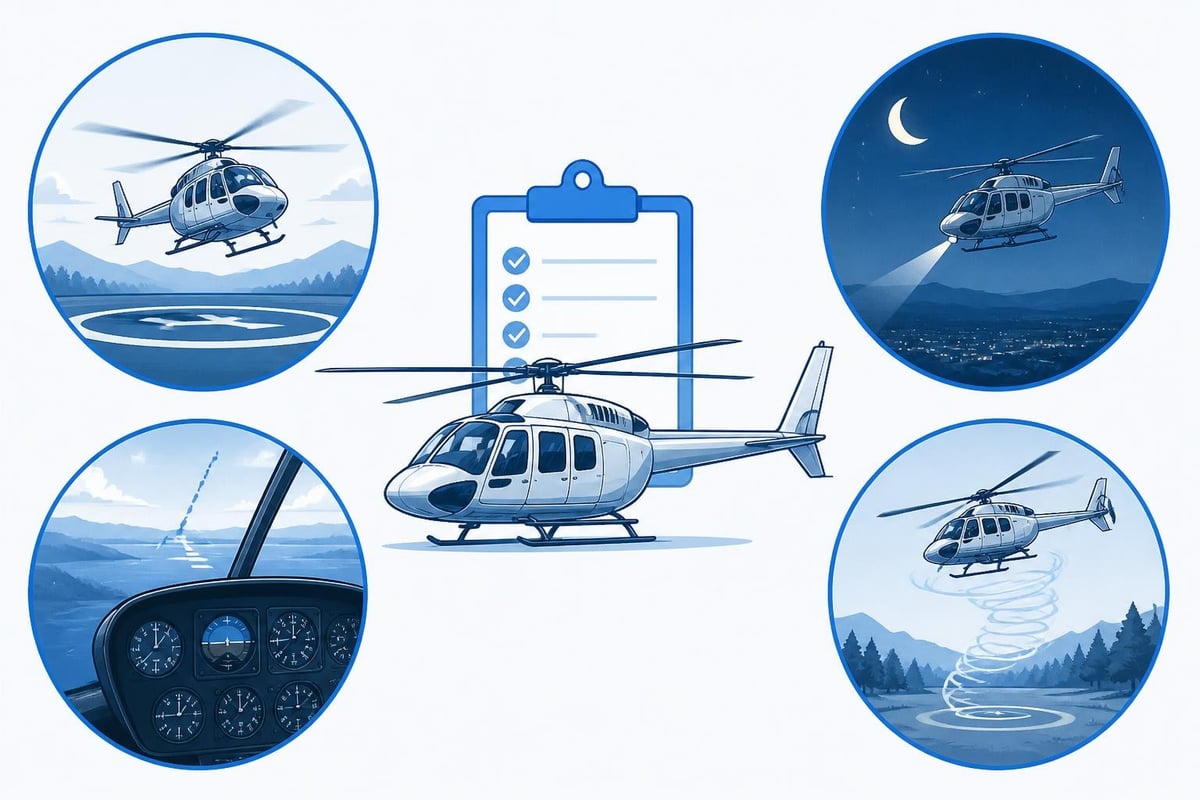
The Flight Safety Foundation publishes regular accident analyses involving helicopters. Common themes include loss of tail rotor effectiveness during low-speed flight, vortex ring state during steep approaches with insufficient airspeed, and dynamic rollover during slope operations.
Each of these hazards receives detailed treatment in the helicopter flying handbook. Loss of tail rotor effectiveness occurs when main rotor downwash strikes the tail boom from specific angles, reducing anti-torque authority. The handbook identifies critical wind azimuths (typically right quartering headwind and left quartering tailwind) and recommends increased airspeed when operating in these conditions.
Vortex ring state (settling with power) develops when the helicopter descends into its own downwash at low airspeeds, creating a recirculating flow that destroys lift. The handbook specifies avoidance parameters: avoid descent rates exceeding 800 feet per minute at airspeeds below 30 knots. Recovery requires immediate forward cyclic to exit the vortex, not increased collective which worsens the condition.
Understanding these concepts from the handbook builds real safety margins. You learn not just how to recover from emergencies but how to recognize developing hazards before they become critical.
Study Strategies for Checkrides and Proficiency
Effective study involves active engagement with the material. Simply reading the helicopter flying handbook once provides surface familiarity. Deep learning requires:
- Read and annotate: Mark key passages, add margin notes with questions
- Draw diagrams: Sketch rotor systems, airflow patterns, force vectors
- Chair fly maneuvers: Verbalize procedures while visualizing control inputs
- Teach concepts: Explain aerodynamics or procedures to another student
- Review errors: After flights, note mistakes and read relevant handbook sections
For commercial pilot preparation, focus particularly on Chapter 10 (advanced maneuvers) and Chapter 11 (emergencies). Examiners test steep approaches, maximum performance takeoffs and landings, and autorotations to full touchdown. The handbook provides the standards you must meet.
Flight instructors should study Chapter 13 (instructional fundamentals) thoroughly. This chapter covers teaching methods, common student errors, and safety considerations specific to helicopter instruction. Understanding how students learn and where they typically struggle makes you more effective in the cockpit.
Maintaining an Updated Reference Library
The FAA updates the helicopter flying handbook periodically. The current version, FAA-H-8083-21B, supersedes earlier editions. Check the FAA website annually for revisions. Regulatory changes, new safety findings, and updated best practices appear in these revisions.
Keep both digital and print copies accessible. Digital versions allow word searches and quick reference during ground school or preflight planning. Print copies work better for sustained study without screen fatigue. Many pilots annotate their print copies with additional notes from instructors or personal experience.
Related FAA handbooks complement this core reference:
- Helicopter Instructor's Handbook (FAA-H-8083-4): Teaching methods and student management
- Rotorcraft Flying Handbook (FAA-H-8083-21A): Broader coverage including gyroplanes
- Risk Management Handbook (FAA-H-8083-2): Decision-making and safety culture
- Aviation Weather (AC 00-6): Weather theory and hazard recognition
Building this reference library supports continuous learning. Regulations change, operational best practices evolve, and your own experience highlights different handbook sections as career phases shift. A private pilot focuses on basic maneuvers; a commercial pilot emphasizes precision and advanced operations; an instructor studies both while adding pedagogical techniques.
Rules and standards change over time. Always verify current requirements against official FAA sources and your operating authority before relying on any secondary reference for regulatory compliance. The helicopter flying handbook itself notes this principle in its introduction.
Applying Handbook Knowledge to Daily Operations
Theoretical knowledge means little without practical application. The helicopter flying handbook bridges this gap by providing real-world scenarios and decision-making frameworks.
Consider a cross-country flight planning example. You are flying a Robinson R44 from Santa Monica to Catalina Airport (KAVX). The handbook's navigation chapter recommends:
- Fuel planning: Calculate consumption at cruise power (typically 12-15 gallons per hour for an R44), add 30-minute reserve minimum
- Weight and balance: Verify you remain within envelope throughout flight including fuel burn
- Weather assessment: Check winds aloft, visibility, cloud layers; identify suitable alternates
- Performance: Confirm you can meet altitude requirements and account for density altitude effects
- Emergency planning: Identify forced landing areas along route, note nearest airports
The handbook's treatment of cross-country operations emphasizes planning margins and conservative decision-making. These same principles apply whether you are flying utility work, aerial tours, or emergency medical services.
For professional helicopter pilots, flight time tracking becomes essential for regulatory compliance and career documentation. Accurate records of flight hours, conditions (day/night, VFR/IFR), and aircraft types demonstrate experience to future employers and satisfy insurance requirements.
Building on the Foundation
The helicopter flying handbook provides your foundation. Advanced helicopter operations require additional specialized training: long-line external load work, mountain flying, offshore operations, emergency medical services. Each specialty builds on handbook fundamentals.
For instance, external load operations introduce new variables: load swing, pendulum effect, hook-up and release procedures. But the underlying aerodynamics, power management, and situational awareness all come from core handbook training. You cannot safely manage a long-line load without mastering basic hover control and wind correction first.
Similarly, instrument flight in helicopters expands on Chapter 12's attitude instrument flying fundamentals. The full instrument rating course adds approaches, holds, and navigation procedures, but the scan patterns and control techniques originate in the handbook.
Your career development follows this pattern: master fundamentals thoroughly, then layer specialized skills atop that foundation. Returning to the helicopter flying handbook periodically reinforces core knowledge and often reveals details you missed during initial training.
The handbook remains relevant regardless of experience level. Airline transport pilots review emergency procedures from this same source. Flight examiners reference it when evaluating applicants. Instructors teach from it daily. Its value does not diminish with time or advancing certificates.
The helicopter flying handbook is your authoritative guide to safe, professional rotorcraft operations. Master its content through deliberate study, regular review, and consistent application during flight training and beyond. Once you are logging flights consistently and tracking currency requirements, Pilotlog keeps you current and legal with automated alerts for expiring currencies, medical certificates, and licence renewals, so you can focus on flying rather than administrative tracking.
- helicopter flying handbook
- faa-h-8083-21b
- rotorcraft training
- autorotation
- helicopter aerodynamics
A logbook that keeps itself.
Join the waitlist and be first in line when Pilotlog launches.
Free to join, no spam. Unsubscribe any time.