flight logbooks
Flight Logbooks: Your Complete Guide (2026)
25 Sep 2026 · 16 min read
Flight logbooks are the official record of your flying career. Every flight you command as pilot in command (PIC), every sector you fly as a co-pilot, and every instrument approach you shoot must be logged accurately. These records prove you meet currency requirements, support licence applications, and provide evidence for insurance and employment. Whether you use a paper book or digital logbook, the entries you make today determine whether you're legal to fly tomorrow.
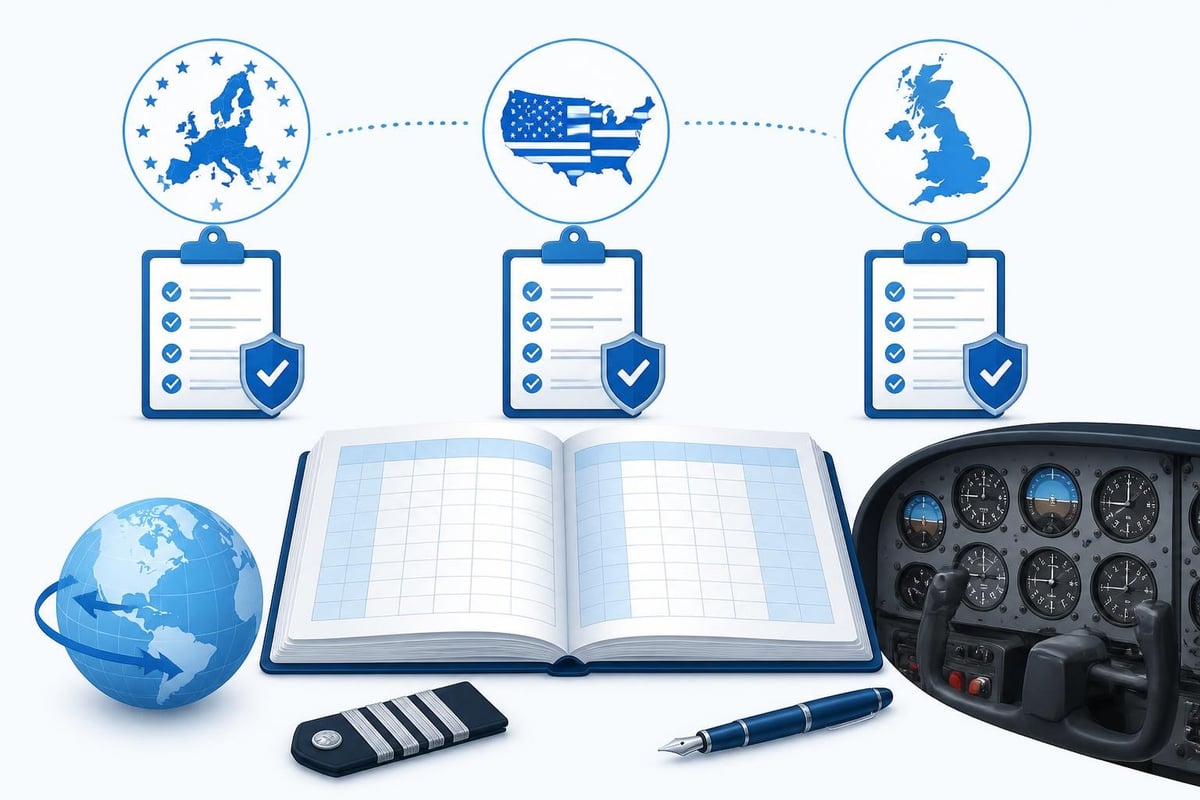
Regulations differ by jurisdiction, but the core principle remains consistent: pilots must maintain accurate records of their aeronautical experience. EASA Part-FCL requires pilots to keep a logbook documenting total flight time, including dates, departure and arrival locations, aircraft registration and type, and capacity (PIC, dual, or co-pilot). The FAA requires similar records under 14 CFR 61.51, specifying that pilots log the date, total flight time, location, aircraft type and identification, and the nature of the flight. The UK CAA follows EASA standards but provides detailed guidance on acceptable formats for both paper and electronic records.
Why Flight Logbooks Matter for Every Pilot
Flight logbooks serve multiple critical functions throughout your aviation career. They are not simply administrative boxes to tick.
Legal Compliance and Currency Tracking
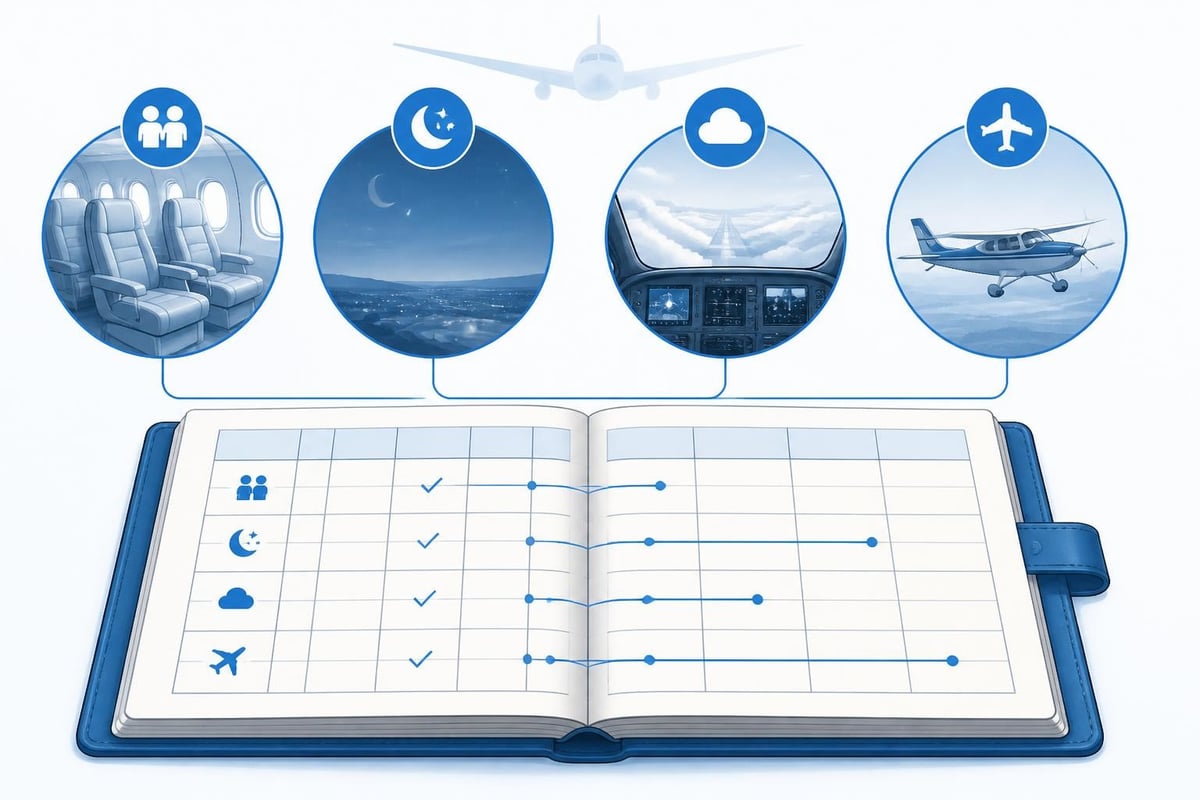
Maintaining currency is a regulatory requirement. EASA Part-FCL FCL.060 requires pilots to complete three take-offs and landings in the preceding 90 days to carry passengers. Night currency requires three take-offs and landings at night in the same period. Instrument rating validity under FCL.625 demands specific approaches, tracking, and holding procedures within the preceding 12 months or a proficiency check.
Your logbook is the only accepted proof of these activities. Without accurate entries showing the date, aircraft type, and number of day or night landings, you cannot demonstrate compliance. Regulators, employers, and insurers will request logbook evidence, and missing or incomplete records can ground you until you regain currency through remedial training.
Currency requirements you must track:
- Passenger-carrying: 3 take-offs and 3 landings within 90 days (EASA FCL.060)
- Night passengers: 3 take-offs and 3 landings at night within 90 days
- Instrument rating: specific approach types, tracking, and holding within 12 months (EASA FCL.625)
- Type rating revalidation: minimum sector and flight-time requirements per aircraft type
Career Progression and Employment
Airlines and commercial operators scrutinise logbook entries during recruitment. Total hours, PIC time, multi-engine experience, turbine hours, and specific aircraft types all factor into hiring decisions. The Pilot Records Improvement Act (PRIA) in the United States mandates that air carriers verify pilot records, including logbook data, before employment.
Your logbook tells your professional story. A well-maintained record showing steady progression from single-engine VFR through multi-engine IFR to turbine PIC time demonstrates competence and discipline. Gaps, unclear entries, or missing pages raise questions. Employers may reject applications with incomplete records, and verification failures can end recruitment processes before they begin.
European airlines typically require minimum thresholds: 1,500 total hours for direct-entry first officers, with specific PIC, multi-engine, and turbine time depending on the operator. Legacy carriers may demand 3,000+ hours for command positions. Every hour in your logbook contributes to meeting these gates.
What You Must Record in Flight Logbooks
Regulatory minimums define the baseline. Smart pilots record more.
Mandatory Fields Under EASA and FAA Rules
EASA Part-FCL and FAA regulations specify required logbook entries. Missing any of these makes the record non-compliant.
| Requirement | EASA Part-FCL | FAA 14 CFR 61.51 |
|---|---|---|
| Date of flight | Mandatory | Mandatory |
| Departure/arrival location | Mandatory | Mandatory |
| Aircraft type and registration | Mandatory | Mandatory |
| Total flight time | Mandatory | Mandatory |
| Pilot function (PIC/dual/co-pilot) | Mandatory | Mandatory |
| Landings (number) | When relevant for currency | When relevant for currency |
| Instructor signature (training) | Mandatory | Mandatory |
| Approaches (type/number) | For IR currency | For IR currency |
Beyond these minimums, recording details such as route, weather conditions, and notable events creates a richer record. If an incident occurs or you need to reconstruct a flight months later, comprehensive entries provide context that bare minimums cannot.
Building Hours Strategically
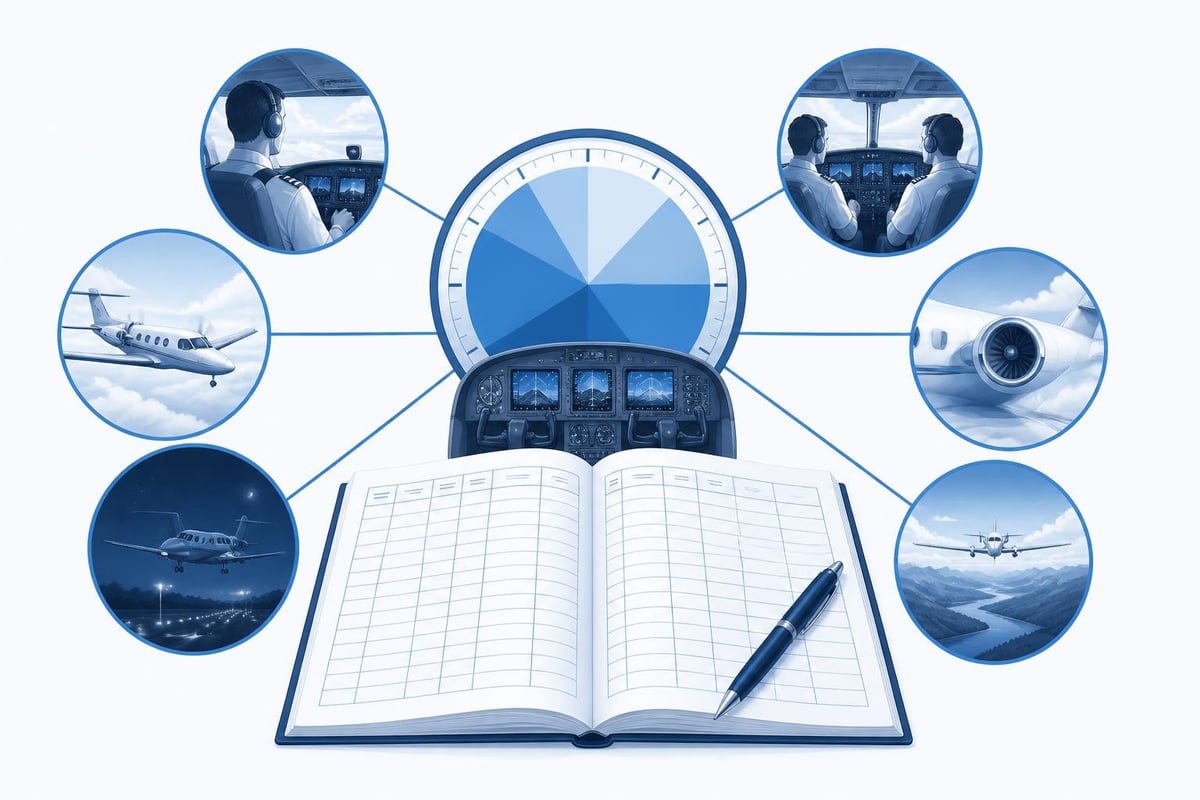
Not all hours carry equal weight. Airlines value PIC time over dual received. Multi-engine turbine hours open doors that single-engine piston time cannot. Your logbook should clearly distinguish these categories.
High-value hours to highlight:
- PIC time – Command authority matters more than total hours
- Multi-engine – Essential for commercial and airline roles
- Turbine – Jet or turboprop experience accelerates career progression
- Instrument actual – Real IMC time demonstrates genuine capability
- Night – Required for many commercial operations
- Cross-country – Proves navigation and planning skills over distance
Track these categories separately. When you reach 78 multi-engine hours from a target of 100, you know exactly how many sectors you need. Precision drives progress.
Paper Versus Digital Flight Logbooks
The choice between paper and digital formats affects daily workflow and long-term reliability.
Paper Logbooks: Traditional and Accepted
Paper logbooks remain the gold standard for many pilots and regulators. They require no batteries, survive technology failures, and provide a physical artefact of your career. The UK CAA provides templates like CAP2606A that ensure your paper logbook meets regulatory expectations for format and required fields.
Advantages of paper:
- Universally accepted by all regulators without question
- No software obsolescence or data migration issues
- Physical backup immune to device failure
- Simple to use with no learning curve
Limitations of paper:
- Manual totalling risks arithmetic errors
- No automatic currency tracking or expiry alerts
- Difficult to produce reports filtered by aircraft type or date range
- Vulnerable to loss, fire, or water damage without copies
Many pilots maintain paper as the primary legal record and supplement with digital tools for analysis.
Digital Logbooks: Efficiency and Analysis
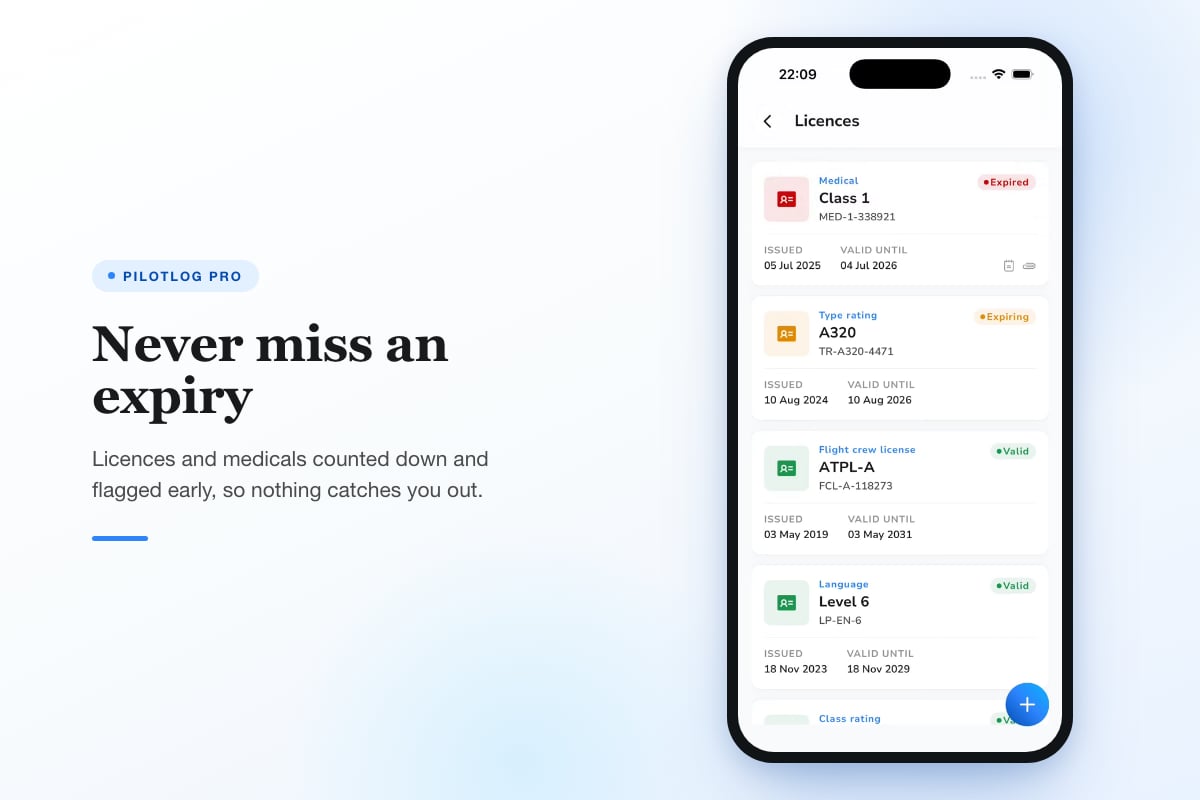
Digital flight logbooks eliminate manual arithmetic, automate currency tracking, and generate instant reports. Modern platforms sync across devices, back up to cloud storage, and provide alerts before currency lapses or medicals expire.
The best digital logbook solutions integrate with flight planning systems, import data from aircraft avionics, and export complete records in multiple formats for regulators or employers. You log a flight in seconds by selecting the aircraft and route, and the system calculates totals, updates currency, and flags any approaching limits.
Pilots flying airline rosters benefit significantly. When you fly 78 sectors in 28 days, manual tracking of flight-time limitations (FTL) becomes error-prone. Digital systems monitor rolling 28-day and 365-day limits continuously, alerting you before you approach regulatory maximums.
Pilotlog Pro tracks these limits automatically alongside passenger, night, and IFR currency with lapse dates flagged early. You add a flight, and the platform updates currency, checks FTL compliance, and reminds you 14 days before your Class 1 medical expires. Nothing catches you by surprise.
Regulatory Acceptance of Digital Records
Regulators increasingly accept digital logbooks if they meet specific criteria. EASA and the FAA do not mandate paper, but they require that electronic records are tamper-proof, complete, and readily accessible for inspection.
The UK CAA guidance on logbook documentation states that electronic logbooks are acceptable provided they can be printed or displayed in full upon request. The record must show all required fields, be chronological, and not allow retroactive alteration of previously logged entries without an audit trail.
Choose digital platforms that:
- Export complete logbooks in PDF or CSV formats
- Provide audit trails showing when entries were made or edited
- Back up data redundantly to prevent loss
- Meet industry standards for data security and privacy
Common Logbook Mistakes and How to Avoid Them
Even experienced pilots make errors that compromise their records.
Inconsistent Entries and Missing Data
Recording "local area" instead of specific departure and arrival aerodromes violates regulatory requirements. EASA and FAA rules demand actual locations. If you depart from and return to the same aerodrome, record both in the correct fields.
Similarly, failing to log night landings separately from day landings creates ambiguity. When you need to prove night currency for passenger-carrying, vague entries like "3 landings" without noting the time of day are insufficient. Record the exact number of night landings in the appropriate column.
Frequent errors to avoid:
- Vague locations ("local", "area", "training") instead of ICAO codes or aerodrome names
- Missing instructor signatures on dual instruction flights
- Incorrect totals due to arithmetic mistakes
- Omitting approach types when logging instrument flight
- Failing to differentiate PIC from dual received
- Not recording simulator sessions when they contribute to currency
Lost or Damaged Logbooks
Losing your logbook is a career setback, not a career end. Regulators understand that loss happens. The solution is reconstruction using available evidence.
Gather:
- Flight school and club records – Training organisations keep copies of student records
- Previous employer records – Airlines and commercial operators maintain crew flight logs
- Licence application documents – Copies submitted to the CAA or FAA often include logbook summaries
- Statutory declarations – Sworn statements reconstructing hours from memory and supporting documents
The UK CAA guidance on lost logbooks outlines the acceptable process for submitting reconstructed records. You must explain the loss, provide all available supporting evidence, and sign a declaration confirming accuracy to the best of your knowledge.
Prevention is simpler than reconstruction. Photocopy paper logbooks quarterly and store copies separately. Digital logbooks should back up automatically to encrypted cloud storage with redundant geographic locations.
Logbooks in Safety Investigations and Audits
Flight logbooks provide critical evidence when things go wrong.
NTSB and AAIB Investigations
Aviation accident investigations frequently examine pilot logbooks to establish experience, recency, and currency. The NTSB database contains numerous cases where logbook evidence clarified whether pilots met regulatory minimums or had recent experience in the aircraft type or conditions encountered.
In a fatal accident involving a commercial pilot flying passengers at night, investigators found the pilot's logbook showed only one night landing in the preceding 90 days. The pilot was not current under FAA regulations and should not have carried passengers after dark. The logbook entry proved the violation and contributed to findings regarding probable cause.
Conversely, accurate logbooks can exonerate pilots. When investigators question whether a pilot had adequate experience for the flight conditions, complete records showing extensive similar flight time in type and weather demonstrate competence.
Ramp Checks and Regulatory Audits
Carry your logbook (or have immediate digital access) when you fly. Ramp inspectors and CAA auditors can request evidence of currency during spot checks. If you cannot produce records showing you meet the 90-day landing requirement or that your licence remains valid, you may be prohibited from continuing the flight.
Digital logbooks on mobile devices satisfy this requirement if they display the full, current record. Ensure your device is charged and the app functions offline, as ramp checks may occur in locations without mobile data coverage.
International Operations and Licence Conversions
Flight logbooks become complex when you operate under multiple regulatory regimes.
Converting Licences Between EASA, FAA, and CAA
Converting an FAA licence to EASA Part-FCL or vice versa requires submitting logbook evidence. The receiving authority will verify that your logged hours meet their minimums for the licence level sought.
For example, an FAA Commercial Pilot Licence requires 250 total hours including specific PIC, cross-country, and night time. Converting that licence to an EASA Commercial Pilot Licence (CPL) requires demonstrating compliance with EASA Part-FCL minimums, which differ in structure. Your logbook must clearly show the breakdown of hours in categories that align with EASA requirements.
Conversion tips:
- Use standardised aircraft type designations (PA28, C172, B737) rather than colloquial names
- Record all dual instruction with instructor signatures
- Separate single-pilot multi-engine from multi-crew operations
- Distinguish synthetic training devices (simulators) from aircraft flight time
- Keep copies of all examiner and instructor endorsements
Regulators may reject applications if logbooks use non-standard abbreviations or formats they cannot verify.
Foreign Licence Validation
Some countries allow short-term validation of foreign licences without full conversion. The validating authority will still review your logbook to confirm experience and currency. Ensure your logbook contains all required ICAO fields and is in English or accompanied by a certified translation.
Logbook Best Practices for Long Careers
Habits you establish as a student pilot will serve you for 10,000 hours and beyond.
Log Every Flight Immediately
Memory fades quickly. Log flights within 24 hours while details remain fresh. If you fly multiple sectors in a day, make brief notes after each leg and complete full entries that evening.
Daily logging workflow:
- Note aircraft registration, departure/arrival, and block times immediately after shutdown
- Record landings (day/night), approach types, and any instrument time while still fresh
- Transfer notes to your permanent logbook before the day ends
- Verify totals and running hour counts for accuracy
- Ensure instructor or examiner signatures on training or test flights before they leave
This discipline prevents the nightmare scenario of reconstructing weeks of flying from vague memory and incomplete records.
Standardise Your Format and Abbreviations
Consistency makes your logbook professional and easy to audit. Use ICAO aerodrome codes (EGLL, KJFK), standard aircraft type designators (A320, B777), and recognised abbreviations (PIC, SIC, NVFR, IFR).
Avoid inventing shorthand. "VIS app" might mean "visual approach" to you, but an examiner may not understand. Write "visual approach" in full or use the standard abbreviation "vis app" if you define it in a key.
Backup and Secure Your Records
Treat your logbook as irreplaceable. If you use paper, scan every page quarterly and store digital copies in multiple locations (home, cloud storage, trusted family member). If you use digital, ensure automatic daily backups to encrypted cloud storage with a local offline backup on a separate drive.
Test your backups annually. Restore a copy to a new device or print a complete PDF to verify the backup is complete and readable.
Emerging Technologies and Future Logbook Trends
Aviation technology continues to evolve, and logbooks evolve with it.
Automatic Flight Logging from Avionics
Modern avionics systems can export flight data directly to logbooks. Garmin and other manufacturers provide downloadable logs with departure/arrival, block times, and route details pre-filled. You review the data, confirm accuracy, and approve the entry in seconds.
This eliminates transcription errors and ensures precise timing. When you fly 12 sectors in a duty day, automatic import saves 20 minutes of manual data entry and reduces the risk of mistakes.
Blockchain and Immutable Records
Blockchain technology offers tamper-proof logbook records with cryptographically verified entries. Each flight logs as a transaction on a distributed ledger, creating an audit trail that cannot be altered retroactively.
Regulators and employers can verify the authenticity of logbook data without relying on physical signatures or trust. While still emerging, blockchain logbooks may become industry standard as regulators establish certification frameworks for distributed ledger aviation records.
Integration with Crew Management Systems
Airlines and commercial operators increasingly integrate logbooks with crew management, rostering, and FTL monitoring systems. Your logged flights update rostering databases, FTL compliance checks run automatically, and scheduling systems prevent assignments that would violate flight-time limits.
This integration reduces administrative overhead and improves safety by catching potential violations before they occur. When your rolling 28-day flight time reaches 95% of the regulatory limit, the system flags you and prevents further assignments until sufficient rest resets the counter.
How Regulations Vary Globally
While ICAO standards provide a baseline, national regulators add specific requirements.
EASA Part-FCL Logbook Requirements
EASA Part-FCL mandates that pilots maintain logbooks in a reliable and permanent format. Entries must include date, departure and arrival locations, aircraft type and registration, total flight time or block time, and pilot function (PIC, co-pilot, SPIC, dual).
For training flights, the instructor must sign the logbook entry. For skill tests and proficiency checks, the examiner signs and stamps the entry with their authorisation number.
FAA 14 CFR Part 61 Logging Rules
FAA regulations under 14 CFR 61.51 specify similar baseline requirements but include nuances. For example, a pilot may log PIC time when acting as sole manipulator of the controls in an aircraft for which they are rated, even if not the designated PIC for the flight. This allows safety pilots and instructors to log PIC time under specific circumstances.
Understanding these subtleties matters. Logging PIC time incorrectly can lead to certificate action if discovered during an audit or investigation.
UK CAA Post-Brexit Adjustments
Since Brexit, UK-licensed pilots must navigate both UK CAA and EASA rules if they operate in the UK and EU. The UK CAA continues to align closely with EASA Part-FCL, but differences are emerging. UK pilots should consult current UK CAA guidance and ensure their logbooks comply with both regimes if they fly internationally.
Regulations change. Always verify current rules against official sources such as the CAA, EASA, or FAA before relying on any guidance. The information here reflects 2026 standards but may not account for future amendments.
Career Milestones Worth Recording
Your logbook captures more than hours. It tells your story.
First Solo to Airline Command
Every pilot remembers their first solo. Record the date, aircraft, and aerodrome. Write a brief note in the remarks: "First solo, C152 G-ABCD, EGKA." Decades later, that entry will bring back the memory of your instructor stepping out and closing the door.
Similarly, log your first PIC cross-country, first night flight, first IFR approach in actual IMC, and first multi-engine flight. These milestones mark progression.
When you reach 1,000 hours, 5,000 hours, or 10,000 hours, note the milestone in your logbook. Add the date and aircraft type. Some pilots include a brief reflection on their career to that point.
Unusual Aircraft and Memorable Flights
Record type conversions and aircraft you fly for the first time. A single flight in a warbird, glider, or vintage aircraft may not contribute significantly to total hours but enriches your experience.
Note flights in challenging conditions or significant events: your first diversion due to weather, an engine failure and successful forced landing, or a particularly demanding instrument approach. These entries provide context and demonstrate your breadth of experience.
Flight logbooks are your professional proof and your personal record. Accurate, complete entries demonstrate currency, support licence applications, and document every milestone from student certificate to airline command. Whether you choose paper, digital, or both, maintaining your logbook with precision and discipline is non-negotiable. Pilotlog keeps your hours, currency, and expiries organised automatically, ensuring nothing catches you by surprise. Log smart, stay current, and let your logbook tell the story of your flying career.
- flight logbooks
- easa part-fcl
- faa 61.51
- currency requirements
- digital logbook
A logbook that keeps itself.
Join the waitlist and be first in line when Pilotlog launches.
Free to join, no spam. Unsubscribe any time.