flight log book
Flight Log Book: Requirements and Best Practices
28 Jul 2026 · 11 min read
A flight log book is your official record of every flight you fly, documenting hours, aircraft types, conditions, and experience. It proves your qualifications to examiners, employers, and regulators. Most importantly, it keeps you legal by tracking the currency and recency requirements that determine whether you can carry passengers or fly IFR.
What the Regulations Actually Require
The FAA requires pilots to log specific flight time under 14 CFR 61.51. You must record the date, total flight time, departure and arrival locations, aircraft type and identification, and the name of any safety pilot if required. If you're logging time to meet experience or currency requirements, you must also record the nature of the flight (solo, PIC, dual, simulated instrument).
EASA Part-FCL takes a similar approach but adds detail. Under FCL.050, you must maintain a reliable record of all flights flown, including date, departure and arrival points, aircraft type and registration, total time of flight, and the PIC name. You must also log each take-off and landing if you're using those flights for recency.
Both systems share core principles:
- Log all flights used to demonstrate experience
- Record enough detail to reconstruct the flight
- Separate PIC time from dual instruction
- Track conditions (night, IFR, VFR)
- Maintain records for the duration of your flying career
The difference lies in enforcement. FAA guidance focuses on what you need to prove, while EASA rules are more prescriptive about format and detail.
Essential Entries in Your Flight Log Book
Every flight log book entry should answer basic questions: where did you go, what did you fly, how long were you airborne, and what role did you perform? The specifics matter because you'll use these records to prove currency, apply for ratings, or demonstrate experience to future employers.
Time Categories
You must separate different types of flight time. PIC time counts when you're sole manipulator of the controls in an aircraft you're rated for, or when you're the designated PIC regardless of who's flying. Dual instruction time is when a CFI is on board providing training. Solo time is when you're the only person in the aircraft.
Night time has a specific definition: FAA uses the period from one hour after sunset to one hour before sunrise, while EASA defines it as the period between the end of evening civil twilight and the beginning of morning civil twilight. This matters for tracking your IFR currency and passenger-carrying privileges.
Approaches and Landings
If you fly IFR, you must log each approach type and whether it was flown to published minimums. The FAA's six-approaches-in-six-months rule requires specific tracking: instrument approaches, holding, and intercepting and tracking courses. EASA requires similar recency under FCL.060.
For VFR passenger currency, you need three take-offs and landings within 90 days in the same category and class. If you carry passengers at night, those landings must be to a full stop and completed at night.
| Requirement | FAA Rule | EASA Rule | Validity Period |
|---|---|---|---|
| IFR Currency | 6 approaches, holding, tracking | IFR approach + tracking | 6 months |
| VFR Day Passengers | 3 take-offs and landings | 3 take-offs and landings | 90 days |
| VFR Night Passengers | 3 full-stop night landings | N/A (national rules apply) | 90 days |
Paper versus Digital: Making the Choice
Traditional paper logbooks have served pilots since the earliest days of aviation. They're simple, require no power, and create a permanent physical record. You can flip back through years of entries in seconds, and no software update will ever make them unreadable.
But paper has real limitations. Totaling columns takes time and introduces errors. Tracking multiple currency requirements means flipping between pages and doing mental arithmetic. If you lose the book, you lose everything unless you've made photocopies.
Digital logbooks solve these problems but introduce new considerations. They calculate totals automatically, flag currency lapses, and back up to the cloud. You can generate reports for job applications or insurance in seconds rather than hours. Most importantly, they track rolling requirements like the 90-day passenger currency without you counting backwards through pages.
The legal status is clear: both FAA and EASA accept electronic logbooks as long as you can produce the records when required. The FAA doesn't mandate a specific format. EASA allows electronic records under Part-FCL as long as they're reliable and available for inspection.
Key factors in your decision:
- Frequency: If you fly daily, digital saves hours of admin
- Complexity: Multi-engine, multi-type operations benefit from automatic totaling
- Currency tracking: Digital systems alert you before currencies lapse
- Backup: Digital allows cloud backup; paper requires manual copying
- Cost: Paper is cheaper upfront; digital requires subscription or purchase

Currency Tracking: The Real Value
Your flight log book isn't just history. It's a forward-looking tool that tells you what you can legally do tomorrow. This is where many pilots struggle with paper systems.
Consider a typical commercial pilot scenario. You flew 78 hours in the last 28 days, with 14 of those at night. You completed your last IFR approach 154 days ago. Your Class 1 medical expires in 47 days. Your ATPL theory credit expires in 23 months. On paper, you'd need to review multiple pages, count days on a calendar, and track several dates separately.
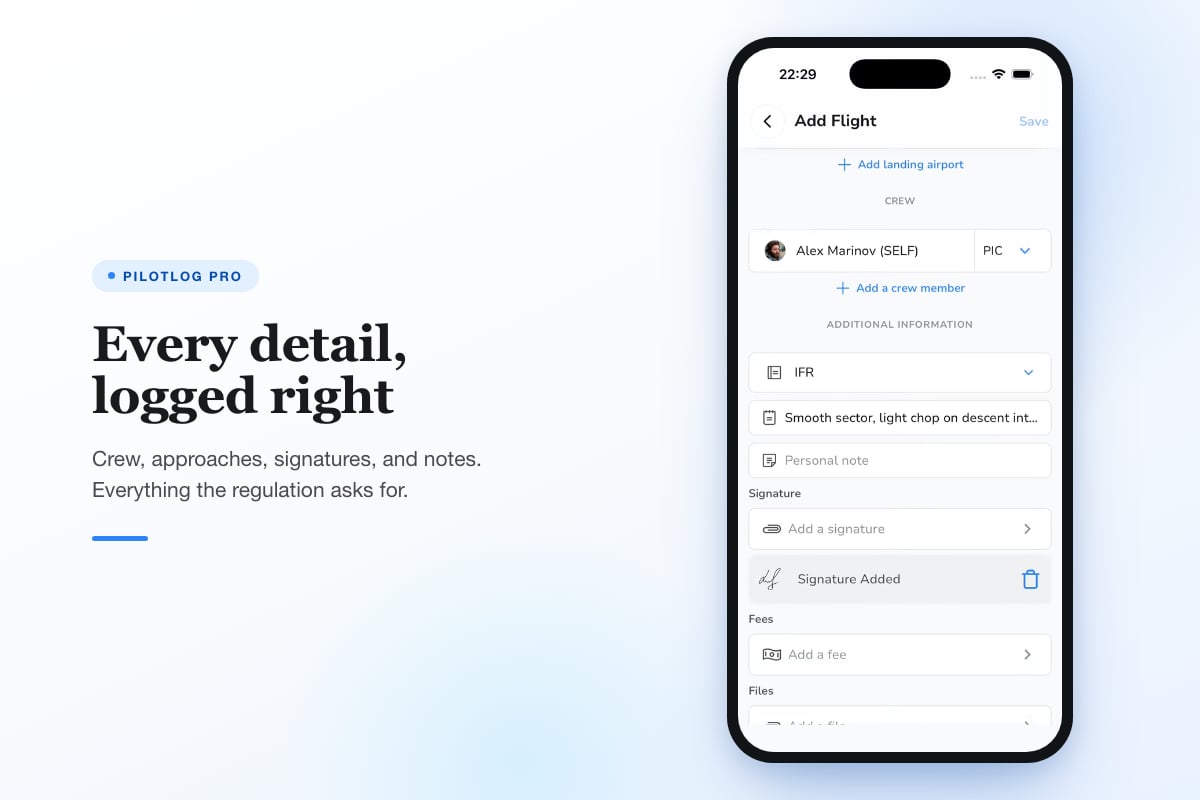
A proper digital flight log book does this automatically. Pilotlog Pro tracks rolling 28-day and 365-day flight-time and duty limits, passenger and night currency with specific lapse dates, and IFR currency calculated to the day. It flags licence and medical expiries early, so nothing catches you by surprise when you're rostered for a trip.
The 90-Day Rule in Practice
Let's work through a real example. You last carried passengers on April 15, 2026, when you completed three touch-and-goes at your home field. Today is July 28, 2026. That's 104 days. Your passenger-carrying privileges lapsed 14 days ago on July 14.
To regain currency, you need three take-offs and landings in the same category and class. If you want to carry passengers at night, those landings must be at night and to a full stop. Your flight log book must show these entries with sufficient detail to prove compliance.
In a paper log:
- Find your last passenger-carrying flight
- Count forward 90 days on a calendar
- Note the lapse date manually
- Remember to check before accepting passengers
In a digital system, you see "Passenger currency: LAPSED 14 days ago. Next flight will restore currency with 3 take-offs and landings."
What Employers Actually Look For
When you apply for a flying job, your flight log book is your CV. Chief pilots and HR teams look for specific things, and how you present your experience matters as much as the hours themselves.
Experience breakdown: Airlines want to see multi-crew time, PIC time, turbine time, and hours by aircraft type. Charter operators care about single-pilot IFR and variety of aircraft. Flight schools want dual given and examining authority experience.
Accuracy: Errors destroy credibility. If your totals don't add up or your currency claims don't match your logged flights, you're creating doubt about everything else. This is another area where digital logbooks excel because they eliminate arithmetic errors.
Presentation: A well-organized flight log book, whether paper or digital, demonstrates professionalism. Entries should be legible, chronological, and complete. Digital systems let you export formatted reports that highlight relevant experience for each application.
| What Employers Check | Why It Matters | Red Flags |
|---|---|---|
| Total hours match application | Verifies honesty | Discrepancies of more than 5 hours |
| Recent flying (last 90 days) | Shows current proficiency | Long gaps without explanation |
| Type-specific experience | Confirms qualification claims | Insufficient hours for claimed types |
| Night and IFR time | Assesses real-world capability | Unrealistically high percentages |
Endorsements and Instructor Signatures
Your flight log book must contain certain endorsements to prove you've met training requirements. These are separate from the flight entries themselves but equally important for regulatory compliance.
Under 14 CFR 61.51, an authorized instructor must endorse your logbook for training received. This includes flight reviews, instrument proficiency checks, and training for new ratings or endorsements. The instructor must sign, include their certificate number, and date the entry.
EASA rules under Part-FCL require similar signatures from authorized instructors. The key difference is that EASA training organizations often maintain their own records as well, creating a dual record system.
Common endorsements include:
- Flight review (every 24 months)
- Instrument proficiency check (if IFR currency lapses beyond six months)
- High-performance aircraft checkout
- Complex aircraft endorsement
- Tailwheel endorsement
- Type rating training
Digital logbooks handle endorsements differently. Some allow instructors to sign electronically; others require you to maintain paper records of endorsements even if you log flights digitally. Check that your chosen system meets the regulatory requirement for instructor signatures in your jurisdiction.

Maintenance and Long-Term Care
A flight log book is a lifetime document. You'll use it to prove experience decades after the flights occurred, so preservation matters.
For paper logbooks, the basics still work best. Use a pen, never pencil. Write legibly. Don't use correction fluid; strike through errors with a single line and initial. Store the book in a dry place away from direct sunlight. Photocopy or scan pages periodically as backup.
Digital systems require different discipline. Enable cloud backup. Export your data regularly to multiple formats (PDF and CSV at minimum). Don't rely on a single company to exist forever. If you switch systems, ensure you can migrate your complete history.
The FAA doesn't specify how long you must retain records, but practical reality means keeping them indefinitely. You'll need to prove total time for ATP applications, demonstrate experience for insurance purposes, and document your career for retirement calculations.
Backup strategies:
- Paper: Monthly photocopies stored separately from the original
- Digital: Daily cloud sync plus quarterly CSV export
- Hybrid: Digital primary with annual PDF archive to external storage
- Professional: Both paper and digital maintained in parallel
Common Mistakes and How to Avoid Them
Even experienced pilots make logbook errors. The most common is inconsistent time rounding. Some pilots round to 0.1 hours, others to the nearest minute using decimal time. Pick one method and stick to it throughout your career.
Another frequent error is logging PIC time incorrectly. You can log PIC when you're sole manipulator of the controls in an aircraft for which you're rated, but this doesn't mean you were the legal PIC for the flight. The distinction matters for insurance and job applications.
Night currency calculations trip up many pilots. Remember that the three take-offs and landings must occur within the preceding 90 days, not exactly 90 days ago. If you completed them on day 89, you have one day of currency, not 91.
Cross-check your totals regularly:
- Page totals should match column by column
- Subtotals should equal the sum of page totals
- PIC time cannot exceed total time
- Dual received time implies you weren't PIC
- Night time cannot be more than total time for any flight
Aircraft and Route Documentation
Your flight log book needs enough detail to reconstruct each flight. Aircraft type and registration are mandatory, but how much detail do you include about the route?
For local flights, departure and arrival airport codes suffice. For cross-country flights (which have specific definitions for different certificates), include any intermediate stops. This proves the flight met distance requirements for training or ratings.
Some pilots log every waypoint and airway. This creates a detailed record but takes significant time. Others note only airports with full-stop landings. The minimum requirement is sufficient to show where you flew and for how long.
Practical route logging:
- Local pattern work: EGLL-EGLL
- Cross-country with stop: EGLL-EGCC-EGNX
- IFR flight: EGLL-LFPG (actual route in remarks if needed)
- Training flight: EGLL (local area, stalls and slow flight)
When Rules Change: Staying Current
Aviation regulations evolve. What was legal last year might not be acceptable now, and hour requirements for ratings change periodically. Your flight log book must reflect the rules that applied when you flew, but you must understand current rules for ongoing currency.
The example most pilots know is the ATP hour requirement change. In the US, it increased from 1,500 hours in 2013, with some restricted ATP options at lower hours. Pilots who qualified under the old rules still hold valid certificates, but their logbooks show different pathways.
Note that this article reflects regulations as of July 2026. Rules change, and pilots should verify requirements against current official sources (FAA regulations, EASA Part-FCL, or your national authority) before relying on any logbook entries for currency or qualification.
If you're a student pilot learning logbook habits, establish good practices now. Consistent entries, regular totaling, and accurate time logging will serve you throughout your career. The flight log book you start today might be the same one you present for an ATP practical test or airline interview years from now.
Your flight log book is more than a regulatory requirement. It's the complete record of your flying career, tracking every hour toward the next rating and keeping you legal for every flight. Whether you choose paper or digital, accuracy and consistency matter more than the format. Pilotlog handles the complexity automatically, logging flights in seconds while tracking currency, limits, and expiries across your whole career, so you can focus on flying rather than arithmetic.
- flight log book
- faa logbook requirements
- easa part-fcl
- currency tracking
- digital logbook
A logbook that keeps itself.
Join the waitlist and be first in line when Pilotlog launches.
Free to join, no spam. Unsubscribe any time.