commercial pilot cost
Commercial Pilot Cost: 2026 Budget Breakdown
16 Oct 2026 · 13 min read
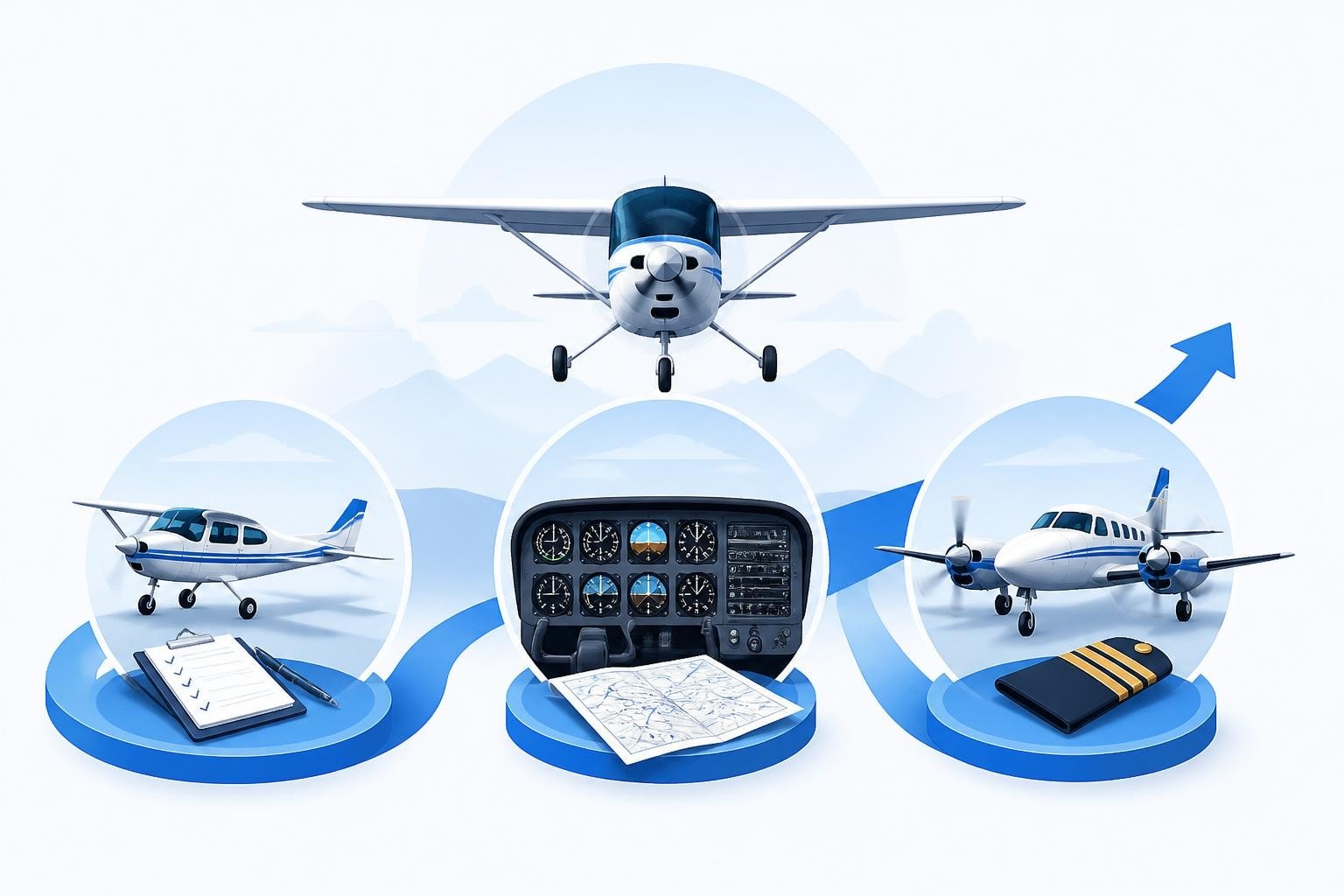
Commercial pilot cost in 2026 typically ranges from £50,000 to £120,000 depending on training pathway, location, and existing qualifications. The FAA requires 250 total flight hours for a commercial pilot certificate, while EASA mandates 150 hours of flight time under Part-FCL. Those figures represent the regulatory minimum; real-world training paths usually demand more time and money to reach safe, employable standards. Understanding the commercial pilot cost structure helps you budget accurately, select the right training route, and avoid common financial pitfalls that ground careers before they start.
What Drives Commercial Pilot Cost
Three major factors determine your final bill: flight hours, ground instruction, and regulatory fees. Flight time makes up 60 to 75 percent of total commercial pilot cost because you pay for aircraft rental, fuel, and instructor time every hour you fly.
Aircraft rental rates in 2026:
- Single-engine piston (Cessna 172): £150–£210 per hour wet (fuel included)
- Complex single-engine (Piper Arrow): £200–£280 per hour
- Multi-engine piston (Piper Seminole): £380–£520 per hour
Instructor fees add £50 to £80 per hour for flight instruction and £40 to £60 for ground lessons. The commercial pilot cost climbs when you train at busy towered airports with higher landing fees or in regions with expensive fuel.
Ground school packages range from £1,200 to £4,500 depending on whether you choose online modules, classroom courses, or integrated academy programs. Exam fees, medical certificates, and checkride costs add another £1,800 to £3,200 to the commercial pilot cost.
Training Pathway Differences
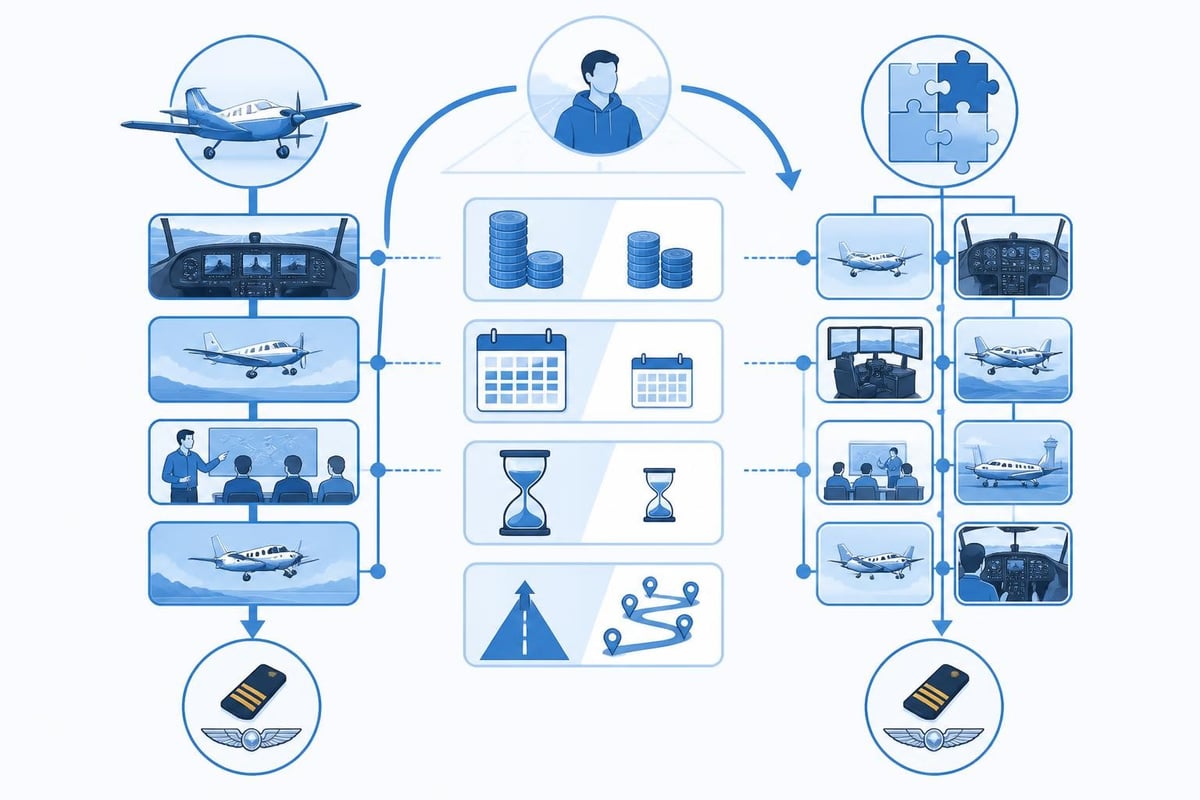
Part 61 versus Part 141 training (in the U.S.) or modular versus integrated (in Europe) creates significant commercial pilot cost variation. Part 141 schools operate under stricter FAA oversight and can certificate commercial pilots at 190 hours instead of 250, potentially saving £9,000 to £12,000 in flight time. Integrated EASA programs bundle all licences (PPL, IR, CPL, MEPL) into one structured course, often totalling £80,000 to £110,000 over 12 to 18 months.
Modular training lets you build ratings step-by-step, spreading the commercial pilot cost across years and allowing you to earn money between stages. A typical modular path in the UK might cost £55,000 to £75,000 from zero to frozen ATPL, but timeline and discipline matter: students who fly infrequently pay more because they repeat lessons.
| Training Type | Total Hours | Typical Cost (£) | Timeline | Best For |
|---|---|---|---|---|
| Part 61 (US) | 250+ | £50,000–£70,000 | 12–24 months | Self-paced, working students |
| Part 141 (US) | 190+ | £55,000–£75,000 | 9–15 months | Structured learners |
| EASA Modular | 200+ | £55,000–£75,000 | 18–36 months | Budget-conscious, flexible |
| EASA Integrated | 200+ | £80,000–£110,000 | 12–18 months | Fast-track to airlines |
Breaking Down Commercial Pilot Cost by Stage
You don't write one cheque for the full commercial pilot cost. Training progresses through licences, each with its own budget and hour requirements. Understanding stage-by-stage expenses helps you plan cashflow and identify funding options.
Private Pilot Licence Foundation
Every commercial pilot starts with a PPL. In the U.S., the FAA minimum is 40 hours (Part 61) or 35 hours (Part 141), but the national average hovers around 60 to 70 hours. At £160 per flight hour plus £60 instructor fees, plus £2,500 for ground school and exams, a realistic private pilot licence cost lands between £16,000 and £22,000.
EASA Part-FCL requires 45 hours for a PPL, with students typically finishing at 50 to 55 hours. European training costs run slightly higher due to airspace complexity and longer cross-country requirements, pushing the PPL stage of commercial pilot cost to £12,000 to £18,000.
PPL cost breakdown (60-hour U.S. example):
- Flight training: 60 hrs × £160 = £9,600
- Instructor time: 60 hrs × £60 = £3,600
- Ground school: £1,500
- Books and materials: £400
- Medical certificate (Class 2): £150
- Written and practical exams: £650
- Total: £15,900
Instrument Rating Investment
The instrument rating (IR) builds all-weather capability and is mandatory for commercial operations in IMC. The FAA requires 50 hours of cross-country PIC time and 40 hours of actual or simulated instrument time. Most pilots complete an IR in 55 to 65 hours of dual instruction, costing £11,000 to £16,000.
EASA's IR (originally IR(A)) demands 50 hours of cross-country flight time as PIC and at least 40 hours of instrument instruction, 10 of which may be simulator time. European IR training typically costs £14,000 to £20,000 because EASA regulations require more theoretical knowledge exams and stricter checkride standards.
Instrument training represents one of the highest concentrations of commercial pilot cost per hour because it demands advanced avionics, precision approaches, and intensive instructor feedback.
Commercial Certificate Build
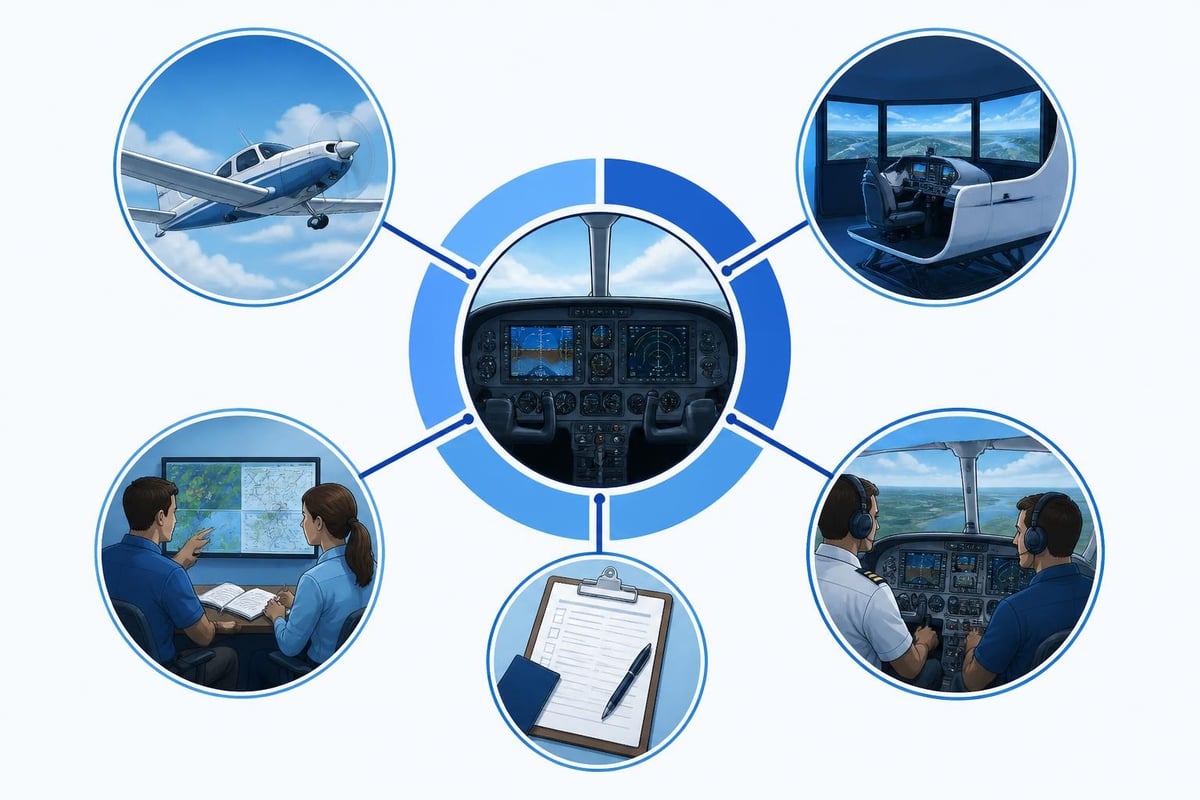
The commercial pilot certificate itself layers on top of PPL and IR. U.S. Part 61 requires 250 total hours with specific sub-requirements: 100 hours PIC, 50 hours cross-country PIC, 20 hours of commercial training (including 10 hours in a complex or TAA aircraft), and one 2-hour day/night cross-country totalling 300 nautical miles.
If you arrive at commercial training with 150 hours (post-IR), you need 100 more hours. Some pilots build time as safety pilots or via cost-sharing; others pay for every hour. At £160 per hour, 100 additional hours cost £16,000. Add 20 hours of commercial-specific dual (10 in a complex aircraft at £240/hr) and the final stage of commercial pilot cost runs £22,000 to £30,000.
250-hour commercial pilot cost summary (U.S. Part 61):
- PPL (60 hrs): £16,000
- Instrument rating (65 hrs): £13,500
- Time-building to 250 hrs (125 hrs): £20,000
- Commercial-specific training (20 hrs dual): £5,200
- Ground school, exams, checkride: £3,200
- Total commercial pilot cost: £57,900
EASA's 150-hour CPL requirement sounds cheaper, but European students must also complete 14 ATPL theory exams and a multi-engine class rating, raising the frozen-ATPL commercial pilot cost to £60,000 to £85,000 depending on academy and location.
Hidden and Variable Costs
Official hour requirements tell only half the story. Real commercial pilot cost includes expenses students overlook until invoices arrive.
Checkride Failures and Retests
FAA practical test standards show first-time pass rates around 80 percent for private, 75 percent for instrument, and 70 percent for commercial checkrides. A failed test costs the examiner fee again (£600 to £900) plus additional dual instruction to correct deficiencies (4 to 8 hours at £220/hr). Budget an extra £2,000 to £4,000 contingency for potential retests across all ratings.
Medical Certificate Renewals
Class 1 medicals (required for commercial operations in many jurisdictions) cost £350 to £500 and must be renewed annually under age 40, every six months over 40. EASA Part-MED rules are similar. A four-year training timeline adds £1,400 to £2,000 to commercial pilot cost just for medical compliance.
- Class 1 medical (EASA): Valid 12 months (under 40), 6 months (40–60)
- Class 1 medical (FAA): Valid 12 months (under 40), 6 months (over 40) for airline ops
- Class 2 medical: Valid 12 months (EASA), 12 months (FAA) for commercial non-airline
Books, Materials, and Technology
Expect to spend £1,200 to £2,000 on charts (paper and digital subscriptions), exam-prep software, headsets, flight bags, and electronic flight bag (EFB) apps. Many students underestimate this line item and discover it adds 2 to 3 percent to total commercial pilot cost.
Time-Building and Multi-Engine Ratings
Raw commercial pilot cost to certificate is one figure; employable commercial pilot cost is another. Airlines and charter operators want multi-engine time, turbine experience, and 500 to 1,500 total hours. Bridging that gap demands strategic time-building.
Multi-Engine Class/Rating
EASA's multi-engine piston (MEP) class rating requires 6 to 8 hours of dual instruction and a skill test. Cost: £3,500 to £5,000. The FAA multi-engine rating (add-on to commercial SEL) needs 10 to 15 hours and runs £5,000 to £7,500. Every airline and most corporate operators require multi-engine time, making this non-negotiable commercial pilot cost.
Instructor Ratings as Time-Builders
Many pilots earn a flight instructor certificate (CFI in the U.S., FI in Europe) immediately after their CPL to build hours while teaching. CFI training costs £6,000 to £9,000 but opens a paid pathway to 1,000+ hours. AOPA's pilot licence cost guide notes instructing remains the most common time-building method in North America.
Instructing pays £25 to £50 per flight hour in 2026, meaning a 1,000-hour instructor can recoup £25,000 to £50,000, offsetting earlier commercial pilot cost outlays. European instructors face lower pay (€20–€40/hr) and longer timelines because fewer training schools operate year-round.
Alternative Time-Building Methods
- Banner towing / pipeline patrol: 500–700 hours/year, £22,000–£35,000 salary
- Skydive / jump pilot: 300–500 hours/year, £18,000–£28,000 salary
- Aerial survey: 400–600 hours/year, £24,000–£32,000 salary
- Cost-sharing / safety pilot: Low-cost hours but slow accumulation
Regional and International Cost Variations
Commercial pilot cost swings wildly by country and even by region within a country. Fuel, airspace fees, instructor wages, and currency exchange all play roles.
United States
The U.S. offers the lowest per-hour training costs among developed nations. States like Arizona, Florida, and Texas dominate flight training because of year-round VFR weather and competitive Part 141 schools. A Rotate Pilot cost calculator analysis shows Arizona-based students save 15 to 20 percent on total commercial pilot cost compared to Northeast or West Coast training.
Europe (EASA)
EASA-regulated training in the UK, Spain, and Greece costs 20 to 40 percent more than U.S. equivalents due to higher instructor wages, stricter theoretical exams, and airspace complexity. Integrated ATPL programs in Oxford, Barcelona, or Athens range from £80,000 to £110,000. However, EASA licences convert easily across 32 member states, offering broader initial job markets.
Asia-Pacific and Middle East
Australia and New Zealand commercial pilot cost sits between U.S. and European levels (AUD 75,000–100,000 / £40,000–£55,000). Singapore and UAE academies charge premiums (SGD 120,000–180,000 / £65,000–£100,000) but offer direct airline cadet pathways with partially sponsored costs. IATA workforce data projects Asia-Pacific will demand 260,000 new pilots by 2035, sustaining premium training markets.

Financing and Scholarships
Few pilots pay commercial pilot cost from savings alone. Loans, sponsorships, and grants fill the gap.
Flight Training Loans
Specialized lenders offer unsecured loans up to £80,000 at 6 to 12 percent APR for pilot training. AOPA's Student Field Guide lists U.S. providers; UK students use Pilot Finance or Future Pilot Finance. A £60,000 loan at 8 percent over 15 years costs £573/month (total repayment £103,140). Early-career pilots earning £28,000 to £40,000 must budget carefully.
Airline Cadet Programs
Major carriers (British Airways, Emirates, Lufthansa) run ab-initio cadet schemes where the airline sponsors part or all of commercial pilot cost in exchange for a training bond (typically 3 to 5 years service). Candidates repay sponsorship via payroll deduction. Competition is fierce: BA's Future Pilot Programme accepts fewer than 5 percent of applicants.
Industry Scholarships
- AOPA scholarships: £500–£10,000 (U.S. students)
- Honourable Company of Air Pilots: £1,000–£5,000 (UK students)
- Women in Aviation International: £1,000–£12,000
- NBAA business aviation scholarships: Up to £5,000 for Part 135 career tracks
Scholarships rarely cover full commercial pilot cost but shave 5 to 15 percent off the total, making the difference between viable and unaffordable training.
Managing Cost While Building Hours
Smart students reduce commercial pilot cost without sacrificing safety or quality. Tracking hours, choosing off-peak slots, and leveraging technology all help.
Cost-saving strategies:
- Train intensively (3–5 flights/week) to minimize repetition and skill decay
- Fly early morning or late evening when demand and fuel costs drop
- Use online ground school (£300–£800) instead of classroom courses (£2,500–£4,500)
- Join flying clubs for discounted aircraft rates (10–20% below FBO rates)
- Leverage simulators for instrument proficiency (£80/hr vs. £220/hr aircraft)
Digital logbooks streamline currency tracking so you never pay for unnecessary recurrent training. Pilotlog Pro calculates rolling 28-day and 365-day limits, flags passenger and night currency lapses, and alerts you when IFR recency expires, ensuring you stay legal without expensive refresher flights.
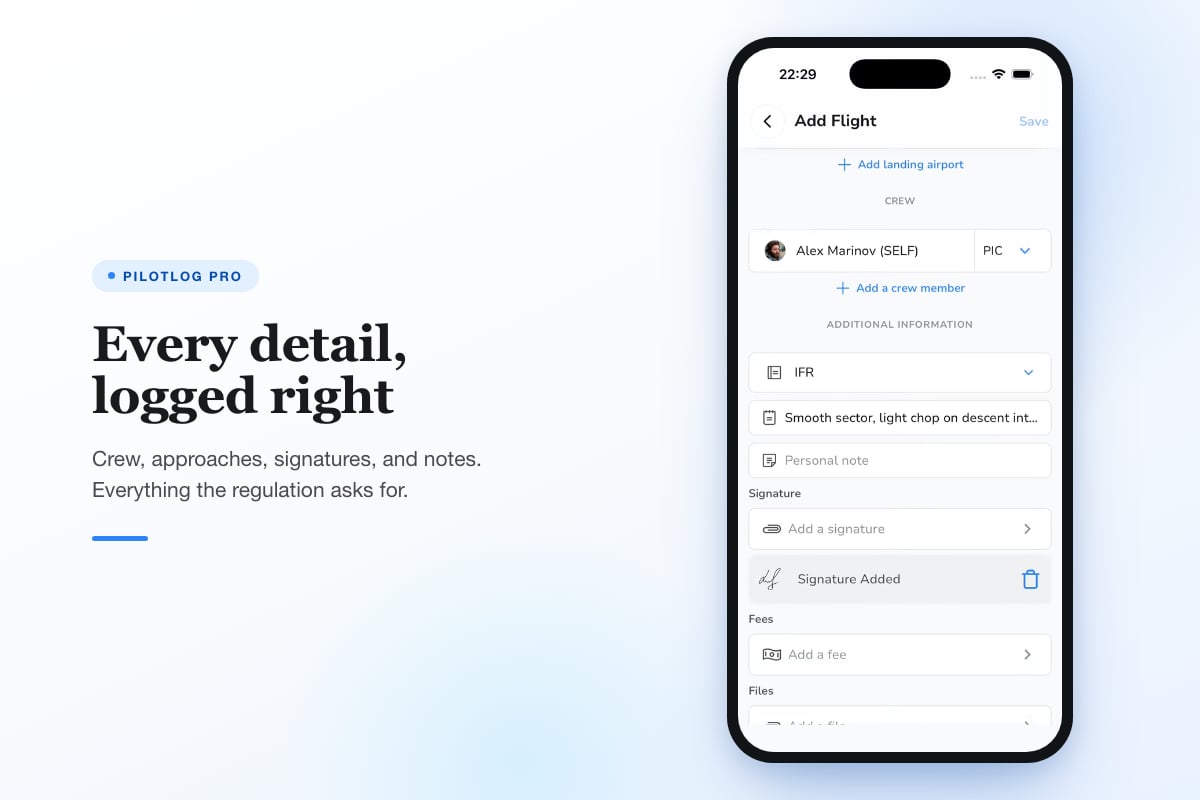
A recreational pilot or private plane pilot might tolerate ad-hoc record-keeping, but commercial training demands precision. Missing a currency deadline means repeating checkrides or dual instruction, adding hundreds to commercial pilot cost for avoidable errors.
Return on Investment and Career Outlook
Commercial pilot cost is an investment, not an expense. Payback timelines vary by career track.
First Officer Salaries (2026)
- Regional airline (U.S.): £35,000–£55,000 year one
- Low-cost carrier (Europe): £28,000–£42,000 year one
- Legacy carrier (post-1,500 hrs): £60,000–£85,000 year one
- Business aviation: £40,000–£70,000 depending on fleet
A pilot who spends £60,000 on training and earns £40,000 in year one achieves breakeven in 18 to 24 months, assuming modest living costs. FAA ATP training requirements and the 1,500-hour rule delay entry into high-paying airline jobs, extending payback to 3 to 5 years for many U.S. pilots.
Long-Term Earnings
Captain salaries at major carriers reach £120,000 to £250,000 by year 10, turning commercial pilot cost into a high-return credential. Career earnings over 30 years easily exceed £3 million, dwarfing initial outlay. However, medical groundings, furloughs, and economic downturns introduce risk; only healthy, adaptable pilots capture full ROI.
Keeping Records Accurate During Training
Every hour you log affects your commercial pilot cost and career timeline. Inaccurate records delay checkrides, fail audits, and force expensive re-flights to prove compliance.
Regulators require specific evidence:
- FAA (14 CFR 61.51): Pilot must log date, aircraft ident, departure/arrival, flight time, landings, conditions (day/night/actual/simulated instrument)
- EASA (Part-FCL.050): Similar detail plus cross-country distance and PIC/dual breakdowns
Students juggling paper Jeppesen logbooks or spreadsheets make errors that surface during commercial checkrides. Examiners spot missing endorsements, miscounted night landings, or unverifiable cross-country legs, grounding the applicant until records are corrected.
A digital logbook auto-totals hours, flags missing endorsements, and exports audit-ready summaries. When you apply for your commercial certificate, clean records save time and examiner fees.
Planning Your Budget
Build a realistic commercial pilot cost forecast before you start. Use these steps:
- Define your end goal: 250-hour CPL? Frozen ATPL? ATP with type rating?
- Calculate minimum hours: Add 20% buffer for weather, repetition, checkride prep
- Price local aircraft and instructors: Get quotes from 3+ schools
- Add fixed costs: Exams, medicals, materials, insurance
- Include contingency: 10–15% for retests and unexpected expenses
- Model financing: Loan payment vs. income during training
| Cost Category | Conservative (£) | Typical (£) | Premium (£) |
|---|---|---|---|
| PPL | 18,000 | 20,500 | 24,000 |
| Instrument Rating | 13,000 | 15,500 | 19,000 |
| Time-building (150–250 hrs) | 16,000 | 20,000 | 26,000 |
| Commercial training | 4,500 | 6,000 | 8,500 |
| Multi-engine add-on | 4,000 | 5,500 | 7,000 |
| Exams, medicals, misc. | 3,000 | 4,000 | 5,500 |
| Total CPL cost | £58,500 | £71,500 | £90,000 |
Track actual spending against forecast monthly. Students who monitor their burn rate adjust training intensity or find part-time work, avoiding the loans-plus-credit-card trap that derails careers.
Regulatory Notes and Staying Current
Commercial pilot cost figures in this article reflect 2026 averages and typical pathways. Hour requirements, medical standards, and certification rules change. Always confirm current rules with your national authority:
- U.S. (FAA): 14 CFR Part 61 and Part 141
- Europe (EASA): Part-FCL (EU Regulation 1178/2011)
- UK (CAA): Part-FCL as retained and amended post-transition
Licence and medical expiry dates shift as you progress. A lapsed Class 1 medical or instrument rating means you cannot exercise commercial privileges, forcing costly refresher training. Proactive tracking prevents lapses and keeps commercial pilot cost predictable.
Commercial pilot cost ranges from £50,000 to £120,000 depending on pathway, location, and efficiency, but the investment unlocks a career with strong long-term earnings and global mobility. Accurate record-keeping, disciplined budgeting, and smart training choices control expenses and keep you on schedule. Pilotlog tracks every hour, flags currency lapses, and alerts you before licences or medicals expire, so nothing catches you by surprise and your training investment stays on course from first lesson to checkride.
- commercial pilot cost
- pilot training cost
- cpl training
- flight training budget
- easa modular training
A logbook that keeps itself.
Join the waitlist and be first in line when Pilotlog launches.
Free to join, no spam. Unsubscribe any time.