maintenance log book
Airplane Maintenance Log Book: Complete Guide for 2026
2 Oct 2026 · 17 min read

An airplane maintenance log book is the official record of all inspections, repairs, alterations, and airworthiness directive compliance performed on an aircraft, its airframe, engine, and propeller. Under 14 CFR §91.417 in the United States and EASA Part-M in Europe, operators and owners must maintain permanent records of maintenance and retain them to demonstrate continuing airworthiness. These records prove an aircraft is legal to fly and preserve its value for sale or lease. Every pilot flying a rented or owned aircraft depends on accurate, complete maintenance logs.
What an Airplane Maintenance Log Book Contains
The airplane maintenance log book documents the aircraft's entire maintenance history from manufacture to present day. It typically consists of three separate physical or electronic logbooks: one for the airframe, one for each engine, and one for each propeller (if applicable). Rotorcraft and turbine aircraft may have additional logs for major components such as transmissions or APUs.
Required Entries Under FAA and EASA Rules
Each maintenance entry must include specific information to meet regulatory requirements. The FAA Advisory Circular AC 43-9D sets out the minimum content for return-to-service entries in the United States, while EASA continuing airworthiness regulations govern European operators.
Every logbook entry must record:
- Date of the work
- Total aircraft time in service (airframe hours)
- Description of the work performed or reference to acceptable data (e.g., manufacturer service bulletin number)
- Name and signature of the person approving the aircraft for return to service
- Certificate type and number of the approving person (A&P, IA, repair station certificate, etc.)
For inspections such as annual inspections (required every 12 calendar months under 14 CFR §91.409) or 100-hour inspections, the entry must also state the type of inspection and include a statement that the aircraft is approved or not approved for return to service.
Airworthiness Directive Compliance Records
Airworthiness directives (ADs) issued by the FAA or EASA are legally binding and require documentation in the airplane maintenance log book. Each AD compliance entry must include:
- AD number and revision (e.g., AD 2026-03-12)
- Method of compliance
- Date of compliance
- Recurring interval if the AD is repetitive
- Signature and certificate of the approving mechanic or organisation
Missing AD compliance records can ground an aircraft immediately. The ICAO airworthiness guidance emphasises that AD tracking is a cornerstone of continuing airworthiness worldwide.

Major Alterations and Repairs
Major alterations or major repairs (those affecting weight, balance, structural strength, performance, powerplant operation, flight characteristics, or other qualities affecting airworthiness) require FAA Form 337 in the United States. A copy of the approved Form 337 must be retained with the airplane maintenance log book permanently. EASA operators use an EASA Form 1 or equivalent certificate of release to service from an approved Part-145 organisation.
| Record Type | Retention Period (FAA) | Retention Period (EASA) |
|---|---|---|
| Maintenance entry | Until work is repeated or superseded | Permanent |
| AD compliance | Permanent | Permanent |
| Major repair/alteration (337/EASA Form 1) | Permanent | Permanent |
| Annual/100-hr inspection | 1 year after next inspection of same type | Until superseded |
| Time-life component removal | Permanent (part of aircraft records) | Permanent |
Who Maintains the Airplane Maintenance Log Book
Responsibility for the airplane maintenance log book lies with the registered owner or operator of the aircraft. Under 14 CFR §91.417, the owner or operator must ensure all required maintenance records are kept and transferred with the aircraft when sold or leased. In commercial operations, the Part 135 certificate holder or Part 121 air carrier maintains the records through dedicated maintenance tracking departments.
Mechanics and Certified Organisations
Only appropriately certificated personnel may make entries in an airplane maintenance log book. In the United States, this includes:
- FAA-certificated mechanics (A&P) for routine maintenance and minor repairs
- Inspection Authorised (IA) mechanics for annual inspections and major alterations
- FAA-certificated repair stations under their approval scope
- The aircraft manufacturer under a production certificate for warranty work
EASA member states require entries from Part-145 approved maintenance organisations, Part-M Subpart F CAMO-approved organisations, or appropriately licensed Part-66 engineers working within their scope. The UK CAA continuing airworthiness guidance provides templates and checklists for UK and European operators.
Pilot-owners holding a pilot licence may perform and document specific preventive maintenance tasks listed in 14 CFR Part 43 Appendix A, such as oil changes, tyre replacement, and lubrication. Each owner-performed entry must be signed with the pilot's name, certificate number, and a statement that the work was performed in accordance with Part 43.
Transfer and Sale Requirements
When an aircraft changes hands, the airplane maintenance log book transfers to the new owner. Buyers scrutinise logbook completeness during pre-purchase inspections. Missing pages, incomplete entries, or gaps in the maintenance history reduce the aircraft's value and may require expensive catch-up inspections or component replacements.
The FAA Aviation Maintenance Technician Handbook, Chapter 8, offers practical examples of proper logbook entries and highlights common mistakes that cause problems during annual inspections or sales transactions.
Electronic vs. Paper Airplane Maintenance Log Books
Traditionally, the airplane maintenance log book was a bound paper book with numbered pages. Many aircraft still use paper logs, especially in general aviation. However, electronic maintenance record systems are now widely accepted under FAA and EASA regulations, provided they meet specific requirements for security, backup, and audit trails.
Regulatory Acceptance of Electronic Records
The FAA accepts electronic maintenance records under 14 CFR §91.417(b) as long as they are legible, stored securely, and protected from unauthorised alteration. AC 43-9D clarifies that electronic signatures are permitted if the system ensures the identity of the signer and prevents subsequent changes to the signed record.
EASA Part-M allows electronic recordkeeping under M.A.305 and M.A.306, subject to approval by the competent authority. The system must ensure data integrity, traceability, and retrieval for the required retention period. IATA's guidance on digital aircraft operations describes industry best practices for eTechLogs and electronic maintenance records, including standards for electronic signatures and blockchain-based record verification.
Advantages of Electronic Systems
Electronic airplane maintenance log book systems offer several benefits over paper:
- Instant retrieval: Search by AD number, component serial number, or date range in seconds
- Automatic calculation: Track hours, cycles, and calendar limits for life-limited parts and recurring ADs
- Backup and redundancy: Cloud storage with geographic redundancy protects against fire, theft, or loss
- Remote access: Mechanics and inspectors can review records from any location
- Audit trails: Immutable timestamped entries show exactly who made each change and when
Aircraft management platforms and maintenance tracking software (such as those used by corporate flight departments and Part 135 operators) link the airplane maintenance log book to scheduling, inventory, and compliance tracking. When a component reaches its overhaul limit or an AD comes due, the system alerts the maintenance team automatically.

Challenges and Considerations
Electronic systems require robust data governance. Loss of electronic records due to software failure, cyberattack, or vendor bankruptcy can ground an aircraft until records are reconstructed. Operators must implement backup protocols, test data recovery procedures, and ensure compliance with retention rules. The NTSB safety recommendations database includes cases where incomplete or lost maintenance records contributed to incidents, underscoring the importance of reliable recordkeeping.
Common Mistakes in Airplane Maintenance Log Book Entries
Even experienced mechanics occasionally make errors that complicate inspections, insurance claims, or aircraft sales. Understanding common pitfalls helps pilots and owners spot problems early.
Incomplete or Ambiguous Descriptions
Vague entries such as "repaired per manufacturer" or "replaced part" fail to meet regulatory requirements. Each entry must describe the work performed in enough detail that another mechanic can understand what was done. Acceptable entries reference specific service bulletins, repair manuals, or technical data by number and revision.
Poor entry example:
"Fixed oil leak."
Proper entry example:
"Removed and replaced oil sump gasket P/N 12345-67. Inspected sump for cracks and corrosion per Lycoming Service Instruction 1458D, Rev. B. Torqued sump bolts to 150 in-lb per manufacturer specifications. Performed engine ground run for 15 minutes and inspected for leaks. No defects noted. Aircraft approved for return to service."
Missing Signatures or Certificate Numbers
An entry without a signature and certificate number is invalid under 14 CFR §43.9 and cannot be used to demonstrate compliance. Each mechanic must sign using their full name, certificate type (A&P, IA, etc.), and certificate number. Electronic systems satisfy this requirement through secure login credentials and digital signatures.
Failure to Record Total Time in Service
Every entry must include the aircraft's total time in service (Hobbs or tachometer time) at the time of the work. This figure is critical for tracking life-limited components, recurring inspections, and resale value. Omitting total time can create ambiguity about when the next inspection is due.
Example with total time:
"Annual inspection completed at 3,487.2 hours total time. Aircraft inspected in accordance with 14 CFR Part 43 Appendix D and manufacturer's inspection checklist. No discrepancies noted. Aircraft approved for return to service. Jane Smith, A&P/IA 1234567890, 15 March 2026."
Alterations Without Form 337
Major alterations require FAA Form 337 and approval by an IA or FAA representative. Installing a new GPS system, upgrading to a glass cockpit, or replacing a factory exhaust system with an aftermarket STC part typically qualifies as a major alteration. Performing the work without filing Form 337 makes the aircraft unairworthy and complicates future sales or certification.
Pilots who understand what belongs in an airplane maintenance log book can review their aircraft's logs before a cross-country flight or annual inspection. Catching missing entries early avoids delays and ensures the aircraft remains current and legal. Tools like Pilotlog help pilots track their own flight hours, currency, and medical expiries, but the airplane maintenance log book is the responsibility of the owner and mechanic.
How the Airplane Maintenance Log Book Affects Pilots
Although pilots do not typically make entries in the airplane maintenance log book (except for preventive maintenance), they rely on it every time they fly. The logbook proves the aircraft has a current annual inspection, all ADs are complied with, and no outstanding maintenance discrepancies exist.
Preflight Responsibility and Logbook Review
Before acting as pilot in command, you must determine that the aircraft is airworthy under 14 CFR §91.7. This determination includes verifying that required inspections are current. Checking the airplane maintenance log book for:
- A valid annual inspection (within the preceding 12 calendar months)
- 100-hour inspection if the aircraft is used for hire or flight instruction
- VOR check (if flying IFR, within 30 days per 14 CFR §91.171)
- Transponder and altitude encoder test (within 24 calendar months)
- Emergency locator transmitter (ELT) battery replacement and test dates
Many pilots carry photocopies or photos of the most recent annual inspection entry and AD compliance summary when flying away from home base. This practice simplifies insurance claims and ramp checks by authorities.
Tracking Currency and Compliance
While the airplane maintenance log book tracks the aircraft, pilots track their own currency for passengers, night operations, and IFR flight. Staying current requires logging six approaches in the preceding six calendar months (for IFR currency under 14 CFR §61.57) and three takeoffs and landings within 90 days for carrying passengers.
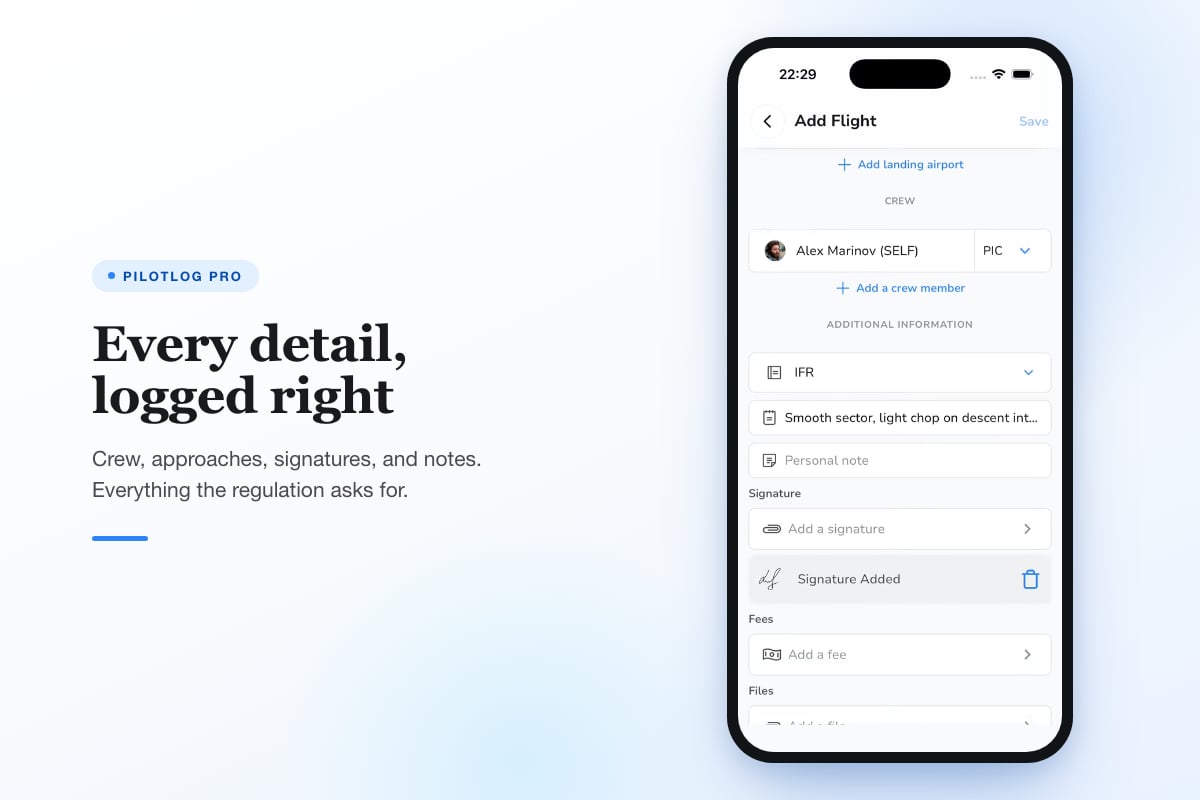
Pilotlog Pro automatically tracks rolling 28-day and 365-day flight-time and duty limits, passenger and night currency with lapse dates, and licence and medical expiry alerts flagged early, making it easier to stay current without manual calculations. Just as the airplane maintenance log book keeps the aircraft legal, a digital logbook keeps you legal and ready.

Renting and Flight School Aircraft
When you rent an aircraft or fly with a flight school, you should still check the airplane maintenance log book before flight. Flight schools and rental operations occasionally miss inspections or delay AD compliance. A prudent pilot asks to see the logs and confirms:
- Annual inspection is in date
- 100-hour inspection is current (if applicable)
- No open squawks or maintenance deferrals that affect airworthiness
Flight instructors often teach students to review logbooks during training, reinforcing the habit for the entire flying career. The lesson is simple: if the logbook is incomplete or the inspection is out of date, the aircraft is not airworthy and you cannot fly it legally.
Tracking currency and limits is just as important for pilots as tracking inspections is for aircraft owners. Resources such as the IFR currency guide and flight time limits reference help pilots understand their own obligations, just as the airplane maintenance log book governs the aircraft's obligations.
Best Practices for Owners and Operators
Owners who maintain meticulous airplane maintenance log books protect their investment and simplify annual inspections, insurance renewals, and resale transactions. A few best practices go a long way.
Regular Audits and Backup
Review your airplane maintenance log book quarterly to ensure all entries are complete, legible, and properly signed. If using paper logs, store them in a fireproof safe or safety deposit box when not in use. Scan or photograph every page and store digital copies in multiple locations (cloud storage, external hard drive, and printed backup). Loss of logbooks can devastate an aircraft's resale value.
Tracking Recurring Items
Create a spreadsheet or database to track recurring inspections, AD compliance intervals, and component life limits. List each item with its last-performed date, interval, and next-due date. This practice prevents surprises and allows you to budget for upcoming work.
Example tracking table:
| Item | Regulation/AD | Interval | Last Done | Next Due |
|---|---|---|---|---|
| Annual inspection | 14 CFR §91.409(a) | 12 calendar months | 15 March 2026 | 31 March 2027 |
| 100-hour inspection | 14 CFR §91.409(b) | 100 flight hours | 3,487.2 hrs | 3,587.2 hrs |
| AD 2023-18-07 (wing spar) | Recurring | 100 hrs or 12 months | 3,450 hrs | 3,550 hrs or March 2027 |
| ELT battery | 14 CFR §91.207(c) | 1 year or 50% life | 10 January 2026 | 10 January 2027 |
| Transponder/encoder test | 14 CFR §91.413 | 24 calendar months | 1 May 2025 | 31 May 2027 |
Linking this table to your airplane maintenance log book ensures nothing falls through the cracks. Digital maintenance tracking platforms automate these calculations and send alerts when items come due.
Choosing a Mechanic and Maintenance Shop
Select a mechanic or Part 145 repair station with a reputation for thorough, accurate recordkeeping. Ask to see sample logbook entries during your first visit. A quality shop will produce detailed, well-organised entries with clear references to technical data and legible signatures.
Continuity matters. Using the same mechanic or shop year after year builds familiarity with your aircraft's history and often catches developing issues before they become expensive problems. The mechanic who knows your airplane maintenance log book inside out can advise on upcoming life-limited components, recurring ADs, and cost-effective maintenance scheduling.
Handling Lost or Incomplete Logbooks
If logbooks are lost, stolen, or destroyed, reconstructing the airplane maintenance log book is possible but time-consuming. Gather all available supporting documents:
- Previous annual inspection sign-offs (from mechanic or shop records)
- Copies of Form 337 from the FAA aircraft registry
- Receipts and invoices for parts and labour
- Airframe and engine manufacturer's production records
- Previous owner records or sale documentation
An IA can perform a one-time inspection to establish a new "zero time" baseline for continuing inspections and AD compliance. Document the reconstruction thoroughly, and note the reason for the new logbook in the first entry. Some insurance companies and buyers remain wary of aircraft with reconstructed logs, which may reduce resale value.
Digital Transition and the Future of Maintenance Records
The aviation industry is steadily moving toward fully electronic airplane maintenance log book systems. The IATA digital aircraft operations roadmap outlines milestones for blockchain-based maintenance tracking, real-time data sharing, and global interoperability of electronic records. These systems promise to eliminate lost logbooks, automate compliance tracking, and improve safety through instant access to accurate maintenance histories.
Blockchain and Immutable Records
Blockchain technology offers an immutable, tamper-proof ledger for maintenance entries. Each entry is timestamped and cryptographically signed, creating a permanent record that cannot be altered retroactively. Blockchain-based airplane maintenance log book systems are already in pilot programmes at several airlines and corporate flight departments.
Benefits include:
- Fraud prevention: No one can backdate an inspection or delete an entry
- Global verification: Regulators, buyers, and insurers can independently verify records
- Component traceability: Track parts from manufacture through installation, removal, overhaul, and reinstallation across multiple aircraft
Challenges remain around data standards, regulatory harmonisation, and the cost of implementation for small operators and private owners.
Integration with Flight Operations
Modern aircraft equipped with datalink and ACARS transmit real-time fault codes and system status to ground-based maintenance systems. When a sensor triggers a fault, the system automatically creates a logbook entry and schedules the corrective maintenance. This integration reduces paperwork and ensures discrepancies are documented immediately.
For general aviation, portable electronic flight bags (EFBs) and tablet-based logbook apps allow pilots to review the airplane maintenance log book, weight and balance records, and aircraft documents from the cockpit. These tools streamline pre-flight checks and reduce the need to carry bulky paper logs on cross-country flights.
Pilots who track their personal flight time electronically often find value in digital logbook platforms that sync across devices and generate reports for currency, ratings, and career milestones. Similarly, electronic airplane maintenance log book systems offer owners and operators instant access to compliance status, upcoming inspections, and historical trends across their fleet.
Regulatory Evolution and Harmonisation
EASA, FAA, and other civil aviation authorities are updating regulations to accommodate electronic recordkeeping. The EASA continuing airworthiness rules now explicitly permit electronic records with appropriate safeguards. The FAA's acceptance of electronic signatures and scanned documents reflects a similar shift.
Global harmonisation remains a work in progress. Transferring an aircraft registered in one country to another can complicate electronic records if the receiving authority requires paper documentation or has incompatible data standards. Industry groups and ICAO working groups are developing common formats and standards to ease cross-border aircraft operations.
Training and Education on Logbook Practices
Proper airplane maintenance log book practice is taught in A&P schools, Part 147 programmes, and aviation maintenance management courses. However, many pilots and aircraft owners receive little formal instruction on how to read, interpret, and safeguard logbooks.
Flight training organisations should incorporate logbook review into private pilot training. Teaching students to check annual inspection dates, AD compliance, and total time in service builds habits that last a career. Similarly, owner transition training (common when buying a complex or high-performance aircraft) should include a thorough walkthrough of the airplane maintenance log book.
Online resources, manufacturer training, and FAA webinars supplement formal instruction. The UK CAA continuing airworthiness guidance provides sample forms and worked examples helpful to both UK and international operators.
Mechanics benefit from ongoing education as well. New ADs, revised manufacturer service bulletins, and evolving interpretations of regulations require continuous learning. Professional organisations such as the Aircraft Mechanics Fraternal Association and the Professional Aviation Maintenance Association offer seminars and publications on recordkeeping best practices.
An airplane maintenance log book is far more than a stack of paper or a database. It is the legal proof that an aircraft is airworthy, compliant, and safe to fly. Whether you own, operate, or simply rent aircraft, understanding what the logbook contains and how to check it keeps you legal and protects everyone on board. Pilotlog makes it easy to track your own flight hours, currency, and medical expiries with the same precision that a well-maintained airplane maintenance log book brings to the aircraft. Log your flights quickly, track your limits automatically, and receive early alerts so nothing catches you by surprise.
- maintenance log book
- aircraft airworthiness
- ad compliance
- 14 cfr 91.417
- faa form 337
A logbook that keeps itself.
Join the waitlist and be first in line when Pilotlog launches.
Free to join, no spam. Unsubscribe any time.