pilot logbook
Aviation Logbook Guide: Keeping Your Pilot Log Legal
13 Nov 2026 · 6 min read

An aviation logbook is legal when every flight entry carries the data your licensing authority requires and you can produce it on request. Which fields apply depends on who issued your licence: the UK CAA, an EASA state authority, or the FAA. This guide covers the UK CAA and EASA Part-FCL by default, and uses 14 CFR only where it names the FAA.
What is the main purpose of an aviation logbook?
Your logbook is the evidence that you hold the experience, recency and currency your licence demands. Authorities do not take your word for your hours. They ask for the record.
It serves three practical jobs:
- Proof of experience for licence issue, rating issue and renewal.
- Proof of recency for carrying passengers, night flying and instrument privileges.
- Proof of progress towards the next licence, such as the hours needed for an ATPL.
For UK applications, the CAA says logbook evidence must cover the requirements of the licence or rating sought. Paper-logbook copies should include the personal-details page and clearly identify the relevant experience.
What must each entry contain?
Each entry must record enough detail to show what you flew, where, when and in what capacity. The exact list differs by authority, so check the rule that governs your licence.
Under the FAA, 14 CFR § 61.51 requires the following for each flight or lesson:
- Date and total flight or lesson time
- Departure and arrival locations (or the training-device lesson location)
- Aircraft or device type and identification
- Safety-pilot name where one is required
The same rule requires you to identify the capacity: solo, pilot in command, second in command, or instruction received. You must also record day or night, actual or simulated instrument conditions, and night-vision goggle use where applicable.
For UK CAA and EASA licences, the equivalent requirements sit in the Part-FCL framework. Holders typically record the same core data: date, places and times of departure and arrival, aircraft type and registration, single-pilot or multi-pilot time, function on board, operational conditions and landings. If you are unsure which fields your authority mandates, read the current Part-FCL text on the official EASA or UK CAA site before relying on a template.

Is a digital aviation logbook accepted?
A digital logbook is accepted if you can produce it in the form your authority asks for. The UK CAA states that for licence or rating applications, electronic logbooks must be downloaded and submitted, and electronically signed to identify the owner.
That means the app you pick needs a proper export, not just a screen you can show an examiner. Test it before you need it. Export a full logbook, open the file, and confirm the totals match your records.
Whatever the format, keep a backup. A phone lost in a crew room should not erase your career total.
How do you check recency in your pilot log?
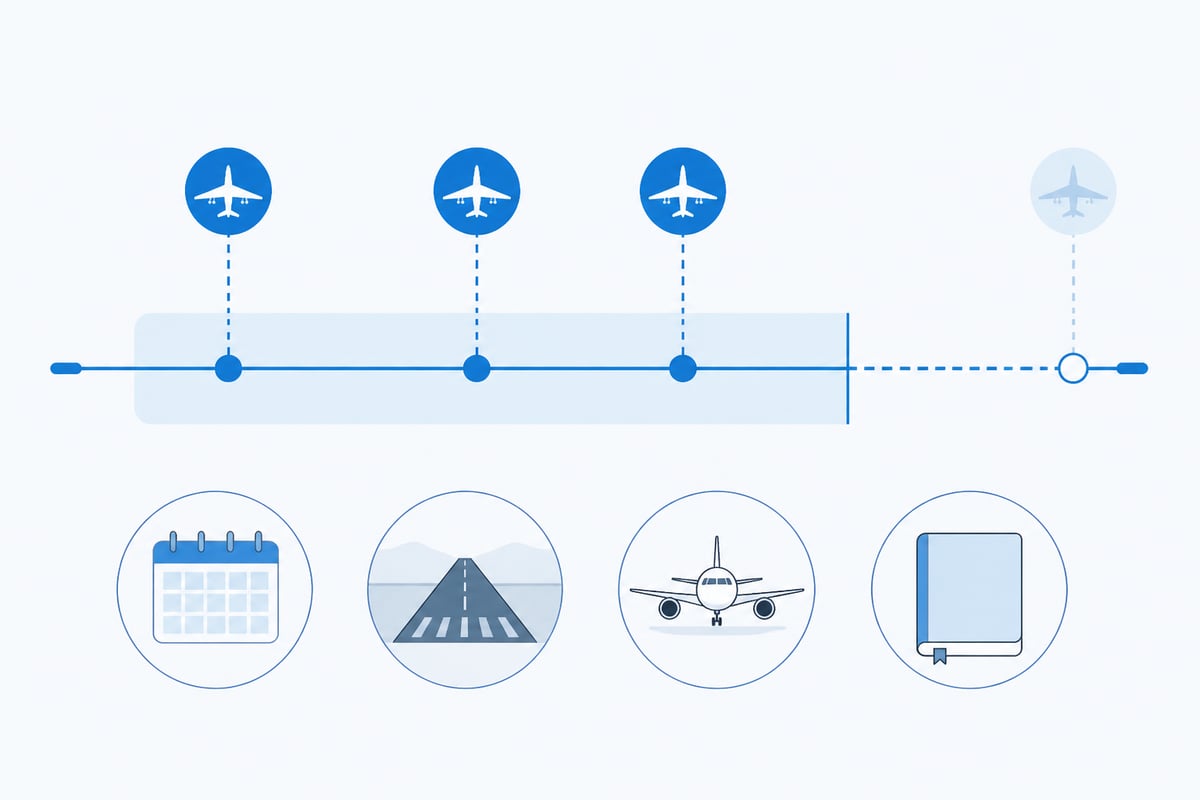
You check recency by counting qualifying events inside the rolling window your rule specifies, then confirming the oldest event has not aged out. Under EASA Part-FCL, one common test is the passenger-carrying requirement tied to recent take-offs and landings in a rolling window. Always confirm the current wording and number of landings for your licence type.
Worked example (EASA, FCL.060(b))
Today is November 12, 2026. You want to carry a passenger. Your last four landings:
| Date | Landings | Days before Nov 12 |
|---|---|---|
| August 20, 2026 | 2 | 84 |
| September 18, 2026 | 1 | 55 |
| October 7, 2026 | 1 | 36 |
Arithmetic: counting back from November 12, 2026 gives the start of the window. All three dates fall inside it. Landings in window: 2 + 1 + 1 = 4.
Now look ahead. The August 20 landings will drop out of the window in mid-November. After that, your count falls, and you may no longer be current for passengers unless you fly again. A good logbook shows that lapse date without you counting by hand.

Which paper or digital logbook suits your career stage?
The right choice depends on how much you must total and how often you must prove it. Compare the main options on what a licensed pilot actually needs:
| Format | Auto totals | Currency view | Export for authority |
|---|---|---|---|
| Paper logbook | No, manual | No | Copies of pages |
| Spreadsheet | Formulas you build | Only if you build it | Printout or file |
| Digital app | Yes | Often | Depends on the app |
Student and private pilots usually need clean totals and a warning before a medical or rating lapses. Airline and career pilots also need rolling limits and progress towards ATPL hours.
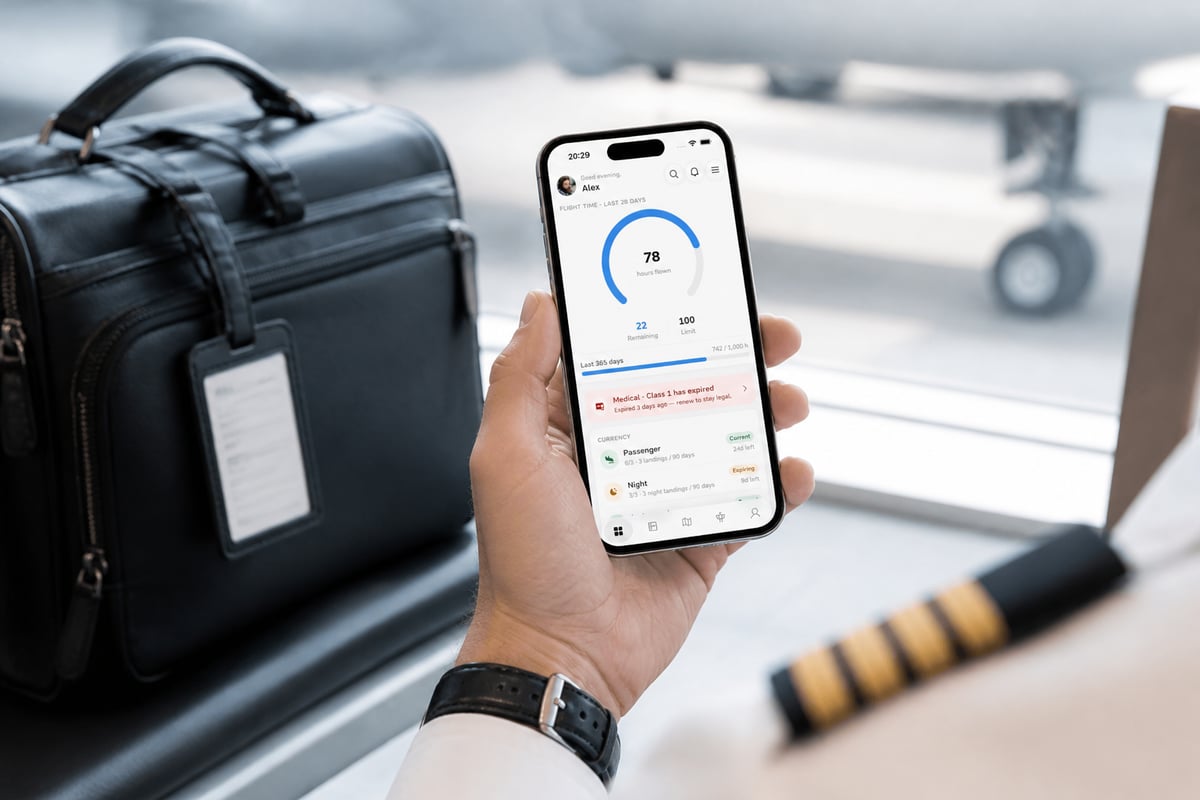
Pilotlog Pro tracks rolling flight-time limits, passenger, night and IFR currency with lapse dates, and early flags for licence and medical expiry. You can see how Pro works and what it includes before deciding. It does not replace your own check of the regulation. It does the counting.
What are common logbook mistakes?
The most common mistakes are small omissions that become large problems at application time. Check for these:
- Missing aircraft registration, which makes time unverifiable.
- Mixing PIC and dual time on one line without splitting them.
- Logging night time without checking the definition in your rules.
- No signature or countersignature where your authority expects one.
- Totals carried forward with an arithmetic error that compounds for years.
Reconcile your totals regularly. A wrong carry-forward is far easier to fix now than during an ATPL application.
FAQ
What is the best online logbook for pilots?
The best one is the one that records every field your authority requires, calculates totals correctly and exports a signed file you can submit. Judge it on those points, not on features. Check the export before you commit your whole history to it.
What is required in an aircraft maintenance logbook entry?
An aircraft maintenance record is separate from your pilot logbook and is kept by the owner or maintenance organisation. Requirements come from the airworthiness rules of the authority that oversees the aircraft, such as EASA Part-M or the UK equivalent. Check the current regulation and your approved organisation's procedures, because the content is set by those rules.
What are the 5 C's in aviation?
There is no single official list, and versions vary between training organisations. A common checklist for a lost or uncertain situation is confess, climb, communicate, comply and conserve. Treat it as a memory aid from your instructor's briefing, not as a regulation.
Summary
- Log every flight with the data your governing authority requires.
- Say which authority applies: UK CAA, EASA or FAA. Do not mix their figures.
- Passenger recency under EASA is 3 take-offs and landings in 90 days (FCL.060(b)).
- Electronic logbooks for UK applications must be downloaded, submitted and electronically signed.
- Back up your records and reconcile totals regularly.
Rules change. Check current official sources, including the U.S. Part 61 regulations, EASA and the UK CAA, before relying on any figure here.
Open your logbook today and check the date your oldest qualifying landing falls out of the 90-day window. If you would rather have that counted for you, with Pilotlog Pro showing lapse dates and flagging medical and licence expiries early, Pilotlog lets you join the waitlist and log your next flight in a few taps after landing.
- pilot logbook
- part-fcl
- logbook recency
- digital logbook
- easa currency
A logbook that keeps itself.
Join the waitlist and be first in line when Pilotlog launches.
Free to join. We’ll email you about the launch and Pilotlog news. Unsubscribe any time. Privacy policy