airplane flying handbook
Flying Handbook: Core Reference for Safe Pilot Practice
18 Sep 2026 · 13 min read

A flying handbook is your structured reference for the aerodynamic principles, aircraft systems, operational procedures, and decision-making frameworks that underpin safe flight. Whether you're learning the basics of lift and drag or reviewing emergency checklists before a check ride, this manual translates aviation theory into practical guidance you can apply in the cockpit. Every certificated pilot started with one, and most keep a copy close by for refreshers and regulation checks throughout their career.
What a Flying Handbook Contains
The FAA Airplane Flying Handbook (FAA-H-8083-3C) and similar texts structure their content around core competencies. You'll find chapters on ground operations, basic flight manoeuvres, slow flight, stalls, spins, takeoffs, approaches, landings, performance calculations, and emergency procedures. Each chapter builds from fundamental principles to complex scenarios, giving student pilots a roadmap and experienced pilots a quick refresher.
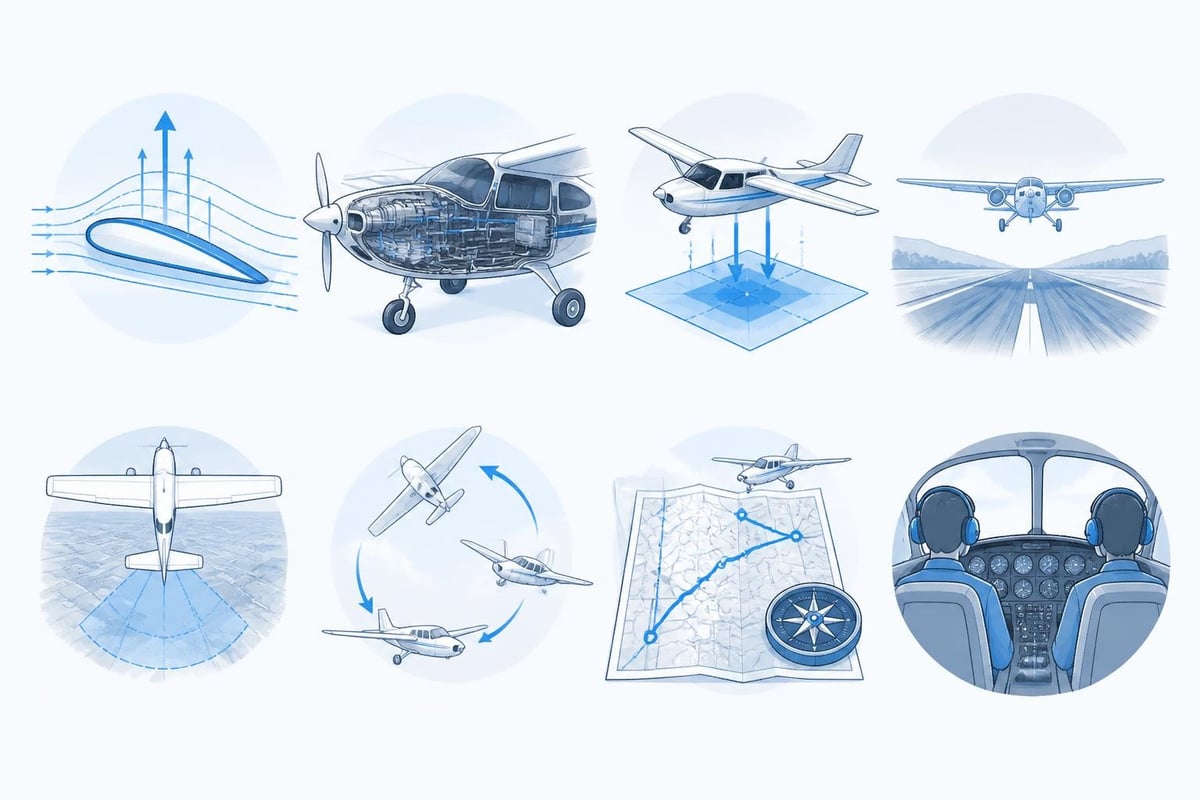
Most flying handbooks open with aerodynamics. Lift, weight, thrust, and drag are not abstract concepts when you're managing angle of attack on short final. The handbook explains how airfoil shape, angle of incidence, and relative wind combine to generate lift, then shows how exceeding critical angle of attack leads to a stall regardless of airspeed. That clarity is why instructors refer students back to the handbook when correcting approach-to-stall recovery technique.
Flight Manoeuvres and Procedures
Straight-and-level, climbs, descents, turns, steep turns, slow flight, and power-off stalls each receive dedicated sections. The handbook specifies entry altitude, power settings, configuration, clearing turns, and recovery steps. When you log practice manoeuvres, you're validating that your technique matches the standards laid out in these pages.
Ground-reference manoeuvres appear later in most handbooks. Rectangular patterns, S-turns, and turns around a point teach wind correction and bank management at low altitude. The handbook diagrams show how to adjust your track over the ground so your path remains symmetric despite a crosswind. A student struggling with these patterns can re-read the relevant chapter, visualise the wind drift, and refine technique on the next lesson.
Using Your Flying Handbook for Training
Student pilots usually receive a flying handbook on day one or shortly after the introductory flight. Your instructor assigns reading before each lesson so you arrive with a mental model of the manoeuvre or concept. After the flight, you review the same chapter to compare what you experienced against the manual's description. That loop of read, fly, review builds understanding faster than either activity alone.
- Pre-flight study: Read the assigned chapter, highlight key airspeeds and configurations, and write down any questions.
- In-flight application: Practise the manoeuvre or procedure under instructor supervision, noting differences between plan and execution.
- Post-flight review: Compare your performance against handbook standards, identify gaps, and plan corrective practice.
Many pilots annotate their handbooks with notes from their instructor or personal reminders. A quick pencil mark next to the crosswind-landing diagram noting "use less aileron, more rudder" becomes a personalised reference for the next windy-day session. Over time, your handbook accumulates these insights, transforming a generic manual into a tailored training record.
Regulatory Knowledge and Operational Limits
A comprehensive flying handbook also covers airspace, weather minimums, medical and licence currency, and operational regulations. The Pilot's Handbook of Aeronautical Knowledge (PHAK) dedicates entire chapters to these topics, ensuring pilots understand the legal framework alongside stick-and-rudder skills.
For example, VFR weather minimums change by airspace class. Class B requires 3 statute miles visibility and clear of clouds; Class E below 10,000 feet MSL requires 3 statute miles and 500 feet below, 1,000 feet above, 2,000 feet horizontal from clouds. Your handbook lists these figures in a table so you can verify compliance before departure. Misremembering a cloud-clearance rule can land you in an enforcement action, which is why periodic review matters.
Currency requirements also appear in regulatory sections. To carry passengers, FAA rules (14 CFR 61.57) require three takeoffs and landings in the preceding 90 days in the same category, class, and type (if a type rating is required). If those landings were to a full stop at night, you're current for night passenger-carrying. Keeping track of these 90-day windows is easier when you log flights digitally and set alerts for approaching lapses.
| Requirement | Regulation | Period | Detail |
|---|---|---|---|
| Passenger currency (day) | 14 CFR 61.57(a) | 90 days | 3 takeoffs and landings, same category/class |
| Passenger currency (night) | 14 CFR 61.57(b) | 90 days | 3 full-stop landings, 1 hour after sunset to 1 hour before sunrise |
| IFR currency (US) | 14 CFR 61.57(c) | 6 months | 6 approaches, holding, intercepting/tracking |
| Biennial Flight Review | 14 CFR 61.56 | 24 months | 1 hour ground, 1 hour flight with CFI |
Weather and Flight Planning Guidance
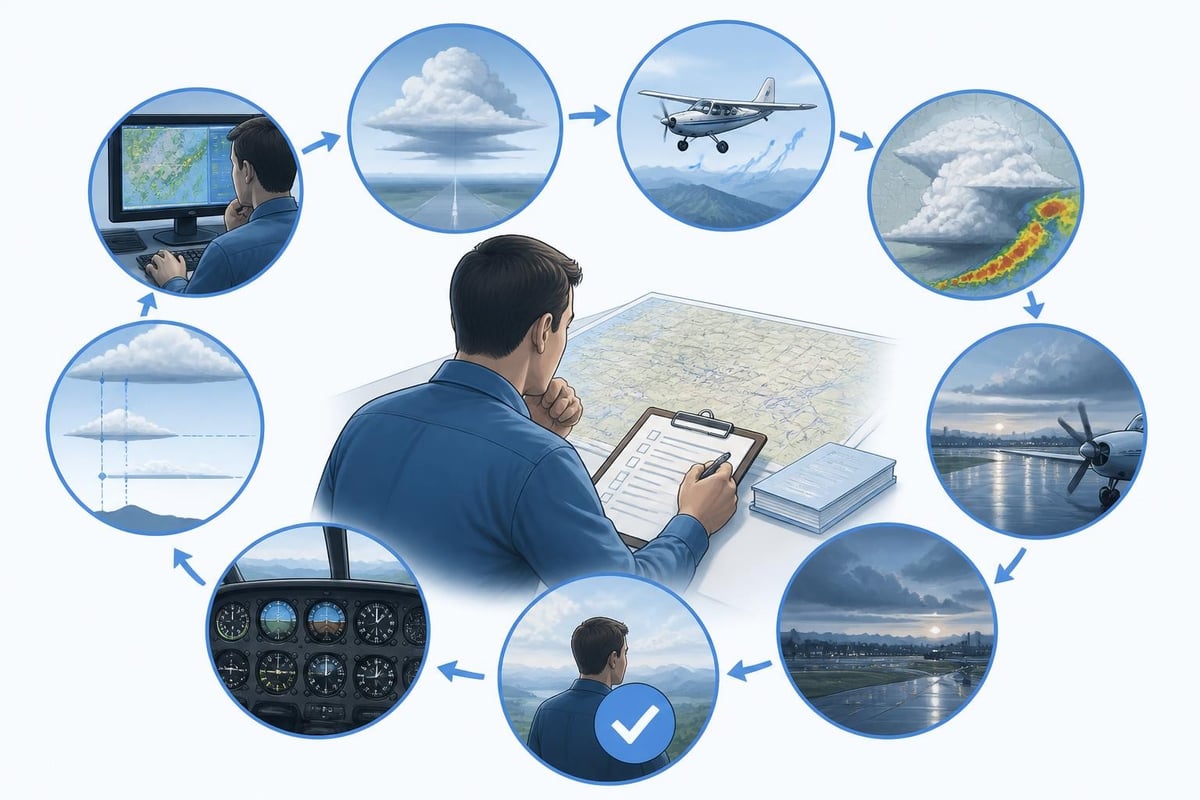
Weather chapters in a flying handbook explain how to decode METAR and TAF reports, interpret surface-analysis charts, and assess convective activity. Many pilots bookmark these pages because weather decoding is a perishable skill. If you fly infrequently, refreshing your memory on TAF amendment codes (AMD) or temporary changes (TEMPO) before calling for a briefing ensures you extract the right information.
The handbook also covers density-altitude calculations and performance planning. On a hot summer day at a high-elevation airport, your aircraft's performance resembles operation at a much higher pressure altitude. The manual walks through the calculation: find pressure altitude, apply temperature correction, then use the performance charts to determine takeoff distance and climb rate. Those extra 400 feet of runway you need aren't optional; they're the difference between a safe departure and an accident.
For structured pre-flight planning, many pilots consult the Aviation Weather Center alongside their handbook. The combination of theoretical knowledge and current data creates a complete picture of what you'll encounter aloft.
Emergency Procedures and Systems Knowledge
Engine failure, electrical-system malfunctions, and unexpected weather are covered in dedicated chapters. The handbook specifies memory items for immediate action (best-glide speed, fuel selector both, magnetos check) and follow-up checklists for troubleshooting. Reviewing these procedures regularly keeps them accessible when stress narrows your focus in a real emergency.
Systems knowledge underpins effective troubleshooting. If your alternator fails, understanding that the battery will power essential avionics for a limited time helps you prioritise a landing at the nearest suitable airport. The flying handbook diagrams the electrical system, showing which buses are battery-backed and which shed load first. That schematic is invaluable when you're interpreting a low-voltage annunciator at 4,500 feet.
Keeping Your Knowledge Current
Regulations change. Aircraft systems evolve. New safety guidance emerges from accident investigations. A flying handbook from 2016 may not reflect updated medical-certificate durations or the latest spin-recovery techniques. Periodically check for revised editions and supplements, especially if you're preparing for a check ride or biennial flight review.
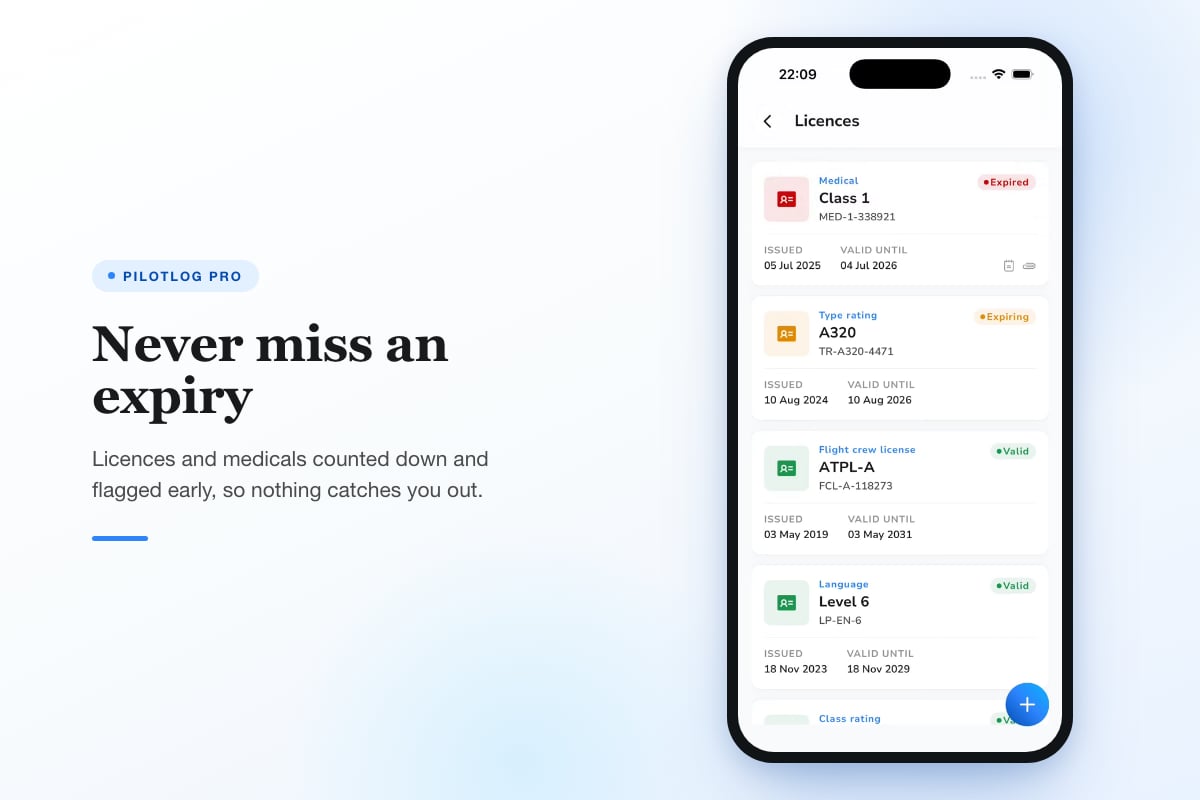
Digital logbooks help bridge the gap between handbook study and operational currency. Pilotlog Pro tracks rolling 28-day and 365-day flight-time totals, passenger and night currency with lapse dates, and IFR recency, flagging upcoming expiries so you can plan refresher flights before you lose legal privileges. Combining handbook knowledge with automated tracking ensures you stay both proficient and compliant.
Many pilots also follow updates from regulatory authorities and safety organisations. The NTSB Safety Alerts highlight recurring issues such as fuel exhaustion or loss of control, and the handbook often references these lessons learned in its safety chapters. Reading accident summaries reinforces the "why" behind procedures your handbook prescribes.
Integrating Handbooks Into Recurrent Training
After earning your licence, the flying handbook remains a valuable resource for recurrent training. Before a flight review, re-read the chapters on slow flight, stalls, and steep turns to refresh standards. Your instructor may ask you to demonstrate a chandelle or lazy eight, and the handbook diagrams make those manoeuvres clearer than a verbal description alone.
If you're adding an instrument rating or multi-engine class, companion handbooks cover those topics in depth. The Instrument Flying Handbook and the Multi-Engine Flying Handbook follow the same structure as the airplane flying handbook, making cross-referencing straightforward. You already know where to find systems, manoeuvres, and emergencies; the new content layers onto a familiar framework.
Comparing International Guidance
Pilots operating under EASA or other authorities benefit from consulting their own national handbooks alongside FAA publications. EASA Easy Access Rules cover air operations, licensing, and training requirements specific to EU member states. For example, EASA Part-FCL defines recency requirements that differ slightly from 14 CFR 61.
Similarly, Transport Canada's Flight Instructor Guide (TP 975) offers an instructor perspective on training syllabi and performance standards. Comparing these documents with the FAA flying handbook reveals common principles (energy management, aerodynamic stalls) and jurisdiction-specific nuances (medical validity periods, controlled-airspace definitions). Understanding both sets of rules matters if you fly internationally or plan to convert licences.
| Authority | Core Handbook | Key Difference |
|---|---|---|
| FAA (US) | Airplane Flying Handbook (FAA-H-8083-3C) | 90-day passenger currency; 6-month IFR currency |
| EASA (EU) | Not single handbook; Part-FCL + national guides | 90-day passenger currency (FCL.060); 6-month IFR currency (variant approaches) |
| Transport Canada | Flight Training Manual (TP 975 for instructors) | Similar currency; metric altitudes; slightly different medical classes |
| UK CAA | Supplements EASA; CAP 737 for human factors | EASA base + UK-specific amendments; CAP 737 adds CRM depth |
Human Factors and Decision-Making
Modern flying handbooks devote significant space to human factors, aeronautical decision-making (ADM), and crew resource management (CRM). The IMSAFE checklist (Illness, Medication, Stress, Alcohol, Fatigue, Eating/Emotion) appears early in many manuals, reminding pilots to assess personal fitness before every flight. Single-pilot operations lack the cross-checks of a multi-crew cockpit, so self-awareness becomes critical.
The UK CAA's Flight-Crew Human Factors Handbook (CAP 737) expands on these themes with case studies, competency frameworks, and threat-and-error management models. Reading CAP 737 alongside your flying handbook adds depth to decision-making chapters, showing how to identify subtle cognitive biases (confirmation bias, plan continuation) that degrade safety margins.
Practical ADM tools include the PAVE checklist (Pilot, Aircraft, enVironment, External pressures) and risk matrices that score each factor. Your handbook explains how to apply these frameworks during pre-flight planning and in-flight replanning. If conditions deteriorate en route, revisiting PAVE helps you decide whether to divert, reduce altitude, or return to departure.
Training Aids and Companion Resources
A flying handbook is rarely the only reference on your shelf. Pilots also keep aircraft-specific pilot's operating handbooks (POH), FAA advisory circulars, and airspace charts nearby. The POH contains performance data, weight-and-balance envelopes, and emergency checklists unique to your make and model, while the flying handbook provides the general aerodynamic and procedural foundation.
Many pilots supplement handbook study with online courses, video tutorials, and interactive apps. However, these tools should reinforce, not replace, the handbook. An animated video on Dutch rolls is helpful, but the written procedure in the manual ensures you remember the steps under pressure. SKYbrary offers safety-knowledge articles and operational guidance that complement handbook chapters on risk management and flight operations.
Practical Application Scenarios
Consider a scenario: you're planning a cross-country flight from a sea-level airport to a mountain destination. Your flying handbook walks you through the process.
- Performance planning: Calculate density altitude at the destination using field elevation, temperature, and altimeter setting. Apply the correction to takeoff and landing distances in your POH.
- Weather assessment: Decode the TAF for destination and alternate, confirm VFR minimums, and check convective outlook for en-route thunderstorms.
- Fuel planning: Compute cruise fuel burn, add reserves for headwind and alternate, then verify total fuel required fits within usable capacity and weight limits.
- Route selection: Choose altitudes that clear terrain by at least 1,000 feet (2,000 in mountainous areas), and confirm controlled-airspace compliance.
- Go/no-go decision: Weigh PAVE factors, review IMSAFE, and confirm you're current for the planned operation (day VFR, or night, or IFR).
Each step references a chapter in your flying handbook. Performance planning links to density-altitude and chart-reading sections. Weather ties to meteorology and decoding chapters. Fuel and weight-and-balance connect to systems and operations. This integrated approach mirrors how the handbook is organised: discrete chapters that combine into a complete flight-planning workflow.
Tracking Your Progress and Currency
As you accumulate hours and endorsements, your logbook becomes the record of how you've applied handbook knowledge in real flight. Logging each cross-country trip, night flight, and instrument approach proves you've met the practical requirements for advanced certificates and ratings. Digital platforms make this tracking seamless, automatically tallying hours by category, class, and conditions of flight.
IFR currency, for instance, requires six instrument approaches, holding procedures, and intercepting and tracking courses within the preceding six months (14 CFR 61.57(c)). A digital logbook flags the date your currency will lapse, prompting you to schedule a practice session or instrument-proficiency check in time. That automation frees you to focus on proficiency rather than spreadsheet arithmetic.
For broader career planning, tracking total hours, multi-engine time, and PIC cross-country supports applications for commercial certificates, flight-instructor ratings, and airline positions. The flying handbook sets the standards; your logbook proves you've met them. Together, they form a closed loop: study, fly, log, review, repeat.
Advanced Topics and Specialised Handbooks
Beyond the core airplane flying handbook, the FAA publishes specialised manuals for helicopters, gliders, balloons, weight-shift control, and powered parachutes. Each follows a similar structure (aerodynamics, systems, manoeuvres, emergencies) but adapts the content to the unique characteristics of that aircraft category. If you transition from fixed-wing to rotorcraft, the Rotorcraft Flying Handbook becomes your new primary reference.
Instrument and multi-engine handbooks add layers of complexity. The Instrument Flying Handbook covers attitude instrument flying, navigation systems, approach procedures, and missed-approach criteria. The Multi-Engine Flying Handbook explains asymmetric thrust, Vmc, engine-out procedures, and systems redundancy. Mastering these texts requires the same discipline you applied to the basic flying handbook: read, fly, review, and annotate.
Safety organisations also publish guidance that complements official handbooks. Flight Safety Foundation articles on manual-flying skills, automation management, and long-term proficiency trends inform modern training syllabi. Reading these pieces alongside your handbook keeps your knowledge aligned with current best practice, not just regulatory minimums.
Maintaining a Reference Library
Experienced pilots maintain a small library: the flying handbook, PHAK, relevant instrument or multi-engine manuals, current far/aim (Federal Aviation Regulations / Aeronautical Information Manual), and perhaps CAP 737 or ICAO guidance. Digital versions on a tablet reduce weight and allow quick keyword searches, but many pilots still prefer printed copies for cockpit reference and margin notes.
Update your library every few years. The FAA revises handbooks to reflect new training techniques, accident lessons, and regulatory changes. An outdated manual may omit recent updates to medical-certificate durations or BasicMed eligibility, leading to confusion during a check ride or ramp check. Verify publication dates and download the latest PDFs from official sources.
ICAO operational safety guidance and EASA materials also evolve. If you fly internationally or operate under multiple jurisdictions, bookmark these sites and check for amendments quarterly. Regulatory harmonisation is ongoing, but differences remain, and your handbook collection should cover all applicable rules.
A flying handbook translates complex aerodynamic, regulatory, and procedural knowledge into actionable steps you can apply from pre-flight planning through landing rollout. Keeping that reference current and integrated with your logbook ensures you remain both proficient and compliant. Pilotlog tracks your flight hours, currency windows, and licence expiries in real time, so the knowledge in your handbook translates into safe, legal operations every flight. Log a trip in seconds on iOS or Android, and let automated alerts handle the rest.
- airplane flying handbook
- phak
- pilot training
- vfr minimums
- currency requirements
A logbook that keeps itself.
Join the waitlist and be first in line when Pilotlog launches.
Free to join, no spam. Unsubscribe any time.