flying academy
Flying Academy: Complete Guide for Student Pilots 2026
4 Nov 2026 · 8 min read
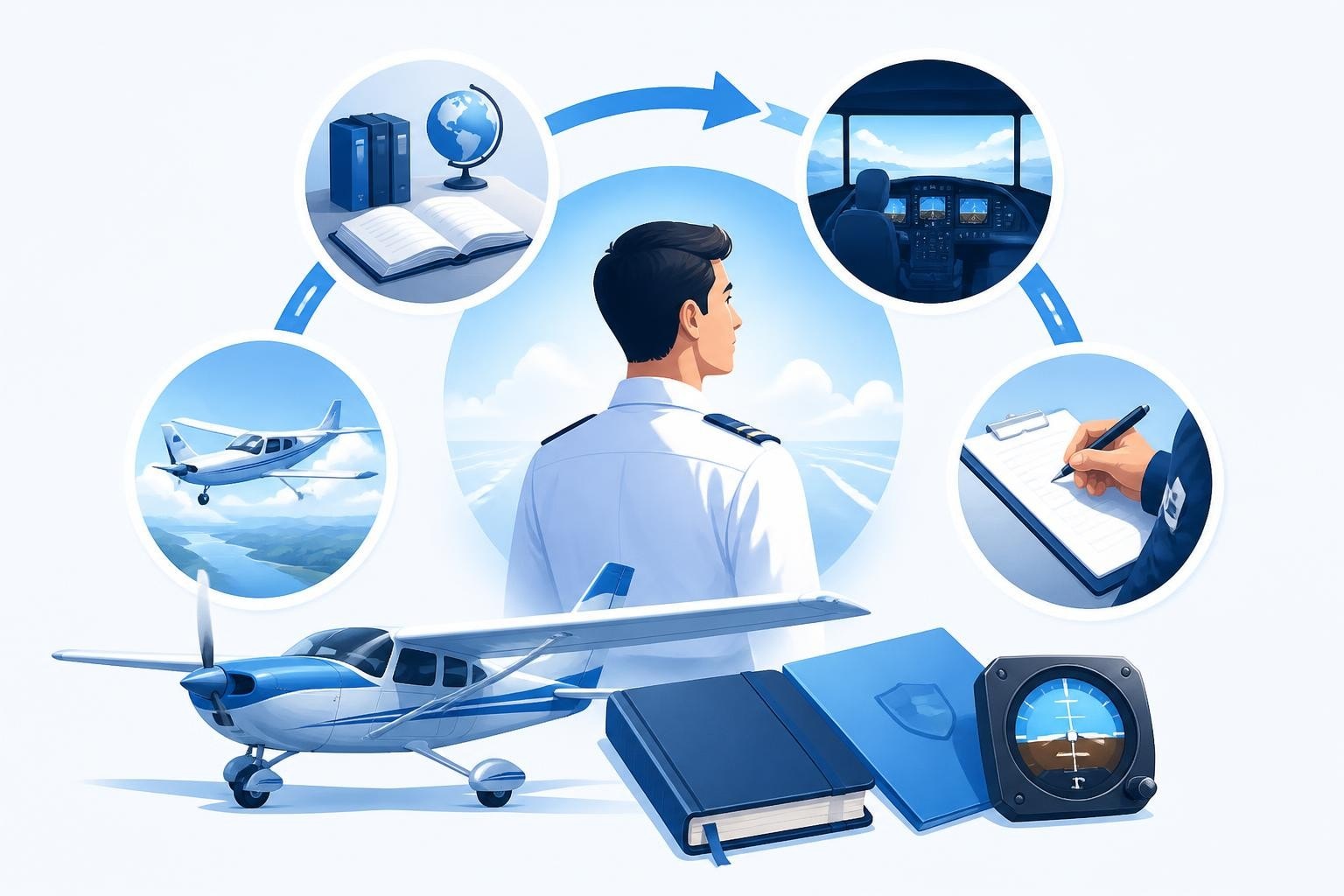
A flying academy is a structured training organization that takes you from zero flight hours to a commercial or airline transport pilot licence through integrated or modular syllabi. Most academies offer Part-FCL Approved Training Organisation (ATO) or FAA Part 141 approval, meaning the regulatory authority has validated their curriculum, instructors, aircraft, and safety management system. Unlike loose clubs or ad-hoc instruction, an academy delivers standardised training designed to meet Airman Certification Standards or EASA FCL requirements within a defined timeline and budget.
What defines a flying academy
An academy differs from a simple flight school in scope and integration. Academies typically deliver the full PPL, CPL, ATPL theory, instrument rating (IR), and multi-engine class rating (MEP) under one roof, often through partnerships with simulator centres and airline cadet schemes. Their approval status matters: EASA Part-DTO (Declared Training Organisation) allows PPL and LAPL training, while ATO status permits CPL, IR, and ATPL integrated courses. In the United States, FAA Part 141 schools follow tighter syllabi and allow pilots to meet minimum hour requirements below Part 61 thresholds (190 hours vs 250 hours for CPL, for example).
The FAA training resources page outlines syllabus design and instructor guidance, while EASA's recent virtual classroom guidance shows how academies have integrated remote theory delivery post-2020. The 'State of Flight Training 2025' report notes that 68% of Part 141 schools now use blended learning for ATPL theory, mixing live sessions with asynchronous modules.
Choosing the right flying academy
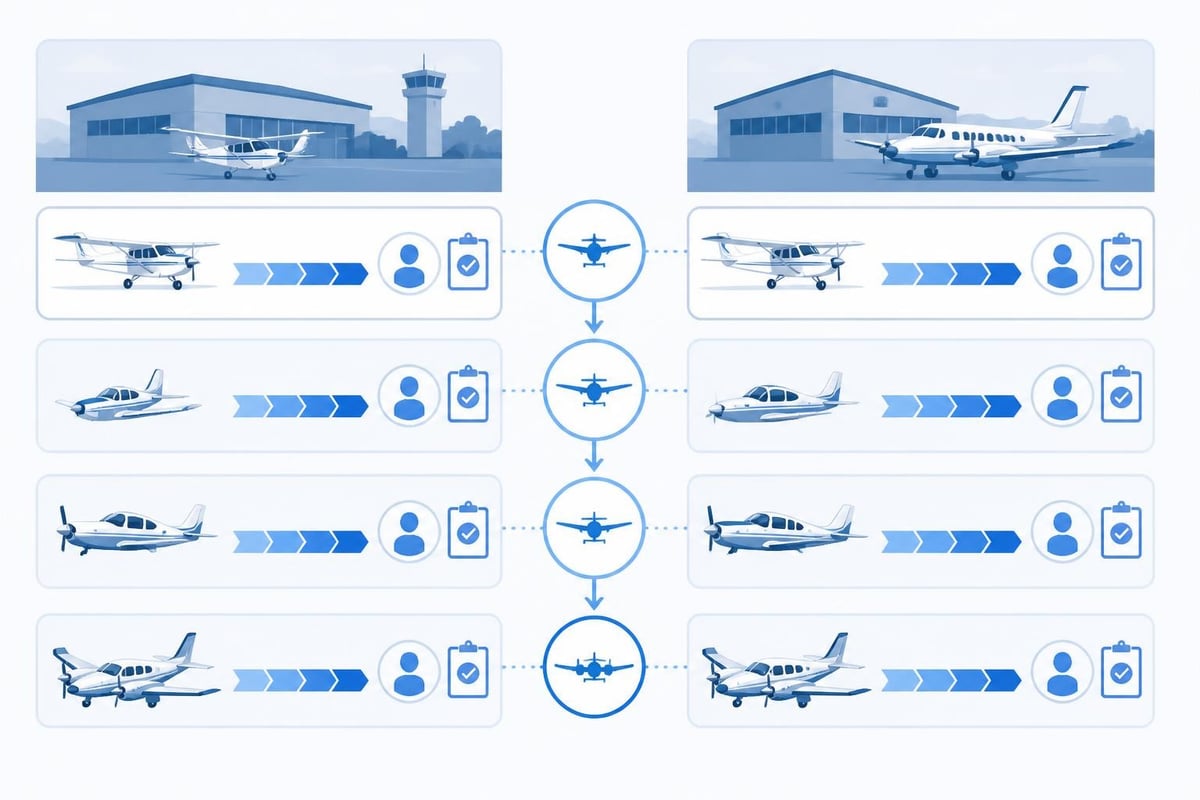
Start by checking approval status and accident history. EASA ATO certificates are searchable on national CAA websites; FAA Part 141 approvals appear in the FAA database. Look for fleet age and diversity: academies with Cessna 152, PA-28, Cessna 172 (G1000), and a multi like the DA42 or Piper Seminole give you exposure to different systems. Ask how often aircraft are replaced and check their maintenance schedule transparency.
Instructor ratio and retention tell you more than brochure photos. An academy turning over instructors every six months cannot deliver continuity. Ask for average instructor tenure and student-to-instructor ratios during peak intake. A 1:4 ratio is workable; 1:8 means delayed bookings and slow progress.
Key questions to ask
- What is the first-time pass rate for skills tests in the last 24 months? (EASA examiners and FAA DPEs report this to authorities; academies should share it.)
- Do you offer fixed-price contracts with defined stage checks, or pay-as-you-go? Fixed contracts protect you if fuel or instructor rates rise mid-course.
- What weather minimums ground training flights, and what is the historical utilisation rate November to February? (UK/Northern European academies often see 40–50% cancellations in winter; some send cadets to Arizona or Spain for phase-two training.)
- Does the academy integrate competency-based training and assessment (CBTA) methods? The IATA CBTA library outlines how modern academies shift from hours-only to competency milestones, improving safety outcomes.
| Factor | EASA ATO | FAA Part 141 | Part 61 School |
|---|---|---|---|
| Minimum CPL hours | 150 (integrated) or 200 (modular) | 190 | 250 |
| Syllabus approval | Yes (CAA) | Yes (FAA FSDO) | No |
| Theory exams | EASA centralised (13 subjects) | FAA written (single test per cert) | FAA written |
| Skills test standardisation | High | High | Moderate |
| Typical duration (zero to CPL/IR) | 14–18 months | 12–16 months | 18–24 months |
What training looks like day to day
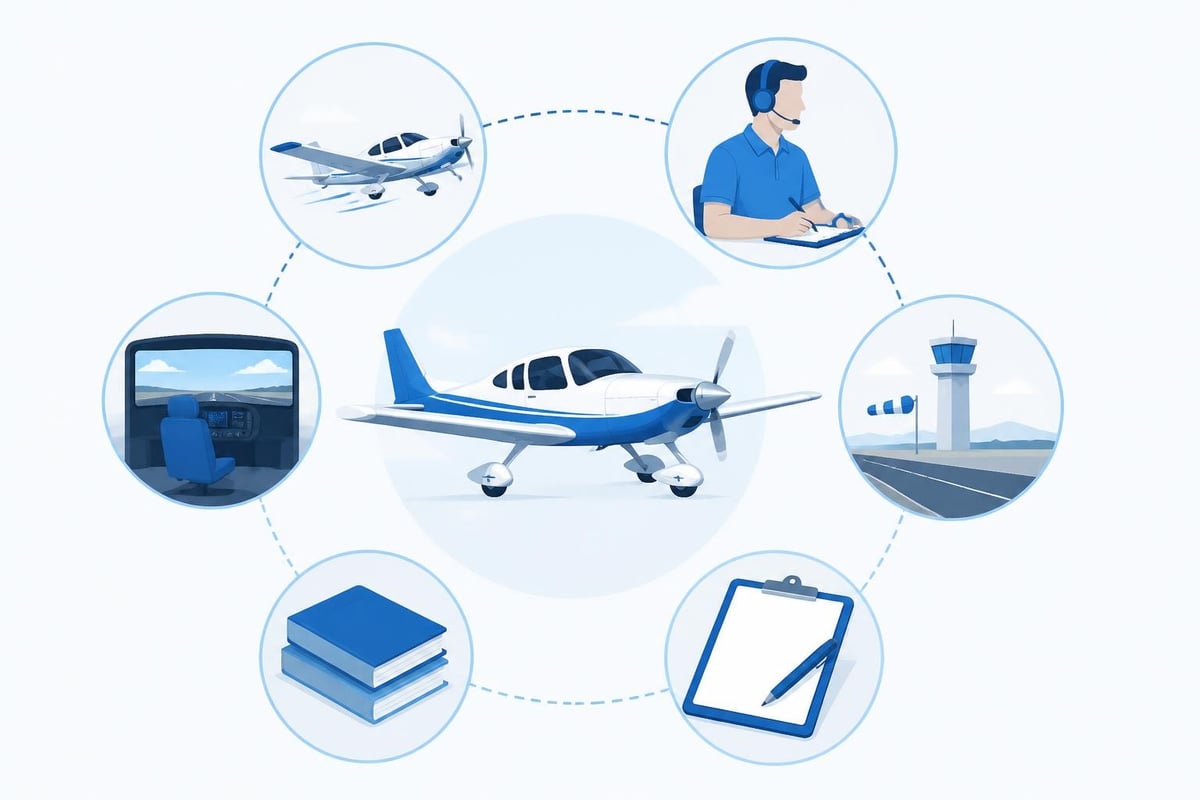
Integrated courses lock you into a sequence: PPL groundwork and 45 hours, then ATPL theory (650 hours classroom or blended), CPL flight phase (55 hours including MEP and IR), then final skills tests. Modular routes let you pause between ratings, useful if you are self-funding or balancing work. The FAA Airman Certification Standards define every task and tolerance for each checkride; EASA Part-FCL does the same through AMC/GM material.
A typical week mid-course might include:
- Monday: Two simulator sessions (instrument approaches, engine failures on multi)
- Tuesday: ATPL theory classroom (meteorology module 4, frontal systems)
- Wednesday: Two solo flights (nav exercises, consolidation)
- Thursday: One dual flight (IR holds, procedure turns), one ground brief for Friday's cross-country
- Friday: Dual cross-country (150 nm each leg, landing at two new airfields)
Currency tracking becomes essential during training. FCL.060(b) requires three take-offs and landings in the preceding 90 days to carry passengers. Even as a student, you lose recency if gaps stretch beyond two weeks; academies schedule stage checks to avoid this. Research on human factors in simulation shows that scenario-based training with realistic time pressure improves decision-making under stress-something progressive academies build into their advanced phases.
Costs and financing
The AOPA pilot training cost guide estimates $80,000–$100,000 (USD) for zero to CPL/IR in the US, while UK/European ATO integrated courses run £70,000–£90,000 depending on whether you train domestically or split phases between countries. Modular training costs less up-front but often more overall due to inefficiencies and duplicate admin.
Some academies tie financing to airline cadet schemes: you sign a training bond, the academy or partner bank funds tuition, and you repay from salary once hired. Default terms vary; read carefully. Others offer pay-by-phase or monthly payment plans at typical APRs of 6–9% for creditworthy applicants.
Budget separately for:
- Accommodation and living (£600–£1,200/month near major academies)
- Exam fees (EASA ATPL theory: ~£2,000; FAA writtens: ~$600 total)
- Medical (EASA Class 1: £350–£500 initial, then revalidation every 12 months under age 40)
- Checkride/skills test fees (DPE or examiner: £500–£800 per test; aircraft hire: £200–£400)
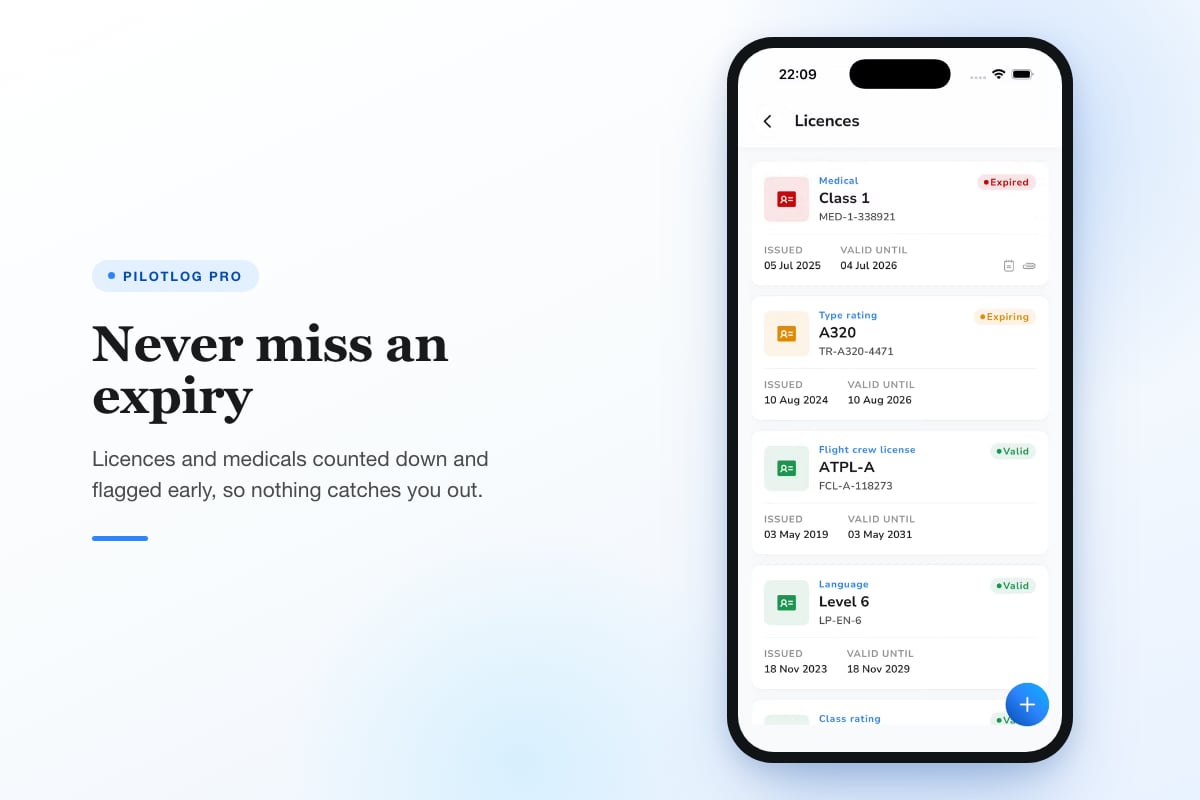
When you track every flight, your hour counts determine eligibility for ratings and jobs. Pilotlog Pro automatically calculates rolling totals-28-day and 365-day flight and duty time, night and IFR recency, and warns when licence or medical expiries approach. That precision matters when an academy submits your training record to the authority or when you apply to airlines expecting exact, verifiable hours.
Technology and training innovation
Virtual reality and advanced simulation have moved from experimental to mainstream. Academic research on VR training devices confirms that high-fidelity headset-based scenarios improve spatial awareness and reduce time-to-solo, particularly for instrument scanning and emergency procedures. Several European academies now include 10–15 hours of VR in their PPL phase, credited toward the total if the device holds at least EASA FSTD Level 1 or FAA ATD approval.
Blended learning for ATPL theory is now standard. Students watch recorded lectures, complete adaptive quizzes, then attend live sessions for complex topics like performance calculations and flight planning. EASA's 2025 guidance formalises this, allowing up to 50% of theory hours as virtual classroom if the ATO's exposition and quality system document it. This flexibility helped academies continue training during lockdowns and now reduces costs by sharing instructor time across multiple intakes.
Many academies also publish live dashboards showing aircraft availability, instructor schedules, weather, and student progression. You log in, see your next five lessons, book slots, upload pre-flight briefs, and review debrief notes. Integration with digital logbooks means your hours sync automatically-no double entry, no arithmetic errors when the examiner asks for your totals.
Tracking progress and staying current
Training spans months or years, and it is easy to lose track of recency, medical expiry, or theory exam validity (EASA ATPL theory credits expire 36 months from the first pass if you do not complete the CPL skills test; FAA writtens expire 24 months). A robust tracking system flags these dates early.
During training you also accumulate PIC, dual, solo, night, instrument (actual and simulated), cross-country, and multi-engine time. Airlines and charter operators want these broken down precisely. Delta Flight Academy graduates, for example, need 78 multi-engine PIC hours minimum before some regional interviews; your logbook must prove it.
Some students use paper logs; others adopt digital logbooks from day one. Digital entries let you filter by aircraft type, export CSV for airline applications, and generate eight-column summary sheets in seconds. It also prevents the nightmare of lost or damaged paper logs halfway through training.
What happens after graduation
Most flying academy graduates hold a frozen ATPL (EASA) or meet R-ATP minimums (FAA)-they have the theory credits and CPL/IR/MEP, but lack the 1,500 hours (FAA) or 1,500 hours including specific PIC/cross-country (EASA) for the full ATPL. The next step is hour building: instructing at the academy, flying regional turboprops, or charter work.
Academies with strong airline partnerships fast-track you into cadet schemes. You join a type-rating course (A320, B737) within weeks of graduation, then begin line training. Without a cadet bond, expect 6–18 months of lower-paid flying before a mainline interview. Either way, your logbook's accuracy and completeness make or break that transition. Interviewers spot invented hours, unexplained gaps, or inconsistent totals instantly.
Choosing a flying academy means evaluating approval status, instructor quality, fleet, costs, and how well the training integrates with your career goals. Once enrolled, disciplined tracking of every flight hour, currency requirement, and expiry date keeps you on schedule and ready for the next rating or job. Pilotlog helps you log each flight in seconds, calculate currency automatically, and stay ahead of licence and medical deadlines-so nothing catches you by surprise as you build toward that first airline job.
- flying academy
- student pilot training
- atpl training
- part 141
- easa ato
A logbook that keeps itself.
Join the waitlist and be first in line when Pilotlog launches.
Free to join. We’ll email you about the launch and Pilotlog news. Unsubscribe any time. Privacy policy