faa airplane flying handbook
FAA Airplane Flying Handbook: The Pilot's Guide
31 Oct 2026 · 7 min read

The faa airplane flying handbook is the primary FAA publication covering aeronautical knowledge and procedures for single-engine and light-twin aircraft. Published as FAA-H-8083-3C, it serves as the reference for student pilots, instructors, and commercial operators who need authoritative guidance on flight maneuvers, systems, and decision-making. Every pilot training in the United States uses this handbook alongside the Pilot's Handbook of Aeronautical Knowledge to prepare for practical tests and maintain proficiency.
What the FAA Airplane Flying Handbook Covers
The faa airplane flying handbook organises 17 chapters around the full spectrum of flight operations. The front matter outlines the handbook's purpose: to teach the aeronautical knowledge and skills needed to obtain a pilot certificate and to serve as a reference throughout a pilot's career.
Core topics include:
- Ground operations and preflight inspection
- Basic and advanced flight maneuvers
- Takeoff and landing procedures
- Slow flight, stalls, and spin awareness
- Night operations and transition to complex aircraft
- Emergency procedures and forced landings
- Multi-engine operations and engine-out flight
Each chapter breaks down the physics, control inputs, common errors, and performance data needed to fly safely. Chapter 5, for example, describes slow flight at 1.2 V<sub>S</sub> with gear and flaps extended, the minimum controllable airspeed at full power, and how to recognise the onset of a stall. Chapter 10 covers short-field and soft-field landings with precise speeds and configurations.
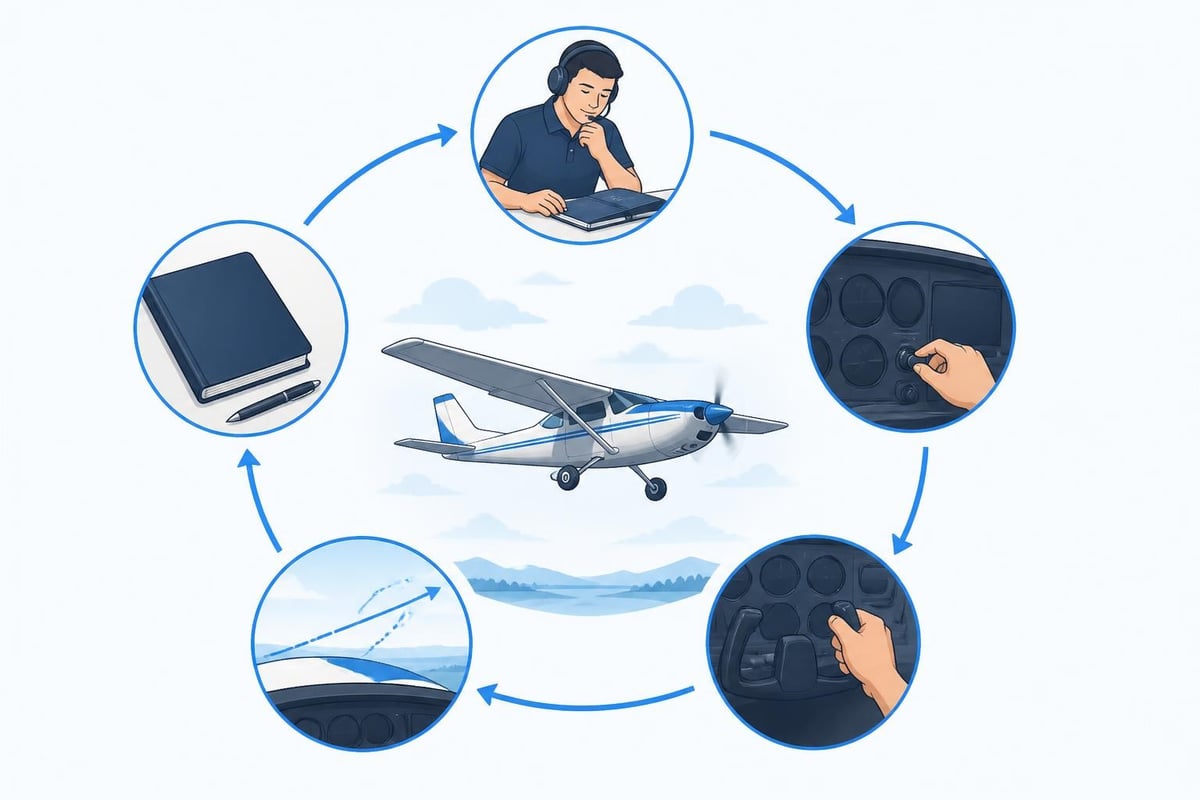
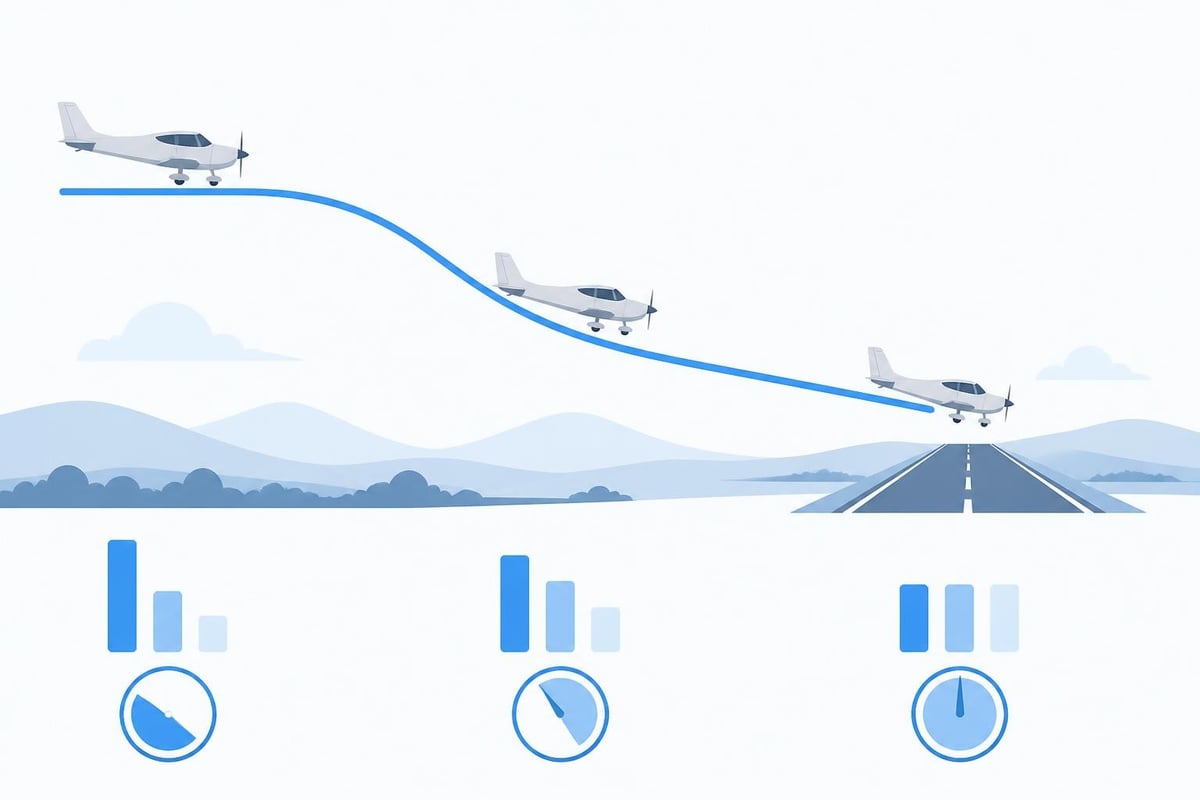
The 2021 revision added Chapter 3 on energy management, a concept developed in collaboration with Embry-Riddle faculty to address approach and landing accidents. The chapter introduces the energy-management diagram, showing how kinetic and potential energy trade off during descent and how excess energy leads to long landings or unstable approaches. This aligns with NTSB safety alerts on approach-and-landing accidents, the leading cause of general-aviation fatalities.
Using the Handbook for Training and Currency
Flight instructors reference the faa airplane flying handbook when building lesson plans and endorsing students for checkrides. The FAA Practical Test Standards and Airman Certification Standards cite the handbook directly; examiners expect applicants to demonstrate maneuvers to the standards described in its pages.
For private pilot training, the handbook defines steep turns as 45° bank with ±100 feet altitude, ±10° heading, and ±5 knots airspeed. For commercial applicants, the same maneuver requires ±50 feet, ±5°, and ±5 knots. The handbook also clarifies chandelles (commercial maneuver): enter at maneuver speed, apply full power, roll to 30° bank, pitch to reach minimum speed at 90° of turn, then recover with coordinated controls to exit at 180° at minimum controllable airspeed.
| Maneuver | Altitude Tolerance | Heading Tolerance | Airspeed Tolerance | Certificate Level |
|---|---|---|---|---|
| Steep turn | ±100 ft | ±10° | ±5 knots | Private |
| Steep turn | ±50 ft | ±5° | ±5 knots | Commercial |
| Chandelle | ±100 ft | Entry/exit only | ±5 knots | Commercial |
| Lazy eight | ±100 ft | ±10° at cardinal points | ±5 knots | Commercial |
Pilots maintaining currency for night or instrument operations use the handbook to review procedures. 14 CFR 61.57(b) requires 3 takeoffs and landings to a full stop within the preceding 90 days to carry passengers at night (1 hour after sunset to 1 hour before sunrise). The handbook describes the full-stop landing technique and emphasizes visual illusions on night approaches.
Worked example:
You last flew 3 night landings on 1 June 2026. Your 90-day currency expires on 30 August 2026. If you fly 3 more full-stop night landings on 25 August 2026, your new currency window runs until 23 November 2026 (90 days from 25 August). The arithmetic: 25 August + 90 days = 23 November.
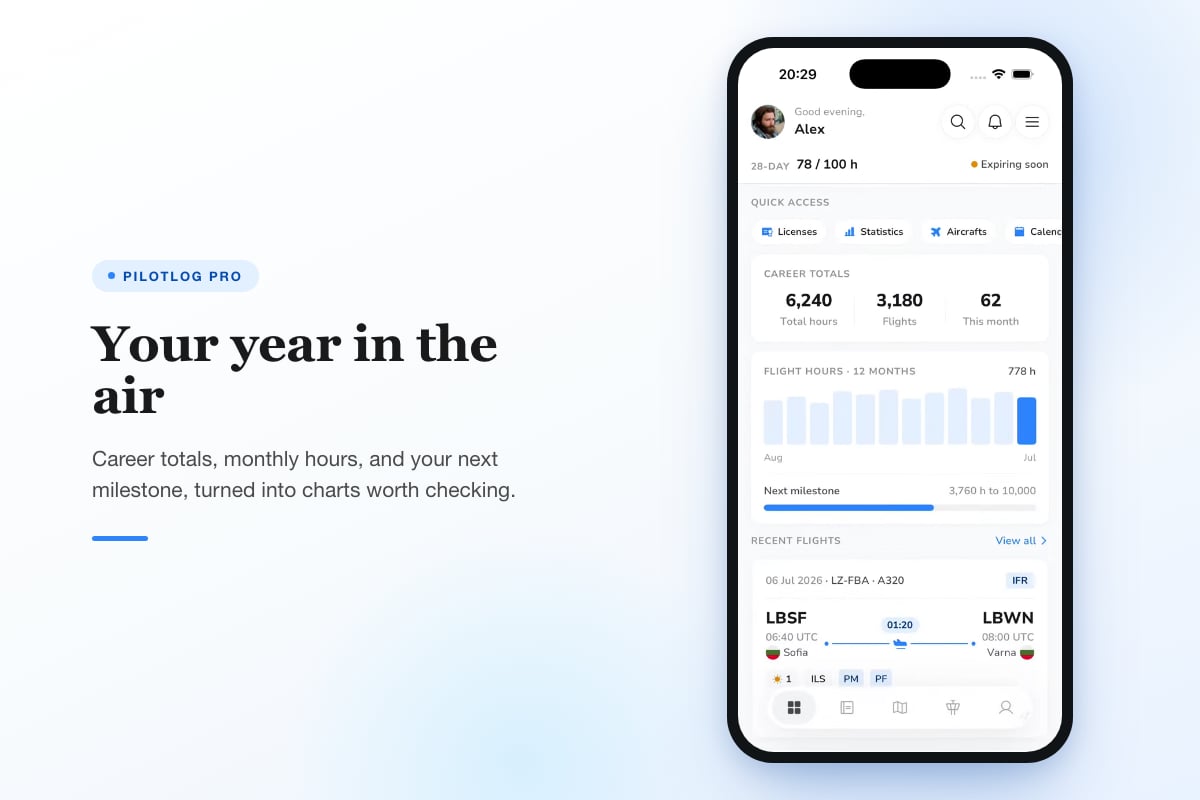
Currency tracking becomes critical when you fly irregularly. Pilotlog Pro monitors rolling 28-day and 90-day periods for passenger, night, and IFR currency, flagging the exact date when recency lapses so you can plan proficiency flights before losing privileges.
Energy Management and Safety Applications
Chapter 3's energy-management framework addresses a long-standing training gap. Traditional instruction focused on airspeed control but often overlooked the total-energy state of the aircraft. The Flight Safety Foundation 2024 report highlights unstable approaches as a top precursor to landing accidents, and energy management directly counters that risk.
The faa airplane flying handbook explains how to assess energy in the pattern:
- Calculate potential energy (altitude above touchdown)
- Calculate kinetic energy (groundspeed)
- Sum total energy and compare to the ideal profile
- Adjust power, flaps, or descent rate to correct excess or deficiency
Excess energy on final means a long float or runway overrun. Deficient energy risks an undershoot or hard landing. The handbook recommends stabilizing by 500 feet AGL on final, with airspeed ±5 knots, descent rate 500-700 fpm, and runway alignment within 5°. An AOPA article describes how instructors now brief energy checks at pattern entry, downwind, base, and final.
Multi-Engine Operations
Chapters 13 and 14 address light-twin operations, critical for commercial and ATP applicants. The faa airplane flying handbook defines V<sub>MC</sub> (minimum controllable airspeed with critical engine inoperative) and explains how bank, power, and rudder authority interact. It describes the zero-sideslip method for single-engine flight: 5° bank toward the operating engine, full rudder to center the ball, and power to maintain altitude or climb.
The handbook also covers accelerate-stop and accelerate-go decisions. For a given runway length, gross weight, and density altitude, the pilot calculates whether to abort or continue after engine failure at V<sub>1</sub>. The arithmetic uses takeoff distance charts and single-engine climb performance. The SKYbrary technical document cross-references these procedures with FAA Advisory Circulars on multi-engine training.
International Comparison and Regulatory Context
While the faa airplane flying handbook governs U.S. flight training, EASA Part-FCL sets European standards. The EASA ATP course manual uses similar maneuver definitions but often tighter tolerances and different currency rules. For instance, EASA FCL.060(b) requires 3 takeoffs and landings in 90 days for passenger currency, matching 14 CFR 61.57(a), but EASA applies it day and night without distinction.
Pilots holding both FAA and EASA licences must track each authority's requirements separately. A flight instructor comparing FAA and EASA training guides will note differences in spin training (required by EASA for CPL, optional in FAA private training) and instrument recency (6 approaches in 6 months under 14 CFR 61.57(c); 6 approaches, holding, and a tracking task under FCL.625).
The faa airplane flying handbook remains the definitive U.S. source, but international pilots benefit from understanding how NASA research and other civil-aviation authorities interpret flight dynamics and energy management.
Summary and FAQ
Key points:
- The faa airplane flying handbook (FAA-H-8083-3C) is the official FAA manual for flight maneuvers, systems, and procedures.
- It defines tolerances for private and commercial maneuvers, night and IFR currency, and multi-engine operations.
- Chapter 3 on energy management addresses unstable approaches and landing accidents.
- Pilots use the handbook for initial training, checkride prep, and proficiency review.
- Currency tracking tools help pilots stay current with 14 CFR 61.57 requirements.
Frequently Asked Questions
Is the faa airplane flying handbook required for checkrides?
Yes. The FAA Airman Certification Standards reference the handbook for maneuver descriptions and performance standards. Examiners expect applicants to demonstrate knowledge of its procedures.
Does the handbook apply to helicopters or gliders?
No. FAA-H-8083-3C covers single-engine and light-twin airplanes. The Helicopter Flying Handbook (FAA-H-8083-21) and Glider Flying Handbook (FAA-H-8083-13) serve those categories.
How often does the FAA update the handbook?
The FAA revises the handbook every few years. The current edition (3C) was published in 2021. Check the official FAA page for the latest version and change notices.
Regulations and currency requirements change. Always verify current rules on official FAA and CAA websites before relying on any published guidance.
The faa airplane flying handbook defines the standards every U.S. pilot trains to and the maneuvers every examiner tests. Mastering its procedures, currency rules, and energy-management principles keeps you safe and legal across your entire career. Pilotlog tracks your flight time, currency windows, and licence expiries automatically, so you can focus on flying to the handbook's standards rather than calculating 90-day rolling totals by hand.
- faa airplane flying handbook
- pilot training
- flight maneuvers
- energy management
- night currency
A logbook that keeps itself.
Join the waitlist and be first in line when Pilotlog launches.
Free to join, no spam. Unsubscribe any time.