aircraft maintenance logbook
Aviation Maintenance Logbook: Records That Keep You Legal
12 Oct 2026 · 18 min read

An aviation maintenance logbook is a legal document that records every inspection, repair, alteration, and component change performed on an aircraft or engine throughout its service life. Regulators worldwide require these records to prove airworthiness and compliance, and without complete, accurate logs an aircraft cannot be returned to service after maintenance or sold at market value. For pilots, understanding what goes into these logs matters because your aircraft's logbook history directly affects legal compliance, safety, and whether you can fly today.
Every time a mechanic or licenced aircraft maintenance engineer (AME/LAME) completes work on your aircraft, they create an entry in the logbook that includes the work performed, the date, the signature and licence number, and whether the aircraft is approved for return to service. These entries build a continuous record from manufacture to present day, and any gap or missing page can ground an aircraft or kill a transaction. Whether you own, rent, or operate under a flying club, knowing how maintenance records work protects you from unpleasant surprises and regulatory findings.
What Regulators Require in an Aviation Maintenance Logbook
Aviation authorities around the world mandate specific content, format, and retention periods for maintenance records. In the United States, FAA Advisory Circular AC 43-9D sets out acceptable methods for recording maintenance and return-to-service entries. The FAA requires logs to include a description of the work, the date it was completed, the name and signature of the person performing it, and the certificate number or authorisation reference. For inspections, the entry must state what type of inspection was performed and confirm the aircraft meets the appropriate airworthiness standards.

In Europe, EASA Part-M continuing airworthiness regulations govern the content and retention of technical records. Part-M requires each maintenance organisation or licenced engineer to create detailed records of work performed, including compliance with airworthiness directives (ADs), service bulletins, and scheduled maintenance tasks. The aircraft technical log (sometimes called the journey log or tech log) records each flight and any defects or rectifications between scheduled maintenance events. Both sets of records must be retained for defined periods: major modifications and life-limited component records are kept permanently, while routine maintenance records are typically held for two to three years after the work is superseded by later maintenance.
Canada's Transport Canada Standard 571 covers similar ground, specifying that journey logs capture flight time and defects, while permanent records of major inspections, overhauls, and modifications must be preserved for the aircraft's life. ICAO provides international guidance on continuing airworthiness records, increasingly including frameworks for electronic aircraft maintenance records (EAMR) that meet the same evidentiary and traceability standards as paper logs.
Key commonalities across jurisdictions include:
- Description of work: specific tasks, parts replaced, and standards applied
- Date and aircraft/engine hours or cycles: establishing when and at what life point work occurred
- Authorising signature and licence number: proving the work was done by someone qualified and approved
- Return-to-service statement: confirming the aircraft or component is airworthy after the work
- Reference to approved data: maintenance manuals, service bulletins, ADs, and type-certificate data sheets (TCDS)
Missing any of these elements can render the entry invalid, requiring re-inspection and a fresh sign-off before the aircraft can legally fly.
Airframe, Engine, and Propeller Logbooks
Most aircraft have separate logbooks for the airframe, engine(s), and propeller(s). This division reflects different service lives and overhaul cycles. An airframe might accumulate 10,000 hours over decades, while the engine is overhauled or replaced at 2,000-hour intervals, and the propeller inspected and overhauled on its own schedule. Keeping separate logs allows each component's history to follow it through sales, exchanges, and installations on different aircraft.
Airframe logbook entries include annual or 100-hour inspections, alteration and repair records, compliance with airworthiness directives, and installations of major modifications like avionics upgrades or structural repairs. Every AD must be recorded with the AD number, compliance method, and date. Future buyers and insurers will scrutinise these entries to verify continuous airworthiness and assess risk.
Engine logbook entries track time since new (TSN), time since major overhaul (TSMO or SMOH), compressions, oil analysis results, and cylinder work. If an engine is replaced, its logbook moves with it, and the airframe log notes the installation date and the new engine serial number. This traceability is essential for value: an engine 200 hours past recommended overhaul without documented on-condition inspections depresses the aircraft's market price by tens of thousands of dollars.
Propeller logbook entries cover inspections, overhauls, repairs, and tracking of life-limited parts like blades and hubs. Propeller strikes or sudden stoppages require immediate inspection and mandatory entries, often triggering engine teardown inspections as well. The FAA Aviation Maintenance Technician Handbook details best practices for recording such events and the associated inspections.
| Component | Typical Overhaul Interval | Common Logbook Entries |
|---|---|---|
| Airframe | Annual/100-hour | Inspections, ADs, alterations, repairs |
| Engine | 2,000 hours (varies) | Oil changes, compressions, overhaul, ADs |
| Propeller | 5 years / 2,000 hours | Inspections, blade repairs, hub overhauls |
Recording Inspections and Compliance
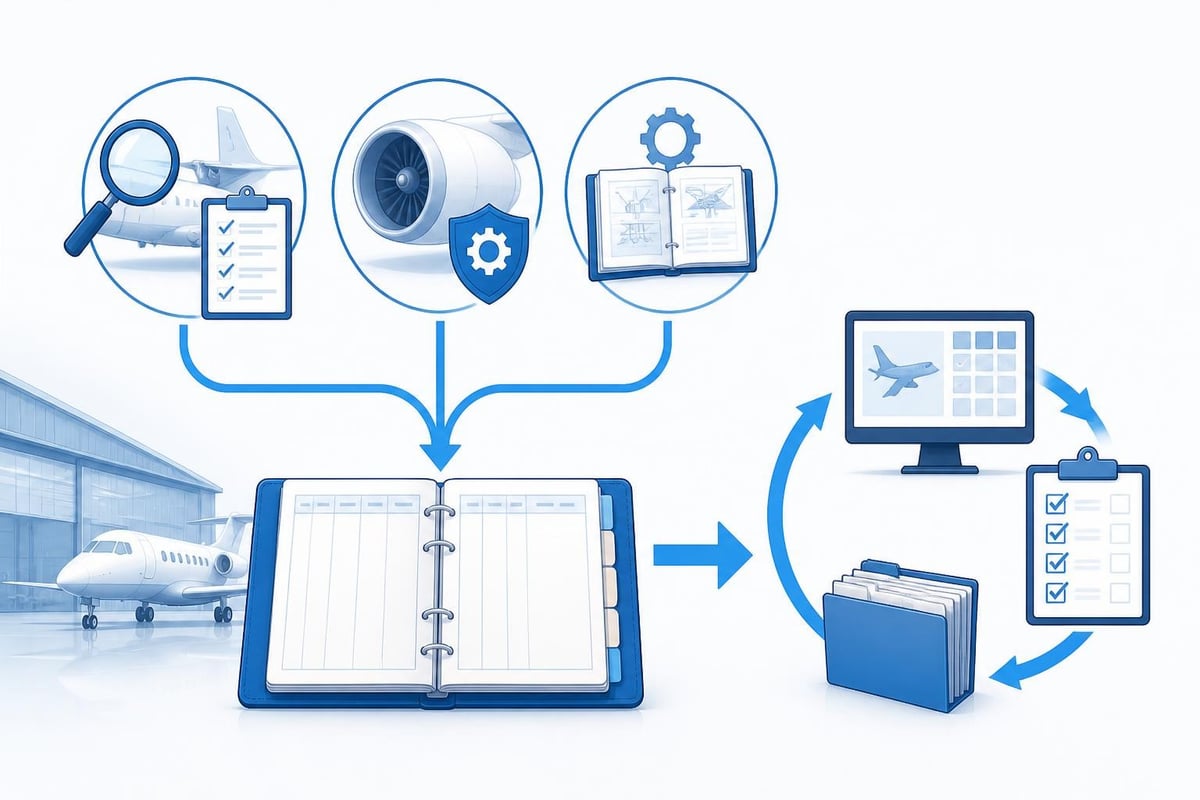
Every required inspection generates a logbook entry. For most general-aviation aircraft operating under FAA rules, that means an annual inspection every 12 calendar months or a 100-hour inspection if used for hire or instruction. The mechanic performing the inspection must make an entry listing the type of inspection, the date, the total aircraft time, and a statement that the aircraft has been inspected in accordance with the applicable regulations and is approved or not approved for return to service.
Airworthiness directives are mandatory safety actions issued by regulators to correct unsafe conditions. Each AD specifies compliance intervals (one-time, recurring, or at specified hours/cycles) and must be tracked in the aviation maintenance logbook. If an AD requires repetitive inspections every 50 hours, the log must show each compliance with date and aircraft time. Missing or incomplete AD compliance is a common finding during pre-buy inspections and ramp checks, and it can ground an aircraft until rectified.
Service bulletins (SBs) issued by manufacturers are often recommended but not mandatory unless adopted as an AD or required by the aircraft's type certificate holder. Recording SB compliance adds value and demonstrates proactive maintenance. Operators often track both mandatory and voluntary maintenance in the logbook to provide a complete picture to insurers, buyers, and auditors.
Defect and Rectification Entries
Between scheduled maintenance, pilots and operators use a technical log or journey log to record defects discovered during pre-flight, flight, or post-flight inspections. This log travels with the aircraft and feeds into the permanent maintenance records when defects are rectified. Skybrary guidance on technical logs explains how entries should describe the defect clearly enough for an engineer to diagnose and repair without guesswork.
A typical defect entry might read: "Left main landing gear strut appears soft; aircraft rests on tyre with minimal extension visible." The rectifying engineer investigates, adds nitrogen to the specified pressure, inspects for leaks, confirms correct extension, then signs off the rectification in the tech log and cross-references it in the permanent airframe logbook if the defect revealed a maintenance issue requiring formal recordkeeping (such as a seal replacement or strut overhaul).
Deferred defects are permitted under minimum equipment list (MEL) procedures if the aircraft's MEL allows operation with certain systems inoperative. The defect remains open in the tech log with a placard noting the inoperative item, and it must be rectified within the MEL-specified interval. Failing to track and close deferred items can lead to regulatory findings and operational disruptions.
Electronic vs. Paper Logbooks
Historically, aviation maintenance logbooks were bound paper volumes with pre-printed columns for date, description, and signature. Paper logs remain legally acceptable and widely used, but they are vulnerable to loss, fire, water damage, and wear. Photocopying or scanning each page after every entry is a common backup practice, but maintaining duplicate sets is cumbersome.
Electronic aircraft maintenance records (EAMR) are increasingly adopted, especially by commercial operators and fleet owners. EAMR systems offer searchable databases, automated AD tracking, alerts for upcoming inspections, and secure cloud storage with redundant backups. Regulators accept electronic logs provided they meet traceability, security, and audit requirements. EASA's Easy Access Rules for Continuing Airworthiness and FAA guidance allow electronic recordkeeping with appropriate safeguards against unauthorised changes and data loss.
Benefits of electronic aviation maintenance logbooks include:
- Instant search: find an AD compliance entry or component change from years ago in seconds
- Automatic alerts: flag upcoming inspections, AD due dates, and life-limited part expirations
- Remote access: mechanics, inspectors, and owners can review records from anywhere
- Tamper-evident audit trails: every change is logged with timestamp and user ID
- Backup and recovery: cloud storage with multiple geographic copies prevents total loss
Challenges include initial setup cost, the need for secure authentication, and ensuring continuity if the software vendor ceases operation. Hybrid systems that maintain a scanned PDF archive alongside an electronic database offer redundancy and regulatory acceptance.
Pilots who track their own flight time and currency already understand the value of digital tools. Just as Pilotlog helps pilots monitor rolling limits and expiry dates, electronic maintenance systems automate compliance tracking for aircraft, reducing the risk of missed inspections or expired certifications.
Why Maintenance Logs Matter for Aircraft Value
When an aircraft changes hands, the buyer's first question is always "Can I see the logs?" Complete, well-organised logbooks are the single most important factor in establishing an aircraft's market value. Incomplete records can devalue an aircraft by 20 to 50 percent, or make it unsellable entirely. AOPA Finance explains why lenders request logbooks: they verify airworthiness, assess risk, and confirm the aircraft is not encumbered by unresolved ADs or major damage history.
A pre-buy inspection includes a detailed logbook review. The inspector will verify:
- Continuous chain of custody from manufacture to present
- Compliance with all applicable ADs
- Major repairs or alterations documented with FAA Form 337 (or equivalent outside the U.S.)
- Engine and propeller time records matching installed components
- No evidence of undisclosed damage history or total-loss incidents
Missing logbooks trigger immediate concern. If an aircraft's logs were lost in a fire or accident, the owner must reconstruct the records using factory build sheets, previous inspection sign-offs, parts invoices, and statements from mechanics who worked on the aircraft. This process is time-consuming, expensive, and never fully restores the confidence lost. Some buyers walk away entirely; others demand a steep discount to offset the unknown risk.
| Logbook Condition | Typical Impact on Market Value |
|---|---|
| Complete, organised, current | Full market value |
| Minor gaps or missing pages | 5–15% discount |
| Major gaps or lost logs | 20–50% discount or unsellable |
| Unresolved ADs or damage | Negotiation leverage; value hit varies |
Regulatory Inspections and Enforcement
Aviation authorities conduct ramp checks, annual audits, and incident investigations where logbook review is central. An inspector may ask to see the airframe and engine logs, the aircraft's current weight and balance, and proof of AD compliance. Missing or incomplete entries can result in a notice of violation, fines, and grounding the aircraft until records are corrected.
NTSB investigation files show how incomplete maintenance records complicate accident investigations and sometimes prevent investigators from identifying root causes. In one case, missing airframe maintenance records meant investigators could not confirm whether a critical AD was complied with before a structural failure. The resulting uncertainty led to broader fleet inspections and reputational damage for the operator.
Pilots who rent or operate under a flying club should confirm that the club or FBO maintains current logs and makes them available for review. Never assume someone else is tracking compliance. Ask to see the last annual inspection entry, verify AD compliance, and check that the aircraft's registration and airworthiness certificate are valid. This due diligence protects your licence and your safety.
Best Practices for Logbook Management
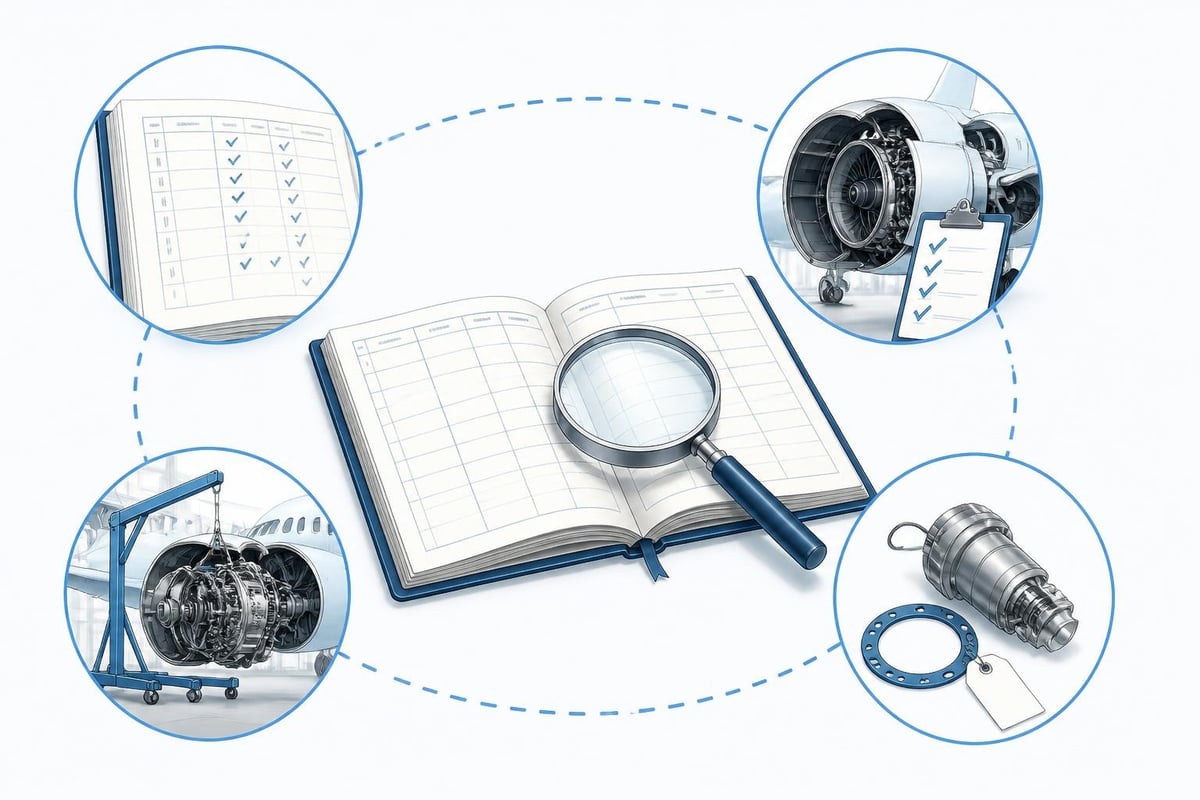
Whether you own an aircraft or manage a fleet, consistent logbook discipline prevents headaches and preserves value. Here are proven practices from experienced operators and AMEs:
- Make entries immediately after work is completed. Memories fade, and delayed entries lead to errors or omissions.
- Use clear, specific language. "Replaced left magneto, P/N 12345, S/N 67890, tested IAW manufacturer's instructions, approved for return to service" is far superior to "Fixed mag."
- Cross-reference supporting documents. Reference the work order number, invoice, or repair station certificate so future reviewers can locate supporting evidence.
- Photocopy or scan every page after each new entry. Store copies in a separate physical location or cloud service. In the event of loss, reconstructed logs from scanned copies are far easier to validate.
- Track ADs in a separate index or spreadsheet alongside the logbook. List each AD number, description, compliance date, and next due date (for recurring ADs). This index speeds up pre-buy reviews and ramp checks.
- Never remove or alter pages. If an error occurs, draw a single line through the incorrect entry, initial and date it, then make the correct entry below. Whiting out or tearing out pages raises red flags.
- Secure the logs. Store them in a fireproof safe or digital vault when not in use. Never leave logbooks in the aircraft; they are irreplaceable.
For student pilots and those working toward advanced ratings, understanding logbook practices builds a foundation for aircraft ownership and professional flying. The habits you develop logging your own flight time in a digital pilot logbook translate directly to maintaining accurate maintenance records. Both require discipline, attention to detail, and respect for the regulatory framework that keeps aviation safe.
Maintenance Logs and Currency Tracking
Pilots track personal currency (takeoffs, landings, instrument approaches) to stay legal and proficient. Aircraft have their own currency requirements: inspections, ADs, and component life limits. The aviation maintenance logbook is the aircraft's equivalent of a pilot's logbook, recording what has been done and what is due.
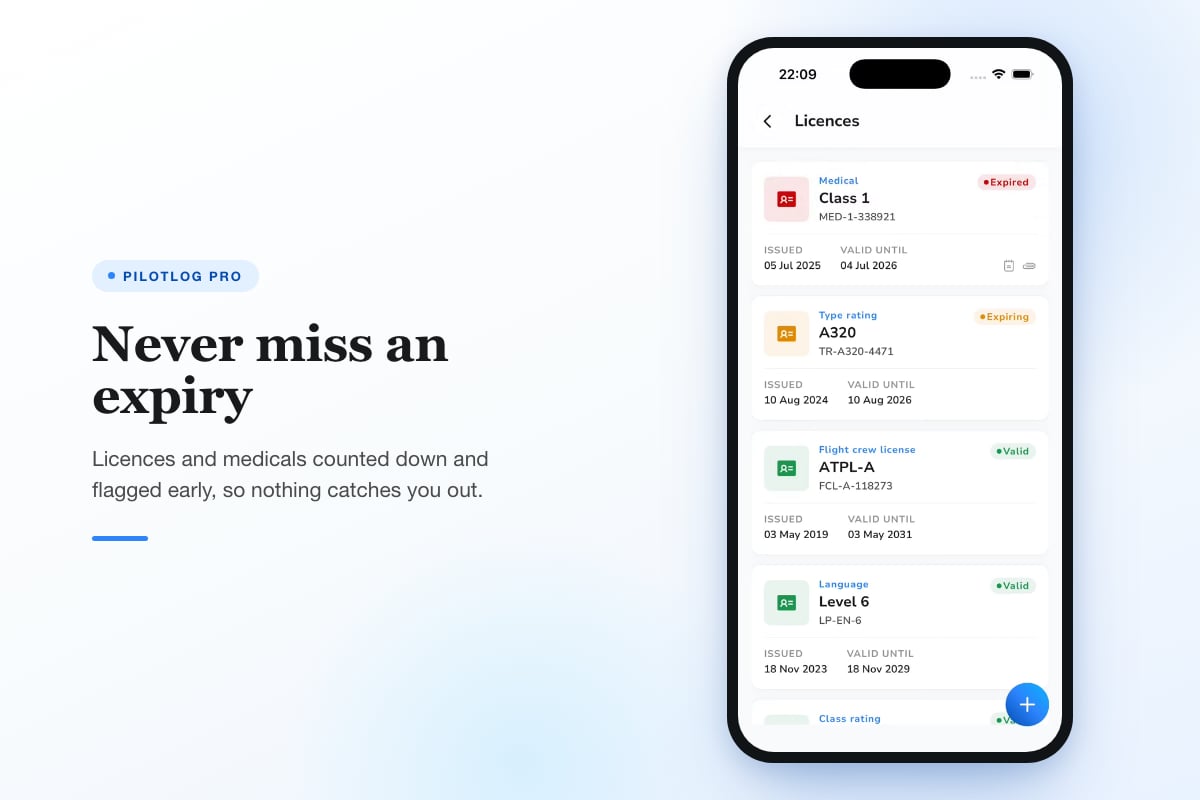
An annual inspection is valid for 12 calendar months. If the inspection was signed off on 15 March 2026, the aircraft must be inspected again by the end of March 2027. Tracking this in a spreadsheet or calendar is straightforward, but add recurring ADs (50-hour, 100-hour, 500-hour intervals), life-limited components (landing gear actuators at 10,000 cycles, certain engine parts at time-before-overhaul limits), and subscription-based avionics database updates, and the complexity grows quickly. Maintenance management software automates these alerts, much as Pilotlog Pro tracks rolling flight-time limits, passenger currency, and medical expiry dates for pilots. Pro monitors 28-day and 365-day flight-time and duty limits, flags upcoming expiries early, and ensures nothing lapses unnoticed.
For owner-operators, integrating personal currency tracking with aircraft maintenance tracking creates a complete picture of readiness. You might be current to carry passengers at night, but if the aircraft's transponder certification expired last month, you cannot fly in controlled airspace until it is re-certified and logged.
Record Retention and Access
Regulators specify minimum retention periods for maintenance records. Under FAA rules, records of current status (most recent annual, AD compliance, major alterations) must be retained and transferred with the aircraft. Records of routine maintenance may be discarded once superseded by later inspections, but many owners retain them indefinitely to provide a complete history. EASA Part-M requires operators to keep major modification and life-limited component records permanently, and other maintenance records for at least two years after the task is superseded or the component removed.
In practice, retaining all records is the safest policy. Storage is cheap, and complete records maximize resale value and simplify insurance underwriting. Digital scans stored in cloud services like Google Drive, Dropbox, or dedicated aviation record platforms cost pennies per month and provide geographic redundancy.
Access control matters. Only authorised mechanics, inspectors, and the aircraft owner should handle the original logs. During maintenance, the logs stay with the mechanic or repair station, and the owner receives them back with new entries upon return to service. If logs must be mailed for a remote transaction, use insured, trackable shipping and retain scanned copies before sending.
Common Logbook Pitfalls and How to Avoid Them
Even experienced operators make mistakes. Here are frequent issues and how to prevent them:
- Illegible handwriting: If an inspector cannot read the entry, it may be deemed invalid. Print clearly or use typed labels.
- Missing signatures or certificate numbers: Every entry must be signed by a licenced person with their certificate number. Stamps are acceptable but must include the number.
- Vague descriptions: "Inspected per manual" is insufficient. Specify the manual, section, and what was found (e.g., "Inspected IAW Cessna Service Manual Section 5-10; control surfaces rigged to limits, cables tensioned to 30–40 lbs, no discrepancies noted").
- Unsigned return-to-service statements: Without "Approved for return to service" (or equivalent), the aircraft is not legal to fly, even if the work was completed.
- Lost or incomplete AD compliance records: If you cannot prove an AD was complied with, you must assume it was not. Re-compliance is often required.
- Mixing personal flight logs with maintenance logs: The aircraft logbook is separate from the pilot's logbook. Never record flight time in the maintenance log; that space is for maintenance entries only.
International Operations and Logbook Differences
Pilots and aircraft crossing borders encounter different recordkeeping systems. An N-registered aircraft visiting Europe must carry logbooks acceptable to FAA standards, but if the aircraft will be based or operated long-term in a European state, it may need to meet EASA Part-M requirements and potentially be re-registered. The maintenance records from the FAA registry must be reviewed and, if necessary, supplemented with EASA-compliant entries.
Conversely, a G-registered aircraft visiting the United States must demonstrate airworthiness under its home state's regulations. The pilot should carry a copy of the certificate of airworthiness and recent logbook entries to prove currency. Differences in terminology (e.g., "journey log" vs. "tech log" vs. "aircraft log") can cause confusion, but the underlying principles are the same: document the work, prove compliance, and keep the records safe.
Transitioning from Paper to Electronic Records
Owners considering a move to electronic aviation maintenance logbooks often worry about losing the authority and authenticity of ink signatures and bound pages. Regulators have adapted: digital signatures with cryptographic verification, blockchain-based immutable records, and cloud systems with multi-factor authentication all meet the legal standard for "record" and "signature."
The transition process involves scanning every page of the existing paper logs at high resolution (300 dpi minimum), verifying the scans are complete and legible, then importing them into the electronic system. Existing paper logs are retained as the legal originals until the electronic system is fully validated and accepted by the authority (FAA, EASA, TCCA, etc.). Some jurisdictions require a one-time approval or notification before switching to electronic-only records.
Benefits become clear immediately: search "left magneto" and find every replacement and inspection in seconds; set alerts for the next 100-hour inspection or AD due in 30 flight hours; export a compliance report for insurance underwriting in one click. The investment in setup time and software subscription pays off in reduced administrative burden and eliminated missed deadlines.
The Pilot's Role in Maintenance Recordkeeping
While pilots do not make logbook entries (except in rare cases where a pilot holds both pilot and mechanic licences), pilots rely on accurate logs for pre-flight decisions and regulatory compliance. Before every flight, you confirm the aircraft is airworthy. That includes verifying that required inspections are current, ADs are complied with, and any open defects are legal under MEL or not safety-critical.
If you discover a discrepancy, record it in the technical log or squawk sheet and notify the operator or mechanic immediately. Do not fly an aircraft with an unresolved safety issue, even if the logbook appears current. The logbook records what was done; your pre-flight inspection confirms the aircraft's actual condition today.
Many pilots keep personal notes on aircraft they fly regularly: dates of last oil change, upcoming inspections, quirks or deferred items. This habit complements the official logs and helps you stay ahead of maintenance cycles. Integrating these notes with your own flight log in a digital pilot logbook creates a single source of truth for your flying activity and the aircraft's status.
Learning from Logbook Failures
Safety investigations reveal how logbook gaps contribute to accidents. An engine failure due to a missed AD might never have occurred if compliance had been tracked and recorded correctly. A structural failure from a hidden repair might have been caught if the logbook disclosed the prior damage and the repair station's certificate number allowed inspectors to verify the repair met approved data.
These lessons are not theoretical. They shape regulatory policy, insurance underwriting, and best practices. When you see a meticulous logbook with every entry cross-referenced and every AD indexed, you are seeing the result of someone learning from others' mistakes and choosing to do better.
For student pilots and those building hours toward professional roles, this knowledge is part of your airmanship. Employers and charter operators will ask about your attention to detail, your understanding of regulatory compliance, and your ability to manage complex information. Demonstrating familiarity with maintenance recordkeeping, even as a renter or club pilot, sets you apart and builds trust with examiners, instructors, and future employers.
An aviation maintenance logbook is far more than a regulatory box to tick. It is the aircraft's biography, its proof of airworthiness, and the key to safe, legal, and valuable flying. Whether you own, rent, or fly professionally, understanding what goes into these records and how to verify them protects you from regulatory violations, safety risks, and financial loss. The same discipline that keeps your personal logbook accurate and your currency current applies to the aircraft you fly. Pilotlog helps pilots track their own hours, currency, and expiries with automated alerts and rolling limits, ensuring nothing lapses unnoticed. Apply that same mindset to maintenance logs, and you will be ready every time you preflight.
- aircraft maintenance logbook
- airframe engine logbook
- return to service
- airworthiness directives
- part-m records
A logbook that keeps itself.
Join the waitlist and be first in line when Pilotlog launches.
Free to join, no spam. Unsubscribe any time.