aircraft logbook
Aircraft Logbook: Complete Guide for Pilots in 2026
24 Aug 2026 · 10 min read
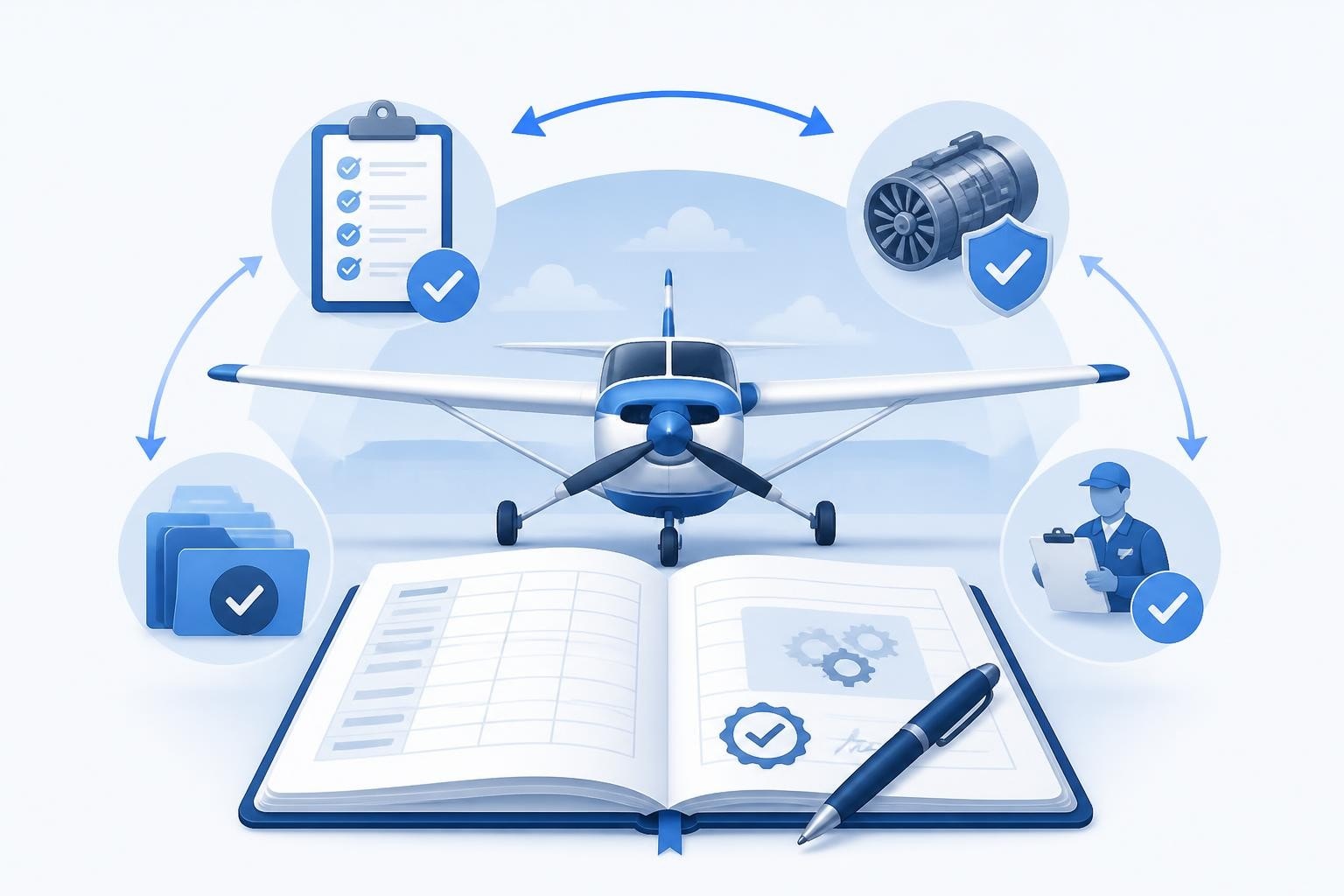
An aircraft logbook is the official, permanent record of an aircraft's maintenance history, airworthiness status, and total airframe hours. It documents every inspection, repair, modification, and compliance action from the day the aircraft enters service, creating an unbroken chain of evidence that the machine meets regulatory standards and remains safe to fly. Pilots rely on these records during preflight checks, annuals, and pre-purchase inspections, while regulators use them to verify compliance.
What Goes Into an Aircraft Logbook
Every aircraft logbook must capture specific information to satisfy both regulatory and operational needs. 14 CFR § 91.417 in the United States and EASA's continuing airworthiness rules in Europe define what owners and operators must keep.
At minimum, an aircraft logbook records:
- Date of each maintenance action or inspection
- Total airframe hours and cycles (landings) at the time of entry
- Description of work performed, including parts replaced, modifications, and repairs
- Airworthiness Directive (AD) compliance status, with reference numbers and completion dates
- Inspection sign-offs, including annual, 100-hour, progressive, and phase inspections
- Certifying technician or organisation details, including licence or approval number
- Defect rectification entries and return-to-service statements

Each entry must be legible, in ink (for paper logbooks), and signed by the person or organisation authorised to perform the work. 14 CFR § 43.9 specifies that the certifying individual must include their certificate type and number alongside their signature.
Airframe, Engine, and Propeller Logs
Most aircraft use separate logbooks for airframe, engine, and propeller. This structure reflects different lifecycles: an engine might be replaced or overhauled while the airframe continues, and its independent record follows the engine to the next aircraft.
| Logbook Type | Tracks | Key Entries |
|---|---|---|
| Airframe | Total hours, cycles, structural work | Annuals, modifications, skin repairs, AD compliance |
| Engine | Time since new (TSN), time since overhaul (TSO) | Oil changes, compressions, overhauls, accessory work |
| Propeller | Hours, overhauls, strike inspections | Balance checks, blade repairs, hub inspections |
When an engine or propeller is sold or transferred, its logbook goes with it. The new owner inherits the full maintenance history.
Regulatory Requirements for Aircraft Logbooks
Aviation authorities worldwide mandate aircraft logbook retention to ensure airworthiness. Under FAA rules, 14 CFR § 91.417 requires owners to retain records of maintenance, preventive maintenance, and alterations for specific periods: records of major alterations and the current status of life-limited parts and ADs must be kept indefinitely, while routine inspection records must be retained until superseded by newer work of equal scope.
In Europe, EASA continuing airworthiness rules require detailed maintenance records to be kept for at least three years after the aircraft or component is released to service. This includes defect reports, certificates of release to service, and records proving compliance with airworthiness directives.
Pilots should confirm current requirements against official sources, as regulations change.
Transfer of Records on Sale
When selling an aircraft, the logbooks transfer with the airframe. Buyers scrutinise these records for:
- Damage history that might affect structural integrity or resale value
- AD compliance gaps that could ground the aircraft or require expensive catch-up work
- Total time and cycles to estimate remaining component life
- Maintenance continuity, ensuring no missing entries or unexplained gaps
A clean, complete logbook adds thousands to an aircraft's value. Missing records often kill deals or force steep price reductions.
Paper vs. Digital Aircraft Logbooks
Traditional paper logbooks remain the norm in general aviation, but digital recordkeeping is gaining ground. FAA Advisory Circular AC 120-78B, issued in December 2024, provides guidance on using electronic signatures, electronic records, and electronic manuals under FAA regulations, including aircraft maintenance logbooks.
Advantages of Digital Logbooks
- Searchability: find an AD compliance entry or inspection sign-off in seconds instead of flipping through years of paper
- Backup and redundancy: cloud storage protects against fire, theft, or water damage
- Regulatory compliance tracking: digital systems can flag upcoming inspections, expiring ADs, or life-limited parts approaching limits
- Audit trails: timestamps and edit histories improve traceability and trust
EASA rules permit electronic or IT-based record systems provided they meet data integrity, backup, and accessibility requirements. Recent academic research explores how metadata and smart contracts can make digital maintenance records even more trustworthy.
Challenges with Digital Systems
Not every mechanic or inspector has access to or training on digital platforms. For aircraft shared across multiple bases or serviced by small shops, paper remains practical. Regulatory acceptance also varies: some jurisdictions require paper originals or certified copies for certain transactions.
Who Owns and Maintains the Aircraft Logbook
The aircraft owner holds legal responsibility for maintaining the logbook and ensuring its accuracy. Operators of leased or hired aircraft must still verify that logbooks are current and complete before flight, even if they don't physically own the records.
Maintenance organisations (Part 145 in EASA, repair stations in the FAA system) generate logbook entries when they perform work. They must issue a certificate of release to service or equivalent statement, which the owner or operator files in the logbook. EASA continuing airworthiness rules detail the required maintenance work orders, defect log entries, and release certificates.
Pilots cross-check logbook entries during preflight. If an AD is listed as complied-with but you notice corrosion or a missing placard, you have both the authority and the duty to refuse the aircraft until discrepancies are resolved.
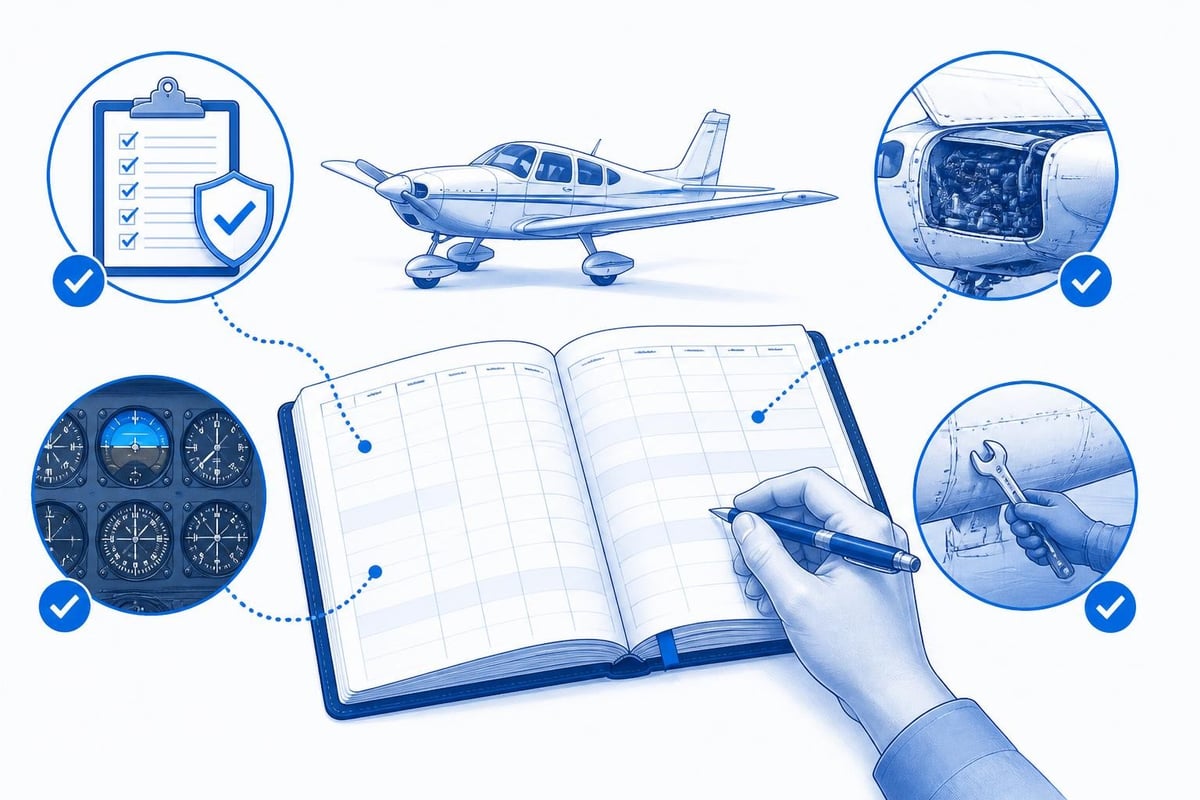
Practical Examples: Reading an Aircraft Logbook Entry
A typical annual inspection entry might read:
Date: 14 March 2026
Total Time: 3,847.2 hours
Work Performed: Performed annual inspection IAW 14 CFR § 91.409(a). Checked flight controls, landing gear, engine mounts, fuel system, electrical system, and instruments. Found and corrected: LH navigation light lens cracked, replaced P/N 12345. No other discrepancies noted.
ADs Complied: AD 2025-08-12 (wing spar inspection) compliant, next due at 4,000 hours.
Return to Service: I certify this aircraft has been inspected IAW annual inspection requirements and is approved for return to service.
Signature: J. Smith, A&P IA 123456789
This single entry confirms airworthiness for the next 12 calendar months (or 100 hours if operated for hire under Part 91). It also documents AD compliance and sets the next inspection milestone.
Spotting Red Flags
Watch for:
- Ink colour changes mid-entry (suggests retroactive tampering)
- Missing AD references when the serial number or model is subject to known directives
- Vague descriptions like "repaired as required" with no part numbers or scope detail
- Unsigned or undated entries
- Gaps in total time that don't match flight hours or tach readings
Any of these warrants further investigation before you fly.
How Pilots Use Aircraft Logbooks Day to Day
Before every flight under 14 CFR § 61.51, you must verify the aircraft is airworthy. That means checking the logbook (or a summary placard or digital dashboard) to confirm:
- Annual inspection current (within the past 12 calendar months)
- 100-hour inspection current if operated for hire
- Airworthiness Directives complied and recurring ADs not yet due
- VOR checks, transponder checks, altimeter/static checks, and ELT battery within regulatory limits
- No open discrepancies or deferred maintenance that affects flight safety
Many operators post a summary card in the cockpit listing inspection due dates and total time. This saves walking to the hangar office before every flight, but you remain responsible for verifying the full logbook if discrepancies arise.
Understanding how to log flights accurately in your own pilot logbook complements aircraft logbook knowledge, ensuring both your personal records and the aircraft's records stay aligned and current.
Tracking Multiple Aircraft and Fleets
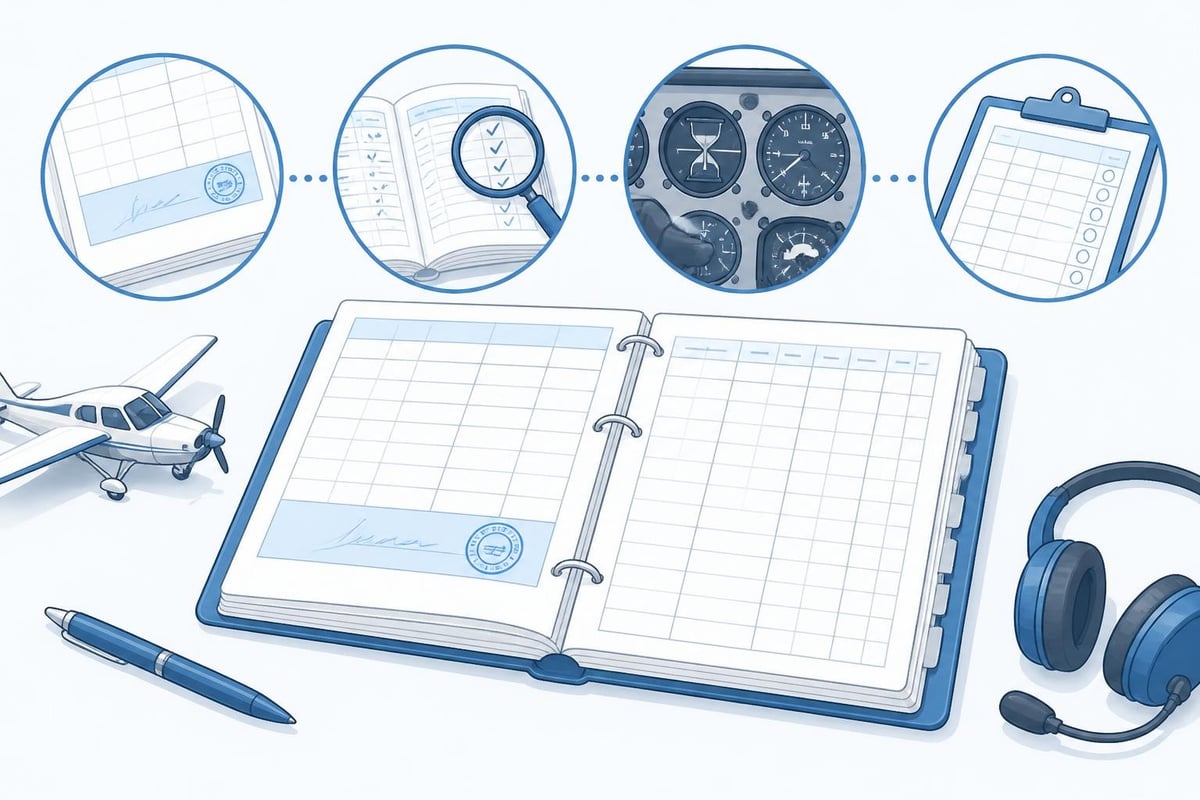
Pilots who fly more than one aircraft, instructors managing a school fleet, or operators running charter or corporate flight departments juggle dozens of logbooks. Keeping track of which aircraft is due for its next oil change, which has an AD coming due in 50 hours, and which needs a transponder check before the end of the month demands organised systems.
Digital tools help. Pilotlog Pro goes beyond personal flight logging to track rolling flight-time limits, currency, and expiry alerts for licences and medicals, ensuring nothing catches you by surprise. While it focuses on pilot currency, the same principles of automated tracking, early warnings, and centralised dashboards apply to fleet management and aircraft logbook oversight.
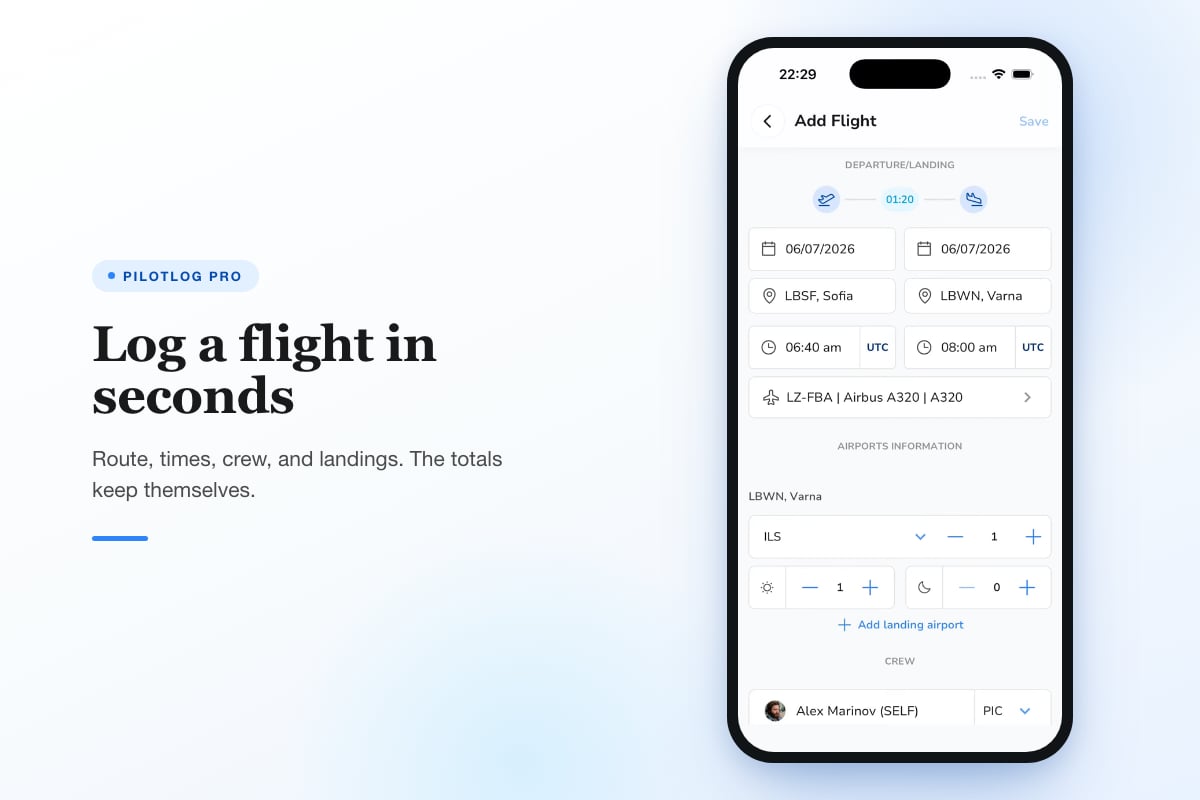
Fleet operators often integrate aircraft logbook software with maintenance scheduling platforms, syncing total hours from the aircraft tach to trigger alerts for oil changes, phase inspections, or AD compliance deadlines. This reduces the risk of flying an aircraft past its inspection or missing a recurring AD.
Common Mistakes and How to Avoid Them
Even experienced pilots and mechanics make logbook errors. Here are the most common:
- Recording hours incorrectly: confusing Hobbs time, tach time, and flight time leads to entries that don't match reality
- Omitting AD references: failing to note the AD number and compliance method leaves future inspectors guessing
- Unsigned entries: work performed without a certifying signature is legally invalid
- Incomplete descriptions: "Changed oil" is acceptable for routine service, but "repaired wing" without details, part numbers, or reference data is not
- Retroactive entries without notes: adding a missing entry months later without documenting why creates suspicion
Best practice: make entries immediately after the work or flight, in ink, with full details. If you discover a missing entry later, add it with a note explaining the delay.
Logbook Retention and Long-Term Storage
Aircraft logbooks must survive the aircraft's entire service life and beyond. Fire, flood, theft, and simple neglect destroy thousands of logbooks every year.
For paper logbooks:
- Store originals in a fireproof, waterproof safe
- Keep photocopies or scanned PDFs in a separate location
- Update scans after every new entry, ideally within 24 hours
- Never leave logbooks in the aircraft during storage or transport
For digital logbooks:
- Use platforms with automatic cloud backup
- Export full logbook copies quarterly to external drives
- Verify data integrity and readability of exports
- Confirm your digital system meets EASA IT-based record requirements or FAA AC 120-78B standards
When selling or decommissioning an aircraft, transfer complete, legible copies to the new owner or permanent archive.
International Operations and Logbook Harmonisation
Pilots operating internationally encounter different logbook standards. An FAA Part 91 operator visiting Europe must still comply with EASA continuing airworthiness rules if the aircraft is registered in an EASA member state, or vice versa.
Key differences include:
| Aspect | FAA (USA) | EASA (Europe) |
|---|---|---|
| Record retention | Indefinite for ADs and major alterations; until superseded for inspections | Minimum 3 years after release to service |
| Logbook format | No prescribed format; must be legible | Specific formats outlined in Part-M; electronic systems permitted with safeguards |
| Release to service | A&P or IA signature | Certifying staff or Part-145 organisation approval |
| Language | English preferred but not mandated | Must be in language acceptable to authority of registry |
If you operate in multiple jurisdictions, maintain records that satisfy the strictest applicable standard. This avoids rework and ensures acceptance everywhere.
For a broader view of digital logbook options, explore the best electronic pilot logbook tools available to pilots in 2026.
Future Trends in Aircraft Logbook Technology
Blockchain-based logbooks, artificial intelligence to flag missing ADs, and integrated aircraft health monitoring systems are moving from concept to deployment. Recent research explores how smart contracts and metadata can automate compliance checks and improve trust in maintenance records.
Expect regulators to publish updated guidance on digital records, biometric signatures for technicians, and real-time data syncing between aircraft sensors and maintenance platforms. The core requirement remains unchanged: accurate, complete, tamper-proof records that prove the aircraft is safe to fly.
Pilots who embrace digital tools early gain an edge in efficiency and compliance. Those who stick with paper should at least digitise backups to protect against loss.
Aircraft logbooks form the backbone of airworthiness assurance, documenting every inspection, repair, and AD compliance action from first flight to retirement. Accurate, complete records protect pilots, owners, and passengers alike. Whether you rely on paper or digital systems, regular checks and backups keep you legal and safe. Pilotlog simplifies flight logging and currency tracking on iOS and Android, giving you the same clarity and control for your personal records that a well-maintained aircraft logbook provides for the machine.
- aircraft logbook
- maintenance records
- ad compliance
- digital logbook
- airworthiness
A logbook that keeps itself.
Join the waitlist and be first in line when Pilotlog launches.
Free to join, no spam. Unsubscribe any time.