Article
Private Pilot Licence: What It Is and What It Lets You Fly
19. Nov. 2026 · 5 Min. Lesezeit
Dieser Artikel ist auf Englisch.
A private pilot licence (PPL) lets you act as pilot in command of an aircraft on non-commercial flights, with passengers, but not for pay. In the UK, the Part-FCL PPL(A) is issued by the UK Civil Aviation Authority, which sets a minimum age of 17 and requires a Part MED Class 2 medical certificate. This article follows UK CAA and EASA Part-FCL rules. FAA certificates follow 14 CFR and differ in several figures, so don't mix them.
What does a private pilot licence let you fly?
A PPL(A) entitles you to act as PIC of aeroplanes in the class or type on your licence, for private flights, with passengers, sharing costs where the rules allow. You can't fly for remuneration.
Your privileges depend on the ratings added to the licence:
- Class rating: for example SEP (land), which covers single-engine piston aeroplanes.
- Night rating: needed to fly VFR at night.
- Instrument-related ratings: needed for IFR flight, added separately.
- Radio: a radiotelephony qualification is needed to use the radio.
The licence is the start, not the finish. Many pilots go on to a commercial licence and, later, an ATPL.
What are the requirements for a private pilot licence?
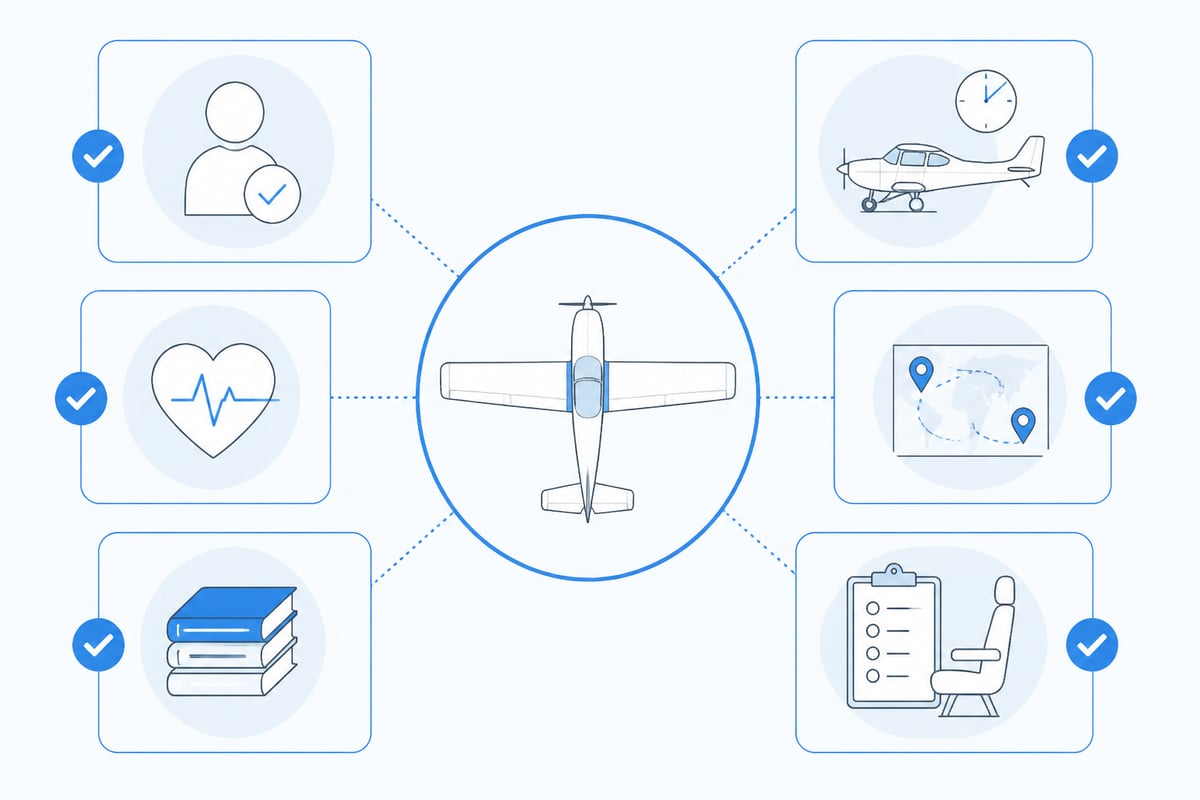
The UK CAA sets the minimums, and your training organisation sets the real timetable. For the PPL(A):
- Be at least 17 and hold a Part MED Class 2 medical.
- Complete 40 hours of flight instruction, including at least 10 hours of supervised solo flight. Up to 5 hours may be in an approved flight simulator.
- Fly a solo cross-country that includes one flight of 270 km (150 NM), with full-stop landings at two aerodromes other than the departure aerodrome.
- Pass the theory exams and the skill test.
The 40 hours can drop to 35 when you train on a course at an ATO approved for that purpose, according to the UK CAA. EASA describes typical PPL(A) training as around 100 hours of theory and 45 hours of flight instruction. That is general guidance, separate from the UK minimum.
Is a private pilot licence hard to get?
A private pilot licence is demanding but within reach of most people who can pass a Class 2 medical and commit to regular training. The difficulty is time, money and consistency, not any single skill.
Pilots who fly regularly tend to finish closer to the minimum hours. Long gaps between lessons mean repeated revision, and total hours can climb past the minimum. Weather cancellations add to that.
Is 32 too late to become a pilot?
No. The UK CAA sets only a minimum age of 17 for the PPL(A), with no upper limit for the licence itself. At 32, the practical limit is your medical, not your age. A Class 2 certificate is what you need to hold and keep valid.
How much does a PPL cost?
The UK CAA's licence fees page lists the fee for initial issue of a PPL(A) or PPL(H). That is the application fee only. It is not the cost of training.
Training costs vary by school and aircraft. The UK CAA's guidance on choosing a flight school advises checking what is included and allowing for extra lessons, landing fees and ground instruction. Ask for a written breakdown before you commit.
Is there a lighter UK option?
Yes. The UK National Private Pilot Licence (NPPL) is a separate, simpler route with its own age, medical declaration and radio-licence considerations. The UK CAA's NPPL page sets out the details. Its privileges are narrower than a Part-FCL PPL, so check what you want to fly before choosing.
How do you stay current on a PPL?
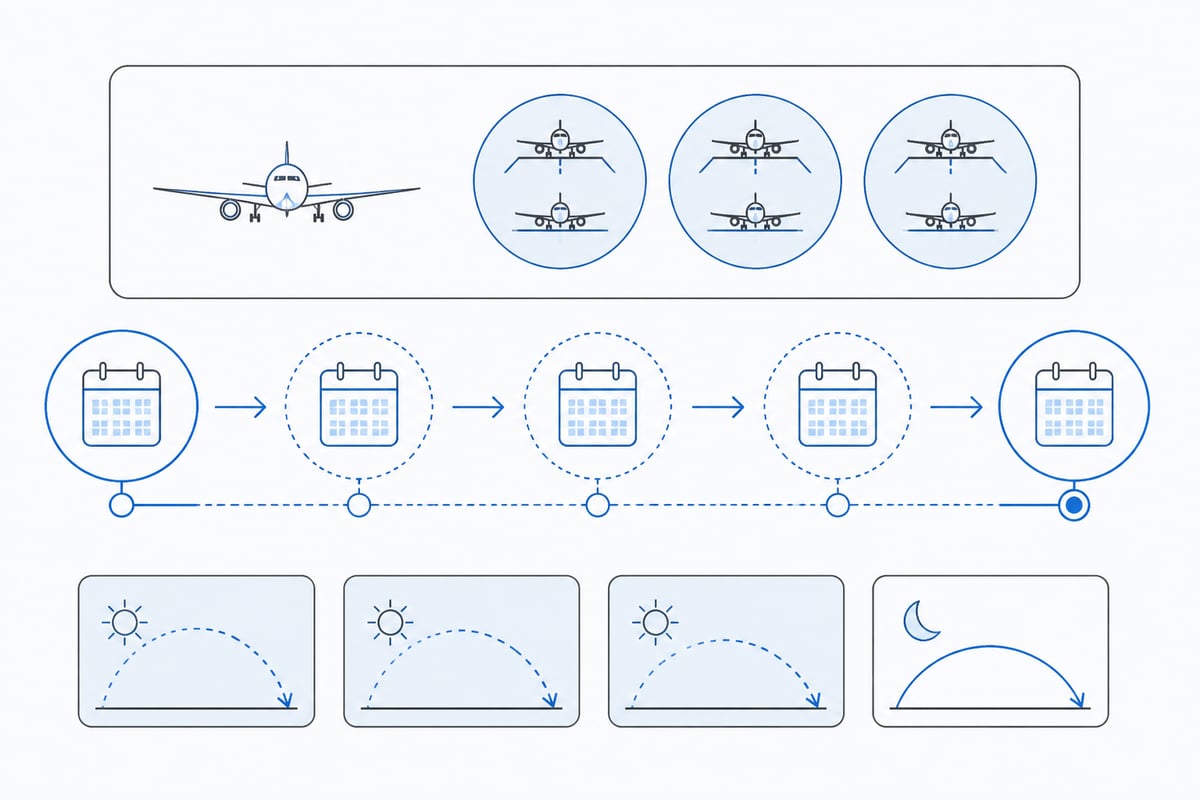
Holding the licence doesn't make you current. Under Part-FCL, passenger carriage requires 3 take-offs and landings in the preceding 90 days (FCL.060(b)). Class ratings and medicals have their own expiry dates.
Worked example: if your last three take-offs and landings were on 12 September 2026, add 90 days:
- Remaining days in September: 30 - 12 = 18
- October: 31, so 18 + 31 = 49
- November: 30, so 49 + 30 = 79
- December: 90 - 79 = 11 days, so 11 December 2026
You can carry passengers until 11 December 2026. After that, you need to refresh recency before taking anyone up.
Pro from Pilotlog tracks passenger, night and IFR currency with lapse dates, and flags licence and medical expiries early. You log each flight in a few taps after landing, with route, times, crew and landings, so the totals update from your entries.

Summary
- A PPL(A) allows non-commercial flight as PIC, with passengers, in the ratings you hold.
- UK minimums: age 17, Class 2 medical, 40 hours (35 at some ATOs), 10 hours solo.
- Solo cross-country includes one 270 km (150 NM) flight with two full-stop landings elsewhere.
- CAA issue fee is £263, separate from training costs.
- Passenger recency is 3 take-offs and landings in 90 days (FCL.060(b)).
Rules change. Check current requirements with the UK CAA or EASA before you act on them.
FAQ
What does the acronym PPL stand for in aviation?
PPL stands for private pilot licence. In UK and EASA usage, PPL(A) means aeroplanes and PPL(H) means helicopters.
Can I fly commercially with a PPL?
No. A PPL doesn't allow flying for remuneration. Paid flying needs a commercial licence, which builds on PPL experience.
Does a PPL expire?
The licence doesn't expire in the way a medical does, but your ratings and Class 2 medical carry their own validity dates. You need all of them valid to fly as PIC.
Start by booking a Class 2 medical and a trial lesson, then ask schools for a written cost breakdown. Once you're flying, keep your hours, recency and expiry dates in one place, so nothing lapses unnoticed. Pro tracks your 90-day recency and flags medical and licence expiries early. Join the waitlist for Pilotlog, the digital pilot logbook for iOS and Android.
Ein Flugbuch, das sich selbst führt.
Melde dich für die Warteliste an und sei ganz vorn dabei, wenn Pilotlog startet.
Kostenlos. Wir schreiben dir zum Start und zu Neuigkeiten von Pilotlog. Abmeldung jederzeit möglich. Datenschutzerklärung