aircraft logbook
Airplane Logbook: What to Record and Why It Matters
3 Sep 2026 · 14 min read

An airplane logbook is a permanent, chronological record of the aircraft's maintenance, inspections, alterations and operational history. It proves the aircraft is legal to fly and shows it has been maintained in accordance with type-certificate data and applicable regulations. For owners, buyers, lenders and operators, the airplane logbook is the single most important document determining airworthiness, market value and legal compliance. If the aircraft's history is not written down, it effectively did not happen.
What the Airplane Logbook Records
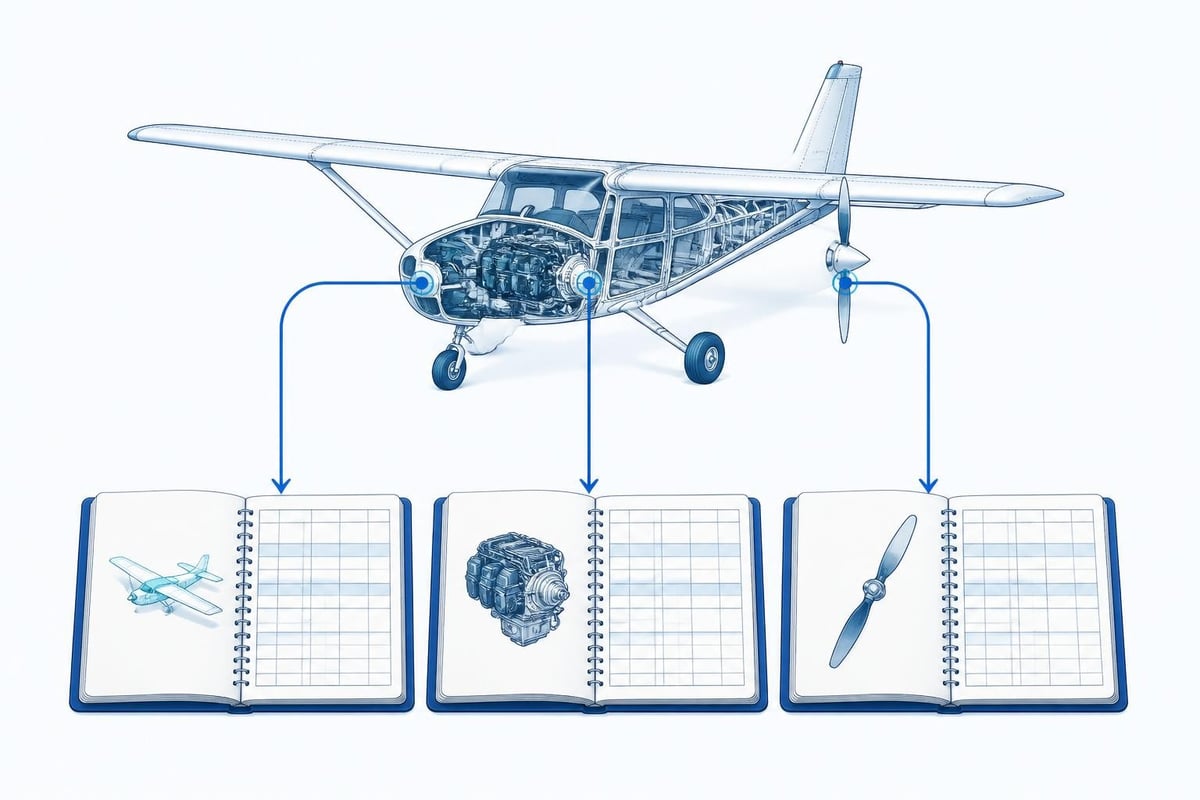
An airplane logbook actually comprises three separate books: the airframe logbook, the engine logbook, and the propeller logbook. Each tracks its respective component from new or major overhaul, through all inspections, repairs and modifications.
The airframe logbook records:
- Total time in service (usually expressed as hours since new)
- Annual or 100-hour inspections (with inspector signature and certificate number)
- Airworthiness directive (AD) compliance (including recurring ADs and next due dates)
- Major repairs and alterations (with FAA Form 337 references)
- Weight and balance changes
- Equipment list updates (radios, autopilots, instruments added or removed)
The engine logbook captures:
- Time since new and time since major overhaul (SMOH)
- Oil-change intervals and records
- Top overhauls or cylinder work
- Compression-check results
- Engine AD compliance
- Major repairs (crankshaft, case, cam)
The propeller logbook includes:
- Time in service since new or overhaul
- Hub inspections and repairs
- Blade replacements or dressing
- Propeller ADs and recurring inspections
Each entry must include the date, total time in service, description of work, reference to approved data, and the signature, certificate number and type of certificate held by the person approving the aircraft for return to service (14 CFR §43.9).
Why the Airplane Logbook Matters
Airworthiness and Legal Compliance
No airplane logbook, no legal flight. An aircraft must have a current annual inspection (or 100-hour inspection if used for hire) endorsed in the logbook to be airworthy. The absence of that signature means you cannot legally act as pilot in command, regardless of the aircraft's physical condition. Similarly, every airworthiness directive must be complied with and documented. Missing AD records can ground an aircraft until compliance is re-established or proven.
Market Value and Resale
Complete, well-kept logs can add tens of thousands of dollars to an aircraft's value. Buyers, lenders and insurers scrutinise the airplane logbook to verify total time, time since major overhaul, damage history and AD compliance. Gaps or missing entries raise red flags and often require expensive pre-buy inspections, title searches or even complete teardown inspections to re-establish airworthiness. AOPA's guidance on logbooks and aircraft financing underscores that lenders treat missing logs as deal-breakers or require significantly higher down payments and interest rates.
Accident Investigation and Liability
The airplane logbook becomes critical evidence after an incident. The NTSB and FAA review maintenance records to determine whether the aircraft was airworthy, whether required inspections were current, and whether any outstanding ADs contributed to the failure. NTSB dockets routinely reference logbook entries (or the lack thereof) in probable-cause findings. Incomplete or falsified entries can expose owners, operators and mechanics to civil penalties and certificate action.
| Logbook Issue | Consequence |
|---|---|
| Missing annual sign-off | Aircraft not airworthy; cannot fly legally |
| Gap in engine time | Unknown SMOH; engine value drops to zero until verified |
| No AD compliance records | Aircraft unairworthy; expensive re-compliance or research required |
| Altered or suspect entries | FAA investigation; possible certificate action for fraud |
| Lost logbooks | Market value cut 20–40%; may require teardown to re-establish history |
Insurance and Registration
Insurers require proof of annual inspection and often ask for scanned logbook pages during underwriting. If you cannot produce current maintenance records, coverage may be denied or premiums increased. Civil aviation authorities (FAA, EASA, UK CAA) may also request logbook copies during registration renewal, aircraft import/export, or certificate validation.
What Must Be Entered
Not every task requires a logbook entry. Routine preflight checks, fuel and oil top-ups, and tyre pressure adjustments are not logged. Maintenance that does require an entry includes:
- Annual and 100-hour inspections (with list of discrepancies and sign-off that all items have been corrected or deferred under an approved MEL)
- Airworthiness directives (date complied, method, next due if recurring, and reference to AD number)
- Major repairs and alterations (with FAA Form 337 filed and copy retained in the aircraft records)
- Preventive maintenance performed by the pilot-owner under 14 CFR Part 43 Appendix A (e.g., tyre changes, spark-plug cleaning, oil changes on certain engines)
- Component overhauls (engine, propeller, magneto, alternator) with shop work order and yellow tag
- Weight and balance changes (new radios, additional fuel tanks, seat modifications)
Each maintenance entry must describe the work, reference the approved data (manufacturer service bulletin, FAA-approved manual, AD), state that the aircraft has been inspected in accordance with the appropriate regulations and is approved for return to service, and include the mechanic's signature, certificate number and type (14 CFR §43.9).

Paper vs Electronic Airplane Logbooks
Traditionally, the airplane logbook is a bound paper book. The advantage is simplicity: no software, no backups, no file corruption. The disadvantage is fragility. Paper logs are lost in hangar fires, floods, and simple misplacement. Once gone, the aircraft's history vanishes.
Electronic airplane logbooks have become more common, especially for commercial operators and fleet managers. FAA Advisory Circular AC 120-78B recognises electronic signatures and records, provided the system ensures authenticity, prevents unauthorised alteration, and maintains a secure backup. Many Part 135 and Part 121 operators use computerised maintenance tracking to manage airworthiness directives, inspections and component life limits across large fleets.
For individual owners, the hybrid approach is common: maintain the paper logbook as the legal record, but scan every page and store the PDF in cloud storage. That way, if the physical book is lost, you at least have images to reconstruct the record and prove compliance.
Rebuilding Lost Logs
If an airplane logbook is lost or destroyed, the aircraft is not automatically unairworthy, but you must reconstruct the history to re-establish compliance. The FAA does not require you to prove every oil change since 1975, but you must document:
- Total time in service (from engine data plates, tachometer, previous insurance or sales records)
- Date and scope of the last annual or 100-hour inspection
- Compliance status of all applicable ADs
- Major repairs and alterations (FAA registry may have Form 337s on file)
- Current weight and balance
An A&P or IA can perform a thorough inspection, document their findings, and issue a fresh annual sign-off that becomes the baseline for future maintenance. Some underwriters and lenders remain wary of reconstructed logs, so expect a discount on resale.
Commercial Operations and the Journey Log
In addition to the permanent airplane logbook, commercial operators (Part 121, Part 135, and certain Part 91K operations) must maintain a journey log or flight log for each aircraft. This temporary record documents each sector: departure and arrival airports, flight time, crew names, fuel uplift, and any defects noted. Regulation (EU) No 965/2012 (for EASA operators) and the FAA's Part 135 rules both require the journey log to be retained for a minimum period (typically 90 days to 12 months) and available for inspection.
The journey log feeds into the airplane logbook when maintenance is performed. If a captain writes up a rough-running engine in the journey log, the engineer's corrective action (magneto timing adjusted, fouled plug replaced) goes into the permanent engine logbook with a return-to-service signature.
| Record Type | Purpose | Retention | Who Maintains |
|---|---|---|---|
| Airplane Logbook (airframe, engine, prop) | Permanent airworthiness and maintenance history | Life of aircraft | Owner or operator |
| Journey Log / Flight Log | Daily flight record and defect reporting | 90 days – 12 months (varies by regulation) | Operator (Part 121/135) |
| Pilot Logbook | Individual pilot experience and currency | Permanent (recommended) | Individual pilot |
Airplane Logbook vs Pilot Logbook
The airplane logbook tracks the aircraft. Your pilot logbook tracks you. Both are required, but for different reasons. The aircraft logbook proves the machine is legal to fly. Your logbook proves you are current, qualified and experienced for the flight.
For example, after a one-hour flight in a Cessna 172, the aircraft logbook gains one hour of total time in service (recorded only when the next inspection or maintenance is performed). Your pilot logbook records one hour of single-engine land, one hour of PIC, and (if the flight included three landings to a full stop in daylight) credit towards your 90-day passenger currency. If you fly the same aircraft on a dozen flights, the airplane logbook does not record each individual flight; it records total time and maintenance events. Your logbook records every flight, every landing, every instrument approach.
Pilots sometimes confuse the two. The airplane logbook is not a place to log your experience. Conversely, your pilot logbook does not prove the aircraft was airworthy (though AOPA reminds us that your logbook may be scrutinised if an incident occurs, to verify you were current and qualified).
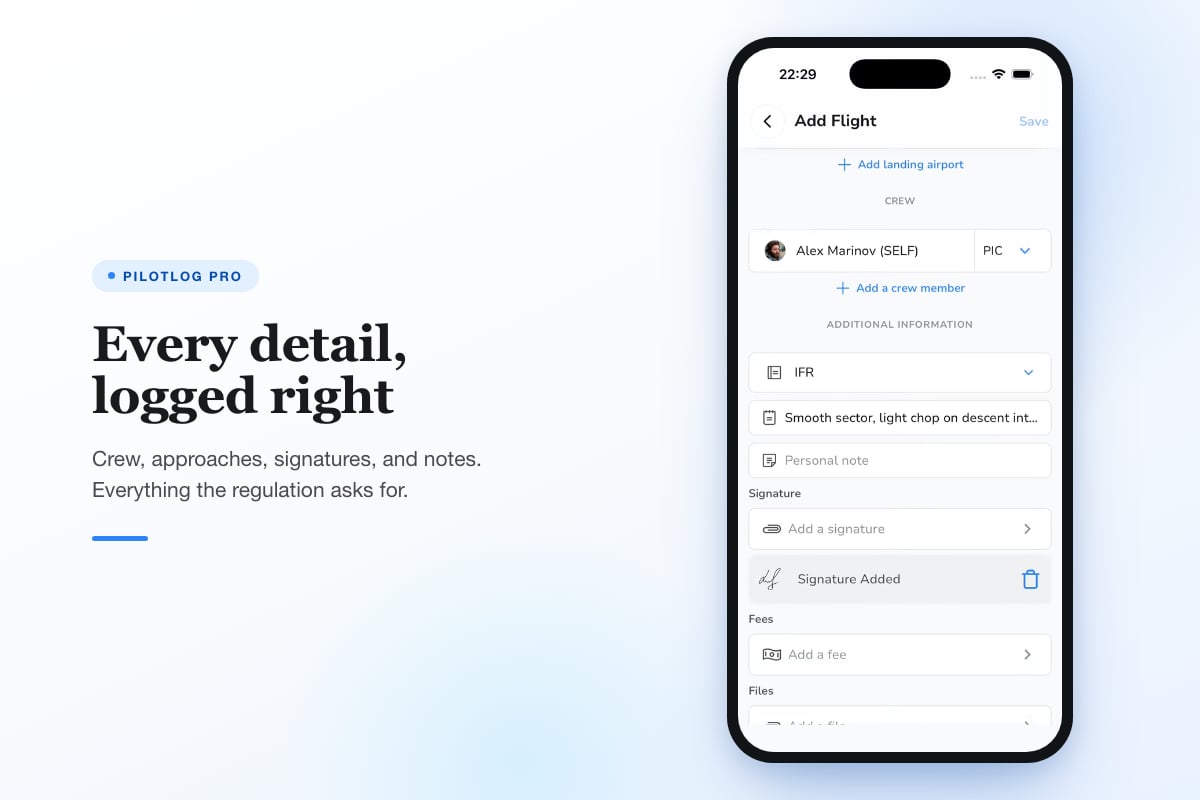
Keeping both sets of records accurate is essential. Digital tools make it easier. Pilotlog Pro tracks your hours, currency (90-day passenger, night, IFR) and licence expiries, alerting you when recency lapses or a medical is due. It handles the pilot logbook side, so you can focus on flying and leave the arithmetic to the app.

EASA and UK Requirements
Under EASA Part-ML (for light aircraft) and Part-M (for complex and commercial aircraft), the aircraft logbook remains mandatory. EASA Easy Access Rules for Aircrew outline acceptable formats for electronic records, provided they are tamper-proof and accessible to competent authorities.
The UK CAA (post-EU Exit) has retained similar requirements under UK Part-ML and Part-M. Aircraft must carry or have available the Certificate of Release to Service (CRS) for the last maintenance, plus logbook records showing continuing airworthiness. Annual Reviews of Airworthiness (ARC renewals) require presentation of the aircraft logbooks to the inspector.
For UK and EASA operators, the Technical Log (similar to the journey log) is carried in the aircraft and records each flight, fuel, defects and commander signature. The Technical Log is temporary; permanent entries go into the aircraft logbook (often called the Continuing Airworthiness Record System or CARS).
Best Practices for Airplane Logbook Maintenance
- One aircraft, one set of logs. Do not split airframe, engine or propeller records across multiple books unless replacing a component (e.g., a factory-new replacement engine brings its own new logbook).
- Sign and date every entry. Even if you are the owner performing preventive maintenance, include your name, certificate number, and the date.
- Reference approved data. State the maintenance manual section, service bulletin number, or AD number you followed.
- Use permanent ink. Pencil fades and invites suspicion of alteration.
- Never remove pages. If you make an error, draw a single line through it, initial and date the correction, and write the correct entry below.
- Scan and back up regularly. After every annual or major entry, photograph or scan the pages and store the file in at least two locations (cloud storage and local drive).
- Check AD compliance annually. The list of applicable ADs grows over time. Your annual inspection should include an AD search and compliance review. Missing ADs can ground the aircraft instantly.
The FAA Safety Briefing on currency and recordkeeping reminds pilots and owners that incomplete records invite enforcement action and complicate insurance claims. Treat the airplane logbook as a legal document, because that is exactly what it is.
Common Mistakes and How to Avoid Them
Vague descriptions. "Inspected and found OK" tells an examiner or buyer nothing. Write "Annual inspection IAW 14 CFR Part 43 Appendix D. All items inspected. Discrepancies listed on attached sheet. All discrepancies corrected. Aircraft approved for return to service."
Unsigned entries. Every maintenance action requires a signature, certificate number and certificate type (A&P, IA, repairman). An unsigned entry has no legal weight.
Missing AD references. Simply writing "ADs complied with" is not enough. List the AD number, compliance method (one-time inspection, recurring, or terminating action) and next due date if recurring.
Confusing SMOH and total time. Engine time since major overhaul resets to zero at overhaul. Airframe total time never resets. Do not mix the two.
Logbook in the aircraft during flight. Many owners leave the logbooks at home or in a fireproof safe. If the aircraft is lost in an accident or stolen, the logbooks survive. For commercial operations where the journey log or technical log must be aboard, the permanent aircraft logbook usually stays in the maintenance office.
Not tracking propeller time separately. The propeller logbook is often forgotten. Propellers have overhaul intervals (typically 2,000 to 2,400 hours or calendar limits) and ADs of their own. Track prop time independently.
When Discrepancies Appear
If you discover an error or missing entry (e.g., an AD that should have been complied with in 2018 but has no record), do not try to backdate an entry. Instead, have an A&P or IA research the AD, determine current compliance status, perform any required inspection or corrective action now, and make a fresh entry with today's date stating what was found and what was done. Include a note referencing the oversight. Honesty protects your certificate and the aircraft's value far better than creative paperwork.
Federal Register guidance on logging and recordkeeping shows that the FAA takes alteration of records seriously. Falsification can result in certificate revocation and criminal charges.
Selling or Buying: The Logbook Review
When selling an aircraft, present clean, complete, chronological logbooks. Gaps, missing pages, or illegible entries will cost you money. Buyers and their pre-buy mechanics will ask:
- Is there a current annual?
- Are all ADs complied with and documented?
- What is the time since major overhaul on the engine?
- Any damage history? (Look for Form 337s referencing substantial damage or major repair.)
- Weight and balance current?
If you are buying, hire an A&P or IA to review the logs before you fly the aircraft or hand over money. AOPA's logbook guidance for buyers suggests budgeting several hours for a thorough logbook audit. A missing AD or undocumented engine overhaul can turn a bargain into a money pit.
Digital Logbook Systems for Aircraft
Several software platforms now manage aircraft logbooks electronically:
- Camp Systems and Traxxall (popular with turbine operators and commercial fleets)
- Coflyt and Safelog (aimed at GA owners and flight schools)
- Foreflight Logbook (integrates aircraft profiles with pilot logbook, though primarily pilot-focused)
These systems alert you to upcoming inspections, track AD compliance automatically, and generate reports for annual reviews. They do not replace the legal requirement for a signed logbook entry, but they make tracking easier and reduce the chance of a missed inspection.
For owner-flown singles and light twins, the traditional paper logbook remains the norm. Whatever format you choose, consistency and accuracy matter more than the medium.
Regulatory Changes and Staying Current
Aviation regulations evolve. ADs are issued. Maintenance requirements change. What was legal in 2020 may not be legal in 2026. Always confirm current requirements against official sources: 14 CFR Part 43 and Part 91 for FAA rules, EASA Part-M and Part-ML for European operations, and UK CAA CAP 562 for British aircraft.
If you operate under multiple jurisdictions (for example, an N-registered aircraft based in Europe), ensure your airplane logbook meets both FAA and EASA standards. Some maintenance performed under FAA rules may not be recognised by EASA without additional paperwork, and vice versa.
The airplane logbook is the aircraft's permanent record of airworthiness, maintenance and compliance. Keep it accurate, complete and backed up. Whether you are an owner, a buyer, or a commercial operator, the logbook is your proof that the aircraft is legal to fly and your best defence in an accident investigation or insurance claim. Pilotlog handles your pilot logbook, tracking your hours, currency and licence expiries so you stay current and legal on the crew side. Together, accurate aircraft and pilot records keep you flying safely and within the rules.
- aircraft logbook
- airframe engine propeller
- ad compliance
- maintenance records
- aircraft airworthiness
A logbook that keeps itself.
Join the waitlist and be first in line when Pilotlog launches.
Free to join, no spam. Unsubscribe any time.