pilot logbook
My Logbook: A Pilot's Complete Record-Keeping Guide
9 Jul 2026 · 11 min read
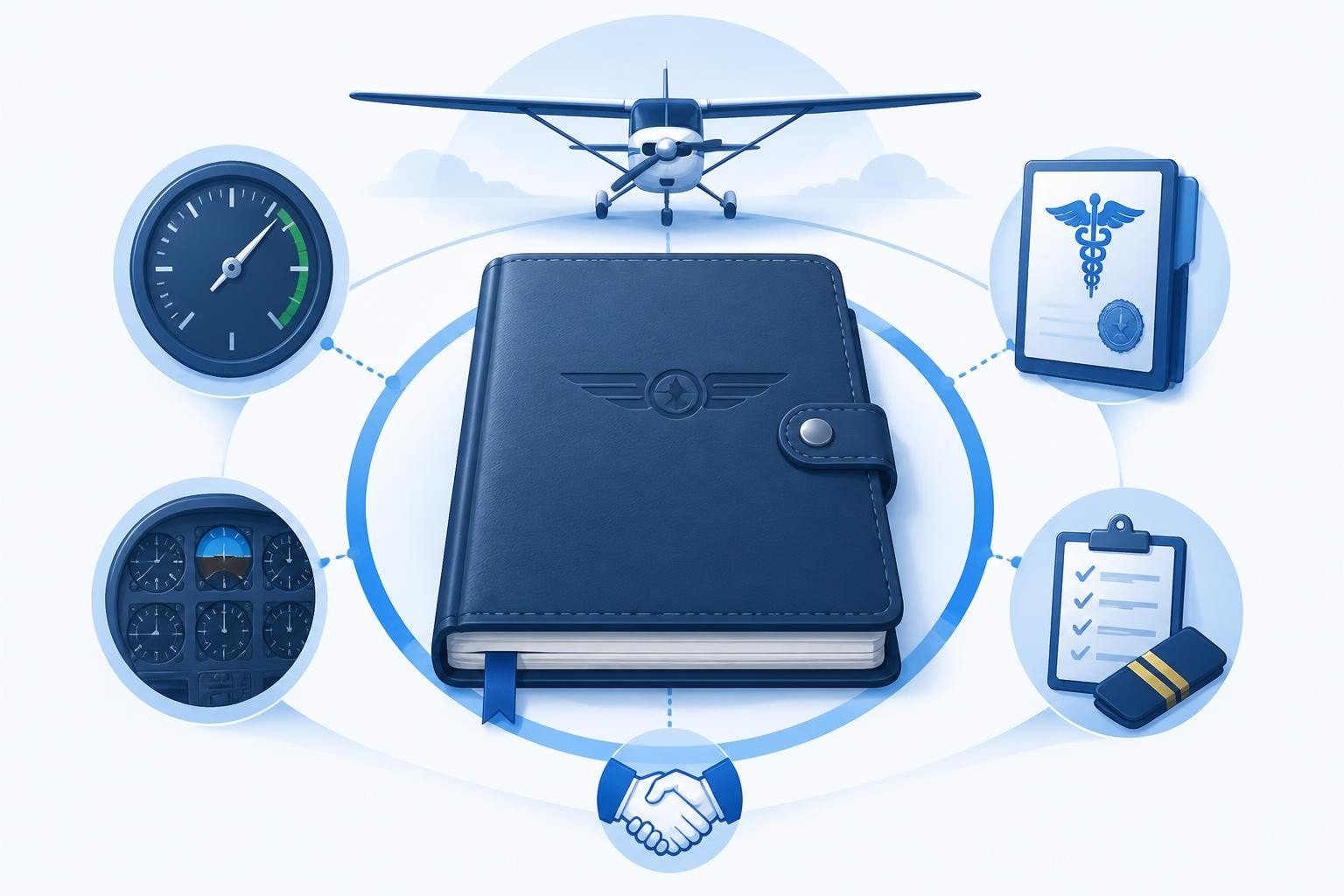
My logbook is the single most important record of your flying career. It documents every flight, tracks your total hours, proves currency, records endorsements, and serves as evidence of compliance with regulatory requirements. Whether paper or digital, your logbook is both a legal document and a career passport.
What My Logbook Must Contain
14 CFR § 61.51 specifies the minimum entries required in my logbook. The FAA demands clear, accurate records of each flight.
Mandatory Flight Entries
Every flight entry must include specific information. Missing any element creates gaps that examiners and employers will spot.
Required data for each flight:
- Date of the flight
- Total flight time or lesson time
- Location of departure and arrival (or training area description)
- Type and identification of aircraft
- Name of safety pilot, if required
- Conditions of flight (day, night, actual instrument, simulated instrument)
- Pilot-in-command (PIC) time, solo time, or flight training received
You must also log the type of piloting experience. Night flight, instrument time, cross-country hours, and dual instruction all require separate columns or clear notation.
Endorsements and Sign-Offs
My logbook holds every instructor endorsement you receive. These include:
- Pre-solo sign-offs
- Solo cross-country authorisations
- Flight review completions (every 24 calendar months)
- Instrument proficiency checks
- Type rating practical test endorsements
- High-performance and complex aircraft sign-offs
Each endorsement must include the instructor's name, certificate number, certificate expiry date, and signature. Without proper endorsements, you cannot legally act as PIC in certain operations.
Currency Tracking in My Logbook
My logbook proves you meet currency requirements. Regulations change, and pilots must confirm current rules with official sources, but the core currency framework remains consistent.
Passenger Currency Requirements
To carry passengers, you must have completed three takeoffs and three landings within the preceding 90 days in the same category, class, and type (if a type rating is required). For night passenger operations, those takeoffs and landings must be to a full stop between one hour after sunset and one hour before sunrise.
Example currency calculation:
| Requirement | Last Three Events | Days Since | Current? |
|---|---|---|---|
| Day passengers | 12 Apr, 18 Apr, 3 May 2026 | 67 | Yes |
| Night passengers | 9 Feb, 14 Feb, 22 Feb 2026 | 137 | No |
| Tailwheel | 1 Jun, 1 Jun, 8 Jun 2026 | 31 | Yes |
If you flew your last three night landings on 22 February 2026, you lost night passenger currency on 23 May 2026 (90 days later). My logbook shows exactly when you need currency flights.
Instrument Currency Rules
Instrument currency requires six instrument approaches, holding procedures, and intercepting and tracking courses through the use of navigation systems within the preceding six calendar months. If currency lapses, you need an instrument proficiency check (IPC) with an authorised instructor or examiner.
My logbook must distinguish between actual instrument conditions and simulated instrument time under a view-limiting device. These are not interchangeable for currency purposes.
Reconstructing My Logbook
Lost or destroyed logbooks create serious problems. According to AOPA, reconstructing flight records requires gathering evidence from multiple sources.
Sources for Reconstruction
When my logbook is lost, you can rebuild records using:
- Flight school records and receipts
- Aircraft rental agreements and billing statements
- Medical certificate applications (which show total hours at the time of application)
- Insurance applications
- Previous employer flight time records
- ATC flight plan archives (limited retention period)
- Aircraft maintenance logs showing your flights
- Personal bank or credit card statements for fuel purchases
Create a sworn statement explaining the loss and your reconstruction methodology. Include all supporting documentation. Many pilots maintain scanned backup copies or photographs of each logbook page specifically to prevent total loss.

Digital vs Paper: Maintaining My Logbook
The FAA accepts electronic logbooks provided they meet specific criteria outlined in AC 120-78A. Digital logbooks must be readily accessible, maintainable, and include safeguards against tampering.
Advantages of Digital Logbooks
Digital systems offer clear benefits:
- Automatic currency calculations (28-day, 90-day, 365-day)
- Built-in flight time totals across categories
- Immediate backup and cloud storage
- Export functions for job applications
- Searchable flight history
- Alert systems for approaching currency lapses
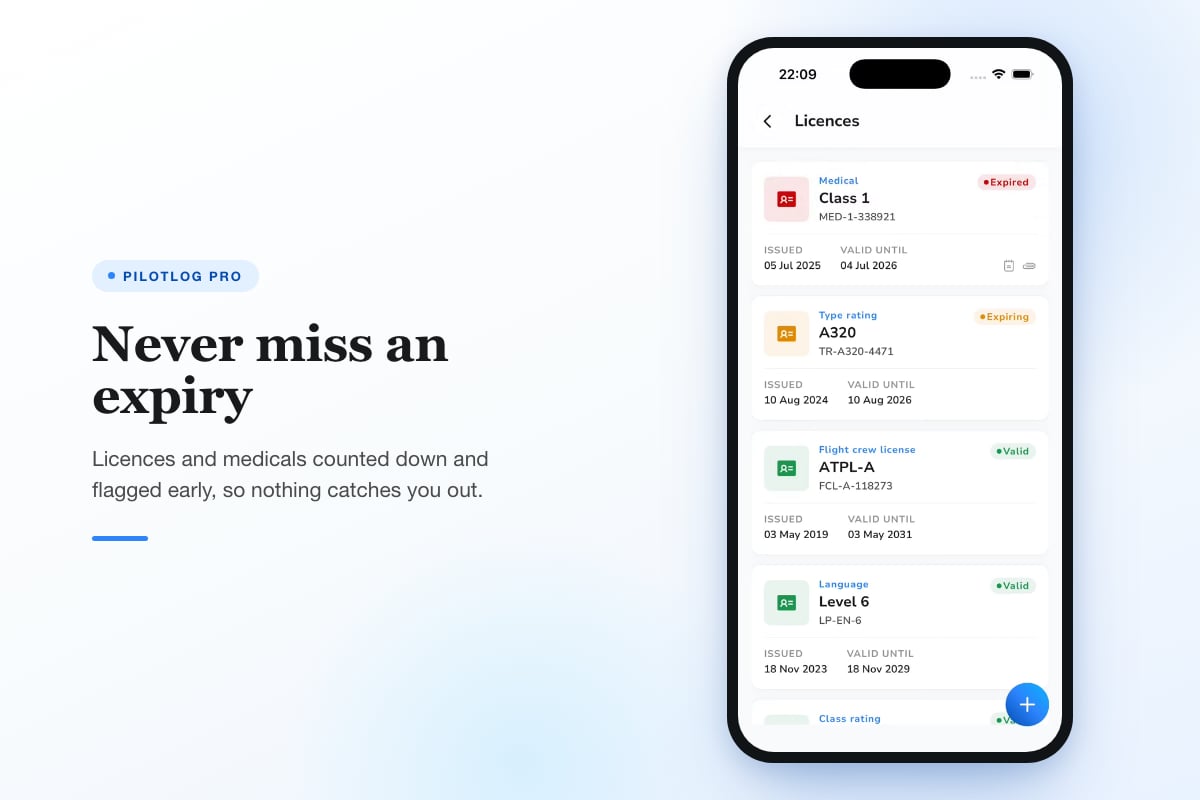
A professional digital logbook tracks rolling totals automatically. If you fly 78 of 100 hours in the past 28 days, the system calculates remaining duty time limits without manual arithmetic. Medical expiry dates trigger alerts 60 days in advance, not the day after expiry.
Pilotlog manages these calculations in the background while you focus on flying. Pilotlog Pro tracks rolling flight-time limits, passenger and instrument currency with exact lapse dates, and flags licence and medical expiries early, ensuring you maintain compliance without spreadsheet work.
Paper Logbook Considerations
Paper logbooks remain valid and widely used. They never require charging, survive electronic failures, and provide tactile satisfaction many pilots value.
Paper logbook requirements:
| Aspect | Requirement |
|---|---|
| Ink type | Permanent (blue or black ballpoint or fountain pen) |
| Corrections | Single line through error, initials, correct entry nearby |
| Pages | Numbered and bound (loose-leaf not recommended) |
| Backup | Photocopies or scans stored separately |
| Endorsements | Original instructor signatures required |
Never use pencil or erasable ink in my logbook. Never tear out pages or use correction fluid. These practices create doubt about the record's authenticity.
Career Progression and My Logbook
My logbook tells your professional story. Every hour logged builds toward the next certificate, rating, or job opportunity.
Commercial and Airline Transport Minimums
Airlines and commercial operators scrutinise logbooks during hiring. They verify total time, multi-engine time, turbine hours, PIC time, and cross-country experience.
Common hiring minimums (examples vary by operator):
- Regional airline First Officer: 1,500 total hours, 100 multi-engine, 50 cross-country PIC
- Corporate Part 91 PIC: 2,500 total hours, 500 multi-engine, 1,000 PIC, type rating
- Charter Part 135 PIC: 1,200 total hours, 500 cross-country, 100 night, 75 instrument actual or simulated
Your logbook must clearly show these categories. If you flew 247 hours of cross-country PIC but logged it vaguely as "local flight", you cannot count those hours for hiring purposes.
Cross-Country Time Definition
Cross-country time means different things for different certificates. For private pilot certification, a cross-country flight must include a landing at an airport at least 50 nautical miles from the departure point. For instrument rating and ATP, certain cross-country flights must meet specific distance requirements.
My logbook should note the route and distances clearly. "KBOS-KACK-KBOS, 62nm each leg" provides proof that meets commercial certificate requirements. "Local area" does not.
Common Logbook Mistakes
Errors in my logbook create problems during checkrides, insurance applications, and job interviews. Avoid these frequent mistakes.
Arithmetic Errors
Manual totalling produces mistakes. If your logbook shows 847.3 total hours but column addition yields 851.7, examiners notice. Check every column total twice. Many pilots use spreadsheets alongside paper logbooks to verify mathematics.
Incorrect Time Logging
Logging flight time incorrectly is among the most common errors. FAA regulations define specific logging requirements for PIC time, solo time, and dual received.
You may log PIC time when:
- You are the sole manipulator of the controls of an aircraft for which you are rated
- You are the sole occupant of the aircraft
- You are acting as PIC on a flight requiring more than one pilot
- You are a flight instructor giving instruction
You cannot log PIC time simply because you hold a pilot certificate. You must meet one of the above criteria and be rated in that category and class.
Missing Medical Certificate Records
My logbook should reference each medical examination. Note the class, date of examination, and expiry date. A Commercial pilot under age 40 with a Class 1 medical has different duration limits than a Private pilot with a Class 3 medical.
Medical certificate durations (for operations requiring that class):
| Certificate Class | Pilot Age | Duration for Commercial Operations | Duration for Private Operations |
|---|---|---|---|
| Class 1 | Under 40 | 12 months | 60 months |
| Class 1 | 40 and over | 6 months | 24 months |
| Class 2 | Any age | 12 months | 24 months (under 40) / 12 months (40+) |
| Class 3 | Under 40 | N/A | 60 months |
| Class 3 | 40 and over | N/A | 24 months |
If your Class 1 medical expires in 14 days, you need an appointment immediately or you will be limited to the privileges of a lower class certificate.

My Logbook as Legal Evidence
My logbook serves as evidence in accident investigations, enforcement actions, and insurance claims. According to legal guidance on FAA logbook requirements, falsifying logbook entries is a federal offence that can result in certificate revocation.
Falsification Consequences
Intentionally making false entries or omitting required information violates 14 CFR § 61.59. Penalties include:
- Certificate suspension (30 to 180 days typical)
- Certificate revocation for serious violations
- Civil penalties up to tens of thousands of dollars
- Criminal prosecution in egregious cases
If you made an error, correct it properly with a single line through the mistake, your initials, and the correct entry. Never obliterate, erase, or remove entries.
Logbook Retention Requirements
You must retain my logbook records indefinitely to prove aeronautical experience for certificate applications and currency demonstrations. The FAA does not specify a retention period because the logbook is your career-long record.
Employers may request logbook copies going back five to ten years. Insurance companies want complete flight history. Keep every logbook you have ever used.
International Operations and My Logbook
If you fly internationally or pursue licences from multiple countries, my logbook must accommodate different regulatory frameworks.
ICAO Standardisation
The International Civil Aviation Organisation provides recommended logbook formats, but individual countries maintain their own requirements. EASA, UK CAA, Transport Canada, and CASA each specify slightly different mandatory fields.
Common international variations:
- Some countries require runway surface type (paved, grass, water)
- EASA logbooks often separate single-pilot and multi-pilot time
- Certain jurisdictions require specific training device (simulator) time columns
- Military logbook transfers require civilian logbook reformatting
Verify that your logbook format meets the requirements of every country where you hold or seek a licence. Conversion between regulatory systems becomes easier when my logbook already contains the necessary detail.
Licence Conversion and Validation
When converting a licence between countries, aviation authorities examine your logbook in detail. They verify total hours, specific training events, and instructor sign-offs.
My logbook must show:
- Exact dates of training flights
- Manoeuvres practiced during each lesson
- Instructor certifications and ratings
- Aircraft types used for different phases of training
- Solo endorsements with explicit authorisations
Missing details delay or prevent licence conversion. A logbook showing "dual received, 2.1 hours" is less useful than "dual received: slow flight, power-off stalls, steep turns, 2.1 hours, C172N."
Building Habits Around My Logbook
Consistent logbook maintenance prevents errors and saves time during checkrides or job applications.
Immediate Post-Flight Logging
Log every flight the same day. Memory fades quickly. If you wait three days, you might misremember approach types, unusual procedures, or exact flight times.
Set a routine: land, secure aircraft, complete logbook entry. Make it part of your shutdown checklist. Many pilots log flights before leaving the airport.
Monthly Reconciliation
Once per month, total all columns and verify arithmetic. Cross-check against:
- Aircraft Hobbs meter records
- Flight school billing statements
- Fuel receipts with dates
- Personal calendar entries
If your logbook shows 12.4 hours in June but the flight school billed for 13.1 hours, investigate immediately. Small discrepancies compound over years.
Annual Backup
Photograph or scan every page of my logbook at least annually. Store copies in three locations: cloud storage, external hard drive, and physical printout kept separately from the original logbook.
If you lose your logbook in a house fire or theft, recent backups mean you reconstruct weeks, not decades. Update backups after major training events, checkrides, or endorsements.
Building Your Professional Foundation
My logbook grows alongside your skills and career. From your first logged student solo to your thousandth hour as PIC, each entry builds evidence of capability and compliance.
Accurate records, properly maintained, open doors to every aviation opportunity. Sloppy logbook work creates doubt and delays. Treat my logbook with the same precision you apply to preflight inspections and you will never face preventable currency or documentation problems.
Your logbook is your professional foundation and legal record combined into one continuous document. Whether paper or digital, accuracy and completeness determine your career options and regulatory compliance. Pilotlog handles the calculations, tracks currency automatically, and flags expiries early, letting you focus on flying while maintaining the precise records that define your aviation career. Log every flight properly and your logbook becomes your strongest professional asset.
- pilot logbook
- logbook requirements
- currency tracking
- digital logbook
- faa 61.51
A logbook that keeps itself.
Join the waitlist and be first in line when Pilotlog launches.
Free to join, no spam. Unsubscribe any time.